Moderated WTC 1 features list, initiation model / WTC 2 features list, collapse model

.............
No, your onscreen measurements were meaningless and your method attrocious given the clear camera movement.

No. My 0th order of approximation was meaningful enough to determine an approximate 40% false drop of the NW corner and that the south wall tilted in relation to this corner.

I do not see an apology from you for your ridiculous accusations of deliberate video manipulation :(

You may be right. I'm having problems downloading the file in reference and can't verify.

If your short clip is from the NIST Cumulus-Levin, and the femr2 one I posted is different, where is the one I posted from.
NISTCumulus-Levin (can't download)
http://www.youtube.com/watch?v=1Q-ffzFjMKQ&feature=player_embedded

Where is this one from
http://www.youtube.com/watch?v=wjnJ7CPIoFA
 
Myriad post 400: "In no way do NIST's conclusions depend upon, or require, the upper block to remain attached until the tiling reached 8 degrees. Indeed, if you could show otherwise, that the upper block did tilt eight degrees before column instability progressed through the north wall, that would be a major discrepancy in NIST's findings. But of course it did not, and NIST knew it did not. Harping on some unclear wording in a parenthetical comment notwithstanding."

So myriad, you disagree with the R Mackey reading of the same biblical passages shown below?

139482298.png


Or how about the Greg Urich reading of the NIST description shown below?

838207362.png

urichcrop.png


How can Greg Urich, a pretty intelligent guy, and two NIST disciples in yourself and R Mackey read the short discription by the NIST so differently?


Myriad, you can see how they both use the north wall as an unbroken pivot, no? Your quote is what I mean by a "tortured explanation".


Let's compare these diagrams to reality:

CNN_Aircheck_Eric_Letvin_Cli24.gif
 
Last edited:
So myriad, you disagree with the R Mackey reading of the same biblical passages shown below?

[qimg]http://femr2.ucoz.com/_ph/1/139482298.png[/qimg]


Okay, let's check:

Text: "Video confirms the upper block rotated before falling." Yes, true.

Text: "Thus, there are no square impacts." This is true. Any noticeable degree of rotation means no square impacts.

Text: "Floors fail gradually across their width, all the way down the structure." This is true, an inevitable geometric result of the rotation.

I have the same quibble I always do regarding the false distinction between "falling" versus "rotation" (the initial rotation is also falling, as the center of gravity is descending) but I seem to be alone in being concerned about that. Thus I would prefer to express the first point as "Video confirms the upper block rotated before falling far enough for any floor-on-floor impact." The overall point remains true.

Image: The image shows an 8 degree tilt, which was observed during the actual collapse. Since the tilt changed as the collapse progressed, any one static drawing can only show the tilt for one particular moment of the collapse. I don't see anything objectionable in illustrating the eight degree condition. The points remain valid regardless of the tilt angle.

No "unbroken pivot" is shown. Indeed, since the spacing of the floors at the left of the drawing where the upper and lower blocks meet is larger than the spacing between any two consecutive floors, this cannot possibly be depicting an unbroken pivot. (The lines only connect because the lower vertical was extended upward to clarify the angle.) It is showing the two blocks at a somewhat later stage of collapse.

Or how about the Greg Urich reading of the NIST description shown below?

[qimg]http://femr2.ucoz.com/_ph/1/838207362.png[/qimg]
[qimg]http://www.sharpprintinginc.com/911/images/photoalbum/13/urichcrop.png[/qimg]


The unbroken pivot shown in these diagrams is incorrect.

Since we're being critical, I should also point out that the vertical in those diagrams is way out of scale with the horizontal. Is that NIST's fault too?

Or perhaps both those details were irrelevant to whatever point Mr. Urich was making with those figures. I don't know. Why don't you ask him?

How can Greg Urich, a pretty intelligent guy, and two NIST disciples in yourself and R Mackey read the short discription by the NIST so differently?


I have no idea how Greg Urich or R. Mackey read the NIST description, or whether it was differently from each other and/or from me or not. These drawings tell me nothing about that. I pointed out what I think are the inaccuracies (I won't say errors because I don't know what those diagrams were trying to show) in Urich's. Mackey's seem accurate, at least for the illustrative purposes intended.

ETA: On further examination, I notice that R. Mackey's drawing does contain an egregious error after all: it shows two floors passing through each other!

What passage in NCSTAR should we blame this on, I wonder? Can you point out where NIST said the floors of the WTC towers were made of ectoplasm and so could pass through each other?

Or is it that R. Mackey is a total imbecile who does not realize that floors are solid objects and cannot pass through each other?

Or just maybe, that is another detail that is not relevant to the point the diagram is intended to make?

Yeah, that last possibility is really tortured, I know, impossible for any reasonable unbiased person to believe. :rolleyes:

Myriad, you can see how they both use the north wall as an unbroken pivot, no?


Greg Urich does appear to have done so. You might wish to ask him why. If the reason is because he focused entirely on one unclear sentence in the NIST report to the exclusion of all else, and interpreted it as meaning that eight degrees of tilt occurred before the hinge detached, I will accept that explanation from him. Your assertion of that, however, is more in the category of mind reading or a wild guess, which has no relevance.

Your quote is what I mean by a "tortured explanation".


You mean this quote:

In no way do NIST's conclusions depend upon, or require, the upper block to remain attached until the tiling reached 8 degrees. Indeed, if you could show otherwise, that the upper block did tilt eight degrees before column instability progressed through the north wall, that would be a major discrepancy in NIST's findings. But of course it did not, and NIST knew it did not. Harping on some unclear wording in a parenthetical comment notwithstanding.

Still makes perfect sense to me. Which part is the torture?

Let's compare these diagrams to reality:

[qimg]http://femr2.ucoz.com/CNN_Aircheck_Eric_Letvin_Cli24.gif[/qimg]


Reality is, apparently, a grainy jumpy animated GIF, almost entirely obscured by white pixel noise, that slows my browser to a crawl.

Yeah, I suppose it is. Thanks for the cool metaphor.

Respectfully,
Myriad
 
Last edited:
Rotation Before Fall vertically

What NIST said :
Table 5-2. “WTC1 began to collapse. First exterior sign of collapse was at floor 98. Rotation of at least 8 degrees to the south occurred before the building section began to fall vertically under gravity,”

Rotation ..... before ..... fall vertically
NIST distinguishes “rotation” and “fall vertically” as two different stages

Third party definitions:

1)Rotation - a circular movement of an object around a center (or point) of rotation..
http://en.wikipedia.org/wiki/Rotation

( In this case, when the movement of any wall is circular in relation to the center of rotation, the 98th floor north wall, the walls are rotating. When rotating, any point on these walls over time, trace a circular path, an arc.)

2)Fall - To drop or come down freely under the influence of gravity.
http://www.thefreedictionary.com/fall

(Under the influence of gravity ,the path traced by a moving object can be a circle, a straight line, parabola, ellipse or other.)

3)Falling vertically - to fall aligned with the direction of the force of gravity.

“Vertical: Vertical means up and down . An object is in a vertical position when it is aligned in an "up-down" direction, roughly speaking perpendicular to the horizon or horizontal plane. In science, it can also refer to: Vertical direction, the direction aligned with the force of gravity.”
(http://sites.google.com/site/mrvphysics/critical-vocabulary )

( In this case, when the movement of any wall is vertical in relation to the ground, the wall is falling vertically, in the direction aligned with the force of gravity. When falling vertically, any point on these walls over time, trace a straight vertical line.)

Corollary: In this case, the start of falling vertically begins when rotation stops.

The task for challengers is to find third party definitions contrary to those above.

The confusion is that at the start, the walls are rotating and falling, but not falling vertically, they are falling in an arc, rotating.
 
Last edited:
Myriad post 400: "In no way do NIST's conclusions depend upon, or require, the upper block to remain attached until the tiling reached 8 degrees. Indeed, if you could show otherwise, that the upper block did tilt eight degrees before column instability progressed through the north wall, that would be a major discrepancy in NIST's findings. But of course it did not, and NIST knew it did not. Harping on some unclear wording in a parenthetical comment notwithstanding."

So myriad, you disagree with the R Mackey reading of the same biblical passages shown below?

[qimg]http://femr2.ucoz.com/_ph/1/139482298.png[/qimg]


Or how about the Greg Urich reading of the NIST description shown below?

[qimg]http://femr2.ucoz.com/_ph/1/838207362.png[/qimg]
[qimg]http://www.sharpprintinginc.com/911/images/photoalbum/13/urichcrop.png[/qimg]

How can Greg Urich, a pretty intelligent guy, and two NIST disciples in yourself and R Mackey read the short discription by the NIST so differently?


Myriad, you can see how they both use the north wall as an unbroken pivot, no? Your quote is what I mean by a "tortured explanation".


snip>


At least many months have passed. New information comes to light, old information revisited. Mackey and Urich may have different opinions now.
 
Last edited:
MT,

TFK post 389: "
1. Where are femr's & MT's graphs of the tilt angle vs. time?
2. How about drop distance (in feet, not pixels) vs. time.
3. How about a statement of the frame in which you think that the drop transitions from rotation to pure descent. "

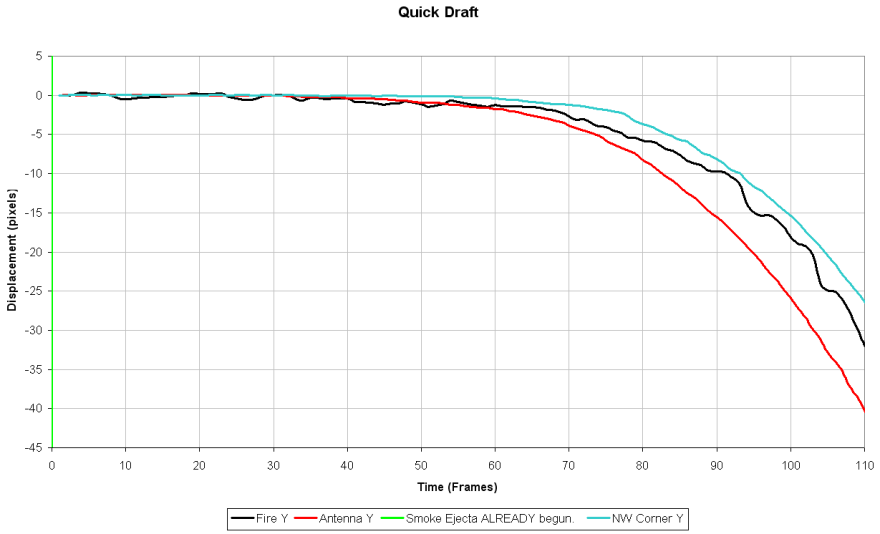
Tom, how many times have I mentioned frame 224 and the failure of the NW corner?? The last columns to fail are along the NW corner, around Sauret frame 224. I have been posting the same graph and explanation for a few months now.

OK, you seem to be answering my 3rd question here...

So, MT, frame 224 is the frame in which "you think that the drop transitions from rotation to pure descent."

Really?

What stops the rotation?

Do you recall the expression "release point"? How about velocity take off point? Do I need to repeat it all again just because you cannot read?

I didn't ask anything about the "release point".
Why can't you answer the questions that I actually ask, instead of launching into all of this.

Tilt angles vs time, Tom? You didn't notice these????

SAURET VIEWPOINT:

[blah, blah, blah,
approximately 350-line wall of irrelevant text]

Please don't do that.
It's really childish.
And really annoying.

I asked a simple question about a graph of "tilt angle vs. time".
In all of that blather, was there a reference to your graph of "tilt angle vs. time"?

If it is there, please consider the concept of Signal to Noise Ratio. And simply point it out.
If not, simply say, "No, I haven't done one."


That 4.4 degree explanation you gave....I'm speechless. I swear, you really don't know how many mistakes you make, do you?

By all means, please point them out.

I would be totally ashamed to post that picture.

Perhaps you would.
Perhaps you could explain your prospective embarrassment.
Perhaps, at some point, you might care to state what point you THINK I was making in posting it, and we could compare notes to see if what YOU think I was saying matches what I think I was saying.

Just a thought...

Tom, can you see the north wall in that picture? Have you wondered why not? Where is your mind when you dream that stuff up?

Why, yes I can.

I am surprised that you appear to be suggesting that one can NOT see the north wall. If you can not, perhaps a trip to the optometrist is in order.

Perhaps this will help.

wtc1closeuplabeled.png


Perhaps you meant "the north wall of the upper block". To which the answer is "no, can't see it thru the smoke".

But, if you read my post, I didn't NEED to see it, because I didn't use it for anything.

I needed to be able to see 3 things: the antenna, the NW corner of the lower block & the NW corner of the upper block.

As you can see, all 3 are visible.

We have established one thing for certain: Nobody posting has a clue about how to find the angle tilt angle over which the columns originally failed.

There are at least 20 posters here who have demonstrated far, far more capacity for evaluating photographic evidence, performing math analyses of various levels of sophistication, etc, than you (or femr) have demonstrated.

There is a sizeable difference between "nobody has a clue how to" and "nobody has any interest in performing an analysis that has no demonstrated (or truther-suggested) significance".

I am not judging you since it is not easy.

Uh yeah, it is easy. A tad tedious, requires a bit of care.

But it is simply measurement of angles on images from multiple angles. Once you've determined aspect ratios, and if you can do a little matrix algebra, it doesn't get much easier.

I do judge the posters that act like they are know-it-alls while they remain ignorant of the basic mistakes they are making.

"Basic mistakes" like, say, refusing to state the reason for, or implications of, doing the analysis in the first place?

More importantly, you now realize that there is nowhere in the NIST report you can go for a clear explanation of the WTC1 collapse initiation motion.

Uh, that would be wrong. But only partially wrong.

NIST was not tasked with "finding out the collapse initiation motion".
They were tasked with "finding out the collapse initiation cause".

They found out the cause.
They kinda glossed over the motion, touching on it in generic terms, because it just ain't that important.

YOU GUYS are the ones obsessing about the details of the motion, and you can't even say why. Talk about "thrashing around in the dark…"

It is a bit embarrassing to watch some posters continue to defend the NIST concerning their description of an 8 degree tilt. If the NIST was clear, would you need such tortured explanations?

You seem to "get embarrassed" for other people on a fairly regular basis.

I'd recommend that you stop being so concerned about other peoples' embarrassment, and start worrying about your own. Nine years down the old crapper on Twoofer nonsense would be a good starting point...

Just a friendly suggestion…


tom

 
Last edited:
Pretty much, yes.
Noted.

I'm talking about an air pressure change doing so.
Sure.

The actual routes the pressure change could have taken, I'll leave to you to work out or be incredulous of if you choose.
I don't think there's any incredulity in the route I suggested. C6, 7 & 50 are the only relatively major routes available.

The first second of collapse at .66g
Our other current thread of discussion comes to mind here.

displaced about 280,000 cubic feet of air.
I know it's a simple point, but what assumptions have you made for the upper block in terms of rotation and descent here ?

Two kickers here: first, witnesses in the path of such a pressure wave at the time of the collapse did indeed report a blast of moving air, as expected; and second, no other plausible hypothesis for the cause of the fire ejections at that time has been put forward by anyone, so there is no reason whatsoever to reject the one plausible existing hypothesis due to mere personal incredulity.
Where is the incredulity ?

The NIST statement is simply unclear wording.
I've stated repeatedly that I'm not particularly interested in arguing about what NIST's various unclear statements were intended to mean, and stated repeatedly that my focus in this context is to determine the point at which, for the connections between upper and lower *blocks*, column instability is effectively complete.

What you want to call it when, is fine. But that has no real physical meaning.
Use of the phrase is prompted directly from the NIST statement...
The entire section of the building above the impact zone began tilting as a rigid block (all four faces, not only the bowed and buckled south face) to the south (at least about 8º) as column instability progressed rapidly from the south wall along the adjacent east and west walls.

Can vertical descent be caused by elastic buckling of support columns? Yes it can.
Are those support columns stable whilst undergoing elastic buckling ?

Can vertical descent be caused by plastic buckling of support columns? Yes it can.
Are those support columns stable whilst undergoing plastic buckling ?

Can vertical descent be caused by fracture and separation of support columns? Yes it can.
Are those support columns stable whilst undergoing fracture and separation ?

Here's a question to look into... at what point did angular acceleration of the upper block drop to zero (if it ever did)?
I don't think it's possible to determine accurate metrics of acceleration data from available imagery of a clearly deforming non-rigid *upper block*.

Again, as I said before, I agree that you have assigned an arbitrary name to an arbitrary time at which rotation of <1 degree had occurred, and something you term "column instability progression" has completed, and descent is underway.
Again, the term is used in relation to the NIST quote above.

And as before, I ask, so what? Why would anyone expect the angle to be greater (or less) at that point? How far should you be able to rotate a chunk of a building before it breaks off?
One purpose is to determine the actual behaviour in detail. As you have repeadtely agreed, the statements from NIST are less than *clear*. Another reason is to stop what I have previously termed NISTitis in others, namely the blind reproduction of statements from NIST and inability to concede any lack of clarity or error on their part, involving rewriting *the laws of physics cap'n* if necessary along the way. For example, how many *twoofers* have you berated for suggesting that the upper section of WTC2 stopped rotating ?

NIST agrees with you that the column failure progressed rapidly
And I want to clarify when that phase completes.

You see, this forum is an entertainment medium.
Hmm.
 
Text: "Video confirms the upper block rotated before falling." Yes, true.
With our recent discussion in mind, how do you separate these two phases Myriad ?

Text: "Floors fail gradually across their width, all the way down the structure." This is true, an inevitable geometric result of the rotation.
No, it's not true. The upper section broke apart pretty rapidly. Floors didn't fail gradually across their width.
 
NIST distinguishes “rotation” and “fall vertically” as two different stages
So, what denotes the end of the first stage and the start of the second, in your opinion ?

Corollary: In this case, the start of falling vertically begins when rotation stops.
Rotation doesn't stop.
 
Tsk, tsk tfk...

tfk said:
How about a statement of the frame in which you think that the drop transitions from rotation to pure descent.
femr2 said:
Inept question.
tfk said:
Nope. Exactly pertinent question. Inept answer, tho. The typical inept response that you give when you can't, or don't wish to, address any particular question.
femr2 said:
Nope. Dumb. Inept question.
Which video ?
Why attempt to create the trap of stating a singular frame, which you'll then whine about ?
Pure descent ? You one of those folks who think rotation stopped suddenly ?
tfk said:
Major_Tom said:
Tom, how many times have I mentioned frame 224 and the failure of the NW corner?? The last columns to fail are along the NW corner, around Sauret frame 224. I have been posting the same graph and explanation for a few months now.

So, MT, frame 224 is the frame in which "you think that the drop transitions from rotation to pure descent."

Really?

What stops the rotation?

You are more than transparent in your attempts to force and shoehorn others' answers to bolster your attempt to coerce folk into making replies upon which you can jump like an over-excited school-boy.

was there a reference to your graph of "tilt angle vs. time"?
Many are include throughout the link contents. Go read it and stop hanging from MT's coat-tail. Each has a context, so you need to read the detail to understand the context.
 
Last edited:
Pretty much, yes. The timing of the claimed fire ejections was not clear, but I now see you're addressing the smaller fire ejections that began about a second after WTC1 collapse initiation, so you're correct, that would be before debris collapsed any basement areas.

Let's keep a few things in mind though. "Fire" is a process not a thing, and as such, has no mass. All that is needed to eject "fire" from behind an existing aperture is to eject a little bit of combustible gas (which does have some mass, but not much, as it is a gas). That doesn't take a lot of force. A mild puff of air can do it, like a breeze through a doorway.

Second, no I'm not talking about air traveling down one tower, though the basement, and up the other one. That would take too long. I'm talking about an air pressure change doing so. That would take... the distance divided by the speed of sound, which works out to -- hey, whadda ya know, about a second.

The actual routes the pressure change could have taken, I'll leave to you to work out or be incredulous of if you choose.

The first second of collapse at .66g displaced about 280,000 cubic feet of air. Let's say 90% of that flow vented immediately to the sides, 90% of the rest vented from the lobby, and 90% of that somehow diffused out before making it up the other tower. Thats still a flow rate of 280 cubic feet per second when the pressure wave reaches the fire floors. Here's a fan that can move almost 280 cubic feet of air per second. Think that thing, at full power and speed, could push some air out a few windows?

Two kickers here: first, witnesses in the path of such a pressure wave at the time of the collapse did indeed report a blast of moving air, as expected; and second, no other plausible hypothesis for the cause of the fire ejections at that time has been put forward by anyone, so there is no reason whatsoever to reject the one plausible existing hypothesis due to mere personal incredulity.

There is also an additional explanation to the fire ejections on the south side of WTC 1 as WTC 2 collapses. Behind the falling mass of WTC 2 there will be a low pressure area. Just like it would be behind a large truck moving down the highway. This will cause air from the surrounding area to flow in to equalize that low pressure. This will generate a slight pressure differential between the north and the south side of WTC 1, that will increase the airflow through the damaged part of the WTC 1, enough push out flames and increase the burn rate.

But a slightly lower pressure inside the upper part of WTC 1 would also increase the airflow coming up the express elevator shaft and the freight elevator shaft from the lobby and the basement areas, due to the stack effect. This effect would be reinforced by an increase in the air pressure inside the ground level areas and the basement areas as described by Myriad above. So we are actually talking of a possible combined effect here. Though the difference in pressure between the north and the south side of the upper part of WTC 1 would be more than enough to explain the fire ejections alone.

A pressure change would use about 2 seconds from floor 78 inside WTC 2 to floor 98 inside WTC 1 traveling through elevator shafts.
 
Our other current thread of discussion comes to mind here.

I know it's a simple point, but what assumptions have you made for the upper block in terms of rotation and descent here ?


Exactly the assumptions I stated. One second of fall at acceleration of 2/3g. (Sorry about the excessive precision, .66 was just meant to mean about 2/3.) Feel free to increase the flow rate estimate as you see fit, to account for the possibility that the first second of fall to reach about 2/3g might not have been from a stationary start. Rotation has a negligible effect on the displacement volume estimate and so was ignored.

Where is the incredulity ?


[python]Over there, in a box.[/python]

I mean, here:

Are you describing......air from WTC2 upper floors travelling, via C6, 7 & 50, 1000 feet down WTC2, bypassing any available venting, especially that around the lobby, increased pressure in the whole basement complex, which then traversed through openings in C6, 7 & 50 in WTC1...in order to push fire out up-top ? Is that what you are describing ?


Are you suggesting that the above phrasing does not, and was not intended to, express incredulity about the scenario described? Is that what you are suggesting? Really?

Are those support columns stable whilst undergoing elastic buckling ?

Are those support columns stable whilst undergoing plastic buckling ?

Are those support columns stable whilst undergoing fracture and separation ?


As I understand it, no, yes, and yes.

My understanding (which may be flawed or incomplete) is that in the context of an analysis of the type undertaken in NCSTAR, "instability" has the specific technical meaning of "a certain type of mathematical analysis of the stresses in the member no longer converges on a solution." You have alternatively defined it as displacement (or maybe velocity) exceeding a certain (unstated) threshold. Neither definition indicates any specific physical state or cause.

I don't think it's possible to determine accurate metrics of acceleration data from available imagery of a clearly deforming non-rigid *upper block*.


I think it would be interesting, even if the error bars were very large.

Again, the term is used in relation to the NIST quote above.


NIST describes the progression of instability. They're describing how instability moved from point A to point B, meaning that for the relevant period of time, point A was closer to reaching instability or farther evolved since reaching instability than point B. That doesn't mean that any actual moment of instability can be reliably identified.

It's the difference between saying that on a certain day, "the chance of rain increases as you go farther north across the county," versus trying to identify the exact line where the chance of rain reaches 65 percent. One could easily be quite certain about the former, while not being able to reliably estimate the latter.

For example, how many *twoofers* have you berated for suggesting that the upper section of WTC2 stopped rotating ?


None that I'm aware of. Have any Truthers attempted to argue that an alleged cessation of rotation is suspicious? Is there a controversy over whether rotation stopped or not?

Respectfully,
Myriad
 
Last edited:
With our recent discussion in mind, how do you separate these two phases Myriad ?


In exactly the way I described a few sentences later, in the same section of the same post you quoted.

No, it's not true. The upper section broke apart pretty rapidly. Floors didn't fail gradually across their width.


Non sequitur. "Gradually" in this context clearly does not mean "slowly", it means "progressively, rather than all at once." (Remember, that whole "missing jolt" argument based on what would happen if there were no tilt, allowing floors to impact squarely on floors or column ends on column ends?) What does how rapidly a floor fails have to do with whether it fails simultaneously at all points or gradually across its width? Nothing.

Respectfully,
Myriad
 
Exactly the assumptions I stated. One second of fall at acceleration of 2/3g.
What I'm asking is for you to say what you consider to be the start of *fall*.

Are you suggesting that the above phrasing does not, and was not intended to, express incredulity about the scenario described? Is that what you are suggesting? Really?
Yes.

As I understand it, no, yes, and yes.
So would you consider instability to be over when all columns across the level of initiation have progressed from elastic to plastic buckling ?

I think it would be interesting, even if the error bars were very large.
I may consider generating such, utilising the very simple method I outlined a little earlier, though the following graph should show the obvious limitation of doing so...
437537321.png


Is there a controversy over whether rotation stopped or not?
See the short, er, entrapment dialogue attempted by tfk above.
 
Last edited:
Non sequitur. "Gradually" in this context clearly does not mean "slowly", it means "progressively, rather than all at once."

You're missing my point...

Myriad said:
Text: "Floors fail gradually across their width, all the way down the structure." This is true, an inevitable geometric result of the rotation.
You're applying a grossly over-simplified virtual *geometric result*. Rotation began, and continued. The upper block rapidly fragmented, shedding the upper perimeter, leaving *rubble*. At least two separate *crush fronts* developed with significant vertical distance separation.

Your statement paints a picture of an intact block at an angle descending and remaining so *all the way down the structure*.

That's not what happened.
 
What I'm asking is for you to say what you consider to be the start of *fall*.


The start of "fall at about 2/3 g" is when the fall reaches an acceleration of about 2/3 g.

I made no claims involving "the start of fall" (without qualifiers) so there is nothing about "the start of fall" to clarify.

So would you consider instability to be over when all columns across the level of initiation have progressed from elastic to plastic buckling ?


No, that's when instability begins (if I'm correct about the elastic vs. plastic issue; it's probably more complicated than that). Instability is not over until a new stable state is reached, most likely (in this case) when the member has come to rest on the ground.

I guess you could say that the progression of instability on the level of initiation is over when all the columns at level have become unstable, for whatever that's worth. (Of course, further progression of instability, downward, continues to occur.)

I may consider generating such, utilising the very simple method I outlined a little earlier, though the following graph should show the obvious limitation of doing so...
[qimg]http://femr2.ucoz.com/_ph/6/437537321.png[/qimg]

In theory, rotations should be able to be more accurately measured from images than movements of single points, since information can be assembled from many different image features at once. An eduction technique -- minimizing the difference between an overlaid pattern, in this case stripes, and the image, over four dimensions of variation (position, frequency and angle) should be effective, but would take some doing to set up and probably a lot of crunching.

See the short, er, entrapment dialogue attempted by tfk above.


Much ado about semantic nothing, as far as I can tell. If there is mostly rotation (with a little fall because the center of gravity is dropping as a result of the rotation, or because the uniformly vertical component of the trajectory is still producing lower velocities than the rotation), most people will call it rotation. If there is mostly fall (with a little rotation because of angular momentum), most people will call it a fall. (You don't often hear "the plate rotated off the table" even though rotation is almost always also involved.) In between, call it whatever you want, and demarcate the two stages however you want. Who cares?

Respectfully,
Myriad
 
Last edited:
No, that's when instability begins (if I'm correct about the elastic vs. plastic issue; it's probably more complicated than that). Instability is not over until a new stable state is reached, most likely (in this case) when the member has come to rest on the ground.
You seem to be getting rather convoluted in your statements about instability, perhaps because you do not want to provide a clear response. Consider...
Myriad said:
Indeed, if you could show otherwise, that the upper block did tilt eight degrees before column instability progressed through the north wall, that would be a major discrepancy in NIST's findings.
femr2 said:
Are those support columns stable whilst undergoing elastic buckling ?
Are those support columns stable whilst undergoing plastic buckling ?
Are those support columns stable whilst undergoing fracture and separation ?
Myriad said:
As I understand it, no, yes, and yes.
I guess you could say that the progression of instability on the level of initiation is over when all the columns at level have become unstable, for whatever that's worth. (Of course, further progression of instability, downward, continues to occur.)

Your responses seem to conflict.

To achieve some form of agreement, I assume you have no problem stating criteria you accept separating the *tilt before north face failure* and *continued tilt and vertical descent of the entire upper section* phases ? If so, what ?

You have stated that columns undergoing plastic buckling, fracturing and separation are NOT unstable.

I assume this is basically what I've called for above...instability on the level of initiation is over when all the columns at level have become unstable...so when instability reached the north wall.

Would that be about right for you ?
 
Last edited:
Are those support columns stable whilst undergoing elastic buckling ?


Are those support columns stable whilst undergoing plastic buckling ?


Are those support columns stable whilst undergoing fracture and separation ?


As I understand it, no, yes, and yes.


Urgh, sorry, I reversed my answer. I was thinking "unstable." So elastic - stable, plastic - unstable, fractured - unstable.

Does that help?

Respectfully,
Myriad
 
Does that help?
Well, it resolves that item, but it doesn't address the base question I'm afraid.

In my opinion, when all core and perimeter columns across the plane of the initiation zone have yielded, fractured or separated, the upper section has transitioned from *tilt about the north face* to *tilt with vertical drop*.

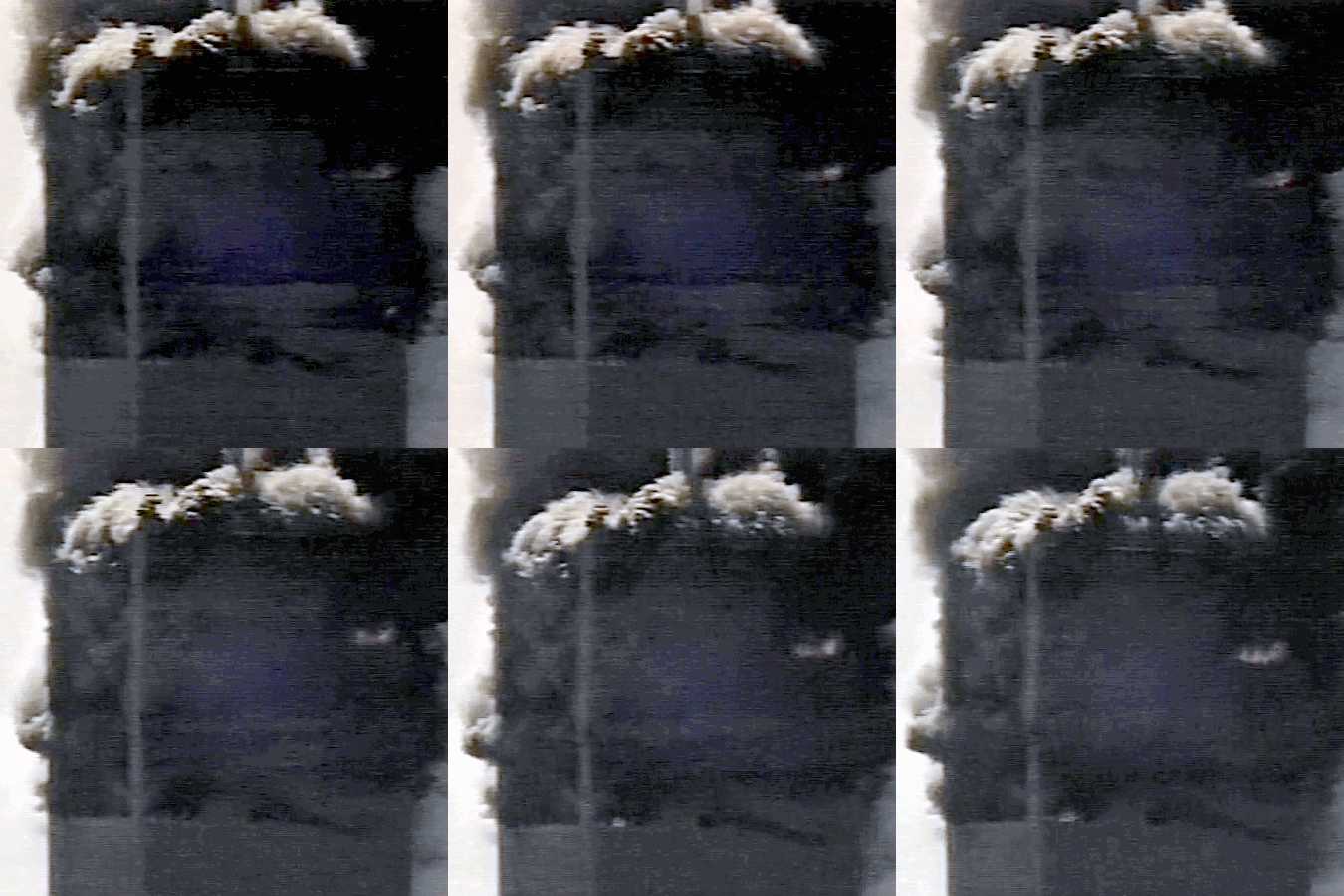
Again, imo, this point is reached when clear vertical drop of the upper section can be determined at the interface between the lowest point of the upper block and highest point of the lower block along the NW edge, here...
700566080.gif


The NW edge interface is the last point to yield along the North face within the inititation zone.

Do you agree with the above ? If not, please provide an alternate description of the point at which you define *vertical fall* to begin, in terms of observable behaviour and building features.
 
Last edited:

Back
Top Bottom