sheeplesnshills
Illuminator
- Joined
- Mar 5, 2010
- Messages
- 3,706
Bump for Femr2 and MT....
when will you have your paper written and who do you imagine will care?
.............
No, your onscreen measurements were meaningless and your method attrocious given the clear camera movement.
I do not see an apology from you for your ridiculous accusations of deliberate video manipulation![]()
So myriad, you disagree with the R Mackey reading of the same biblical passages shown below?
[qimg]http://femr2.ucoz.com/_ph/1/139482298.png[/qimg]
Or how about the Greg Urich reading of the NIST description shown below?
[qimg]http://femr2.ucoz.com/_ph/1/838207362.png[/qimg]
[qimg]http://www.sharpprintinginc.com/911/images/photoalbum/13/urichcrop.png[/qimg]
How can Greg Urich, a pretty intelligent guy, and two NIST disciples in yourself and R Mackey read the short discription by the NIST so differently?
Myriad, you can see how they both use the north wall as an unbroken pivot, no?
Your quote is what I mean by a "tortured explanation".
Let's compare these diagrams to reality:
[qimg]http://femr2.ucoz.com/CNN_Aircheck_Eric_Letvin_Cli24.gif[/qimg]
Table 5-2. “WTC1 began to collapse. First exterior sign of collapse was at floor 98. Rotation of at least 8 degrees to the south occurred before the building section began to fall vertically under gravity,”
(http://sites.google.com/site/mrvphysics/critical-vocabulary )“Vertical: Vertical means up and down . An object is in a vertical position when it is aligned in an "up-down" direction, roughly speaking perpendicular to the horizon or horizontal plane. In science, it can also refer to: Vertical direction, the direction aligned with the force of gravity.”
Myriad post 400: "In no way do NIST's conclusions depend upon, or require, the upper block to remain attached until the tiling reached 8 degrees. Indeed, if you could show otherwise, that the upper block did tilt eight degrees before column instability progressed through the north wall, that would be a major discrepancy in NIST's findings. But of course it did not, and NIST knew it did not. Harping on some unclear wording in a parenthetical comment notwithstanding."
So myriad, you disagree with the R Mackey reading of the same biblical passages shown below?
[qimg]http://femr2.ucoz.com/_ph/1/139482298.png[/qimg]
Or how about the Greg Urich reading of the NIST description shown below?
[qimg]http://femr2.ucoz.com/_ph/1/838207362.png[/qimg]
[qimg]http://www.sharpprintinginc.com/911/images/photoalbum/13/urichcrop.png[/qimg]
How can Greg Urich, a pretty intelligent guy, and two NIST disciples in yourself and R Mackey read the short discription by the NIST so differently?
Myriad, you can see how they both use the north wall as an unbroken pivot, no? Your quote is what I mean by a "tortured explanation".
snip>
TFK post 389: "
1. Where are femr's & MT's graphs of the tilt angle vs. time?
2. How about drop distance (in feet, not pixels) vs. time.
3. How about a statement of the frame in which you think that the drop transitions from rotation to pure descent. "
Tom, how many times have I mentioned frame 224 and the failure of the NW corner?? The last columns to fail are along the NW corner, around Sauret frame 224. I have been posting the same graph and explanation for a few months now.
Do you recall the expression "release point"? How about velocity take off point? Do I need to repeat it all again just because you cannot read?
Tilt angles vs time, Tom? You didn't notice these????
SAURET VIEWPOINT:
[blah, blah, blah,
approximately 350-line wall of irrelevant text]
That 4.4 degree explanation you gave....I'm speechless. I swear, you really don't know how many mistakes you make, do you?
I would be totally ashamed to post that picture.
Tom, can you see the north wall in that picture? Have you wondered why not? Where is your mind when you dream that stuff up?
We have established one thing for certain: Nobody posting has a clue about how to find the angle tilt angle over which the columns originally failed.
I am not judging you since it is not easy.
I do judge the posters that act like they are know-it-alls while they remain ignorant of the basic mistakes they are making.
More importantly, you now realize that there is nowhere in the NIST report you can go for a clear explanation of the WTC1 collapse initiation motion.
It is a bit embarrassing to watch some posters continue to defend the NIST concerning their description of an 8 degree tilt. If the NIST was clear, would you need such tortured explanations?
Noted.Pretty much, yes.
Sure.I'm talking about an air pressure change doing so.
I don't think there's any incredulity in the route I suggested. C6, 7 & 50 are the only relatively major routes available.The actual routes the pressure change could have taken, I'll leave to you to work out or be incredulous of if you choose.
Our other current thread of discussion comes to mind here.The first second of collapse at .66g
I know it's a simple point, but what assumptions have you made for the upper block in terms of rotation and descent here ?displaced about 280,000 cubic feet of air.
Where is the incredulity ?Two kickers here: first, witnesses in the path of such a pressure wave at the time of the collapse did indeed report a blast of moving air, as expected; and second, no other plausible hypothesis for the cause of the fire ejections at that time has been put forward by anyone, so there is no reason whatsoever to reject the one plausible existing hypothesis due to mere personal incredulity.
I've stated repeatedly that I'm not particularly interested in arguing about what NIST's various unclear statements were intended to mean, and stated repeatedly that my focus in this context is to determine the point at which, for the connections between upper and lower *blocks*, column instability is effectively complete.The NIST statement is simply unclear wording.
Use of the phrase is prompted directly from the NIST statement...What you want to call it when, is fine. But that has no real physical meaning.
The entire section of the building above the impact zone began tilting as a rigid block (all four faces, not only the bowed and buckled south face) to the south (at least about 8º) as column instability progressed rapidly from the south wall along the adjacent east and west walls.
Are those support columns stable whilst undergoing elastic buckling ?Can vertical descent be caused by elastic buckling of support columns? Yes it can.
Are those support columns stable whilst undergoing plastic buckling ?Can vertical descent be caused by plastic buckling of support columns? Yes it can.
Are those support columns stable whilst undergoing fracture and separation ?Can vertical descent be caused by fracture and separation of support columns? Yes it can.
I don't think it's possible to determine accurate metrics of acceleration data from available imagery of a clearly deforming non-rigid *upper block*.Here's a question to look into... at what point did angular acceleration of the upper block drop to zero (if it ever did)?
Again, the term is used in relation to the NIST quote above.Again, as I said before, I agree that you have assigned an arbitrary name to an arbitrary time at which rotation of <1 degree had occurred, and something you term "column instability progression" has completed, and descent is underway.
One purpose is to determine the actual behaviour in detail. As you have repeadtely agreed, the statements from NIST are less than *clear*. Another reason is to stop what I have previously termed NISTitis in others, namely the blind reproduction of statements from NIST and inability to concede any lack of clarity or error on their part, involving rewriting *the laws of physics cap'n* if necessary along the way. For example, how many *twoofers* have you berated for suggesting that the upper section of WTC2 stopped rotating ?And as before, I ask, so what? Why would anyone expect the angle to be greater (or less) at that point? How far should you be able to rotate a chunk of a building before it breaks off?
And I want to clarify when that phase completes.NIST agrees with you that the column failure progressed rapidly
Hmm.You see, this forum is an entertainment medium.
With our recent discussion in mind, how do you separate these two phases Myriad ?Text: "Video confirms the upper block rotated before falling." Yes, true.
No, it's not true. The upper section broke apart pretty rapidly. Floors didn't fail gradually across their width.Text: "Floors fail gradually across their width, all the way down the structure." This is true, an inevitable geometric result of the rotation.
So, what denotes the end of the first stage and the start of the second, in your opinion ?NIST distinguishes “rotation” and “fall vertically” as two different stages
Rotation doesn't stop.Corollary: In this case, the start of falling vertically begins when rotation stops.
tfk said:How about a statement of the frame in which you think that the drop transitions from rotation to pure descent.
femr2 said:Inept question.
tfk said:Nope. Exactly pertinent question. Inept answer, tho. The typical inept response that you give when you can't, or don't wish to, address any particular question.
femr2 said:Nope. Dumb. Inept question.
Which video ?
Why attempt to create the trap of stating a singular frame, which you'll then whine about ?
Pure descent ? You one of those folks who think rotation stopped suddenly ?
tfk said:Nope.
Major_Tom said:Tom, how many times have I mentioned frame 224 and the failure of the NW corner?? The last columns to fail are along the NW corner, around Sauret frame 224. I have been posting the same graph and explanation for a few months now.
So, MT, frame 224 is the frame in which "you think that the drop transitions from rotation to pure descent."
Really?
What stops the rotation?
Many are include throughout the link contents. Go read it and stop hanging from MT's coat-tail. Each has a context, so you need to read the detail to understand the context.was there a reference to your graph of "tilt angle vs. time"?
Pretty much, yes. The timing of the claimed fire ejections was not clear, but I now see you're addressing the smaller fire ejections that began about a second after WTC1 collapse initiation, so you're correct, that would be before debris collapsed any basement areas.
Let's keep a few things in mind though. "Fire" is a process not a thing, and as such, has no mass. All that is needed to eject "fire" from behind an existing aperture is to eject a little bit of combustible gas (which does have some mass, but not much, as it is a gas). That doesn't take a lot of force. A mild puff of air can do it, like a breeze through a doorway.
Second, no I'm not talking about air traveling down one tower, though the basement, and up the other one. That would take too long. I'm talking about an air pressure change doing so. That would take... the distance divided by the speed of sound, which works out to -- hey, whadda ya know, about a second.
The actual routes the pressure change could have taken, I'll leave to you to work out or be incredulous of if you choose.
The first second of collapse at .66g displaced about 280,000 cubic feet of air. Let's say 90% of that flow vented immediately to the sides, 90% of the rest vented from the lobby, and 90% of that somehow diffused out before making it up the other tower. Thats still a flow rate of 280 cubic feet per second when the pressure wave reaches the fire floors. Here's a fan that can move almost 280 cubic feet of air per second. Think that thing, at full power and speed, could push some air out a few windows?
Two kickers here: first, witnesses in the path of such a pressure wave at the time of the collapse did indeed report a blast of moving air, as expected; and second, no other plausible hypothesis for the cause of the fire ejections at that time has been put forward by anyone, so there is no reason whatsoever to reject the one plausible existing hypothesis due to mere personal incredulity.
Our other current thread of discussion comes to mind here.
I know it's a simple point, but what assumptions have you made for the upper block in terms of rotation and descent here ?
Where is the incredulity ?
Are you describing......air from WTC2 upper floors travelling, via C6, 7 & 50, 1000 feet down WTC2, bypassing any available venting, especially that around the lobby, increased pressure in the whole basement complex, which then traversed through openings in C6, 7 & 50 in WTC1...in order to push fire out up-top ? Is that what you are describing ?
Are those support columns stable whilst undergoing elastic buckling ?
Are those support columns stable whilst undergoing plastic buckling ?
Are those support columns stable whilst undergoing fracture and separation ?
I don't think it's possible to determine accurate metrics of acceleration data from available imagery of a clearly deforming non-rigid *upper block*.
Again, the term is used in relation to the NIST quote above.
For example, how many *twoofers* have you berated for suggesting that the upper section of WTC2 stopped rotating ?
With our recent discussion in mind, how do you separate these two phases Myriad ?
No, it's not true. The upper section broke apart pretty rapidly. Floors didn't fail gradually across their width.
What I'm asking is for you to say what you consider to be the start of *fall*.Exactly the assumptions I stated. One second of fall at acceleration of 2/3g.
Yes.Are you suggesting that the above phrasing does not, and was not intended to, express incredulity about the scenario described? Is that what you are suggesting? Really?
So would you consider instability to be over when all columns across the level of initiation have progressed from elastic to plastic buckling ?As I understand it, no, yes, and yes.
I may consider generating such, utilising the very simple method I outlined a little earlier, though the following graph should show the obvious limitation of doing so...I think it would be interesting, even if the error bars were very large.
See the short, er, entrapment dialogue attempted by tfk above.Is there a controversy over whether rotation stopped or not?
Non sequitur. "Gradually" in this context clearly does not mean "slowly", it means "progressively, rather than all at once."
You're applying a grossly over-simplified virtual *geometric result*. Rotation began, and continued. The upper block rapidly fragmented, shedding the upper perimeter, leaving *rubble*. At least two separate *crush fronts* developed with significant vertical distance separation.Myriad said:Text: "Floors fail gradually across their width, all the way down the structure." This is true, an inevitable geometric result of the rotation.
What I'm asking is for you to say what you consider to be the start of *fall*.
So would you consider instability to be over when all columns across the level of initiation have progressed from elastic to plastic buckling ?
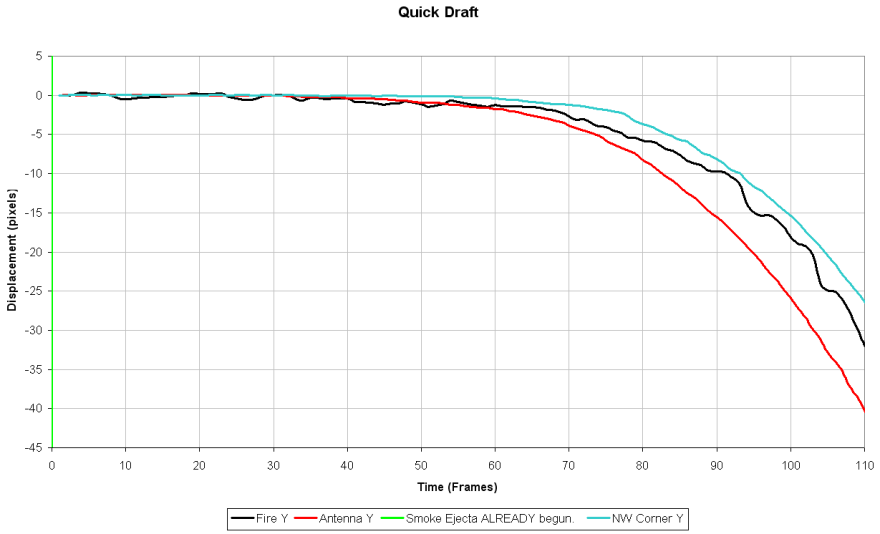
I may consider generating such, utilising the very simple method I outlined a little earlier, though the following graph should show the obvious limitation of doing so...
[qimg]http://femr2.ucoz.com/_ph/6/437537321.png[/qimg]
See the short, er, entrapment dialogue attempted by tfk above.
You seem to be getting rather convoluted in your statements about instability, perhaps because you do not want to provide a clear response. Consider...No, that's when instability begins (if I'm correct about the elastic vs. plastic issue; it's probably more complicated than that). Instability is not over until a new stable state is reached, most likely (in this case) when the member has come to rest on the ground.
Myriad said:Indeed, if you could show otherwise, that the upper block did tilt eight degrees before column instability progressed through the north wall, that would be a major discrepancy in NIST's findings.
femr2 said:Are those support columns stable whilst undergoing elastic buckling ?
Are those support columns stable whilst undergoing plastic buckling ?
Are those support columns stable whilst undergoing fracture and separation ?
Myriad said:As I understand it, no, yes, and yes.
I guess you could say that the progression of instability on the level of initiation is over when all the columns at level have become unstable, for whatever that's worth. (Of course, further progression of instability, downward, continues to occur.)
Are those support columns stable whilst undergoing elastic buckling ?
Are those support columns stable whilst undergoing plastic buckling ?
Are those support columns stable whilst undergoing fracture and separation ?
As I understand it, no, yes, and yes.
Well, it resolves that item, but it doesn't address the base question I'm afraid.Does that help?