Windows Breaking From Heat

wait a second, this contradicts your earlier statement that steel, being a good conductor of heat, would wick away any heat before it could get red hot

keep seeking that truth, keep seeking

Interesting theory, but I have done experiments to prove that you can heat steel up very hot at one end of a short bar and have the other end be cool to the touch. Those experiments I called blacksmithing.

And I don't see red hot steel in that picture I see broken windows showing the fire inside
 
I was looking at the "squib" video on this site:
http://www.debunking911.com/overp.htm
And I noticed that the ejected material started out small and slow and then increased in volume and velocity as the floor continued to collapse (just as you would expect from increasing air pressure). If the squib had been a explosive device the plume would have big at first and then die off rather quickly.
 
It means that other fires in other buildings were hotter. Like the 1st interstate bank building, which did have windows popping out, and which burned for 3 1/2 hours, and which is still standing just fine.

And tell us please, how many aircraft hit that building?
 
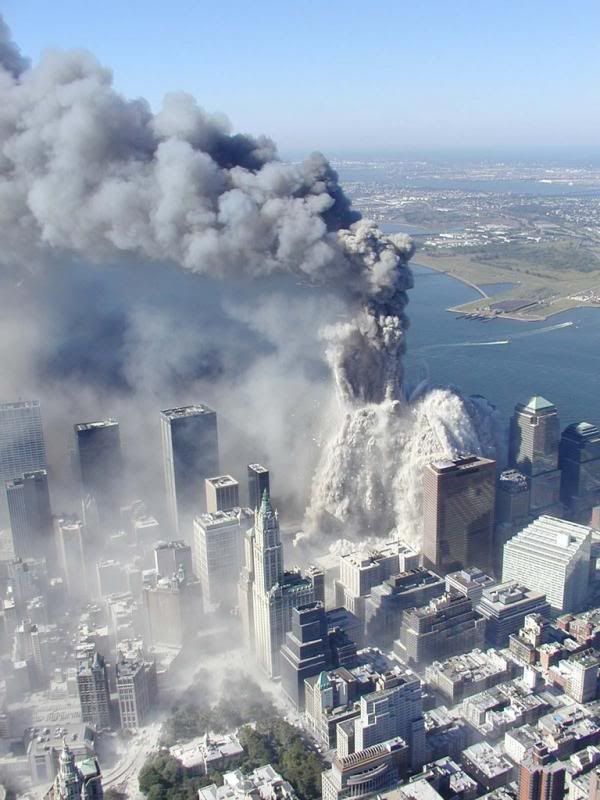
I also observe a 110 story building being dissociated into shredded steel and fine powder, ejecting all contents horizontally with great energy in all directions...

Experiment:

1) Take hammer.
2) Smash an ice cube.

Is the ice cube hammered into the ground? What's that you say? Chunks fly out horizontally? :jaw-dropp

Repeat experiment using 20 stories of skyscraper as hammer.
 
It means that other fires in other buildings were hotter. Like the 1st interstate bank building, which did have windows popping out, and which burned for 3 1/2 hours, and which is still standing just fine.

I'm really sick of you making these kinds of analogies. You are beating a dead strawman.


Fire != collapse
Fire + plane = collapse.
 
I'm really sick of you making these kinds of analogies. You are beating a dead strawman.


Fire != collapse
Fire + plane = collapse.

That is just silly, saying that structural dammage from a collision could be at all related to collapse? Who would ever believe that?


Ok ok, anyone with any understanding of basic structural engeneering, but apart from that?
 
So where is this mushroom cloud I'm supposed to be observing?

You must take your magic mushrooms to see it :)

I wouldn't be suprised if there was something very similar formed, though. And this is because, unlike many Truth Seekers, I actually care enough to go beyond the movies and TV to get my knowledge of physics, and have a basic understand of what forms a mushroom cloud.

But, again, a few hours of research and reading is, apparently, too far for most Truth Seekers to go.
 
But if anything, it was an upside down mushroom cloud. Normal mushroom clouds happen when a column of hot air rises, and at the top the air goes around in a vortex. The towers' dust columns were travelling down, being entrained with the falling building, then spread out at ground level (though different from a vortex).
 
Mushroom Cloud:


easy3.jpg


Not a Mushroom cloud:

91104.jpg
 
Last edited:
Interesting theory, but I have done experiments to prove that you can heat steel up very hot at one end of a short bar and have the other end be cool to the touch. Those experiments I called blacksmithing.

And I don't see red hot steel in that picture I see broken windows showing the fire inside
I think he should do a safer experiment. He could stick both ends of an uncoiled paperclip into the slots of an electric outlet. Test is to see how quickly the middle heats up.

Hey, why did it get so dark in the lab? :eek:

ETA:

King Merv, did you mean this?

Mushroom_Cloud.jpg

DR
 
Last edited:
But if anything, it was an upside down mushroom cloud. Normal mushroom clouds happen when a column of hot air rises, and at the top the air goes around in a vortex. The towers' dust columns were travelling down, being entrained with the falling building, then spread out at ground level (though different from a vortex).

Well, yeah, I did say something similar :p

But, It wouldn't be unreasonable to assume a large cloud tossed into the air after impact, which did happen. Of even the outrushing dust to be pushed up the sides of nearby buildings, creating things that look much like mushroom clouds.

Basically, anything that would have forced dust upwards could have created the effect. I was mainly arguing that even a mushroom cloud does not mean explosives.
 
Experiment:

1) Take hammer.
2) Smash an ice cube.

Is the ice cube hammered into the ground? What's that you say? Chunks fly out horizontally? :jaw-dropp

Repeat experiment using 20 stories of skyscraper as hammer.

A few problems with this analogy.

1) The hammer doesn't shatter, only the ice. With WTC, the "hammer" (the upper part of the building) disintergrates along with the lower part. Odd.

2) Breaking the ice requires not only the hammer hitting from above, but also tremendous resistance from below. Yet, according to NIST, the intact structure below offered "very little resistance". This low resistance, of course, is needed to explain the rapid collapse times.

3) Swinging the hammer is imparting great energy into the system beyond gravitational potential energy. WTC supposedly crushed themselves using gravity alone.


So, if you want to construct for us a valid analogy, try to come up with an example where these two things occur:

1) An object stands there maintaining its shape for a long time.

2) Then, after some internal part of the object fails (for whatever reason) and goes away, the top part falls into the bottom part, and both top and bottom are crushed, and then great amounts of the resulting stuff is thrown sideways, and it all happens within, say 150% of free fall time.

 
So, if you want to construct for us a valid analogy, try to come up with an example where these two things occur:

1) An object stands there maintaining its shape for a long time.

2) Then, after some internal part of the object fails (for whatever reason) and goes away, the top part falls into the bottom part, and both top and bottom are crushed, and then great amounts of the resulting stuff is thrown sideways, and it all happens within, say 150% of free fall time.
Here's one: A big ol' building (millions of pounds of mass). That oughta work.
 
Interesting theory, but I have done experiments to prove that you can heat steel up very hot at one end of a short bar and have the other end be cool to the touch. Those experiments I called blacksmithing.

And I don't see red hot steel in that picture I see broken windows showing the fire inside

well i know that, and most relatively intelligent peopel know that, but previously TS1234 had said that steel would copnduct heat away before it would be hot enough to weaken (thus long before it would be red hot) despite being wrong on 2 statements, he still contradicted himself
 

ISF - Join now!

Every member here is approved by hand. No bots, no spam, just people who care about evidence and honest debate.

Membership is free!

Create your free account

Back
Top Bottom