TJM
Potsing Whiled Runk

AJM claims he made a similar descent in 2 minutes.[/color]
You keep saying that. I think you don't know what it means.

AJM claims he made a similar descent in 2 minutes.[/color]

I agree that Mr. Hess emphasized that when he reached the 6th floor, all at once and at the same time, there was an explosion, the lights went out, there was smoke, there was soot and dirt, and he could feel the building shaking.
Mr. Jennings states that "after" he got to the 8th floor, everything got dark.

What Mr. Hess experienced fit with the described explosion that blew out the 6th floor stairwell landing and left Mr. Jennings briefly hanging with his hands holding the railing.
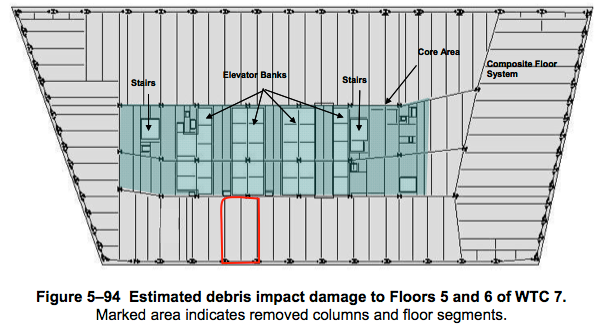
If you look at the NIST damage estimates to 7 WTC from debris dropping from the collapsed WTC towers, you can see that it was impossible for such major damage to have occurred at their east stairwell location.
If you had an ounce of honesty you would also state how NIST came to the estimates.
As we all know it was by looking at pictures from the outside and using what little information gathered from witnesses.
NIST gives an admitted conservative estimate and you use it as fact.
It would help if you proofread your work.
You could use a bit of proofreading yourself.
Jennings states that one of the people he calls tells them to evacuate.
Here you claim its an incoming call to a supposedly empty OEM.
A "superior"?
Yes. From a superior, or are you unfamiliar with that term?
Mr. Jennings had been making calls to find out what was going on.
Obviously once alerted to this fact, one of his superiors knew where to contact him and did so.
He's is on record as having made two mutually exclusive statements about how and from whom , he got the message.
Yet you find his account so very consistent.
Mr. Jennings said:"After I called several individuals, one individual told me that, um "to leave, and leave right away."
Mr. Hess came running back in.
He said "we're the only ones up here, we gotta get out of here." "
Mr. Jennings said:"At that time I received a phone call from one of my higher ups.
And ah..he said "where are you?"
And I said uhm..you know, the Emergency Command Center.
A long pause.
And then he came back and he said; "Get out of there. Get out of there now."
I agree that Mr. Hess emphasized that when he reached the 6th floor, all at once and at the same time, there was an explosion, the lights went out, there was smoke, there was soot and dirt, and he could feel the building shaking.
As noted in my post, The NIST reported that some 7 WTC occupants also felt the building shaking when the first plane crashed into 1 WTC.
What Mr. Hess experienced fit with the described explosion that blew out the 6th floor stairwell landing and left Mr. Jennings briefly hanging with his hands holding the railing.
It also fits extremely well with what one would expect to be the effect of WTC 1 collapsing on WTC 7.
Hess disputes that the landing fell away.
However even if it did its not that far away from the SW corner where the column was violently removed for a dozen floors.
Only two columns between south side and stairwell, and the lobby floor open from ground to fifth slab.
The SW corner damage, quite obvious in photos . seems to be missing from your diagram.
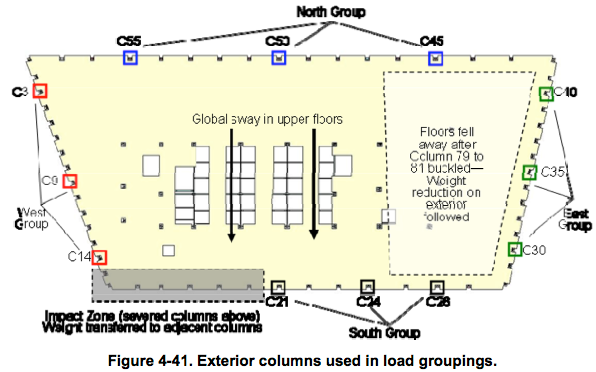
How does it compare to fig 4-41 in ncstar1-9a?
NIST_NCSTAR_1-9A said:"Figure 4-41 shows a plan view of Floor 8 that highlights the exterior columns that were used to track the column load history for each face. Also noted on the figure is the debris impact zone, which shows the southwest columns that were severed. Loads were extracted just above Floor 8 from three columns per face and averaged to produce Figure 4-42."
How does it compare to figs 5-83 and 5-89 in ncstar1-9?
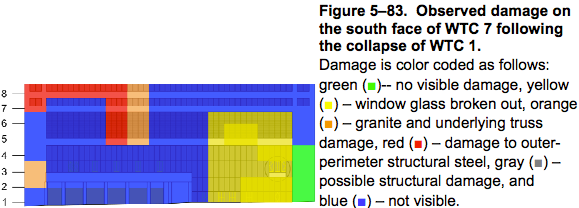
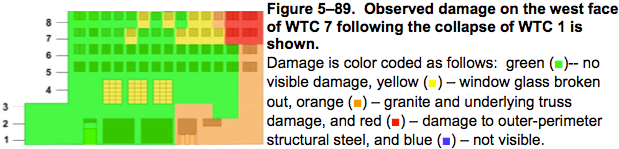
The later [Figure 5-89] show that every window on the eighth floor south side was broken along with several on the west side, and column and truss damage occurred in a couple of locations on the eighth floor.
Note exterior column damage visible down to the fifth floor just to the east of the columns supporting the stairs.
Not visible in the extent of damage to the SW corner below eighth floor but it can be assumed that the gouging out of that corner did not stop at the seventh.
In fact you seem to have ignored altogether fig 5-95,96,97. NIST seems to have attributed damage to columns only by what could be seen.
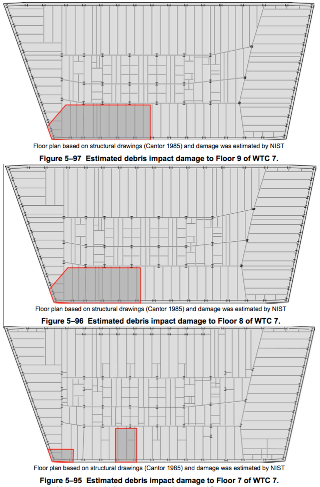
Now, knowing of the severe damage to the eighth floor, how then do Jennings and Hess not mention the particular hell that must have been visited upon them by supposedly being on the eighth floor at the time this is done?
You quibble that they did not mention the building shaking when they were on a floor not directly affected by the first collapse.
You take a literal interpretation of an explosion being described as having cut the lights,infused the structure with choking dust and causing structural damage,
and yet cannot bring yourself to note the inconsistency that is implicit in your preferred timeline, which has neither Jennings or Hess making comment on the particular hell that would have visited them when every window on the eighth floor south side was broken , exterior columns on that and several other floors of their south side ripped apart, and that massive dust cloud rolled through the eighth floor.
The mind reels!
I agree that Mr. Hess emphasized that when he reached the 6th floor, all at once and at the same time, there was an explosion, the lights went out, there was smoke, there was soot and dirt, and he could feel the building shaking.
Mr. Jennings states that "after" he got to the 8th floor, everything got dark.
Which is it MM?
Either you believe the lights went out when the explosion happened in the stairwell or you believe that the lights went out sometime after they climbed back up to the 8th floor. You used the latter argument to try and show my timeline incorrect in a previous post.
Seems to me you change your beliefs on the fly just so you can look like you're correct in regards to the current debate. Do you think people forget what you've stated before?
<world record amounts of snippage>
From the perspective of a two 'uninformed' men, trapped in 7 WTC, who at various times, described building shake, power outage, smoke, dust, heat, repeated explosions inside and out, and burning emergency vehicles outside on the street, I think they generally convey the hell they were living through.
I think when Mr. Jennings said he wanted to climb down a firehose from the 8th floor window, it was quite evident the amount of stress he was under.
There is nothing to suggest an expectation of debris damage over in the north east quadrant where the east stairwell is located.
I am looking at the framing drawings and I see only one freight elevator. DOes anyone know of other freight elevators?

There was a bank of them, 2 singles and 1 double it seems, next to the W stairway.
[qimg]http://i250.photobucket.com/albums/gg274/sap-guy/wtc7elevators_zps824449a2.gif[/qimg]
Mr. Hess said the lights went out. He omitted the lights going back on soon in his one-sentence summary, but we know they did.Mr. Hess didn't say the lights flickered. The NIST did.
As all of the emergency responder restructuring operations were underway, three people became temporarily trapped inside WTC 7. Two New York City employees had gone to the OEM Center on the 23rd floor and found no one there.16 As they went to get into an elevator to go downstairs, the lights inside WTC 7 flickered as WTC 2 collapsed. At that point, the elevator they were attempting to catch no longer worked, so they started down the staircase.
_______
16 WTC 7 Interviews 2041604 and 1041704, spring 2004.
Are you sure he didn't? Do you have his interview with NIST? All you can say for sure is he didn't in the interviews posted in this thread so far.Mr. Hess didn't say he went back to the elevators to evacuate. The NIST said he did.
MY timeline is problematic?I am not disputing Mike Catalano's statement.
It is your interpretation of the timeline that is problematic.
There would still be light in the 8th floor and in the elevators, were that the case.It does not take 30 minutes to evacuate from the 23rd floor to the 6th floor. AJM claims he made a similar descent in 2 minutes.
An explosion from below the 6th floor landing could have severed the stairwell wiring to the lighting.
Or unless they have to pause every three flights to take air, as Hess reports: "Previously you could breathe for about three flights down."The fact that it only requires a fraction of 30 minutes to reach the 6th floor stairwell, establishes that the descent time could not possibly represent the activity of Mr. Jennings and Mr. Hess, between the collapses of the two WTC towers.
Unless of course, they reached the 6th floor and waited about 20 minutes.
No. Jennings does not report it at any time at all. Therefore it's insignificant that he doesn't report it in particular while he was at floor 23. Different people focus on different things when reporting their experiences.It means a helluva lot.
What part of my quote is speculation, exactly?With difficulty to breathe, remember.
It looks like they had to stop every three flights to take some air.
There was smoke in the stairway from the generator fire after the collapse of WTC 2.
Jennings probably needed to wait for Hess, despite his "leaping stairwells".
Or is your conjecture that he outran Hess, leaving him alone?
It was only Mr. Hess who made that claim several years later to the BBC.
Now who is speculating?
So, was it speculation on my side? Or just a reasonable assumption based on the fact that they started together and arrived together?At any rate, it appears from their testimonies that they both arrived at the 6th floor around the same time.
You can't seriously claim that the contamination from the outside would have such a huge impact in the staircase's air.When they were in the stairwell, it was after the aircraft crashes into both of the WTC twin towers.
The fiery debris from those impacts created a number of ground fires. That, and whatever preceded the explosion they witnessed from the 6th floor might account for the air quality in the east stairwell.
Yet they didn't, as JayDee has indicated previously. It's quite obvious the damage ran all the way from the top to the bottom of the building, yet NIST don't presume damage in the parts that were not visible.Unlike you with your armchair analysis, the NIST engineers had the expertise and several years to study this issue, using all the data available.
They had a lot of incentive to predict greater damage because it would make the resulting collapse hypothesis easier to develop.
FTFY. The issue was that that air was used for venting the generators, but not the rest of the building. Generators need air for combustion and for safety reasons. The air quality doesn't matter that much as in the rest of the building. You're grasping at straws there.Mike Catalano noted that the 5th floor drew in air through vents which was a particular issue when12 WTC collapsed.
Can you explain why Jennings states the following at 5:50 in the video, http://www.youtube.com/watch?v=1o0PTsP1_AE ?Why do you assume that the stairwell lights and the floor lighting had to be on the same circuit?
Barry Jennings said:When I made it to the 6th floor... and... and... and the... there was an explosion... the explosion was beneath me. Keep in mind now, it's pitch black in there, all the lights went out. So when the explosion happened, it blew us back.
Until questioned further, when he arrived at the 8th floor, he focused on the window breakage, his rescuers on the street, the burning vehicles, the dust, heat and smoke, and repeatedly about all the explosions he kept hearing inside 7 WTC.

The diagram from the east side shows damage extending into the structure. There are only two columns between the south exterior and the stairwell. It is very possible that the stairwell would be damaged. It would most certainly have been shaking for several seconds.You insult the readers.
People know the difference between something that is an estimation and something that is fully known.
Whether conservative or not, the inside perimeter of the nearest estimated debris damage location is a far cry from the 6th floor stairwell landing.
Where is your honesty?
[qimg]http://i1265.photobucket.com/albums/jj515/Miragememories/NISTWTC7dmageflr5amp6_zps71380853.png[/qimg]
Yes I find those statements to be quite in agreement with each other.
You do know what "mutually exclusive" means do you not?
Neither of those two statements by Mr. Jennings negates the other.
In both statements Mr. Jennings said he was told by an individual to get out of there.
In one of the statements he added that the individual was his superior.
No. It does not fit "extremely well" since it was about 3 times further away from the nearest inside perimeter damage, and is well protected by columns and elevator shafts.
Mr. Hess does not mention the condition of the landing. Since Mr. Jennings was the one who dropped and was left hanging, it is safe to assume that Mr. Hess didn't try for himself.
Mr. Hess only claimed that they ran "into a wall" which can easily be interpreted as meaning their way was obstructed, which it was.
The east stairwell was unusable due to debris and/or dust.Back to your perception of damage, the SW corner was about as far away as you could get. Though one of Mr. Jenning's rescuers claims that both stairwells were damaged and inaccessible, others claimed they were able to use the west stairwell which was the closest to the SW corner.
It shows the impact zone for the south west corner, 8th floor. I see no relevance to either stairwell.
Actually Figure 5-89 only graphically represents the west side.
Lie, about which diagram? No I was in error.Lie much?
Not my intent to say it is. If you responded after reading my entire post you'd probably be able to discern that.Window damage is hardly representative of serious internal damage, or do you believe elevator shafts and stairwells were enclosed with balsa wood?
Believe what you will. Your religion won't allow otherwise anyway.Actually, no I don't. You do like to make assumptions.
Are you seriously trying to say that they were protected from the tremendous shaking the structure would experience when columns are torn apart? Are you seriously saying that a dust cloud that enveloped buildings, chased people down the street faster than they could run, did not fill the floors with choking dust? The fall of WTC2 did that to the third floor lobby, but you expect J&H to have been somehow protected from it when WTC1 collapsed? Really?They were in the north east corner as shown by the video evidence.
The known damage to the 8th floor, a floor densely populated by office cubicles, was mostly confined to the south side and in particular to the west.
Undoubtedly Mr. Jennings and Mr. Hess experienced the shaking, the dust, the explosive sounds, the darkness and the heat.
But, once they decided to hide out and call for help from that secluded NE corner office, they were not in a position to see much of what occurred in the area that you describe.
Everyone else in 7 WTC appeared to quite notice the crash of 2 WTC.
It is not unreasonable to believe an explosion below the 6th floor would disrupt lighting in that vicinity, create a lot of dust, and do structural damage.
How many instances of the building shaking do the recount? How many times do the comment on thick choking dust?From the perspective of a two 'uninformed' men, trapped in 7 WTC, who at various times, described building shake, power outage, smoke, dust, heat, repeated explosions inside and out, and burning emergency vehicles outside on the street, I think they generally convey the hell they were living through.
I think when Mr. Jennings said he wanted to climb down a firehose from the 8th floor window, it was quite evident the amount of stress he was under.
Barry Jennings said:After getting to the 8th floor everything was dark. It was dark and it was very, very hot. VERY hot. Um... I asked Mr. Hess to check the phones as I took a fire extinguisher and broke out the windows. Once I broke out the windows I could see outside below me... I saw uh... police cars... on fire... buses on fire. I looked one way the building was there, I looked the other way, it was gone.
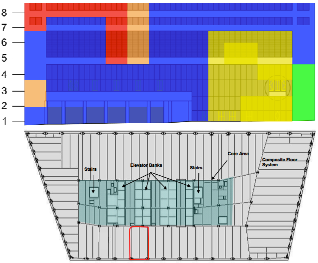
Is it safe to assume that the red outline is where the EOC was located on the 23rd floor?
[qimg]http://i238.photobucket.com/albums/ff290/gamolon/EOC_zps6843bfa4.gif[/qimg]
[qimg]http://i238.photobucket.com/albums/ff290/gamolon/wtc7_EOC_diagram_zpsd83033cf.jpg[/qimg]
That would put the closest entrance of the EOC to the freight elevator in the southwest corner, right next to the stairwell.
My reasoning for the east stairwell has been that the security manager who become trapped on Floor 7, used the west stairwell when he went up after the collapse of WTC 2, to look for personnel he feared might still be left on Floor 44. I would have expected him to maybe meet Jennings and Hess on their way down. No such meeting is mentioned any place I have looked; not that it need to be either. Next that they broke the window in the northeast corner, since that corner was closer to the stairwell. But of course, if they came down the west stairwell it would be natural to move as far away from the damaged southwest corner as possible. Another indication, is that Jennings in the BBC interview, describes how he moves over to the other side of the building finding it gone.
When I look at the floor schematics of Floor 6 and 7 on page 50 and 51 in NIST NCSTAR 1-9, I have speculated as you that the stair changed direction on Floor 6. If so my guess is the east stairwell, since the schematic indicates a rather large landing there. But as mentioned by someone earlier in the thread, they may have been so far down as floor 5 where the stairs ends in transfer corridors. That would also explain why Hess hit a wall in the dark, while likely attempting a 180 degrees turn, expecting to move down the next flight of stairs.
I have found no indication of damage to the stairwells. On page 300 in NIST NCSTAR 1-9, there is a description of damage assessment done by firefighters moving up the east stairwell to Floor 5, then moving over to the west stairwell and moving up to the 9th floor.
Regarding Jennings claiming that the landing gave way during the collapse of WTC 1, my take is that it only happened in his imagination. Quiet understandable when you in a state of fear in the dark, feel the floor/stair strongly shaking. He might very well have lost his balance.
So this is my take on the their choice of stairs, but I have seen no definitive information on this.
@Gamalon,
MM , iirc, already stipulated that the window was unbroken between tower collapses.
Sometime after 10:28 am, following the collapse of 1 WTC, Mr. Jennings breaks out two windows, one of which is in the NE corner.
Yes.
Jennings' claim that their retreat and return, twice, was down to the tower collapses is wrong by MM's own admission.
This leaves us with J+H on the 8th for 30 minutes yet never noting the collapse of either tower.
Breathtaking illogicality.


