'What about building 7'?

Status
Not open for further replies.
No sense of urgency?

You noted this interview in your followup post and your spin was absolutely absurd.

The only spin here is yours. The person on the phone was the only one that expressed urgency. Mr Jennings had no clue. You know this but it doesn't work well for you.

Keep hammering that peg. :p
 
I cannot recall MM having ever addressed the fact that no one other than Jennings and Hess made note of an explosion in WTC7 despite the fact that there were people in and around that building at the time.
He can't, other than to say every other account is wrong.

MM's belief rest on one statement. Mr Jennings claim that he saw the towers standing after the explosion. It's all he has.
 
Mr. Hess said the building lost power.

Mr. Jennings made no mention of any power loss on the 23rd floor.

Hmm why did they take the stairs?

The NIST said the lights on the 23rd floor only flickered. Presumably, the NIST makes this claim because the emergency backup generators would have automatically kicked in when a power interruption was sensed.
In my experience a few ccts will be on UPS. Normally only computers. Other ccts come back once power has transfered to gen power. That occurs about a minute or two after gen start. This give the genset time to come up to speed and allows for momentary street power outages to take place w/o transfer to gen power. However any computer controlled system not on UPS would not automatically come back online, like perhaps elevators.

In his statement, Mr. Jennings, after being told he must leave immediately, makes no mention of spent time loitering around the elevators.

Nor does he ever mention being engulfed in dust on the eighth floor or the effect on the building one would expect when structural columns are violently ripped away. But you're ok with that for some odd reason.

Is it really reasonable to believe that their position on the 23rd floor was so secluded that the collapsing 2 WTC was unnoticeable?
Certainly more reasonable than expecting the eighth floor to not suffer choking dust and extreme shaking when columns are violently torn from the building.

In his revised recollection years later, Mr. Hess claimed in a BBC interview, that when he was in the stairwell at the 6th floor, during the time of the explosion which blocked their further descent, 7 WTC shook for from 5 to 10 seconds
Hmm that would be the incident he is adamant was not an explosion If that time period sounds familiar, ,,,,,, , oh yeah, about the same as the collapse of the towers.

Yet on the 23rd floor when 2 WTC was collapsing...nada.
Yet on the eighth floor when WTC1 ( the one that actually caused severe structural damage) was collapsing...nada
 
Last edited:


In his statement, Mr. Jennings, after being told he must leave immediately, makes no mention of spent time loitering around the elevators.

.....................

In spite of Mr. Jenning's superior telling him to leave, and leave immediately, you believe they idled away precious time waiting for an elevator that would never come.

I think you should read my post again MM. The sequence of event was; Jenning and Hess finding the EOC empty on their second attempt goes back to elevator; WTC 2 collapses; elevator no longer working -> Jennings and Hess wait for elevator to become operational again -> gives up and goes back to the EOC -> Jennings calling several individuals -> Jennings gets the call telling him to leave immediately -> Jennings and Hess goes for the stairs.

Neither of them said they waited for an elevator and the NIST disagrees with Mr. Hess over the power outage.

I would say it is quiet implicit in the radio interview Michael Hess gave shortly after getting out of the building, that they walked down the stairs because the elevators no longer were working due to a power failure. I will assume that Hess is fully able to differentiate between the building loosing utility power and the building being on emergency power only.

NIST fully agrees with Hess on this, as does the accounts of Mike Catalano and the resident elevator operators.

I understand that you want to dismiss the Hess interview, since it pretty firmly places them on the 23rd floor at the time WTC 2 collapses.

You know you have a serious problem accounting for the 30 minutes that passed between the two WTC tower collapses.

Not if we take into account the time possibly spent waiting for the elevator, and then spent making several telephone calls before being told to leave immediately. So by the time they rush for the stairwell the time could be closer to the collapse of WTC 1, than it was to the collapse of WTC 2.
 
He's dishonest. What do you expect?

I do believe there is a difference between dishonesty and religious belief so fervent, you end up chasing your tail trying to avoid having to change the beliefs you hold so tightly.

That said, I don't see much luck picking away at the awkward supporting ball of twine built up around one single observation of "explosion!" because this ball of twine apparently keeps rewinding itself.
 

In his revised recollection years later, Mr. Hess claimed in a BBC interview, that when he was in the stairwell at the 6th floor, during the time of the explosion which blocked their further descent, 7 WTC shook for from 5 to 10 seconds.


Yet on the 23rd floor when 2 WTC was collapsing...nada.

The 6th floor experience included WTC1 collapsing a good deal closer than WTC2 and its debris hitting WTC7 (including one piece that appears to have lodged between exterior columns at the roof line and slid down most of the building, creating the well-known gouge)

It's doesn't surprise me in the least that they were hugely different experiences.

Meanwhile, why would your precious 'explosion' make the building shake for 5-10 seconds?
 
Last edited:
I think you should read my post again MM. The sequence of event was; Jenning and Hess finding the EOC empty on their second attempt goes back to elevator; WTC 2 collapses; elevator no longer working -> Jennings and Hess wait for elevator to become operational again -> gives up and goes back to the EOC -> Jennings calling several individuals -> Jennings gets the call telling him to leave immediately -> Jennings and Hess goes for the stairs.


I would say it is quiet implicit in the radio interview Michael Hess gave shortly after getting out of the building, that they walked down the stairs because the elevators no longer were working due to a power failure. I will assume that Hess is fully able to differentiate between the building loosing utility power and the building being on emergency power only.

NIST fully agrees with Hess on this, as does the accounts of Mike Catalano and the resident elevator operators.

I understand that you want to dismiss the Hess interview, since it pretty firmly places them on the 23rd floor at the time WTC 2 collapses.


Not if we take into account the time possibly spent waiting for the elevator, and then spent making several telephone calls before being told to leave immediately. So by the time they rush for the stairwell the time could be closer to the collapse of WTC 1, than it was to the collapse of WTC 2.
Just like to note that those people experiencing the WTC2 collapse on lower floors would have also contended with breaking windows and choking dust., neither of which would affect the 23rd floor. It is quite possible that for those on low floors, the shaking was not that severe but seemed greater due to the other emotion charging effects of collapse.
Second, there may well have been some damping of the shaking at higher floors such as translating it into building sway.
 
Hmm why did they take the stairs?
Good point.

Also, in Jennings' interview, he says:
Barry Jennings said:
...Only me and Mr. Hess was up there. Um... After I called several individuals, one individual told me that um... to leave and leave right away. Mr. Hess came running back in, He said "We're the only ones up here, we gotta get outta here", he found the stairwell.

Why did Hess feel the need to tell Jennings that he found the stairwell and that the stairwell was going to be the way they needed to exit the building? They chose a stairwell to descend 23 floors instead of taking a functioning elevator? When there was supposedly nothing going on in WTC7 at that time?
 
In his statement, Mr. Jennings, after being told he must leave immediately, makes no mention of spent time loitering around the elevators.

Yet you eagerly embrace the notion that 2 WTC was collapsing while Mr. Jennings and Mr. Hess were on the 23rd floor although they didn't hear or feel a thing worth mentioning at that time.

In spite of Mr. Jenning's superior telling him to leave, and leave immediately, you believe they idled away precious time waiting for an elevator that would never come.

Neither of them said they waited for an elevator and the NIST disagrees with Mr. Hess over the power outage
I think you should read my post again MM.

The sequence of event was;

Jennings and Hess finding the EOC empty on their second attempt goes back to elevator; WTC 2 collapses; elevator no longer working -> Jennings and Hess wait for elevator to become operational again -> gives up and goes back to the EOC -> Jennings calling several individuals -> Jennings gets the call telling him to leave immediately -> Jennings and Hess goes for the stairs.

It would help if you proofread your work.

Your timeline is inaccurate and totally screwed up to fit the scenario you wish to believe.

Mr. Jennings and Mr. Hess arrive at 7 WTC and take the automatic elevator to the 23rd floor OEC and find it locked.

They return to the lobby whereby the police escort them back to the 23rd floor OEC by freight elevator and they are able to gain access.

While in the OEC Mr. Jennings observes still smouldering coffees and half-eaten sandwiches while phoning people to find out what is happening.

During this time, he receives a call from a superior telling him to leave, and leave immediately.

Which they do.

There is little point in responding to the rest of your post if you are unwilling to acknowledge the correct order of events regarding Mr. Jennings arrival and departure to the 23rd floor OEC
 
What I see is so much ego publicly invested so heavily over several years that his position has become so entrenched that the idea of abandoning it is unbearable. And so counter-argument against debunkers had become mandatory and the substance of that counter-argument hardly matters. Hence the circular arguments and self-contradictions that others see don't matter, only the process matters.
 
It would help if you proofread your work.

Your timeline is inaccurate and totally screwed up to fit the scenario you wish to believe.

Mr. Jennings and Mr. Hess arrive at 7 WTC and take the automatic elevator to the 23rd floor OEC and find it locked.

They return to the lobby whereby the police escort them back to the 23rd floor OEC by freight elevator and they are able to gain access.

While in the OEC Mr. Jennings observes still smouldering coffees and half-eaten sandwiches while phoning people to find out what is happening.

During this time, he receives a call from a superior telling him to leave, and leave immediately.

Which they do.

There is little point in responding to the rest of your post if you are unwilling to acknowledge the correct order of events regarding Mr. Jennings arrival and departure to the 23rd floor OEC
You could use a bit of proofreading yourself. Jennings states that one of the people he calls tells them to evacuate. Here you claim its an incoming call to a supposedly empty OEM. A "superior"?
Originally Posted by Barry Jennings
...Only me and Mr. Hess was up there. Um... After I called several individuals, one individual told me that um... to leave and leave right away. Mr. Hess came running back in, He said "We're the only ones up here, we gotta get outta here", he found the stairwell.

Once again MM, why did they take the stairs? Not functioning is my guess. So, one goes to the elevator and pushes the down button. How long before one deduces the elevator isn't coming? What other clues might there be to the fact that the elevator isn't coming? Perhaps the power is out or was out for a few minutes indicating it may not be reliable, that would be another.

What clues would J&H have to the collapse of WTC2? No direct view, no monitors of the outside world, no dust cloud infiltrating that high up. Just building shaking. When the aircraft hit WTC1 Catalano said it was a thump so it would seem that being higher up lessens what one feels in this regard.
 
Last edited:
The problem is with people like yourself who do not like the answer.

Honestly, put yourself in Mr. Jenning's shoes inside 7 WTC on 9/11 and out of sight of the WTC twin towers.

All you know regarding what is happening outside the building is that you were called to the 23rd floor OEM because you were told that a small private plane crashed into 1 WTC.
Mr. Jennings said:
"I was on my way to work.

And..traffic was excellent.

And I received a call that a small Cessna had hit the WTC.

And I was asked to go and man the Office of Emergency Management (OEM) at WTC 7 on the 23rd floor.

What the ****? Small plane crash?

That small plane crash.

Driving "above the limit" in New York's financial district at 9 in the morning on a weekday after a *********** plane crashed into the World Trade Center?

Are you *********** high?

No, but I suspect you and your buddies usually are.

Assistant Commissioner Drury turned on his emergency lights as he drove towards the WTC during the 9/11 emergency.

I don't think he was at risk for a speeding ticket.

It was not a 'typical' "9 in the morning weekday".

Regular commuters would have diverted, or been diverted by police, away from the WTC.

Only emergency-related vehicles, such as Mr. Drury's would be heading inbound.


He's [Mr. Hess] condensing the 2-3 hours they were in the building into basically a single sentence. There's a bit of everything there.

My interpretation is that he is referring to the flickering of the lights (lights go out for a few seconds while the generator starts).

Power went out for long enough as to make the elevators stop working, so he assumed the power went out in the whole building.

Sounds like a reasonable assumption for a layman who doesn't know the power structure of a building.

Describing the lights out + building shake + soot increase + sprinklers + blockage + (probably) rumble as an explosion sounds like a pretty concise way to describe the experience.

He says he felt like it was an explosion in the basement. Again, quite consistent with what a witness perceives in the middle of the traumatic experience.

In short, I see no inconsistency there.

Mr. Hess didn't say the lights flickered. The NIST did.

Mr. Hess didn't say he went back to the elevators to evacuate. The NIST said he did.

Mr. Hess said all the power went out in the building and then he and Mr. Jennings took the stairs down to the 6th floor where they were met by an explosion and could proceed no further.

I agree that Mr. Hess emphasized that when he reached the 6th floor, all at once and at the same time, there was an explosion, the lights went out, there was smoke, there was soot and dirt, and he could feel the building shaking.

As noted in my post, The NIST reported that some 7 WTC occupants also felt the building shaking when the first plane crashed into 1 WTC.

What Mr. Hess experienced fit with the described explosion that blew out the 6th floor stairwell landing and left Mr. Jennings briefly hanging with his hands holding the railing.

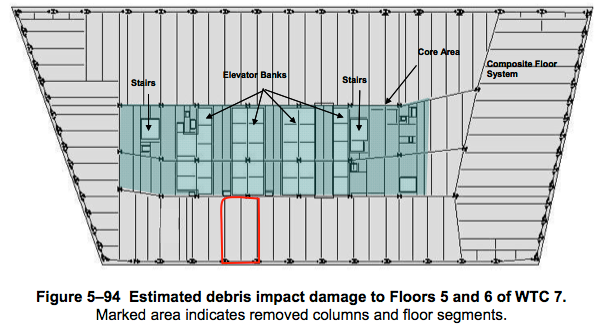
If you look at the NIST damage estimates to 7 WTC from debris dropping from the collapsed WTC towers, you can see that it was impossible for such major damage to have occurred at their east stairwell location.


NISTWTC7dmageflr5amp6_zps71380853.png


Now cross-check that with Catalano's interview with the Commission (from the MFR that I posted upthread), where he basically says the power went definitely out during the collapse of WTC1, and what is the most logical explanation for all these five things?

Certainly not an explosive blast.

I am not disputing Mike Catalano's statement.

It is your interpretation of the timeline that is problematic.

It does not take 30 minutes to evacuate from the 23rd floor to the 6th floor. AJM claims he made a similar descent in 2 minutes.

An explosion from below the 6th floor landing could have severed the stairwell wiring to the lighting.


Catalano also said the power went out during the collapse of WTC2 and then the generators started. The elevator mechanics, whose testimony was linked earlier by GlennB (thanks), also point out that the WTC2 collapse caused a power outage, causing the elevators to cease working, trapping people until they reset the elevators.

That's quite some people telling the same story as NIST now. What's the reason for Jennings and Hess using the stairs, again?

Didn't you say that Mr. Hess was; "condensing the 2-3 hours they were in the building into basically a single sentence...In short, I see no inconsistency there."?

Regardless, no where do Mr. Hess or Mr. Jennings say they attempted to use the elevators to evacuate.

In my building, we are always told that during an emergency evacuation, or fire drill, to take the stairs, DO NOT USE THE ELEVATORS!

The fact that it only requires a fraction of 30 minutes to reach the 6th floor stairwell, establishes that the descent time could not possibly represent the activity of Mr. Jennings and Mr. Hess, between the collapses of the two WTC towers.

Unless of course, they reached the 6th floor and waited about 20 minutes.


Oddly, neither Mr. Hess or Mr. Jennings made mention of any building shake when 2 WTC was supposedly collapsing while they were on the 23rd floor of 7 WTC.
Nor does Jennings at any time. That means nothing.

The lights going out and then the generator starting is the same story told by Catalano.

The WTC 2 collapse as the cause of the elevators ceasing to work is the same story told by Flanagan and Klaum.

It means a helluva lot.

You like to cite others but you are casually dismissive when the support for your argument goes the other way.

This is also part of the story told by Mike Catalano when 2 WTC collapsed;


Mike Catalano said:
"Then everything went pitch black.

The rumbling, the screeching, and the noises — you can’t imagine.

I really can’t describe it.

It was nasty.

I’m telling you the building was shaking.
"

As I pointed out before, Mr. Jennings claimed he was in such a hurry to evacuate from the 23rd floor, that he was leaping stairwells.

Yet if if you accept the NIST and Hess version of what happened, it took 30 minutes for Mr. Jennings to make a descent that others have easily completed in under 10 minutes.
With difficulty to breathe, remember.

It looks like they had to stop every three flights to take some air.

There was smoke in the stairway from the generator fire after the collapse of WTC 2.

Jennings probably needed to wait for Hess, despite his "leaping stairwells".

Or is your conjecture that he outran Hess, leaving him alone?

It was only Mr. Hess who made that claim several years later to the BBC.

Now who is speculating?

Why would Mr. Jennings race ahead if he knew he was going to have to keep stopping and waiting?

You either move at the pace of the slower party or you forge ahead at your own pace.

At any rate, it appears from their testimonies that they both arrived at the 6th floor around the same time.

When they were in the stairwell, it was after the aircraft crashes into both of the WTC twin towers.

The fiery debris from those impacts created a number of ground fires. That, and whatever preceded the explosion they witnessed from the 6th floor might account for the air quality in the east stairwell.


Continuing with Mr. Hess's latest retelling, when he and Mr. Jennings arrived at the 6th floor stairwell landing, debris from the collapsing 1 WTC, penetrated deep down to the 6th floor east side stairwell landing creating a physical blockage and caused an immediate smoke and soot producing fire.

Sorry, but I find him seriously lacking in credibility.


NISTWTC7dmageflr5amp6_zps71380853.png


It seems pretty credible to me.

We don't know how many of the interior beams were affected and how, and how that affected the floor and how that broke walls and caused the stairwell to become blocked, but it's quite possible something like that happened.

And the sudden impact of the WTC 1 debris stirred the air, spreading the smoke to many places.

All I see is you trying to weasel out of a situation that doesn't support your belief by making up excuses.

Unlike you with your armchair analysis, the NIST engineers had the expertise and several years to study this issue, using all the data available.

They had a lot of incentive to predict greater damage because it would make the resulting collapse hypothesis easier to develop.

NIST Figure 5-94 above shows their best estimate.

Keep in mind we are talking about a building with a footprint the size of a football field.

There are a lot of columns and reinforced elevator shafts between the inner periphery of the debris damage zone and the east side 6th floor stairwell landing.

Like I said, the smoke could have come in from outside fires caused by the fiery plane crash debris.

Mike Catalano noted that the 5th floor drew in air through vents which was a particular issue when 1 WTC collapsed.


Mike Catalano said:
"The vents on the top of the building and on the 5th floor sucked in the air and jammed the generators and caused them to burn.


It would help if you proofread your work.
You could use a bit of proofreading yourself.

Jennings states that one of the people he calls tells them to evacuate.

Here you claim its an incoming call to a supposedly empty OEM.

A "superior"?

Mr. Jennings said:
"At that time I received a phone call from one of my higher ups.

And ah..he said "where are you?"

And I said uhm..you know, the Emergency Command Center.

A long pause.

And then he came back and he said; "Get out of there. Get out of there now."

Yes. From a superior, or are you unfamiliar with that term?

Mr. Jennings had been making calls to find out what was going on.

Obviously once alerted to this fact, one of his superiors knew where to contact him and did so.
 
Last edited:
If you look at the NIST damage estimates to 7 WTC from debris dropping from the collapsed WTC towers, you can see that it was impossible for such major damage to have occurred in that location

If you had an ounce of honesty you would also state how NIST came to the estimates.

As we all know it was by looking at pictures from the outside and using what little information gathered from witnesses.

NIST gives an admitted conservative estimate and you use it as fact.

Does this help you pound that peg?
 
Last edited:


That small plane crash.


No, but I suspect you and your buddies usually are.

Assistant Commissioner Drury turned on his emergency lights as he drove towards the WTC during the 9/11 emergency.

I don't think he was at risk for a speeding ticket.

It was not a 'typical' "9 in the morning weekday".

Regular commuters would have diverted, or been diverted by police, away from the WTC.

Only emergency-related vehicles, such as Mr. Drury's would be heading inbound.


Mr. Hess didn't say the lights flickered. The NIST did.

Mr. Hess didn't say he went back to the elevators to evacuate. The NIST said he did.

Mr. Hess said all the power went out in the building and then he and Mr. Jennings took the stairs down to the 6th floor where they were met by an explosion and could proceed no further.

I agree that Mr. Hess emphasized that when he reached the 6th floor, all at once and at the same time, there was an explosion, the lights went out, there was smoke, there was soot and dirt, and he could feel the building shaking.

As noted in my post, The NIST reported that some 7 WTC occupants also felt the building shaking when the first plane crashed into 1 WTC.

What Mr. Hess experienced fit with the described explosion that blew out the 6th floor stairwell landing and left Mr. Jennings briefly hanging with his hands holding the railing.

If you look at the NIST damage estimates to 7 WTC from debris dropping from the collapsed WTC towers, you can see that it was impossible for such major damage to have occurred at their east stairwell location.


[qimg]http://i1265.photobucket.com/albums/jj515/Miragememories/NISTWTC7dmageflr5amp6_zps71380853.png[/qimg]


I am not disputing Mike Catalano's statement.

It is your interpretation of the timeline that is problematic.

It does not take 30 minutes to evacuate from the 23rd floor to the 6th floor. AJM claims he made a similar descent in 2 minutes.

An explosion from below the 6th floor landing could have severed the stairwell wiring to the lighting.


Didn't you say that Mr. Hess was; "condensing the 2-3 hours they were in the building into basically a single sentence...In short, I see no inconsistency there."?

Regardless, no where do Mr. Hess or Mr. Jennings say they attempted to use the elevators to evacuate.

In my building, we are always told that during an emergency evacuation, or fire drill, to take the stairs, DO NOT USE THE ELEVATORS!

The fact that it only requires a fraction of 30 minutes to reach the 6th floor stairwell, establishes that the descent time could not possibly represent the activity of Mr. Jennings and Mr. Hess, between the collapses of the two WTC towers.

Unless of course, they reached the 6th floor and waited about 20 minutes.


It means a helluva lot.

You like to cite others but you are casually dismissive when the support for your argument goes the other way.

This is also part of the story told by Mike Catalano when 2 WTC collapsed;


It was only Mr. Hess who made that claim several years later to the BBC.

Now who is speculating?

Why would Mr. Jennings race ahead if he knew he was going to have to keep stopping and waiting?

You either move at the pace of the slower party or you forge ahead at your own pace.

At any rate, it appears from their testimonies that they both arrived at the 6th floor around the same time.

When they were in the stairwell, it was after the aircraft crashes into both of the WTC twin towers.

The fiery debris from those impacts created a number of ground fires. That, and whatever preceded the explosion they witnessed from the 6th floor might account for the air quality in the east stairwell.


[qimg]http://i1265.photobucket.com/albums/jj515/Miragememories/NISTWTC7dmageflr5amp6_zps71380853.png[/qimg]


Unlike you with your armchair analysis, the NIST engineers had the expertise and several years to study this issue, using all the data available.

They had a lot of incentive to predict greater damage because it would make the resulting collapse hypothesis easier to develop.

NIST Figure 5-94 above shows their best estimate.

Keep in mind we are talking about a building with a footprint the size of a football field.

There are a lot of columns and reinforced elevator shafts between the inner periphery of the debris damage zone and the east side 6th floor stairwell landing.

Like I said, the smoke could have come in from outside fires caused by the fiery plane crash debris.

Mike Catalano noted that the 5th floor drew in air through vents which was a particular issue when 1 WTC collapsed.


Yes. From a superior, or are you unfamiliar with that term?

Mr. Jennings had been making calls to find out what was going on.

Obviously once alerted to this fact, one of his superiors knew where to contact him and did so.

Wow, one monster post that amounts to no evidence of CD :jaw-dropp
 
..Only me and Mr. Hess was up there. Um... After I called several individuals, one individual told me that um... to leave and leave right away.
Originally Posted by Mr. Jennings, BBC Interview
"At that time I received a phone call from one of my higher ups.

And ah..he said "where are you?"

And I said uhm..you know, the Emergency Command Center.

A long pause.

And then he came back and he said; "Get out of there. Get out of there now."
Yes. From a superior, or are you unfamiliar with that term?

Mr. Jennings had been making calls to find out what was going on.

Obviously once alerted to this fact, one of his superiors knew where to contact him and did so.

IOW, he's is on record as having made two mutually exclusive statements about how and from whom , he got the message. Yet you find his account so very consistent.
 
What Mr. Hess experienced fit with the described explosion that blew out the 6th floor stairwell landing and left Mr. Jennings briefly hanging with his hands holding the railing.

It also fits extremely well with what one would expect to be the effect of WTC 1 collapsing on WTC 7. Hess disputes that the landing fell away. However even if it did its not that far away from the SW corner where the column was violently removed for a dozen floors. Only two columns between south side and stairwell, and the lobby floor open from ground to fifth slab.

If you look at the NIST damage estimates to 7 WTC from debris dropping from the collapsed WTC towers, you can see that it was impossible for such major damage to have occurred at their east stairwell location.
The SW corner damage, quite obvious in photos . seems to be missing from your diagram


NISTWTC7dmageflr5amp6_zps71380853.png

How does it compare to fig 4-41 in ncstar1-9a?
How does it compare to figs 5-83 and 5-89 in ncstar1-9? The later show that every window on the eighth floor south side was broken along with several on the west side, and column and truss damage occurred in a couple of locations on the eighth floor. Note exterior column damage visible down to the fifth floor just to the east of the columns supporting the stairs. Not visible in the extent of damage to the SW corner below eighth floor but it can be assumed that the gouging out of that corner did not stop at the seventh.

In fact you seem to have ignored altogether fig 5-95,96,97. NIST seems to have attributed damage to columns only by what could be seen.

Now, knowing of the severe damage to the eighth floor, how then do Jennings and Hess not mention the particular hell that must have been visited upon them by supposedly being on the eighth floor at the time this is done?

You quibble that they did not mention the building shaking when they were on a floor not directly affected by the first collapse. You take a literal interpretation of an explosion being described as having cut the lights,infused the structure with choking dust and causing structural damage, and yet cannot bring yourself to note the inconsistency that is implicit in your preferred timeline, which has neither Jennings or Hess making comment on the particular hell that would have visited them when every window on the eighth floor south side was broken , exterior columns on that and several other floors of their south side ripped apart, and that massive dust cloud rolled through the eighth floor.

The mind reels!


An explosion from below the 6th floor landing could have severed the stairwell wiring to the lighting.
All it need do it take out the location of the battery supplying power to those lights. There could be several lights supplied by a battery located on the ground floor. Given the damage noted in fig 5-95 to 5-97 and especially in fig 5-93 , its quite possible that the power to stairway exit lighting was severed.

 
Last edited:
Status
Not open for further replies.

Back
Top Bottom