William Parcher
Show me the monkey!

- Joined
- Jul 26, 2005
- Messages
- 27,666
Shrike, did you read the 110 page review?


I think the main question is, with the advent of DNA sampling, was there any reason to label the Eastern cougar a different subspecies? Would the DNA findings show that the Eastern cougar is really no different than a W. cougar, or a Florida cougar?

USFWS said:DNA testing documented that an adult male puma killed in Georgia in 2008 originated in Florida. Given substantial barriers to dispersal, it is highly unlikely that Florida panthers are dispersing with enough frequency out of Florida to establish populations in the Southeast (USFWS 2008); however, prey and habitat are available in Georgia to support a population (Belden and McCown 1996).

There are definitely cougars in the south east. Maybe by extinct they meant, hard to find and rare. I think it was in 2008 someone shot one here in Georgia. I personally have seen tracks. (though it was about 4 years ago) I thought extinct meant none left alive. Kind of wonky they made such a declaration if you ask me.

No, extinct means extinct - not rare.
Right, the eastern cougar is extinct. That does not mean there are no cougars today within the former distribution of the eastern cougar.
...for hundreds of years a cougar found E. of the Mississippi was labeled an Eastern Cougar.
No. Despite what the report says, extinction as the term is currently used applies solely to species. If the taxonomic classification is re-worked and the Eastern Couger is found to be a distinct population of another species at best it can be argued that a population was wiped out. And it really doesn't matter what the Department of Fish and Wildlife report says--extinction=species going away. If the species still exists, the species did not go extinct.Can an animal be deemed extinct, if it is determined that there was never any genetic reason for it to be classified as a distinct species?
None of which matter in taxonomy. Or, rather, none of which matter in taxonomy sensu stricto; there are any number of cases where biologists and paleontologists have named a new species and been in error. But the original point still stands: Unless the Eastern Couger is classified as a distinct species it is impropper to refer to the loss of the Eastern Couger as an extinction. The species still exists, and can repopulate the area. Yes, it will be a different population, but if it's the same species the bruden is on the people saying that repopulation cannot work to demonstrate that there is substantial enough difference between the populations to make reintroduction not viable (this is not because the default is that reintroduction is viable, but rather because once it's established that the cougers are the same species it follows that they fill the same biological nitche and therefore the populations are similar enough to allow for viable reintroduction).The EC is not defined (and never ever was) by its genotype. It is defined by its historic breeding and population range.
Read the report, River...
The Florida Cougar ("Florida Panther") is not the Eastern Cougar.
Taxonomy is full of redundancy.The reason I made that comment is it seems there is little difference between the eastern and western cougar. (is there a genetical difference?) I would hope so if it is declared is subspecies.
I'm quite curious now as to the origin of cougars in this state. (or pumas if you'd rather call them that) I don't really see many cougars crossing the Mississippi, so do they all originate from Florida? Where did the "eastern cougar" originate? If anyone has read the report, or has that information, I'm quite curious.
The reason I made that comment is it seems there is little difference between the eastern and western cougar. (is there a genetical difference?)
Got any specifics on the highlighted stuff?All cougars (pumas) everywhere originated from South America in prehistoric times. This was long before any humans inhabited North America.
But by your own statement it is the same species. Besides, what (other than breeding range, which for large predators like this is going to be a WAG at best) defines the subspecies?Coryi is not the "Eastern Cougar" which was found further north.
And since they're the same species (though admitedly different subspecies) the ecosystem shouldn't care too much about it.The last wild breeding "Florida Panthers" in Georgia were long gone before you were born. Any cougars found in your state now would be wild roaming males from the Florida population, or escaped/released pets.
No. The Cougar is alive and well. It merely lost a subpopulation.The Eastern Cougar is extinct.
Welcome to the Wonderful World of Taxonomy.Some scientists who observed Eastern Cougar specimens found morphological differences in the pelage, skull and skeleton that made them distinct from other subspecies. Some scientists saw no differences.
Genetic testing on specimens has revealed Eastern to be quite similar to others. Some scientists say there is no meaningful difference. Some scientists argue that all cougars everywhere are the same species and that there should be no subspecies designations whatsoever. Others disagree.
 While normally I detest the biological species concept (in fact, I typically detest the species concept in general) in this case I'll give it a pass--if the cougars fill the same ecological niche and could interbreed (and given the obvious amount of genetic similarity I'd argue it's likely they interbred more than people thought) they're the same species, which means they're the same thing.
Got any specifics on the highlighted stuff?

HA!Your arguments are a waste of time. Biological and ecology sciences seem to be your enemy.
No. All of the evidence you've presented is that a subpopulation of cougars--a designation that's questionable at best--died out. If you want to call that an extinction event that's fine, have fun, but "extinction" refers to species, not subpopulations. And certainly not subpopulations of such questionable provenance.The Eastern Cougar is gone.
The Eastern Cougar is extinct.
The Eastern Cougar is extirpated.

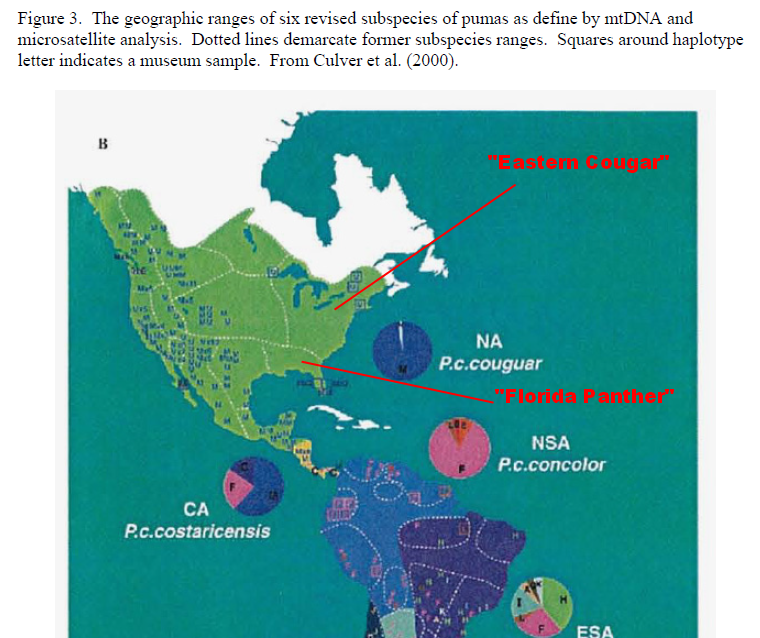
Pg 57 said:Based on recent genetic analysis (Culver et al. 2000), the federally endangered eastern cougar=puma
Felis=Puma concolor couguar subspecies may no longer be a valid taxonomic entity (according to
Wilson and Reeder 2005 the nomenclature P. c. couguar now applies to all North American pumas).
http://pediaview.com/openpedia/Cougar#Naming_and_etymologyPediaview said:Until the late 1980s, as many as 32 subspecies were recorded; however, a recent genetic study of mitochondrial DNA[15] found that many of these are too similar to be recognized as distinct at a molecular level. Following the research, the canonical Mammal Species of the World (3rd edition) recognizes six subspecies, five of which are solely found in Latin America:[1]
Argentine puma (Felis concolor cabrerae)
includes the previous subspecies and synonyms hudsonii and puma (Marcelli, 1922);
Costa Rican Cougar (Felis concolor costaricensis)
Eastern South American cougar (Felis concolor anthonyi)
includes the previous subspecies and synonyms acrocodia, borbensis, capricornensis, concolor (Pelzeln, 1883), greeni and nigra;
North American Cougar (Felis concolor couguar)
includes the previous subspecies and synonyms arundivaga, aztecus, browni, californica, coryi, floridana, hippolestes, improcera, kaibabensis, mayensis, missoulensis, olympus, oregonensis, schorgeri, stanleyana, vancouverensis and youngi;
Northern South American cougar (Felis concolor concolor)
includes the previous subspecies and synonyms bangsi, incarum, osgoodi, soasoaranna, sussuarana, soderstromii, suçuaçuara and wavula;
Southern South American puma (Felis concolor puma)
includes the previous subspecies and synonyms araucanus, concolor (Gay, 1847), patagonica, pearsoni and puma (Trouessart, 1904)
The status of the Florida panther, here collapsed into the North American Cougar, remains uncertain. It is still regularly listed as subspecies Felis concolor coryi in research works, including those directly concerned with its conservation.[17] Culver et al. themselves noted low microsatellite variation in the Florida panther, possibly due to inbreeding;[15] responding to the research, one conservation team suggests "the degree to which the scientific community has accepted the results of Culver et al. and the proposed change in taxonomy is not resolved at this time."[18]
(d) The factors considered in delisting a species are those in paragraph (c) of this section as they relate to the definitions of endangered or threatened species. Such removal must be supported by the best scientific and commercial data available to the Secretary after conducting a review of the status of the species. A species may be delisted only if such data substantiate that it is neither endangered nor threatened for one or more of the following reasons:
(1) Extinction. Unless all individuals of the listed species had been previously identified and located, and were later found to be extirpated from their previous range, a sufficient period of time must be allowed before delisting to indicate clearly that the species is extinct.
(2) Recovery. The principal goal of the U.S. Fish and Wildlife Service and the National Marine Fisheries Service is to return listed species to a point at which protection under the Act is no longer required. A species may be delisted on the basis of recovery only if the best scientific and commercial data available indicate that it is no longer endangered or threatened.
(3) Original data for classification in error. Subsequent investigations may show that the best scientific or commercial data available when the species was listed, or the interpretation of such data, were in error.
Read more: http://cfr.vlex.com/vid/424-factors-delisting-reclassifying-19895270#ixzz1GIfgirWb