Moderated The validity of classical physics - Part 2

Yes, it was my test. I told you than I expected that you would screw it up, so I made it logically tight. You saw what you wanted to see, but failed to notice that the result was illogical. So hell-bent on proving me wrong, that you ignored all evidence to the contrary. The above quote supports that.


Try again. You are confusing pressure with velocity.
Generally, it is more difficult to blow down a straw, than it is to blow through an open window. DOH.


How can you possibly know that from your unmetered and uncontrolled tests? It does leave you to explain how the fan in the "Harold Bricer " test manages to blow the cart off the belt, even though it is said to be trained on the fan.


Nope. I can put that down to your ineptitude.
What you have to explain, is your results, and independently of what I said would happen. You have to explain why the hole causes the cart to move forward. So far, your explanations have been wanting, illogical and contrary to fact.

All of my replies have been constructed carefully to allow you to connect the dots. There is only so much I can do for you. Sorry that it isn't enough.
 
Another example of you failure of logic, concerns wheels. You work with them, but you do not understand them.

You say that rolling resistance is constant with velocity, so V*Fr= K. That is true of a simple ideal wheel, but so what?
If that force is constant at velocity V, how does the wheel accelerate to 2V? To accelerate, the force must exceed K , and that will cause the wheels to slip. By changing shape under load, tyres change their dynamic friction, or more folksily, "traction", to accommodate the load. Now you know a lot more about the complex nature of wheels.

As I have said many times, you have to do your homework if you expect to understand tires. Try a book about actual tires instead of a single specialized text on the minutiae of train wheels on steel rails. I've provided many links about tires and guided you through them to no avail. You have to at least try to understand, humber, I can't force you to understand against your will.
 
All of my replies have been constructed carefully to allow you to connect the dots. There is only so much I can do for you. Sorry that it isn't enough.

Don't let the escape hatch hit you in the butt as you leave. The facts of physics are available to all, but you are illogical. You will take the same fact to "prove" one point, and then again to "prove" its contrary. You rely solely on your opinion.

Actually, this thread has caused me to re-evaluate the humble wheel. They are amazing. In the preface of one book I have on tyres, the author opines that more is understood about aerodynamics, than is understood about tyres. He may well be right.
 
Last edited:
Don't let the escape hatch hit you in the butt as you leave. The facts of physics are available to all, but you are illogical. You will take the same fact to "prove" one point, and then again to "prove" its contrary. You rely solely on your opinion.

Last man standing is your only way of "winning" an argument, humber. You lose anyway and you just don't get it. Humberism #2 again and always.
 
Mmmm, OK, what is the "force into the prop", and why would it always be less than "the force produced by the prop" ? How are these forces reataed to energy and therefore its conservation?

The force into the prop is the force that causes it it turn. The force produced by the prop is the thrust. The thrust moves the cart that turns the wheels that causes the thrust.
 
humber and Christoph are trying desperately to derail the 2 cart analysis. Why are they so afraid to let the analysis proceed step by step.

tsig, you still have a chance to redeem yourself (I can read PM's too), just follow the analysis, make sure that each step is clear and nothing is inserted that is not fully explained. Only when you know that the math and physics are correct will you have the strength to question your own intuition.
 
In restricted cases, the rolling resistance is constant with velocity. Do you see what that implies "constant velocity"? No acceleration. A rolling wheel will slip if accelerated.
Wow.

This is definitely my favorite of all time. English words hooked together randomly, with no regard for their actual meaning, and an utterly bizarre conclusion drawn from it. If I were interested in having a mocking signature line, this would be it.

In fact, this is so far over the top that I can't believe that humber is earnest. I believe that tsig is unenlightened but would be interested in understanding, and I believe that Christoph is too stubborn to ever follow the reasoning presented so that he can understand, but I now think that humber has pushed things beyond the bounds of credibility, and has to be a troll.
 
humber and Christoph are trying desperately to derail the 2 cart analysis. Why are they so afraid to let the analysis proceed step by step.

tsig, you still have a chance to redeem yourself (I can read PM's too), just follow the analysis, make sure that each step is clear and nothing is inserted that is not fully explained. Only when you know that the math and physics are correct will you have the strength to question your own intuition.

In what way have a failed you proven your example? My acceleration argument shows that you have nothing more than a gear set. You can change the acceleration by that means, but not the final velocity.
The net forces argument shows that even if the Cart2 drag forces are linear with velocity, the neither cart can reach Vw.
What is your response to these dragon slayers?
 
Wow.

This is definitely my favorite of all time. English words hooked together randomly, with no regard for their actual meaning, and an utterly bizarre conclusion drawn from it. If I were interested in having a mocking signature line, this would be it.
U huh. That is often the response of the dull mind to new information.

In fact, this is so far over the top that I can't believe that humber is earnest.
http://en.wikipedia.org/wiki/Rolling_resistance
"Rolling resistance, sometimes called rolling friction or rolling drag, is the resistance that occurs when a round object such as a ball or tire rolls on a flat surface. It is caused mainly by the deformation of the object, the deformation of the surface, or both."
I will add that ideal wheels don't deform. What does that suggest to you? Do you need to be simply told everything?
 
Last edited:
Well I know a dead horse when I'm riding one so I'll get off now.

Let's see how that works out.

Reality will speak for itself when the cart is built.

Yes. And you will be silent. Nowhere to be found.

All of my replies have been constructed carefully to allow you to connect the dots. There is only so much I can do for you. Sorry that it isn't enough.

This is a "connect-the-dots" test humber had to do recently. He came up with a truck.

dot-1.gif


The force into the prop is the force that causes it it turn. The force produced by the prop is the thrust. The thrust moves the cart that turns the wheels that causes the thrust.

So you haven't left then?

humber and Christoph are trying desperately to derail the 2 cart analysis. Why are they so afraid to let the analysis proceed step by step.

Asked and answered.

tsig, you still have a chance to redeem yourself (I can read PM's too), just follow the analysis, make sure that each step is clear and nothing is inserted that is not fully explained. Only when you know that the math and physics are correct will you have the strength to question your own intuition.

Your optimism is charming.

I believe that tsig is unenlightened but would be interested in understanding...

An easy mistake for a newcomer. My bet against any of the fab four learning anything is available to all.
 
The force into the prop is the force that causes it it turn. The force produced by the prop is the thrust. The thrust moves the cart that turns the wheels that causes the thrust.

Right, well we would normally consider that a force which turns a shaft has to be applied at a radius, and hence call that Torque. Also we would calculate the energy flow (Transfer) in terms of Work or Power, as the Product of that Torque with Angular Displacement or Angular Rate respectively.The same technique is used for the transfer at the wheel road interface.

To calculate the power transfer at the wheel, use the force at the wheel road interface, and the angular rate of the wheel (hint, this will be directly proportional to wheel radius and ROAD speed of the cart. A very small percentage of energy is loss in friction etc, a few percent maybe.

As for the thrust, there is a relationship between the propeller input torque, angular rate and remote relative airflow velocity. Difficult to compute analytically, but easy to measure and plot on a graph. The designer can vary the magnitude of the thrust force for any given input power and velocity. The propeller efficiency can easily be maintained up to 90% if the designer is careful to match the required performance parameters.

You need to be far more careful with your terms, both in expressing the concepts and understanding the concepts you are talking about before you try to critique any analysis or experimental evidence for the ddwfttw machine.
 
Right, well we would normally consider that a force which turns a shaft has to be applied at a radius, and hence call that Torque. Also we would calculate the energy flow (Transfer) in terms of Work or Power, as the Product of that Torque with Angular Displacement or Angular Rate respectively.The same technique is used for the transfer at the wheel road interface.

To calculate the power transfer at the wheel, use the force at the wheel road interface, and the angular rate of the wheel (hint, this will be directly proportional to wheel radius and ROAD speed of the cart. A very small percentage of energy is loss in friction etc, a few percent maybe.

As for the thrust, there is a relationship between the propeller input torque, angular rate and remote relative airflow velocity. Difficult to compute analytically, but easy to measure and plot on a graph. The designer can vary the magnitude of the thrust force for any given input power and velocity. The propeller efficiency can easily be maintained up to 90% if the designer is careful to match the required performance parameters.

You're just trying to confuse him with facts. He knows what he knows. (is there a "fingers in the ears" emoticon?)
 
I have said before it approaches the velocity of the wind asymptotically and that is what Isaac Newton says also.

Christoph,

You understand that this is NOT what Humber believes, yet you spent weeks on Dawkins arguing that he was right.

You also understand that showing that a balloon in a wind and a balloon moving in still air (and your statement is equally valid to both cases) acted the same from a frame of reference at wind speed (again, your stataement confirms this) was a way of showing that the cart on a moving surface in still air is equivelent to a cart on a fixed surface in moving air.

The motor does not power the cart, it powers the surface. If the cart could not utilise the difference between the surface speed and the speed of the air, it would slide off the back of the belt.

You have made a correct (and Humber-contradicting) statement about balloons and should now be able to see the equivelence between the relative motion of balloons and air , regardless of what the air is doing relative to the surface.

Cart on a treadmill is ALSO a csae of equivelence.
 
How dumb is humber? He ahs been told countless times that he is conflating rolling friction with traction. humber, if you don't exceed rolling friction a tire (note spelling) will not slip, it will not even advance. It will just stay in place. If you somehow exceed traction on a tire it will slip, but that force is at least two orders of magnitude larger than the rolling friction. Try again.
 
On the treadmill the source of the energy that spins the prop is the treadmill motor.

In the wind the wind is the source of the energy.
Okay, that may be true, but the next question is: What is the difference to the cart? That is, if one can show that all forces imposed on the cart are the same on the treadmill as on the street, does that imply that the source of the energy is not important?

You can only get energy from the wind if there is a difference in wind speed between the wind and the object getting energy.

At wind speed there is no difference between the cart and the wind.

(Yes TAD the prop is moving relative to the wind but the reason why it is moving is the question.)
TAD has a point. But let's get through the above first. It's important and more topical.
 
Christoph...
You have made a correct (and Humber-contradicting) statement about balloons and should now be able to see the equivelence between the relative motion of balloons and air , regardless of what the air is doing relative to the surface.

And yet I will go way out on a limb and make the bold prediction that Christoph would sooner gnaw his own arm off than admit such a thing.
 
Forces don't produce "input". They either balance, or they don't. There is no law of physics that says those two forces need to be equal, and they aren't. There is a law of physics that says the total power should balance. But power is force times velocity, and the velocities of the air and ground are not equal. That means the forces are not equal either. That's what drives the cart.

The force produced by the prop will always be less than the force into the prop.

"Energy can be changed from one form to another, but it cannot be created or destroyed"

The force into the prop is the force that causes it it turn. The force produced by the prop is the thrust. The thrust moves the cart that turns the wheels that causes the thrust.

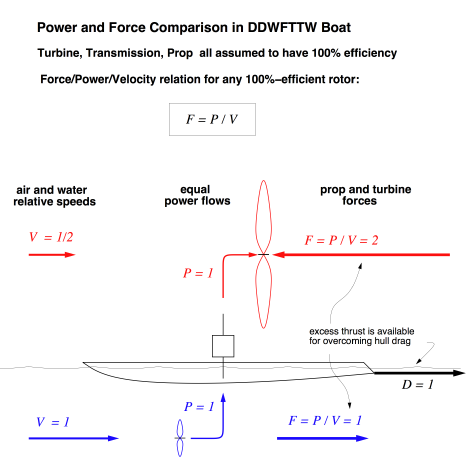
Don't confuse force and energy. Yes, energy cannot be created or destroyed. Another way of saying this is "power in = power out". Power = force x speed: output force can be greater than input force if output speed is less than input speed. In the case of the ddwfttw cart, the speed of the wheels of the cart along the ground is greater than the speed of the prop though the air. Therefore the force produced by the prop can be more than the opposing force on the wheels. Have a look at Drela's force/power diagram.

1661249c4eb86dfc8e.png


Here the boat is travelling at twice wind speed. If the speed of the boat relative to the water is 1, then the speed of the boat relative to the air is 1/2. Since the turbine is operating in the water and the propeller in the air, the force produced by the propeller in the air is twice the force of the water on the turbine.

The cart works in just the same way: the wheels on the road take the place of the turbine in the water.
 
No, it's the electric plug the treadmill is plugged in to, which is powered by a power plant, which is powered by burning coal, which was produced by dead plants, which were powered by the sun.


The point being that the ultimate source of the energy is totally irrelevant. The cart obeys Newton's laws of motion, which means it reacts to the forces and velocities its wheels and prop are exposed to. That and that alone is all one needs to determine its acceleration, and those forces and velocities are identical between the treadmill and a cart outside in the wind.

It may help to express this with a short story. I happen to like my beer cold. In fact, I like it ice-cold so I place it in the freezer compartment of the fridge. The problem with that method is sometimes it cools too fast and freezes before I can drink it. So I started placing my beer in an icebox which of course is packed with ice. According to the laws of physics, the beer in the icebox can never get colder than the ice it is packed in. In fact, it only approaches the temperature of the ice as an asymptote. Even given an infinite amount of time in the icebox, the beer will never reach the temperature of the ice.
I tried attaching a wheel and a propeller to a can of beer and put it in the icebox, and it still never got any colder than the ice! Damn! But when I put the can of beer in the freezer compartment of my fridge, it can get colder than ice! Holy crap! Do you suppose the compressor motor on the fridge has anything to do with that, as well as the fact that the icebox has no motor but just ice? Do you see any possible similarity here to the motorized treadmill and the wind? Do you really really think they are exactly the same?
 

ISF - Join now!

Every member here is approved by hand. No bots, no spam, just people who care about evidence and honest debate.

Membership is free!

Create your free account

Back
Top Bottom