
Moderated The validity of classical physics - Part 2

Very good, humber. You have just listed the forces that I isolated only a short time ago when I measured the force of air moving across the cart without a prop, the cart with a prop and connected to the wheels in the normal fashion, and the cart with the prop taped to the chassis
Really, you isolated the forces...err...you? Taping the prop to to the chassis is somewhat similar, but...err...it's taped, so the wind can't affect it, right? That just is like when you held the cart in your hand to measure the friction to the belt!
And where is the gauge you say measures the force? And the force of that driving fan, unrelated to cart velocity?
Not really the same hat and cow. DOH.

....of the cart. I also configured the cart as a turbine to verify that the prop will either add or take away from the force acting on the cart when the prop is hooked up.
Well, we only have your expert word that a hat has not become a herd.

"Configuring the cart as a turbine" means what? You removed the motor that was driving the prop? No, of course not - it's Mender-speak.

What you are probably struggling to say, is that you changed the relative rotation of prop and wheel, such that the the turbine could efficiently drive the cart forwards. Oddly enough, you don't seem to realise that the former case must have been less efficient at doing that. Some like to say as if it were an upwind cart. I see the milking shed.

Do you remember the results? I listed the forces as static forces, and also as a dynamic test, where the cart is allowed to travel under the influence of the air flow, supplied by a fan as you requested. I can link you to the results and save you the trouble of trying to guess what the forces are.
How could I forget. They were nonsense.

You still have not explained how the cart moves forward more readily when some of the tailwind is blocked, and how that contradicts your former "results".
Since I posted my acceleration argument around the sail cart and load, you have been very quite on that topic. What is your response?
 
Since the force to turn the prop shaft comes from the wheels and the force that moves the wheels is the thrust of the prop we have a force producing more output than input.

tsig, maybe this post from ynot will twig something for you.He was arguing the same as you for a while almost a year ago when he got it and went on to do some of the most interesting and convincing tests showing that DDWFTTW is well within the laws of physics.

"EUREKA! . . . and all that

I now believe that this type of vehicle can and does travel faster than the wind in the direction of the wind (no zigzagging required). What’s more important I believe I know and understand the why and how.

There are two important facts to consider that aren‘t intuitively apparent . . .

(1) There are two winds involved not one. The initial wind that moves the vehicle over the ground and a second wind created by the spinning propeller.

(2) The initial wind doesn’t push against any part of the vehicle (including the propeller) it pushes against the opposing propeller wind.

The total amount of potential energy available to move the vehicle is a combination of both winds as they are opposing each other. Of course it takes energy from the initial wind to create the propeller wind, but this loss is immediately replaced by a piece of “new” wind at full energy. The rolling resistance of the vehicle caused by the generation of the propeller wind means the vehicle will never reach the combined speed of both winds, but it can and will exceed the speed of the initial wind.

The treadmill demonstration proves this as it effectively recrates the conditions of the vehicle travelling at the speed of the initial wind. That the vehicle moves against the movement of the treadmill clearly demonstrates that the rolling resistance to create the propeller wind is less than the thrust of the propeller wind.

My slight disappointment at being previously wrong is more than compensated by the discovery of the truth. Thanks to those that were always right for your tolerance. Now I’m off to design a myriad faster than wind vehicles."

This way of thinking sometimes is the bridge needed to get over the energy at wind speed issue. Once that is realized, the rest is easy. Hope this helps.
 
Since I posted my acceleration argument around the sail cart and load, you have been very quite on that topic. What is your response?

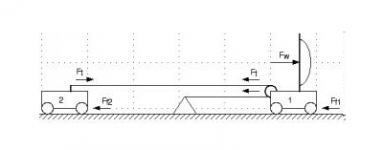
I was waiting for you to correct your mistake that I pointed out here:

No matter what you do, the end result will be the sailed cart, towing the load cart behind it at the same speed.
No. The second cart always runs at twice the speed of the first cart because of the pulley system's mechanical advantage.

This is really simple humber, no forces or acceleration involved, just pulleys and a ratio between the speed of the sail cart and the towed cart. It's a two to one ratio with the sail cart going slower than the towed cart. If the sail cart's speed is 8 mph, what is the speed of the towed cart?
 
Last edited:
You really need to expand on this tsig. Can you tell us a little more about the relationship between the "force required to make the prop spin" , "the force input to the shaft of the prop" and the "thrust produced by the prop".

The force produced by the prop will always be less than the force into the prop.

"Energy can be changed from one form to another, but it cannot be created or destroyed"


http://www.emc.maricopa.edu/faculty/farabee/BIOBK/BioBookEner1.html
 
How are you recovering it?

tsig, quit asking questions if you don't want to hear the answers. That is the definition of a troll.

tsig, If you care to work with me to finish the analysis of the 2 cart problem, I will then show you how the result is in fact equivalent to dwfttw cart.

No one is going to work with you to finish any analysis. They ARE NOTE WILLLING TO ACCEPT REALITY. I have become bored of offering the bet that the DDWFTTW cart can in fact go downwind faster than the wind. The new bet I'm offering is that tsig, harold, christoph, and humber will NEVER let anyone walk them through the full discussion. Who wants some of this action?
 
tsig, If you care to work with me to finish the analysis of the 2 cart problem, I will then show you how the result is in fact equivalent to dwfttw cart.

The acceleration kills that device dead, but there is another way.

attachment.php


Fw = K1*(Vw-Vc)^2
so,
F1 = 0.5*K1*(Vw- Vc)^2

The opposing forces, F2, have two major components;
(1) Drag with the air, proportional to the square of velocity of Cart2
(2) Tyre losses, which are quite complex. The rolling resistance will not allow acceleration beyond that force without the wheel slipping. Practical vehicles have tyres to improve on that, but losses can increase as the cube or more of velocity. We can compromise at V^2. So the drag forces are F2 =K2*V^2.

The cart is is geared to 2:1 by the pulley so V_Cart2 = 2*V_Cart1,
while the force on Cart2, is 1/2 of that on Cart1.

The system will stop accelerating when F1 = F2, when the net force is zero.

F1 = 0.5*K1(Vw-Vc)^2
F2 = K2*(2Vc)^2 ( traveling at twice the speed of Cart1)

Maximum velocity is when the net force is zero and,
0.5*K1(Vw-Vc)^2 - K2*(2Vc)^2 = 0

There is no hope of reaching windspeed, even with very high ratios of K2/K1.
 

Attachments

  • dano.png
    dano.png
    17.5 KB · Views: 42
You still have not explained how the cart moves forward more readily when some of the tailwind is blocked, and how that contradicts your former "results".

Here, let me help you with this so you can argue more coherently. The tailwind to the prop itself is not reduced in any way by the cardboard, only the bluff body force on the chassis, which is so small that it hardly registers. When the air that normally goes by the prop without affecting it hits the cardboard, some of that air spills around the outer edge of the cardboard and some around the edge of the hole cut for the prop. That extra air has to go through the same orifice and as a result speeds up a bit, pushing harder against the prop and making the cart go farther than when the cardboard isn't there to redirect more air onto the prop.

It matches perfectly with my previous results because the cart is still operating the way it always does, according to the laws of physics as we know them and not according to the humberverse.

There, now you can take the opposite side and deny to your heart's content that you were 100% wrong in your prediction of your test that I did just for you.
 
"Energy can be changed from one form to another, but it cannot be created or destroyed"

Fg = G * m1 * m2 / r^2

(I assume this is where we post random natural laws that are in no way related to the problem at hand)
 
tsig, quit asking questions if you don't want to hear the answers. That is the definition of a troll.


No one is going to work with you to finish any analysis. They ARE NOTE WILLLING TO ACCEPT REALITY. I have become bored of offering the bet that the DDWFTTW cart can in fact go downwind faster than the wind. The new bet I'm offering is that tsig, harold, christoph, and humber will NEVER let anyone walk them through the full discussion. Who wants some of this action?

Well I know a dead horse when I'm riding one so I'll get off now.

Reality will speak for itself when the cart is built.
 
(2) Tyre losses, which are quite complex. The rolling resistance will not allow acceleration beyond that force without the wheel slipping. Practical vehicles have tyres to improve on that, but losses can increase as the cube or more of velocity. We can compromise at V^2. So the drag forces are F2 =K2*V^2.

Wrong, humber. In fact, the rolling resistance can be considered to be constant for the speed range that we are discussing. That makes the rest of you post more of your nonsense = worthless.

At least you seem to have corrected your former mistake from this:

No matter what you do, the end result will be the sailed cart, towing the load cart behind it at the same speed.

To this:

( traveling at twice the speed of Cart1)

That at least is correct now. You're welcome for helping you with that.
 
Last edited:
Here, let me help you with this so you can argue more coherently. The tailwind to the prop itself is not reduced in any way by the cardboard, only the bluff body force on the chassis, which is so small that it hardly registers.
You don't get to say what is what, only what is observed and that is less wind, makes the cart travel further. It is irrational to think that blocking the flow creates more flow.

When the air that normally goes by the prop without affecting it hits the cardboard, some of that air spills around the outer edge of the cardboard and some around the edge of the hole cut for the prop
So, rather than blocking the bluff force as asked, you have allowed "some" of the air that would otherwise hit the prop, to strike the body? An increase in the bluff force! That explains why it moves forward.
Sight unseen, I said you had done that, because it is the only logical solution.

You did not perform the test where the prop is blocked. That will drive the cart forward producing the contrary result, that blocking either the body or the fan, causes it to move forward. Great testing.

That extra air has to go through the same orifice and as a result speeds up a bit, pushing harder against the prop and making the cart go farther than when the cardboard isn't there to redirect more air onto the prop.
You now have "extra" air going around the cardboard and through the hole? You earlier suggested that is was the same air, but divided between the hole and the cardboard.
The hole is not a venturi, so there is no change of volume, and no increase in velocity. You are simply guessing.

The hole will create drag, and the air immediately on the other side will be slower, and restricted in volume than if the hole were not there.
If the hole presents adequate impedance, then like water, the air will find the "path of least resistance" and go around the cardboard.

It matches perfectly with my previous results because the cart is still operating the way it always does, according to the laws of physics as we know them and not according to the humberverse.
If you make the same mistakes, you get the same results.

There, now you can take the opposite side and deny to your heart's content that you were 100% wrong in your prediction of your test that I did just for you.
It is clear that your tests are nonsense, and you do not have the logical skills to separate the chaff from the wheat.
 
Wrong, humber. In fact, the rolling resistance can be considered to be constant for the speed range that we are discussing. That makes the rest of you post more of your nonsense = worthless.
At least you seem to have corrected your former mistake from this:
You just posted that force beyond the rolling resistance would cause the wheel to slide and now you have changed you mind. Lose=win Mender.

In restricted cases, the rolling resistance is constant with velocity. Do you see what that implies "constant velocity"? No acceleration. A rolling wheel will slip if accelerated. Tyres solve that problem, but introduce losses that are more related to internal flexing and viscous loss than friction to the road.
You have no idea what you are yapping about.

As for the remainder, that is your usual lack of mathematical skill. Keep digging.
 
Last edited:
This is really simple humber, no forces or acceleration involved, just pulleys and a ratio between the speed of the sail cart and the towed cart. It's a two to one ratio with the sail cart going slower than the towed cart. If the sail cart's speed is 8 mph, what is the speed of the towed cart?

That is the level of you skill 2*8 =16. The notion that incremental velocity gain and acceleration, are the same thing, goes right over your head.
 
You have no idea what you are yapping about.

On the contrary, I know exactly what you are yapping about, and it is the result of your usual illogical reasoning and very poor observation skills.

Your style, amply displayed here, is to try and weasel out of your very obvious mistakes by conflating results and statements until things line up in your mind according to your predetermined conclusions.

You are not allowed to change facts to support your opinion.
 
That is the level of you skill 2*8 =16. The notion that incremental velocity gain and acceleration, are the same thing, goes right over your head.

Not in the slightest. You were the one making the simple mistake; I understood it perfectly from the start. I'm glad I helped you see that you were wrong even if you can't admit it.
 
Last edited:
You don't get to say what is what, only what is observed and that is less wind, makes the cart travel further. It is irrational to think that blocking the flow creates more flow.

So why do you think that?
 
Last edited:
So, rather than blocking the bluff force as asked, you have allowed "some" of the air that would otherwise hit the prop, to strike the body? An increase in the bluff force! That explains why it moves forward.

Remember, this was your test, humber. The extra air that is entrained by the hole is directed at the prop right after the hole, more correctly known as the vena contracta, resulting in more force against the prop. The bluff body force is so insignificant that even a slight entrainment of air is enough to propel the cart more than all the bluff body force that the chassis has to offer.

This is in direct opposition to your supposition that the bluff body force is a major force acting on the cart, and your attempts to counter that evidence by defamation are laughable. Move on to another point, you've lost this one and are only digging yourself in deeper every time you post.
 
So why do you think that?

According to you, blocking the air makes the cart move further. The smaller the tailwind, the better the cart travels. That is irrational. I am sure you have some ad hoc explanation, but you know...

Another example of you failure of logic, concerns wheels. You work with them, but you do not understand them.

You say that rolling resistance is constant with velocity, so V*Fr= K. That is true of a simple ideal wheel, but so what?
If that force is constant at velocity V, how does the wheel accelerate to 2V? To accelerate, the force must exceed K , and that will cause the wheels to slip. By changing shape under load, tyres change their dynamic friction, or more folksily, "traction", to accommodate the load. Now you know a lot more about the complex nature of wheels.
 
Remember, this was your test, humber.
Yes, it was my test. I told you than I expected that you would screw it up, so I made it logically tight. You saw what you wanted to see, but failed to notice that the result was illogical. So hell-bent on proving me wrong, that you ignored all evidence to the contrary. The above quote supports that.

The extra air that is entrained by the hole is directed at the prop right after the hole, more correctly known as the vena contracta, resulting in more force against the prop.
Try again. You are confusing pressure with velocity.
Generally, it is more difficult to blow down a straw, than it is to blow through an open window. DOH.

The bluff body force is so insignificant that even a slight entrainment of air is enough to propel the cart more than all the bluff body force that the chassis has to offer.
How can you possibly know that from your unmetered and uncontrolled tests? It does leave you to explain how the fan in the "Harold Bricer " test manages to blow the cart off the belt, even though it is said to be trained on the fan.

This is in direct opposition to your supposition that the bluff body force is a major force acting on the cart, and your attempts to counter that evidence by defamation are laughable. Move on to another point, you've lost this one and are only digging yourself in deeper every time you post.
Nope. I can put that down to your ineptitude.
What you have to explain, is your results, and independently of what I said would happen. You have to explain why the hole causes the cart to move forward. So far, your explanations have been wanting, illogical and contrary to fact.
 
Last edited:

ISF - Join now!

Every member here is approved by hand. No bots, no spam, just people who care about evidence and honest debate.

Membership is free!

Create your free account

Back
Top Bottom