Moderated The validity of classical physics - Part 2

Very "simple" indeed! Also very wrong! 85% is all this type of vehicle can do no matter how big you make the sail. I would post the math behind that statement, but you would never understand it so I won't.

Oh come on, why not? You do realize that many of the participants here are proper scientists, engineers and mathematicians don't you? Even just supply links to back up your 85% limit statement. I'll try searching for the "Christoph Limit".
 
Now, you are apparently not convinced that the treadmill setup constitutes a valid proof of the concept. Would you care to explain (probably again) why? Because that's the topic of this particular thread.

On the treadmill the source of the energy that spins the prop is the treadmill motor.

In the wind the wind is the source of the energy.

You can only get energy from the wind if there is a difference in wind speed between the wind and the object getting energy.

At wind speed there is no difference between the cart and the wind.

(Yes TAD the prop is moving relative to the wind but the reason why it is moving is the question.)
 
Here's another link to Bauer's DDWFTTW paper.

Just read the first few paragraphs and you'll see that Bauer is talking about a cart with a propeller, for which the power is obtained by gearing it to the wheels.
The equations show the airscrew as the power source driven by the wind, and the wheels are a CW-turning, and a loss of some energy acquired from the wind.

Later in the paper Bauer describes in detail how his cart functioned: it was possible to vary the pitch from negative to positive, so at slow speed the propeller was functioning as a turbine (Bauer calls this "windmilling mode"). As the cart accelerated, the pitch of the prop was brought to zero, then increased in the positive direction: from this point on, it was working in "propeller mode". According to Bauer, the crossover point between windmilling and propeller modes is at about 60% of wind speed for optimum acceleration.
That is what Drela ( perhaps) calls "hover mode". Like Bauer, he is not specific how he hopes to achieve >windspeed, but Bauer's prop pitch is changed such that to the oncoming headwind, it is turbine.

The difference between turbine and prop is not the angle of the blades, but whether they are driven by wind upon the blades, or if the props accelerates the air, when driven from a power source.

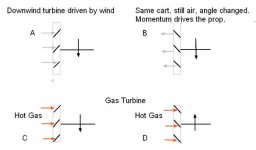
Both types exist on the one shaft of a gas turbine engine. Hot gases drive the turbine, which drives the shaft, which drive the fans (props), that accelerate and compress the incoming air, the feeds the combustion chamber.

Changing the angle, changes the turbine's efficiency, but does not make it a prop. He is not using any other energy source than the wind.
 
Thanks all for the links. Of course that won't stop humber from misreading them:rolleyes:

Only one document is of interest, and that is behind the link that Micheal_C provided. That paper is the description of the cart he actually built and presented at a conference.
 
Just a quick note to tsig, you have not shown the close mindedness of humber and Christoph yet to me so I will try to help. When the propeller moves through the air there are essentially two forces on it, lift and drag. The lift will pull the cart forward, the drag will oppose the spin of the prop. Now for the prop to make the cart go faster than wind speed all it has to do is to overcome the forces on it at wind speed. So besides lift and drag what forces are on the cart at wind speed. There is no wind resistance at that speed so we can ignore that. All that leaves is the relatively low forces of friction from the wheels and transmission. So for an ideal situation with no wheel or internal resistance all you need is a prop that has a lift to drag ratio greater than one. I don't have the numbers handy but I am sure that a lift to drag ratio for a prop can easily exceed ten. So even with real resistances the prop should be able to drive the cart faster than the wind.

I think the only force that counts here is the amount of force required to make the prop spin.

The thrust produced by the prop cannot exceed the force input to the shaft of the prop.

http://www.epi-eng.com/propeller_technology/selecting_a_propeller.htm
 
You can only get energy from the wind if there is a difference in wind speed between the wind and the object getting energy.

I think this might be a major problem in your understanding tsig, could you please expand on this theory?
 
On the treadmill the source of the energy that spins the prop is the treadmill motor.
In the wind the wind is the source of the energy.
You can only get energy from the wind if there is a difference in wind speed between the wind and the object getting energy.
At wind speed there is no difference between the cart and the wind.
(Yes TAD the prop is moving relative to the wind but the reason why it is moving is the question.)

It can also be seen another way. If the cart is on the floor, it can be moved by turning the prop. The prop's load is essentially the rolling resistance, but restraining the cart by hand increases the load. That increased work is felt at the prop as it is turned, and demonstrates that the prop can do real work on the cart.

On the treadmill, the wheels drive the prop, but there is negligible torque in the wheel or prop shafts. Restraining the cart does not produce an increase in torque, suggesting that no work is being done on the cart.
There is no tangible relationship between prop thrust and work.

From the belt, it is possible for an observer to turn the prop and load the cart as on the floor, but of course, the observer cannot be the force turning the prop, but could restrain the cart, while the "tailwind" drives the prop.

That force would be the largest torque that the wheels would see; maximum wind, maximum restraint, and that could be measured.
 
Last edited:
Maybe because when they do talk about the cart, that doesn't work either?


If you don't buy the words, work through the math - or just read through one of the several treatments you can find of it, such as Drela's.


Yes, so far as good.


They will have greater drag than they would have if the prop wasn't connected to them, yes.


And it can, so long as the cart is designed that way and the ground is moving at a sufficiently different speed than the air (i.e. there is enough wind).

Why would the ground/air speed have any effect on the cart at windspeed?
 
Last edited:
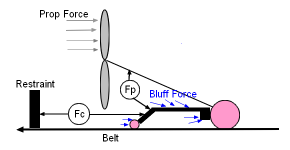
The cart can be set on the belt and restrained by tethers as show.
The gauge Fc, measures the total force on the cart, and is the sum of the bluff and prop forces. The second gauge measures the torque, Fp, between the prop shaft and the cart chassis. Subtracting that result from Fc, will give the bluff force (blue drag arrows).
Of course the moment of the shaft torque must be taken into account, but once that is done, it can be compared to the linear force Fc.

attachment.php
 

Attachments

  • belt force.png
    belt force.png
    11.9 KB · Views: 39
Okay, so what? That still does not say the cart cannot advance. Your link did not really do anything towards saying that ddwfttw is possible or not.

Since the force to turn the prop shaft comes from the wheels and the force that moves the wheels is the thrust of the prop we have a force producing more output than input.
 
Since the force to turn the prop shaft comes from the wheels and the force that moves the wheels is the thrust of the prop we have a force producing more output than input.

How do you think you would go at estimating these forces? How would you determine the work done or power transfered by each force?
 
A blade is a turbine or prop, dependent upon use. (A) is perhaps Bauer's cart, where the wind drives the blade as a turbine. If the same cart finds itself at speed in still air, the prop angle can be changed, so that the momentum (KE) of the prop and cart (huge in Bauer's machine), can drive the blade as a prop.
I think he reports that he broke the chain when he tried this.

(C) and (D) are a simplified gas turbines. Changing the angle changes the direction or rotation, but it is the hot gas that says its a turbine.

attachment.php
 

Attachments

  • Turbines.jpg
    Turbines.jpg
    18.3 KB · Views: 37
The cart can be set on the belt and restrained by tethers as show.
The gauge Fc, measures the total force on the cart, and is the sum of the bluff and prop forces. The second gauge measures the torque, Fp, between the prop shaft and the cart chassis. Subtracting that result from Fc, will give the bluff force (blue drag arrows).
Of course the moment of the shaft torque must be taken into account, but once that is done, it can be compared to the linear force Fc.

[qimg]http://www.internationalskeptics.com/forums/attachment.php?attachmentid=15423&stc=1&d=1255993778[/qimg]

Very good, humber. You have just listed the forces that I isolated only a short time ago when I measured the force of air moving across the cart without a prop, the cart with a prop and connected to the wheels in the normal fashion, and the cart with the prop taped to the chassis of the cart. I also configured the cart as a turbine to verify that the prop will either add or take away from the force acting on the cart when the prop is hooked up.

Do you remember the results? I listed the forces as static forces, and also as a dynamic test, where the cart is allowed to travel under the influence of the air flow, supplied by a fan as you requested. I can link you to the results and save you the trouble of trying to guess what the forces are.
 
jjcote said:
Really? I'm not sure who you're addressing right there, but since I'm pretty sure you don't know my math and engineering credentials, try me.

I will agree to this: if you can impose arbitrary inefficiencies anywhere you like in the system, you can definitely thwart DDWFTTW. In fact you can thwart just about anything.

To bring up an old, dead horse, if you claim that 85% of wind speed is the most that a sail&wheel vehicle can go, what's the maximum % of wind speed that a balloon can go?
The balloon again!! I have said before it approaches the velocity of the wind asymptotically and that is what Isaac Newton says also. If I remember correctly, 5 time constants is 99.3% so I will settle for that. The cart is not a balloon!
Let's look at an example:
My parachute has an area of 330 sq ft. That's about 31 sq meters. When loaded with (me + harness + broken hang glider), which have a combined weight of about 1100 N, it sinks at a rate of 5 m/s. Using the standard formula for drag [F = ((rho)CdAV^2)/2], we can see that it has a drag coefficient of 2.2. I'll use that for a sail.
For a cart, I'll use my bicycle. Coefficient of rolling resistance for bicycle tires is something like .004, and I'll double that to account for bearing friction. The bike and rider come in at 800 N, so we have about 6 N required to pull the bicycle along the ground. Note that we don't need to account for aero drag here, because we're only trying to go almost wind speed with a simple sail, and therefore we'll still have a mild tailwind.
Let's use a wind of about 20 kt, for which 10 m/s is close enough. Christoph claims that my parachute, acting as a spinnaker, won't pull my bicycle along at more than 8.5 m/s, thanks to math that only he can understand.
I observe that I need 6.4 N from my parachute. Applying the formula for drag again, solving for V, I get 0.38 m/s as the wind speed at which the parachute will deliver that much force. That means that in a 10 m/s wind, the parachute will pull my bicycle at 9.62 m/s. That's a lot more than 85%. Are there some other considerations that you need to apply in order to slow me down?

As always, somebody check my math.

 
Last edited:
On the treadmill the source of the energy that spins the prop is the treadmill motor.

No, it's the electric plug the treadmill is plugged in to, which is powered by a power plant, which is powered by burning coal, which was produced by dead plants, which were powered by the sun.

In the wind the wind is the source of the energy.

Which is powered by the sun.

The point being that the ultimate source of the energy is totally irrelevant. The cart obeys Newton's laws of motion, which means it reacts to the forces and velocities its wheels and prop are exposed to. That and that alone is all one needs to determine its acceleration, and those forces and velocities are identical between the treadmill and a cart outside in the wind.

You can only get energy from the wind if there is a difference in wind speed between the wind and the object getting energy.

And there always is, even at "wind speed", because "wind" means relative motion between air and surface, and it is impossible for the cart to move at the same speed as both (unless there is no wind).

At wind speed there is no difference between the cart and the wind.

That's your mistake.

Why would the ground/air speed have any effect on the cart at windspeed?

Why does the motion of air have any effect on a windmill? After all, the windmill is moving at the same speed as the ground.

Since the force to turn the prop shaft comes from the wheels and the force that moves the wheels is the thrust of the prop we have a force producing more output than input.

Forces don't produce "input". They either balance, or they don't. There is no law of physics that says those two forces need to be equal, and they aren't. There is a law of physics that says the total power should balance. But power is force times velocity, and the velocities of the air and ground are not equal. That means the forces are not equal either. That's what drives the cart.
 
I think the only force that counts here is the amount of force required to make the prop spin.

The thrust produced by the prop cannot exceed the force input to the shaft of the prop.

http://www.epi-eng.com/propeller_technology/selecting_a_propeller.htm

You really need to expand on this tsig. Can you tell us a little more about the relationship between the "force required to make the prop spin" , "the force input to the shaft of the prop" and the "thrust produced by the prop".
 
tsig, If you care to work with me to finish the analysis of the 2 cart problem, I will then show you how the result is in fact equivalent to dwfttw cart.
 

ISF - Join now!

Every member here is approved by hand. No bots, no spam, just people who care about evidence and honest debate.

Membership is free!

Create your free account

Back
Top Bottom