Moderated The validity of classical physics - Part 2


Here we see the effect of the humberverse on Christoph. He has totally forgotten that when computing the force of wind on a sail he needs to use the relative speed of the wind on the sail and not the speed of the cart over the ground.
 
It won't!

It will and it does.

At wind speed the wind does not cannot exert any force on anything that is also moving at wind speed directly down wind.

Nonsense. The cart on the treadmill is at rest with respect to the air, and yet it experiences a force because it exploits the different in speed between air and treadmill belt. A difference in speed between two media is all that is required, and the cart at windspeed has that (as do sailboats, iceboats, windmills, autogiro boats, dynamically soaring birds, etc.).

This is indisputable and not even open to discussion!

And yet we are discussing it.
 
Last edited:
It won't! At wind speed the wind does not cannot exert any force on anything that is also moving at wind speed directly down wind. This is indisputable and not even open to discussion!

Your point is both accurate and misapplied.

The airfoil is not "moving at windspeed directly downwind", and thus isn't covered by your above statement. Just as the ice-boat airfoil is moving at an angle to the true wind and is thus able to use apparent wind at windspeed, so is the spinning airfoil on the cart.

3da0b91f959ab803a4c85ea61daeb6bc6g.jpg


JB
 
Last edited:
As has been pointed out, the plane cannot move faster than the wind if the wind is steady and constant and the plane is in level flight. What allows travel at other speeds is a difference in velocity between two layers or two media.
For example, dynamic soaring allows birds (and gliders) to travel at speeds much faster than the wind with no other energy source. This is possible by exploiting the difference in velocity between two layers of air; basically, the bird slows the air in one layer relative to the other, and uses the kinetic energy to accelerate to a speed well above either layer. That's how the cart works, except that it slows the air relative to the ground rather than one layer of air relative to another. That's obviously true.
Yes, that is true and there is no dispute that a vehicle can exploit energy sources that are actually there. In the case of the cart, the two "layers" are the wind and ground, and nothing else, but only the wind has exploitable energy.

However you're jumping from there to the conclusion that the cart cannot extract enough energy at windspeed to overcome the friction in its wheels etc., which is unjustified (and wrong). The friction forces can be made arbitrarily small,
No they can't. There is a definite need for a minimum level of friction if the wheels are to accelerate the cart. Even under constant velocity, the wheels will have a rolling resistance, and there must also be sufficient friction to the road, if the cart is not to be blown away. That means the wheels must be capable of meeting both lateral and longitudinal forces of the wind upon the cart's body.

An ideal wheel will not roll, but slide or spin. http://en.wikipedia.org/wiki/Rolling_resistance
Real wheels roll with some distortion of the wheel, and that is related to the amount of traction that can be sustained when torque is applied to the axle.

That is the role of the tyre; it distorts under load to allow traction, but resumes a more efficient circular shape when simply rolling.
So far, nobody has produced a practical wheel or tyre, that allows the losses to be arbitrarily low, and certainly not under any arbitrary set of conditions.

...but the cart can extract some fixed amount of energy given its propeller configuration and some given wind speed. If the energy lost to friction is smaller than the energy extracted from the wind, the cart will accelerate to faster than wind speed. If not, it won't. So it's purely a matter of engineering.
The losses would have to be zero for the remainder of the system, and that is impossible.

Wrong. Ice boats can beat the wind. So can gliders when using dynamic soaring.
Ice boats tack, gliders use sheer winds, thermals, and gravitational potential energy.

Carts can start from rest with respect to the ground and start moving, either upwind, downwind, or across the wind. Therefore there is no reason a cart cannot start from at rest with respect to the air and move in any direction the designer chooses.
Yes, but there are forces that oppose the motion of a vehicle traveling in still air, that are also at work on a vehicle traveling in the wind. A tailwind changes nothing other than the initial conditions. A car starts in still air, with zero velocity for both car and air, but in a tailwind, the wind has a "headstart", otherwise, things are much the same in each case. Galileo and the Theorem of Superposition say so.

Air pressure is air pressure. The average molecular velocity at room temperature is about 478m/s. Adding 10m/s to that is really not going to change the transfer of KE to objects very much.
That's the basis of my plate KE model. My "the frame of reference" is that average molecular velocity. The plate moves at a relatively slow 10m/s, so I can take the motion of the plate w.r.t to the background molecular velocity.

 
:confused: where did I say they were? The article is about Autogiro Boats, and posted as possibly relevant or interesting with regard to your question about boats that 'tack and yet don't tack', as you put it.

But they are not tacking then. Tacking has a definite and limited meaning. The cart cannot be tacking, if it is traveling ddw.
Only the prop blade is at an angle to to the wind, right?
If that works, then there should be sailboats that can do the same; a sail set at an angle, travelling ddw, but faster than the wind.
 
humber the prop is moving downwind on and presenting a constant angle to the wind, it is tacking. Look up the definition of what a sail does when moving downwind on a tack.
 
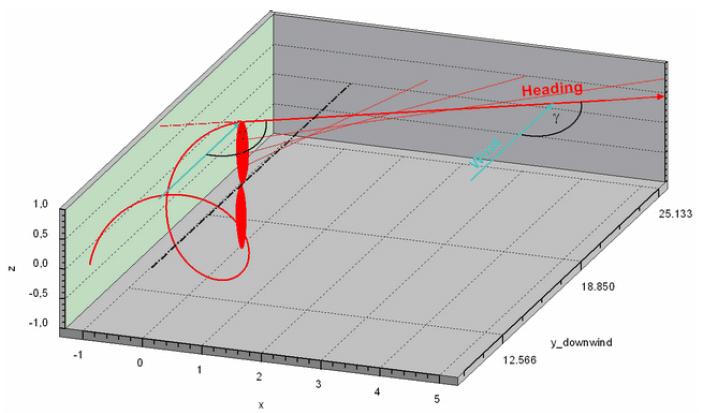
The problem here is your apparent inability to think in 3d space and see the path of the airfoil for what it really is.

[qimg]http://www.mediafire.com/imgbnc.php/3da0b91f959ab803a4c85ea61daeb6bc6g.jpg[/qimg]

This graphic easily shows that if one 'unwraps' the path of the circling airfoil, it equates with the angled path of the reaching airfoil on the traditional sailing rig. The spinning airfoil can take this angled path through the air while still allowing the chassis to go DDW.

JB

There are so many muddled ideas there, it is difficult to know where to start, but why don't planes do this? Surely the airlines could save a lot of fuel and that must apply to to jet turbines too.

The prop drives the cart's wheels, so it's the prop's torque that is important. The "bluff "area of the blade could only contribute a little and is met by opposing force on the other side of the blade anyway.
Because the prop is geared to the wheels, the cart moves about 200mm for each turn of the prop. Work = force*distance, so anything that could be gained, is distributed over time and distance. Too small to be of interest.
 
humber the prop is moving downwind on and presenting a constant angle to the wind, it is tacking. Look up the definition of what a sail does when moving downwind on a tack.

The entire boat moves at an angle to the wind and travels a greater distance than the ddw path.
 
Here we see the effect of the humberverse on Christoph. He has totally forgotten that when computing the force of wind on a sail he needs to use the relative speed of the wind on the sail and not the speed of the cart over the ground.

You are claiming that you can increase the total energy in the system by loading down the first cart. What you do not seem to understand is that any calculated increase in wind force on the sail is exactly offset by an increase in drag from pulling the other cart. This must be true since the carts are in steady state uniform motion; they are not accelerating. Thus, the kinetic energy available stays exactly the same and must be divided between the two carts. It is made clearer by using the kinetic energy in this case as I have shown in my previous calculation:

Kinetic Energy = 1/2 mv^2 If we let mass = 1 Kg , and V is 8m/sec, the kinetic energy = 1/2*1*64 = 32 Joules That is total energy that is available to drive the two carts with the rope and pulley arrangement. Let V1 be the velocity of the slower cart and 2V1 the velocity of the faster cart. KE = 1/2*1*(V1)^2 + 1/2*1*(2V1)^2

So we have: 32 = 2.5 (V1)^2 or V1 = 3.58 m/sec and 2V1 = 7.16 m/sec

Now calculate the kinetic energy of the two carts and you will get 6.4 joules for the slower cart and 25.4 joules for the faster cart for a total of 32 joules……the same as the original single cart as it must be!
 
I notice that you measure windspeed at the chassis rather than at the airfoil to come up with zero.

Measure windspeed at the relevent place and it's in the 200mph region even when the wind over the chassis is zero because the airfoil is not going DDW like the chassis is.

JB


What force is driving the propeller at 200mph?
 
Here we see the effect of the humberverse on Christoph. He has totally forgotten that when computing the force of wind on a sail he needs to use the relative speed of the wind on the sail and not the speed of the cart over the ground.

The speed of the wind over the ground is a given constant. The cart moves relative to both the wind and ground at the same time. It has no choice.

The cart is a ddw vehicle, and whatever ideas you have about the prop, they will not change the speed of the wind relative to the ground.
If the cart reaches windspeed, its velocity w.r.t ground is a maximum, but w.r.t the air, a minimum (zero)
That is because one velocity is the complement of the other. The wind and ground are in relative motion, but the cart's motion is common to both. Elementary arithmetic.
 
humber, with a traditional sailboat the entire boat tacks, not so with the cart, try again.

That is what I said. The boat follows a path that is a greater distance than the ddw path. That is how it does what it does.
The cart is magical. It can get the benefit of tacking, while traveling ddw.

That is nonsense, and not seen in any other vehicle ever made.
 
What force is driving the propeller at 200mph?

You like to drop arguments and pretend you never made them as soon as they are shown to be hollow. I'm not going round and round with you unless you finish one argument on the record.

You say there is no force available if the airspeed is zero -- now your asking about the 200mph airspeed. Do you now concede that the airspeed is NOT zero over the airfoils and thus will stop with your continual use of the "zero" argument?

If you concede that your "zero wind" argument is no longer valid and you state that with the cart going DDW there IS lots of relative wind over the carts spinning airfoils, I will be willing to address your next question.

JB
 
It will and it does.

Nope.


Nonsense. The cart on the treadmill is at rest with respect to the air, and yet it experiences a force because it exploits the different in speed between air and treadmill belt. A difference in speed between two media is all that is required, and the cart at windspeed has that (as do sailboats, iceboats, windmills, autogiro boats, dynamically soaring birds, etc.).

Nonsense. The cart on the treadmill experiences a force because it has a motorized belt driving the wheels around! It is part of a machine.
The cart at windspeed experiences no force from the wind in the same way that a cart standing still in still air experiences no force from the air. Motion is relative and so is force. Windmills are not moving at windspeed and no sailboat moves at windspeed directly down wind. Birds flap their wings and when they are soaring they can make use of temperature differentials as well. None of your examples is relevant to a cart with wheels and a propeller.
 
humber, you keep forgetting that the prop is spinning. And the rate of rotation is directly proportional to the cart's speed over the ground. So the prop is still "seeing" a relative wind even when the cart is moving at wind speed. Now all you have to do is show that it can have lift greater than its drag, as Jet Black told you at Talk Rational. Once you do that it is obvious that the prop can create a net positive force downwind even at wind speed and above.
 
Christoph, you keep making unsubstantiated claims about the cart on the treadmill not being the same as the cart in the wind. Would you be willing to go through a step by step analysis that shows that it is?
 
You like to drop arguments and pretend you never made them as soon as they are shown to be hollow. I'm not going round and round with you unless you finish one argument on the record.

You say there is no force available if the airspeed is zero -- now your asking about the 200mph airspeed. Do you now concede that the airspeed is NOT zero over the airfoils and thus will stop with your continual use of the "zero" argument?

If you concede that your "zero wind" argument is no longer valid and you state that with the cart going DDW there IS lots of relative wind over the carts spinning airfoils, I will be willing to address your next question.

JB

tsig has asked a valid question. Your claim is that the wheels drive the propeller and you concede that there is no force from the wind on the chassis once the cart is at windspeed. That would mean there is no force to drive the wheels! So how do the wheels drive the propeller? Hmmmm?
 

ISF - Join now!

Every member here is approved by hand. No bots, no spam, just people who care about evidence and honest debate.

Membership is free!

Create your free account

Back
Top Bottom