
Moderated The validity of classical physics - Part 2

Wrong again humber. You have seen from JB's illustration how the prop takes a different path from the cart. No magic required at all.

Real boats follow a longer path then ddw, but the magical cart does not need to. It's just JB's nescience, that is all.
This is the last post to you on that point.
 
I said at windspeed zero force = zero then you pointed to the prop and said there was wind over it when it was spinning.

So, just to be clear ... you now concede that your constantly repeated argument that there is NO WIND over the airfoils when the cart is ddw and at windspeed is false?

The next question is what keeps it spinning.

And again, I'll be happy to address your 'next question' as long as you clearly concede that there IS relative wind over the sails even when the chassis is going DDW.

JB
 
I have a friend who studies the mechanics of human walking (so as to design better prosthetics, etc.). You know how she does her experiments? Not with people walking outside, or even inside on an ordinary floor. That's two uncontrolled, too difficult to instrument. No, she uses a treadmill. A rather expensive scientific grade treadmill, but a treadmill.

Why? Because it's easy to instrument, and because it doesn't make the slightest bit of difference to the mechanics of walking whether the tread is driven by an electric motor and the person is walking "in place", or whether the person is walking along a normal floor. The mechanics isn't just similar, it's identical.

That's not quite right, there is one aspect that might differ - the treadmill is identical to a person walking in a tailwind blowing at the speed they are walking. That wind is too small to matter much for my friend, but for the cart it makes all the difference...
 
That's a very strange objection. If the cart was shown to work in a wind tunnel, would you object that that doesn't prove anything because the wind in the wind tunnel is generated by an electric motor?

The treadmill is exactly the same, except that it creates wind by moving the belt (relative to its motor and frame) rather than blowing air (relative to its motor and frame).

It is not exactly the same at all. The motor on the treadmill is directly driving the wheels of the cart. It is a purely mechanical drive system and has nothing at all to do with any wind! A wind tunnel uses wind to affect the object in the tunnel and it does not matter that a motor generates the wind. Your defense of the treadmill as a wind simulator is weak and very strange indeed.
 
Real boats follow a longer path then ddw, but the magical cart does not need to.
.
Not only do parts of the cart need to follow this same 'longer path', part of it does.
.
3da0b91f959ab803a4c85ea61daeb6bc6g.jpg


JB
 
That's not quite right, there is one aspect that might differ - the treadmill is identical to a person walking in a tailwind blowing at the speed they are walking. That wind is too small to matter much for my friend, but for the cart it makes all the difference...


There is no tailwind on the treadmill. NONE.
 
Yeah sure. Next time I am riding my motorcycle I will be sure to drag my feet on the ground to get some of that "ground energy" and make the bike go faster!

Your foot will be gaining energy by slowing the difference between the speed of the bike and the speed of the ground (i.e. by braking the bike). Your foot will heat up and the sole of your shoe will melt.

That's how the cart works, except it brakes the air relative to the ground and turns the energy into force applied over distance rather than heat.

This is all really rather simple, Christoph.
 
Real boats follow a longer path then ddw, but the magical cart does not need to. It's just JB's nescience, that is all.
This is the last post to you on that point.

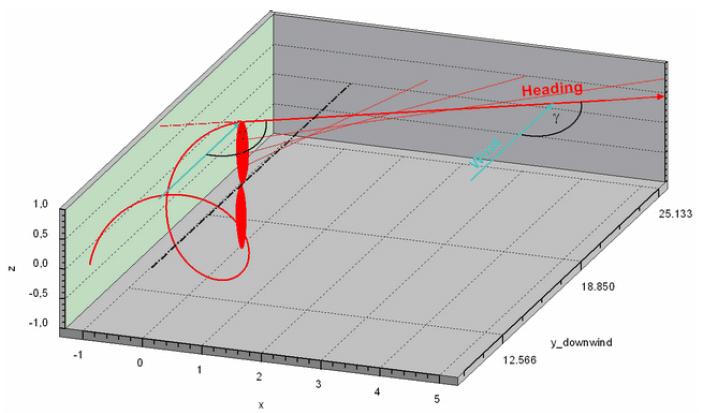
Well that's good, because as usual you are wrong. You have seen JB's illustration several times that shows the props path as the cart moves downwind. To tack the airfoil that is doing the tacking is all that cannot move directly downwind. The body that it drives is under no such restrictions.
 
The airfoil on the cart follows the same angled, "greater distance than the ddw" path that the airfoil on the boat follows.
[qimg]http://www.mediafire.com/imgbnc.php/3da0b91f959ab803a4c85ea61daeb6bc6g.jpg[/qimg]
The boat travels further than the ddw path.


There's nothing magic, but the cart chassis indeed does get the benefit of it's tacking airfoils while the chassis itself goes ddw.
U huh. The prop is attached to the chassis.

T
Well, other than the fact that it works you mean.
It works in your mind only.


Well, that's enough reason right there to believe that this whole internal combustion engine nonsense is just that -- there was a time when your argument held true for them as well.
JB
And you equate your ideas with that?
As usual your logic is faulty. Other prop and sailed vehicles existed before the car, and still do.
 
There is no tailwind on the treadmill. NONE.

Really? Would you like me to ask my friend, a professor of mechanical engineering that uses treadmills every day in her research, what she thinks about that?

Or are you capable of doing a high-school level vector analysis? If so, you might even be able to figure this out by yourself!
 
So, just to be clear ... you now concede that your constantly repeated argument that there is NO WIND over the airfoils when the cart is ddw and at windspeed is false?


And again, I'll be happy to address your 'next question' as long as you clearly concede that there IS relative wind over the sails even when the chassis is going DDW.

JB


I only said there no wind relative to the cart. What I am trying to find out is where that wind relative to the propeller blades is coming from.

What's with all this conceding business?
 
Yeah sure. Next time I am riding my motorcycle I will be sure to drag my feet on the ground to get some of that "ground energy" and make the bike go faster! Dragging something on the ground is commonly called "braking". The cart does not extract any energy from the ground. In fact, it will give energy back to the ground as it slows down.

According to your theory, removing the keel of a sailboat would make it go faster as there would be less drag.

While it's very true that there would be less drag overall, it also clear that in the real world, the sailboat is exploiting that drag to enable it to go faster than it could without that drag.

JB

Ooh wait wait, I know what the deniers will say next, "The cart is not a boat":rolleyes:
 
I have a friend who studies the mechanics of human walking (so as to design better prosthetics, etc.). You know how she does her experiments? Not with people walking outside, or even inside on an ordinary floor. That's two uncontrolled, too difficult to instrument. No, she uses a treadmill. A rather expensive scientific grade treadmill, but a treadmill.
Major over simplification of fact;
http://www.sciencedirect.com/scienc...serid=10&md5=69fd2a01f2edfbd66d13a57127c70e21

Major error of logic;
http://en.wikipedia.org/wiki/Syllogism

Why? Because it's easy to instrument, and because it doesn't make the slightest bit of difference to the mechanics of walking whether the tread is driven by an electric motor and the person is walking "in place", or whether the person is walking along a normal floor. The mechanics isn't just similar, it's identical.
It does make a difference....

"Results. In the females, only the maximum hip flexion angle was significantly different in the two conditions with greater flexion occurring on the treadmill. For males, significant differences were noted between the two conditions for cadence and maximum knee flexion angle with greater values in the treadmill walking. When all subjects were compared, significant increases were seen during treadmill walking in hip range of motion, maximum hip flexion joint angle and cadence, while a significant decrease was observed in stance time."

....but it's much easier and more productive, if the patient and doctor can remain in the room.

That's not quite right, there is one aspect that might differ - the treadmill is identical to a person walking in a tailwind blowing at the speed they are walking. That wind is too small to matter much for my friend, but for the cart it makes all the difference...

There is no tailwind. If the patient stops walking, he is driven by the belt, and will experience drag as he is driven by the motor through the air.
There is no real world equivalent; the belt is there because the treadmill, is a treadmill. You are hoping to take the artifact of the treadmill, and enforce that upon reality. No, models of the real world work the other way around.
That is not a wind, nor is there an equivalent in the real world. Pure fantasy.
 
It is not exactly the same at all. The motor on the treadmill is directly driving the wheels of the cart.

Well then, try getting on a treadmill wearing roller skates. The motor will turn the wheels on your skates and you'll just sit there, right?
 
Really? Would you like me to ask my friend, a professor of mechanical engineering that uses treadmills every day in her research, what she thinks about that?

Or are you capable of doing a high-school level vector analysis? If so, you might even be able to figure this out by yourself!

You ask her. I do hope she is polite in her reply.
 
Do you consider the spinning airfoils to be part of the cart, or when you say "cart" are you only referring to the chassis?

JB


What I'm trying to find out is why the propeller is spinning. So far what I've got from you is that they are spinning because of their relative movement thru the air.
 
Well then, try getting on a treadmill wearing roller skates. The motor will turn the wheels on your skates and you'll just sit there, right?

There will be a force on the skater down the belt, that is the result of the work the belt does on the skater. It is not simply a matter of friction.
 
Sorry humber but your conclusions are incorrect about the article on the treadmill. People may walk differently on a treadmill but that is only because of the psychological effects of walking on one. A machine which cannot tell whether it is on the treadmill or on the ground would see no difference. People who make the mistake of looking at the ground and at the treadmill can change their gait because of their confusion.
 

ISF - Join now!

Every member here is approved by hand. No bots, no spam, just people who care about evidence and honest debate.

Membership is free!

Create your free account

Back
Top Bottom