Moderated The validity of classical physics - Part 2

I will do more reading. I do want to understand.

Measuring wind speed and the vehicles ground speed shouldnt be difficult though IMO. But more than that, the math should be easy to show in an idealized situation. Imagine a plane with a tail wind and a prop. What is giving it additional speed? Is there a solution for that? Or do I entirely not understand?!? :D

The essence is that you need both the air and the ground for the cart to work, not just the air. The cart will exceed windspeed when the speed difference between the air and the surface that the cart is running on is above a certain value. The speed difference determines how much energy is available from the wind.

A cart that has only a sail can only ever get close to the speed of the wind but never quite get to it even with a huge sail and very low rolling resistance. When that cart is running as fast as it can in that wind, it will only be slowing down the wind by a small amount, say 10%, or 9 mph in a 10 mph wind (numbers are for convenience but are close to what would actually happen). That means that there is still a lot of energy in the wind for the taking but only if the wind can be slowed more than what the sail is doing.

The cart does that by using its motion across the ground to turn the prop and have the thrust from the prop slow the wind more than a sail cart. That takes more energy out of the wind, solving the energy issue that some get caught on.

One way to see how DDWFTTW works is to imagine two carts, one with a sail and one without. The sail cart also has a pulley on it, with a line that attaches to the other cart on one end and is anchored to the ground on the other end. If the sail cart can run at 9 mph in a 10 mph wind, doubling the load will slow the sail cart by less than one additional mph. That doubling of the speed loss from 1 mph to 2 mph less than the wind actually represents four times as much force, so that sail cart can either pull three more carts at 8 mph, or one more at quite a bit faster.

Okay, set the sail cart loose in the wind. It gets close to the speed of the wind (8 mph) while pulling the other cart along behind. In fact, with the way the pulley and lines are arranged, the second cart will be moving at double the speed of the 8 mph sail cart or 16 mph in a 10 mph wind! If you consider the average speed of both carts, the whole system is moving at 12 mph in a 10 mph wind. Of course this only lasts as long as the line does but it illustrates that something can move faster than the wind that powers it with the right method.

The prop cart effectively combines the sail cart, the pulley and the other cart all in one device. The wheels act as the ground anchor, the prop acts as the sail and the pulley (multiplies the speed while maintaining "contact" with the wind) and the cart of course is the whole system, again moving at 12 mph in a 10 mph wind. Not the scientifically correct version but one that might help you "get it".
 
Last edited:
One way to see how DDWFTTW works is to imagine two carts, one with a sail and one without. The sail cart also has a pulley on it, with a line that attaches to the other cart on one end and is anchored to the ground on the other end. If the sail cart can run at 9 mph in a 10 mph wind, doubling the load will slow the sail cart by less than one additional mph. That doubling of the speed loss from 1 mph to 2 mph less than the wind actually represents four times as much force, so that sail cart can either pull three more carts at 8 mph, or one more at quite a bit faster.

Okay, set the sail cart loose in the wind. It gets close to the speed of the wind (8 mph) while pulling the other cart along behind. In fact, with the way the pulley and lines are arranged, the second cart will be moving at double the speed of the 8 mph sail cart or 16 mph in a 10 mph wind! If you consider the average speed of both carts, the whole system is moving at 12 mph in a 10 mph wind. Of course this only lasts as long as the line does but it illustrates that something can move faster than the wind that powers it with the right method.

The prop cart effectively combines the sail cart, the pulley and the other cart all in one device. The wheels act as the ground anchor, the prop acts as the sail and the pulley (multiplies the speed while maintaining "contact" with the wind) and the cart of course is the whole system, again moving at 12 mph in a 10 mph wind. Not the scientifically correct version but one that might help you "get it".

This is just exactly the type of nonsensical fairy tale that the cart is based on, and of course it is not true! The sail collects the same amount of energy, whether it is driving only one cart or it is driving two carts.

Kinetic Energy = 1/2 mv^2
If we let mass = 1 Kg , and V is 8m/sec, the kinetic energy = 1/2*1*64 = 32 Joules That is total energy that is available to drive the two carts with the rope and pulley arrangement.

Let V1 be the velocity of the slower cart and 2V1 the velocity of the faster cart. KE = 1/2*1*(V1)^2 + 1/2*1*(2V1)^2
So we have: 32 = 2.5 (V1)^2 or V1 = 3.58 m/sec and 2V1 = 7.16 m/sec

You see what happens when you consider all the information, such as energy? The fastest cart in the rope and pulley situation is going slower than the original single cart! That is, 7.16 m/sec versus the original 8 m/sec.

It is just this same type of sleight of hand, and ignoring inconvenient facts of physics which feeds this irrational belief in DDWFTTW. When you consider the energies involved, and not over simplified transforms of velocities, you find it cannot work.
 
Kinetic Energy = 1/2 mv^2
If we let mass = 1 Kg , and V is 8m/sec, the kinetic energy = 1/2*1*64 = 32 Joules That is total energy that is available to drive the two carts with the rope and pulley arrangement.

I don't think that's how it works; it's a question of how much energy can be extracted from the wind, not how much energy is in the first cart. The kinetic energy in the first cart is actually the energy that ISN'T transferred to the second cart.
The real question is how much energy can be extracted from the wind, and your equations don't seem to be taking the wind into account at all.
 
Last edited:
that seems like the key..."the prop goes down a tacking path if you open up the spiral of the prop's motion. If you can visualize it the outer part of the prop describes a spiral as the cart moves directly downwind. So it can continually add energy to the cart, it does not have to tack back and forth the way a sailboat would have to."

Thats interesting.

If you can imagine an iceboat or land sailing boat (both of which can easily outpace the wind in the downwind direction) tacking back and forth while attached to a sliding frame (assume ideal materials so that losses due to the frame would be minimal), that may help. The vehicle as a whole (the frame) can go directly downwind faster than the wind. The sail acts something like a single-blade prop, but it is going in a zig-zag instead of in a spiral. The "bite" against the ground is provided by the angle of blades or wheels to the wind, while in the cart it is provided by the connection from prop to wheels.
 
If you can imagine an iceboat or land sailing boat (both of which can easily outpace the wind in the downwind direction) tacking back and forth
To get that apparent increase in speed, the boats must actually tack.

...while attached to a sliding frame (assume ideal materials so that losses due to the frame would be minimal), that may help. The vehicle as a whole (the frame) can go directly downwind faster than the wind.
A complicated way of doing what a single boat can already do.

The sail acts something like a single-blade prop, but it is going in a zig-zag instead of in a spiral. The "bite" against the ground is provided by the angle of blades or wheels to the wind, while in the cart it is provided by the connection from prop to wheels.

The claim is ddw. It is claimed that the angles of blade and wheel, allow the cart to gain from tacking, but without actually tacking.
If that is true, I would expect to see boats do the same; tack, yet not tack.
Are there such boats, Modified?
 
I don't think that's how it works; it's a question of how much energy can be extracted from the wind, not how much energy is in the first cart. The kinetic energy in the first cart is actually the energy that ISN'T transferred to the second cart.
The real question is how much energy can be extracted from the wind, and your equations don't seem to be taking the wind into account at all.

And just why do you “think” that?

The amount of energy that the first cart has, IS the total amount of energy that can be extracted from the wind! It is the only cart with a sail, remember? Do you think having it pull a second cart with a pulley somehow allows the first cart to extract more energy from the wind? 32 Joules is all she has and now that must be divided between two carts, one of which must go twice the speed of the other. Do the math and you will find that my numbers are correct. There is no way for either cart to go faster than the single cart, let alone go faster than the wind.

The usual refrain from the carters is that “there is a lot of energy in the wind” and “the cart extracts energy from the air/ground interface”. While there IS a lot of energy in the wind, the cart must have a means of extracting that energy. There is a hell of a lot of energy and power in the sunlight that reaches the surface of the Earth. Billions of MegaWatts of power! But somehow my solar powered calculator cannot manage to tap into more than a few milliWatts at any given time. If only it could extract one billion MegaWatt or two, it could power all of mankind’s needs for the forseeable future. But the calculator is limited by the geometry of the solar cell and the parameters by which it operates. And so is the cart! The cart can extract only a limited amount of energy from the wind at any time, on the order of one Joule/second. And at wind velocity should it ever get there, it cannot extract any energy at all!
 
It is claimed that the angles of blade and wheel, allow the cart to gain from tacking, but without actually tacking.
If that is true, I would expect to see boats do the same; tack, yet not tack.
Are there such boats, Modified?
This illustrated talk on Autogiro Boats has some interesting discussion and history of using air turbines to propel boats.
 
The claim is ddw. It is claimed that the angles of blade and wheel, allow the cart to gain from tacking, but without actually tacking.
If that is true, I would expect to see boats do the same; tack, yet not tack.
Are there such boats, Modified?

That is like claiming you can have a hypotenuse, without having a triangle! :eek:

The carters live in a strange universe indeed! Shall we call it sporkyville?:D
 
This is just exactly the type of nonsensical fairy tale that the cart is based on, and of course it is not true! The sail collects the same amount of energy, whether it is driving only one cart or it is driving two carts.

It was already explained that when the first cart is slowed by the additional drag of the second cart, the force of the wind on the sail increases in proportion to the square of the apparent wind speed. Since we have been over this before several times, I can only assume that you are deliberately attempting to mislead the newcomers.

Here is a wind load calculator if anyone wants to plug in some numbers to see the effect.

Until Christoph starts showing evidence instead of ignorance, I suggest he just be ignored.
 
Last edited:
Christoph, you fail. It was already explained that when the first cart is slowed by the additional drag of the second cart, the force of the wind on the sail increases in proportion to the square of the apparent wind speed. Since we have been over this before several times, I can only assume that you are deliberately attempting to mislead the newcomers.

Here is a wind load calculator if anyone wants to plug in some numbers to see the effect.

And until Christoph starts showing evidence instead of ignorance, I suggest he just be ignored.

I notice that if wind speed = zero the force = zero.
 
I notice that if wind speed = zero the force = zero.

I notice that you measure windspeed at the chassis rather than at the airfoil to come up with zero.

Measure windspeed at the relevent place and it's in the 200mph region even when the wind over the chassis is zero because the airfoil is not going DDW like the chassis is.

JB
 
But more than that, the math should be easy to show in an idealized situation. Imagine a plane with a tail wind and a prop. What is giving it additional speed? Is there a solution for that?

As has been pointed out, the plane cannot move faster than the wind if the wind is steady and constant and the plane is in level flight. What allows travel at other speeds is a difference in velocity between two layers or two media.

For example, dynamic soaring allows birds (and gliders) to travel at speeds much faster than the wind with no other energy source. This is possible by exploiting the difference in velocity between two layers of air; basically, the bird slows the air in one layer relative to the other, and uses the kinetic energy to accelerate to a speed well above either layer. That's how the cart works, except that it slows the air relative to the ground rather than one layer of air relative to another.

The usual refrain from the carters is that “there is a lot of energy in the wind” and “the cart extracts energy from the air/ground interface”. While there IS a lot of energy in the wind, the cart must have a means of extracting that energy. There is a hell of a lot of energy and power in the sunlight that reaches the surface of the Earth. Billions of MegaWatts of power! But somehow my solar powered calculator cannot manage to tap into more than a few milliWatts at any given time. If only it could extract one billion MegaWatt or two, it could power all of mankind’s needs for the forseeable future. But the calculator is limited by the geometry of the solar cell and the parameters by which it operates. And so is the cart! The cart can extract only a limited amount of energy from the wind at any time

That's obviously true. However you're jumping from there to the conclusion that the cart cannot extract enough energy at windspeed to overcome the friction in its wheels etc., which is unjustified (and wrong). The friction forces can be made arbitrarily small, but the cart can extract some fixed amount of energy given its propeller configuration and some given wind speed. If the energy lost to friction is smaller than the energy extracted from the wind, the cart will accelerate to faster than wind speed. If not, it won't. So it's purely a matter of engineering.

And at wind velocity should it ever get there, it cannot extract any energy at all!

Wrong. Ice boats can beat the wind. So can gliders when using dynamic soaring. Carts can start from rest with respect to the ground and start moving, either upwind, downwind, or across the wind. Therefore there is no reason a cart cannot start from at rest with respect to the air and move in any direction the designer chooses.
 
Last edited:
To get that apparent increase in speed, the boats must actually tack.

No, only the airfoil must actual tack.

With a traditional sailing rig, the hull/chassis just happens to be fairly rigidly mounted to the airfoil and thus must follow it around at whatever angle to the wind it goes. There is no such restraint on the propeller cart -- the chassis is free to go in one direction relative to the wind, while the airfoil is free to go a totally separate and produtively constrained direction.


The claim is ddw. It is claimed that the angles of blade and wheel, allow the cart to gain from tacking, but without actually tacking.
If that is true, I would expect to see boats do the same; tack, yet not tack.

And I would expect you to notice the difference between a sailing rig traditionally fixed, and one that has a degree of freedom relative to the hull/chassis, but that may be expecting too much.

Are there such boats, Modified?

Yes their are such boats.
.
Windmill-Sailboat.jpg
 
Last edited:
This illustrated talk on Autogiro Boats has some interesting discussion and history of using air turbines to propel boats.

None of those are wheeled props carts, dlorde, and sailboats must actually follow a tacking path and not travel ddw, if they are to get VMG.

The cart is always something else other than a wind cart. I posted some video frames showing that the cart clearly slides. The response from JB was to liken the sliding cart to a dragster doing a burnout. To equate a tiny wind cart to a 1000hp dragster is one matter, but the analogy is false.

If the dragster's wheels spin, adding more power from the engine, just makes more heat and smoke, but does not return traction. The same applies to the cart. If the wheels spin under low acceleration, they will contunue to do as the demand for acceleration increases.

Comparison with other windcarts shows that Spork's design is not workable, which is why those comparisons are avoided.
 
That is like claiming you can have a hypotenuse, without having a triangle!

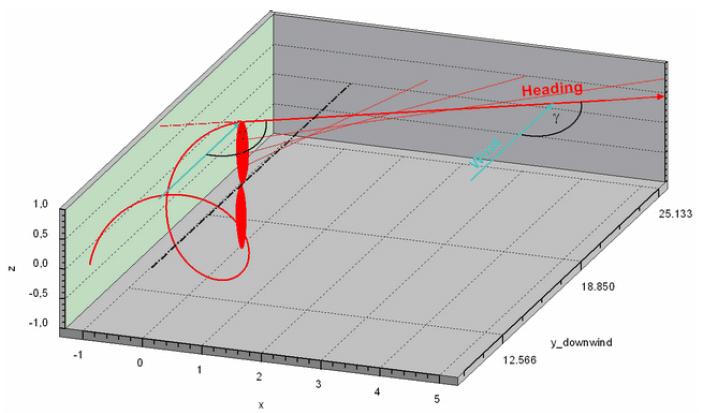
The problem here is your apparent inability to think in 3d space and see the path of the airfoil for what it really is.

3da0b91f959ab803a4c85ea61daeb6bc6g.jpg


This graphic easily shows that if one 'unwraps' the path of the circling airfoil, it equates with the angled path of the reaching airfoil on the traditional sailing rig. The spinning airfoil can take this angled path through the air while still allowing the chassis to go DDW.

JB
 
None of those are wheeled props carts, dlorde, and sailboats must actually follow a tacking path and not travel ddw, if they are to get VMG.

The cart is always something else other than a wind cart. I posted some video frames showing that the cart clearly slides. The response from JB was to liken the sliding cart to a dragster doing a burnout. To equate a tiny wind cart to a 1000hp dragster is one matter, but the analogy is false.

If the dragster's wheels spin, adding more power from the engine, just makes more heat and smoke, but does not return traction. The same applies to the cart. If the wheels spin under low acceleration, they will contunue to do as the demand for acceleration increases.

Comparison with other windcarts shows that Spork's design is not workable, which is why those comparisons are avoided.

No.
 
None of those are wheeled props carts
:confused: where did I say they were? The article is about Autogiro Boats, and posted as possibly relevant or interesting with regard to your question about boats that 'tack and yet don't tack', as you put it.
 
Last edited:
It was already explained that when the first cart is slowed by the additional drag of the second cart, the force of the wind on the sail increases in proportion to the square of the apparent wind speed. Since we have been over this before several times, I can only assume that you are deliberately attempting to mislead the newcomers.

Here is a wind load calculator if anyone wants to plug in some numbers to see the effect.

Until Christoph starts showing evidence instead of ignorance, I suggest he just be ignored.

WHAT?!! :eek:
You claim the force of the wind on the sail increases as the velocity of the cart decreases?

That is not what the calculator shows, nor is what common sense dictates!

As a matter of fact, the calculator confirms exactly what I had calculated; which is that the total force and thus energy, remains unchanged and that neither of the connected carts can travel as fast as the single cart.

Go ahead and plug in the numbers.

My original calculation was for a single cart travelling at 8 m/sec and when connected as two carts via rope and pulley, one would travel at 3.58 m/sec and the other at 7.16 m/sec.

To see a similar case on the calculator, I plugged in 8 Knots and a sail of 1 square foot. This produced a wind force of 0.28 lbf

Next, I used 3.58 Knots and same 1 ft^2 which returned a force of 0.06 lbf

Finally, I used 7.16 Knots and same sail area which returned a force of 0.22 lbf.

Do you see how that works? One cart = 0.28 lbf and the total of two carts is exactly the same, just as I said it must be. The wind force cannot increase to give you the result that you wanted to see but must obey the laws of physics and mathematics.:D

Thank you for the calculator link, which proves me right and you wrong. :D

Do you put everyone who knows better than you on ignore? You will never learn anything at all!
 
However you're jumping from there to the conclusion that the cart cannot extract enough energy at windspeed to overcome the friction in its wheels etc., which is unjustified (and wrong). The friction forces can be made arbitrarily small, but the cart can extract some fixed amount of energy given its propeller configuration and some given wind speed. If the energy lost to friction is smaller than the energy extracted from the wind, the cart will accelerate to faster than wind speed. If not, it won't. So it's purely a matter of engineering.


Wrong. Ice boats can beat the wind. So can gliders when using dynamic soaring. Carts can start from rest with respect to the ground and start moving, either upwind, downwind, or across the wind. Therefore there is no reason a cart cannot start from at rest with respect to the air and move in any direction the designer chooses.

It won't! At wind speed the wind does not cannot exert any force on anything that is also moving at wind speed directly down wind. This is indisputable and not even open to discussion!
 

ISF - Join now!

Every member here is approved by hand. No bots, no spam, just people who care about evidence and honest debate.

Membership is free!

Create your free account

Back
Top Bottom