Moderated The validity of classical physics - Part 2

That may be, but they are not about energy and they're not frame independent.
Energy plays a surprisingly important part in the physical world; it is about energy. If you check your posts, you will see that you have told me that KE is both frame variant and invariant, either directly or by inference or implication. I insist that KE goes with the mass of the body, and to play frames with it, is just play.

Please do supply a derivation.
A simple body travels through the air;
v = body velocity
u = molecular velocity (-u strikes the front of the body)
m = molecular mass
Some simplifying assumptions are; the air is inviscid, collisions are elastic, and there is no scattering.

(1) A molecule moving towards the body at -u from the ground, has a velocity of -u-v when referred to the body. Because the body is massive, it bounces off that body at u+v, and so u+2v from the ground.

(2) A molecule moving towards the body at u from the ground, has a velocity of -u+v when referred to the body. Because the body is massive, it bounces off that body at u+v, and so -u+2v from the ground.

(3) From the ground, the KE of the molecules striking the front of the body with velocity -u, has increased from m/2*u² to m/2*(u+2v)² = m/2*u² +2*m*u*v + 2*m*v². A change of +2*m*u*v + 2*m*v².

(4) From the ground, the KE of the molecules striking the rear of the body with velocity u, has decreased form m/2*u² to m/2*(-u+2v)² = m/2*u² -2*m*u*v. A change of -2*m*u*v + 2*m*v².

(5) Therefore the average increase of the kinetic energy of the air molecules with mass m hitting the body with velocity v is,
ΔK = 2*m*v².

Air has a mass of 1.2kg/m^3. At 10/ms, a body of area 1m^2, will strike 12kg of air. Substituting that for the molecular mass (m) in (5) we get.
ΔK = 2*m*v². = 2*12kg*100m/s = 2400 Joules

In reality, scattering and the common motion of object and air molecules (stagnation), will lower that loss, but then again, there will be viscous drag.
That value is the energy lost to the air as the body travels, but with a wind-driven object, all of the energy the body gains, comes from the air. That constant loss which increases with velocity, will prevent the object from reaching the velocity of the air.
To travel exactly at the speed of the medium, the KE exchange must be zero; an impossible state of static, rather than dynamic equilibrium.

Yes, quite obviously indeed, because it describes the exact same situation twice, which is my point: Coordinate transformations do not alter the situation, only the description of the situation.
Indeed, only the description changes, and that must include mathematical descriptions too. It should not be possible describe the situations as equivalent or not, dependent upon numerical or initial conditions.
The situations are superficially similar, having the same relative velocities, yet not equivalent as the mathematics shows. Attempting to add a linear transform to an exponential is also telling mathematical error, btw.

Good, since you now seem to see that this is the case, let's get to the elephant in the room: Is treadmill running anything like a coordinate transformation of running with a tailwind or is it fundamentally not?
No, of course not. To add a tailwind is foolish. The explanation you offered was that a treadmill is the equivalent of a runner, who always runs at exactly the speed of an unspecified and immeasurable tailwind. Remarkably, the machine that reproduces that, needs no sensors or feedback to achieve that effect, just a belt. I think NASA may be interested in such technology.

Please name me the velocities and/or phenomena that exert forces on the runner, that do not have an equivalent counterpart between the two situations.
(1) On a still day, a jogger pausing to rest, is not suddenly transported in the other direction. How's that for a difference?
I think your reasoning goes like this;
(a) A runner, running at the speed of an idealized tailwind, feels no tailwind.
(b) Those waiting in the lobby for job interviews at NASA, also feel no tailwind
(c) Therefore, all NASA job applicants are running in a tailwind.

Oh, and a final word on the ski machine: It can be used to simulate the dynamics of cross-country skiing, fairly accurately, I'd imagine,
I would imagine that you are forced to agree, and that while that machine is a good simulation, it's not perfect. There are a few things missing of course, like linear KE or downhill travel under gravity.

...but what's nice about treadmills and wind tunnels is that the equivalence doesn't stop at the soles of your shoes.
What's nice about having a sole...

It goes on for a bit into the environment, making it possible to do things like flying, driving and down-wind carting in the comfort of one's own home*.
* or research institute, or what have you.
The treadmill belt is truly a wonder. *Don't tell anyone at your institute that you just got badly wounded in your own field of bio mechanics.

Actually, there's this nifty way you can avoid choosing. You just subtract the same velocity from it you subtracted from all the other velocities. Another benefit of this method is that you won't be doing it wrong.
No. Precisely not.
?
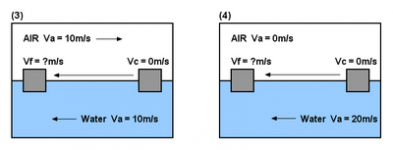
That is what I did. I made the same transform to each media. The speed of the body is the variable to be found. That is the point of using Stokes' equations. If you simply assert the object's velocity, Vc, to be 10m/s so that you will get the right answer, you don't need to employ Mr Stokes.

May I ask, humber, what, in your opinion, is the point of wind tunnel testing, exactly?
Windtunnels are used to study the effect of wind as is passes over the surface of an object. Any old object, not just planes that move, but static objects like buildings. Do buildings move at airspeed when in a wind tunnel, even though they don't in the real world?

It would good if the emulation were 100% complete, and that planes could actually fly, or be in motion while under examination. Unfortunately, that is not convenient, because for one thing, engineers and scientists spill their coffee while trying to hang on to the wing of a plane or the rear of an F1 car. All simulators, either by design or circumstance, suppress linear motion for that reason alone, while trying to keep as many of the real world traits as is possible. Treadmills, dynos, flight simulators, wind tunnels... are all needed in the room.

ETA: Another question I'm struggling with is this: What criterion do I use to decide which velocities to change and which ones to keep the same under 'humberian' transformation?
I don't. I keep the transforms the same, don't change the media, justify any use of zero for any media or object, and use commonsense to tell me that static objects don't move.
Also, I don't make my "observers" corporeal or sentient, nor do I include their effects as features of my models.

Yes, obviously, since you're not describing equivalent situations, which is your point, I guess. But let me just get back to the heart of the matter.
You have just made many posts arguing that they are equivalent.

You are ambivalent about this:

attachment.php


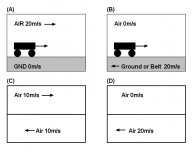
And the four examples below?
(A) an (B) are the treadmill. If you say that (3) and (4) are not the same, then that is true of (A) and (B), unless you think windcarts do never travel slower that 100% of windspeed.
At windspeed of 0m/s w.r.t the cart, that zero difference makes it effectively not there, which is why everyone wants to know "where does the energy come from?" and why excuses and nonsense are used to summon it.

Most Carteers, Relies and Four-Spacers, agree that (c) and (d) are equivalent too, yet there are no influential bodies in motion. Do you think that may why there are problems trying to relate them to the others?

attachment.php
 

Attachments

  • barrels.png
    barrels.png
    13.7 KB · Views: 111
  • 4frames.png
    4frames.png
    8.2 KB · Views: 107
Last edited:
A simple body travels through the air;
v = body velocity
u = molecular velocity (-u strikes the front of the body)
m = molecular mass
Some simplifying assumptions are; the air is inviscid, collisions are elastic, and there is no scattering.

(1) A molecule moving towards...

...

...To travel exactly at the speed of the medium, the KE exchange must be zero; an impossible state of static, rather than dynamic equilibrium.
Aha. I thought it had something to do with reference frames. Also, I feel obliged to tell you there are more apt mathematical descriptions of the dynamics of fluids on this scale. You'll find them under 'fluid dynamics'.

(1) On a still day, a jogger pausing to rest, is not suddenly transported in the other direction. How's that for a difference?
Yes he is. He is transported precisely to where that piece of earth is going, whereas he was going somewhere else before.

Try again; even I can think of better ones than that.

?
That is what I did. I made the same transform to each media. The speed of the body is the variable to be found.
No, that's not what you did. What you did was approximate the velocity over time for an object that starts at 0 m/s relative to both frames. What you didn't do, is transform the initial condition. (Incidentally, why don't you transpose the steady state solution of (4) back to (3) and see if they differ?)

That is the point of using Stokes' equations. If you simply assert the object's velocity, Vc, to be 10m/s so that you will get the right answer, you don't need to employ Mr Stokes.
What I calculated was an instantaneous force balance on an irregularly shaped floating object. I wasn't calculating Vc(t), I was calculating forces at some fixed point in time, which depends on the instantaneous values of all three velocities. You're comparing apples with pears here and accusing me of making pears not be apples.

Windtunnels are used to study the effect of wind as is passes over the surface of an object.
In your opinion, what good is that for aircraft then? What does that tell you about the aircraft? How it performs on taxiways? What questions do engineers try to answer with wind tunnel tests?

I don't. I keep the transforms the same, don't change the media, justify any use of zero for any media or object, and use commonsense to tell me that static objects don't move.
So you transformed each and every velocity, except that you only transformed the non-zero velocities? That's nice.

You have just made many posts arguing that they are equivalent.

You are ambivalent about this:

attachment.php
No I'm not. Your original (3) and (4) were equivalent. Then you added an object that is stationary in both (3) and (4). Then they were not equivalent.

And the four examples below?
(A) an (B) are the treadmill. If you say that (3) and (4) are not the same, then that is true of (A) and (B),
Not necessarily. It depends on the values you omitted for the velocity of the cart. For instance, for the values 49.2 and 29.2 in (A) and (B) respectively, they are equivalent.
In general: If Vc(A) = Vc(B) + 20, then (A) and (B) are equivalent.

At windspeed of 0m/s w.r.t the cart, that zero difference makes it effectively not there, which is why everyone wants to know "where does the energy come from?" and why excuses and nonsense are used to summon it.
Actually, only you want to know that. The energy comes from the relative motion of surface and air.

Most Carteers, Relies and Four-Spacers, agree that (c) and (d) are equivalent too, yet there are no influential bodies in motion. Do you think that may why there are problems trying to relate them to the others?[qimg]http://www.internationalskeptics.com/forums/attachment.php?attachmentid=15384&stc=1&d=1255521390[/qimg]
No, it has nothing to do with the presence of "influential bodies". It has to do with whether or not you consequently apply the transformation to every single velocity.
 
Last edited:
Aha. I thought it had something to do with reference frames.
Generally, it is not necessary use frames of reference for such a trivial problem, but I did so for your benefit. The molecular motion is made with reference to the object, whereas the KE referred to the ground. Way cool use of "frames of reference" because it shows not only the simple velocity that a small child can see, but the energy involved.

Also, I feel obliged to tell you there are more apt mathematical descriptions of the dynamics of fluids on this scale. You'll find them under 'fluid dynamics'.
Yes, I know, but I took some equations from the "big book of fluid dynamics" and their principles, to expose the underlying process. Excuse me for having my own ideas.
As I made clear, it is an approximation only, and to show that 100% air or waterspeed is not possible in principle. Perhaps you would care to address that matter, rather tell me where I may find other books.
By the way, if you were hoping to show that your equations were general, then you will have a lot of problems with particulate matter such as sediment.

humber said:
(1) On a still day, a jogger pausing to rest, is not suddenly transported in the other direction. How's that for a difference?
Yes he is. He is transported precisely to where that piece of earth is going, whereas he was going somewhere else before. Try again; even I can think of better ones than that.
(1) The jogger will lose KE as he slows to a stop, dissipating it in his muscles, and friction to the road.
(2) The pausing treadmill jogger, will gain KE, as the electric motor propels him to speed. Your argument is in direct contradiction of Galileo.
The "wind" argument is reminiscent of ghosts. They are there, but immeasurable, but only there, because someone simply said they are.

No, that's not what you did. What you did was approximate the velocity over time for an object that starts at 0 m/s relative to both frames.
If there are 3 objects, each must be relative to the other two; as in the manner of a triangle. Anything else is physically impossible. I did anticipate your objection, which is why I proposed the asymmetrical drag device. Do that, and you can force any Vc, and still show the difference.

What you didn't do, is transform the initial condition. (Incidentally, why don't you transpose the steady state solution of (4) back to (3) and see if they differ?)
There can be no transform of the initial condition, because in both cases, the initial conditions are the same. The difference of velocity of the object and the water, is the speed of the water. By forcing Vc to 10m/s in (4), that is quite obviously symmetrical about 0m/s, just like (3), so there is no need to even bother with a calculation, or did you not see that?

What I calculated was an instantaneous force balance on an irregularly shaped floating object.
What you calculated was the force on the object at terminal velocity, on the assumption that all of the KE of the propelling medium is expended upon the object. There is no (t) in the equation.

Your simplification due to Rayleigh. That does make for a simple model, but ignores the consequence that all of the fluid driving the object must stagnate in front of it. (having no KE). The other half of the equation is missing. It is precisely because most objects don't travel at a large percentage of the speed of the medium, that allows that approximation to be used. And you added a linear equation a quadratic like this; (10)^2 + 10 = (10 + 10)^2

I wasn't calculating Vc(t), I was calculating forces at some fixed point in time, which depends on the instantaneous values of all three velocities. You're comparing apples with pears here and accusing me of making pears not be apples.
You are analysis was entirely static. You calculated the force when in both cases it is proportionals to (V-Vc) = 10.

In your opinion, what good is that for aircraft then? What does that tell you about the aircraft? How it performs on taxiways? What questions do engineers try to answer with wind tunnel tests?
Not as much as you seem to think. Information is gathered about aerodynamic effects, and that is used as input to the overall design. Aerodynamic shape is but one aspect of aircraft design, and much of that is already known. The frontiers of design are in materials, and control systems.
Currently, data from wind tunnels is combined with mathematical models of the dynamics of real flight. The object is to bridge the gap between the tunnel and the real world of flight. BMW F1 do this, and have a large computers that make those adjustments in real time as the car is in the tunnel and engineers can teak this and that.

So you transformed each and every velocity, except that you only transformed the non-zero velocities? That's nice.
The cart example is not mine, as you well know, and none of the others have zero values. You cannot disagree that (A) and (B) are a simple subtraction of "20" from the real wind model. This holds for the cart. When stationary in the real wind, that is like moving with the belt at -20m/s (0 -20) = -20m/s
At "windspeed", the real cart is traveling at 20m/s, so (20-20) = 0m/s
Absolutely consistent.

No I'm not. Your original (3) and (4) were equivalent. Then you added an object that is stationary in both (3) and (4). Then they were not equivalent.
Without the object, what do you have? It is the effect upon the object that is important. For example, remove the air in both cases, now what?

Not necessarily. It depends on the values you omitted for the velocity of the cart. For instance, for the values 49.2 and 29.2 in (A) and (B) respectively, they are equivalent.
In general: If Vc(A) = Vc(B) + 20, then (A) and (B) are equivalent.
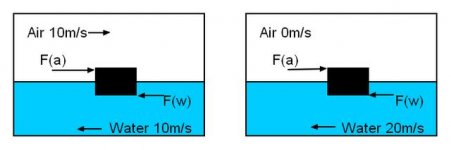
Not at all because that is not what you did.

attachment.php


In the left example, the wind and water are independent power sources, that produce F(a) and F(w), but on the right, (Fa) is drag, and the work to oppose that, comes from the water and so F(w)!
By setting Vc to 10m/s, you get the same "apparent" wind as on the left, and also 10m/s relative to the water, but all the power comes from the water. Adding to to a quadratic is not valid mathematically, and ignoring the energy source, invalidates it again.

Actually, only you want to know that. The energy comes from the relative motion of surface and air.
The energy comes from the KE of the mass flow. It is moving because it has KE.

No, it has nothing to do with the presence of "influential bodies". It has to do with whether or not you consequently apply the transformation to every single velocity.
No? Can you get a treadmill tailwind with a non-physical observer?
 

Attachments

  • twobarrels.jpg
    twobarrels.jpg
    13.3 KB · Views: 105
humber, I'm honestly at a loss here. There is so much wrong with your last post, I don't know where to begin. I appreciate the huge amount of work you put into this, but it's so overwhelmingly silly.

If you don't mind I'd like to ask you questions in stead:

What "aerodynamic effects" do you think are measured in a wind tunnel, and why?

What would engineers do about the design of aircraft, armed with knowledge of "aerodynamic effects"?

What, specifically, could one say about the performance of an aircraft when we measure a lift and drag polar in a wind tunnel?

How does lift measured on a wind tunnel model relate to actual lift on a flying aircraft?


Now if you do mind, and declare victory or something, I'll be happy to oblige, celebrate if necessary, and carry on doing what I do someplace else. I'm not worried about my paycheck.
 
humber, why don't you take up your many mistakes one at a time with H'ethetheth and I am fairly sure that he will try to enlighten you. Unlike spork and I he is not sick of your garbage yet. H'ethetheth, good luck.
 
Yes, I think much smaller posts, where we start with the basic claims and then walk through the proofs one step at a time (getting agreement for each step first), would be a lot more useful.
 
Just a word of warning for H'ethetheth, once I took humber through the equivalency of the cart on the treadmill to a cart running at wind speed outside. I did this by using the cart on a treadmill on the back of a truck situation. Then you drive the truck at wind speed and take away the sides. From there I switched to a tank with a treadmill driven by the tank tread. He was at the inevitable point of having to admit that it was exactly the same and he ran away from the discussion. If you are about to win your debate it will probably be a hollow victory. humber will run away rather than admit that he is wrong.
 
I'm pretty sure the last 3 posts are not specifically exactly on-topic, and must therefore be deleted. We're not allowed to talk about humber, what he has done, should do, or will do. Nor am I allowed to talk about what we're allowed to talk about - as that's not on-topic either.
 
humber, I'm honestly at a loss here. There is so much wrong with your last post, I don't know where to begin. I appreciate the huge amount of work you put into this, but it's so overwhelmingly silly.
If you don't mind I'd like to ask you questions in stead:
What "aerodynamic effects" do you think are measured in a wind tunnel, and why?
Only part of the aerodynamic effects. That is all. A fixed model is just the air over the surface, and the resultant turbulence. Actual plane dynamics would not simply scale, even if the model had some freedom. All models have limits.

What would engineers do about the design of aircraft, armed with knowledge of "aerodynamic effects"?
They use that to modify shapes but there are only so many shapes that work. Flying wings were made in the 1940's. Not much is new.
http://en.wikipedia.org/wiki/Flying_wing.

Small scale is different, because the behaviour at that level is unstable and often unpredictable. Models get better and better, but there is still no complete analytical answer to any given problem. Both NASA and ESA run simple fluid dynamic tests in the micro-gravity of space, and ESA have at least 2 "vomit comet" programmes, just to get more primary information. One such study was just small bubbles in an enclosure, something like a cloud chamber, and tracked with laser interferometers.

What, specifically, could one say about the performance of an aircraft when we measure a lift and drag polar in a wind tunnel?
How does lift measured on a wind tunnel model relate to actual lift on a flying aircraft?
You can tell of that behavior, but not 100% of what happens in real flight. It's a compromise. The differences are not necessarily huge, and can be compensated for, or even ignored if not of interest, or small compared to other effects. You are barking up the wrong tree with these questions.
They have nothing to do with the matter at hand. That you can think a runner on a treadmill is not only in motion, but has a tailwind, is one of the strangest misconceptions that I have ever seen. It's as cranky as cranky can be.

Now if you do mind, and declare victory or something, I'll be happy to oblige, celebrate if necessary, and carry on doing what I do someplace else. I'm not worried about my paycheck.

Getting paid, and earning that pay, are often quite different matters. You can stop anytime you like, but if you do, next time, please don't even suggest that you have NASA's support, because I know you don't.
 
Just a word of warning for H'ethetheth, once I took humber through the equivalency of the cart on the treadmill to a cart running at wind speed outside. I did this by using the cart on a treadmill on the back of a truck situation. Then you drive the truck at wind speed and take away the sides. From there I switched to a tank with a treadmill driven by the tank tread. He was at the inevitable point of having to admit that it was exactly the same and he ran away from the discussion. If you are about to win your debate it will probably be a hollow victory. humber will run away rather than admit that he is wrong.

Yes, well that test is a bizarre joke. I did no such thing as admit to you that it was valid, and I even arrived at the same answer as you did, but by a different route that showed the test has at least two contradictory outcomes. You simply asserted that your ideas were right, and left it at that.
I am not in the habit of "running away" from anything, let alone Spork's silly and ridiculous ideas.

Would you like to show some mathematical support for your claim? If you can't do that in physics, you don't have a claim worth having, and that's flat.
 
Last edited:
Yes, I think much smaller posts, where we start with the basic claims and then walk through the proofs one step at a time (getting agreement for each step first), would be a lot more useful.

Perhaps you will have noticed, AvalonXQ, that I need to re-post and add more detail, otherwise inconvenient facts are simply dropped in favour of something else.
I don't need to answer to wind tunnels. Fixed-model planes do not emulate dynamic behaviour, and you won't find reference text that says they do. And you won't find one that says bodies travel a the speed of the medium.
 
Last edited:
Perhaps you will have noticed, AvalonXQ, that I need to re-post and add more detail, otherwise inconvenient facts are simply dropped in favour of something else.
I don't need to answer to wind tunnels. Fixed-model planes do not emulate dynamic behaviour, and you won't find reference text that says they do. And you won't find one that says bodies travel a the speed of the medium.

Hmmm, "dynamic behaviour" eh Humber? Is that like the behaviour of air when flowing past a solid? You know, like maybe an aeroplane model. Will the forces exerted by the model on the air be somewhat similar to those exerted by the air on the model Humber, Hmmm, just how similar?
 
humber, your claim that you did not run away is another of your bald faced lies. As far as mathematical proof, I already supplied you with a Galilean transform and I see that H'ethetheth did as well. What point would there be to do it again? Why don't you supply some math that supports your side? Try to do it without using bad math as you have done in the past.
 
I ask these questions because the difference between wind tunnel and real flight is quite exactly the difference between treadmill running and running outside.

Only part of the aerodynamic effects. That is all. A fixed model is just the air over the surface, and the resultant turbulence. Actual plane dynamics would not simply scale, even if the model had some freedom. All models have limits.
Can you name a few effects, and can you name some of the limits? How are these specific effects different from those in flight?

They use that to modify shapes but there are only so many shapes that work. Flying wings were made in the 1940's. Not much is new.
http://en.wikipedia.org/wiki/Flying_wing.
How do they know what to change about a shape so that it does what they want it to do in the air?

You can tell of that behavior, but not 100% of what happens in real flight. It's a compromise.
What difference would I measure? More lift? less lift? What about drag?

The differences are not necessarily huge, and can be compensated for[/quote]How large are the differences, roughly, in percent? How can they be compensated for?

They have nothing to do with the matter at hand. That you can think a runner on a treadmill is not only in motion, but has a tailwind, is one of the strangest misconceptions that I have ever seen. It's as cranky as cranky can be.
So you've been saying. The thing is, you're wrong, and over a century of wind tunnel test demonstrates this. That's why I ask the questions: Not because I want to know the answers. I'd like to know your answers, and I'd like you to be more specific. Until now all you've told me is that wind tunnel tests are useful and having to do with aerodynamics and design optimization, but are different from the real thing.

Getting paid, and earning that pay, are often quite different matters. You can stop anytime you like, but if you do, next time, please don't even suggest that you have NASA's support, because I know you don't.
NASA's support...hehehe.


I said I could speak for NASA on one occasion, because you're too lazy to ask them, and you construe this as if I claimed I have NASA's support. That's rich.

I assure you, no one at NASA even knows I exist, and they might never find out. And I don't mind.
 
Let me ask you a question.

Assume that you're in a really long hallway running forward at 5 mph. The hallway is completely enclosed, but long enough that you can keep running for a long time without getting to the front of the hallway.

Now, somebody claims that this "hallway" is actually an extremely long trailer, being pulled by a truck going 5 mph on a very smooth road, and that you're running toward the rear of the trailer. Without looking outside the trailer, is there any difference between what you'd experience if their claim were true or false such that you can know whether their claim is right or wrong?
 
Small scale is different, because the behaviour at that level is unstable and often unpredictable. Models get better and better, but there is still no complete analytical answer to any given problem.

Suppose the engineers use NASA's large wind tunnel and put a real single-seater aircraft in there? In what way are the aerodynamic forces different from the same plane in free flight?
 
Last edited:
... That you can think a runner on a treadmill is not only in motion, but has a tailwind, is one of the strangest misconceptions that I have ever seen. It's as cranky as cranky can be.
It's a question of equivalence, not identity. Clearly a runner on a treadmill is not in motion relative to the ground, and there is no actual tailwind - but the runner is in motion relative to treadmill belt, and feels no wind of motion. In this respect, his experience is equivalent to a runner in the open who is running at the speed of a tailwind. It's a simple concept and you're clearly intelligent enough to realise this - you just seem determined not to acknowledge it.

The reality of the equivalence is easier to visualise if you make a thought experiment and extend the area of the treadmill belt to the horizon, and put houses, roads, and trees, etc., on it. If we extend the scope and take the surface of the Earth as our treadmill, the only difference as far as the runner is concerned is the breeze - on the real Earth, he feels the breeze of his running through the air, on the Earth-size treadmill he doesn't, so adding an equivalent tailwind on the real Earth makes the two situations indistinguishable to the runner. Simples.

Oh, and objects have KE because of their motion, not the other way around. KE is the energy of motion. Motion is relative, so KE is relative. An object only has KE relative to some other object (in the other object's frame of reference). If there are many other objects moving at many different velocities relative to it, it may have a different KE relative to each of them (in each different frame). From each object's frame, its own KE is zero, and it is the other object(s) that have the KE.
If you accelerate an object to match the velocity of another object, you actually reduce its KE relative to that object. Usually we deal with KE of objects moving relative to the Earth's surface or objects fixed to the Earth's surface, but that is just a matter of everyday experience. I'm sure you know this too, and just pretend not to.
 
Last edited:
I ask these questions because the difference between wind tunnel and real flight is quite exactly the difference between treadmill running and running outside.
I have shown you that is not correct, and provided you with links that contradict your view of the tailwind, and correct your knowledge of the bio-mechanics for running.

Can you name a few effects, and can you name some of the limits? How are these specific effects different from those in flight?
Are they not obvious to you? Imagine an object that experiences vertical buffeting during flight because of the random detachment of vortex streets over the wing, so creating a vertical force (F). That force will cause the plane to be;
(a) Accelerated
(b) Displaced
(c) Increase its KE.

If a model is placed in a wind tunnel and fixed in place with a support, none of the above 3 effects can occur. Strain gauges may be put in the support to measure F, but there will still be no motion of the model. If may be possible to calculate the other effects, but they are not directly simulated by the windtunnel. That is what real-time or post-processing of the wind tunnel data, achieves.

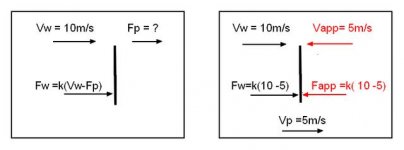
You claim that being in the wind, is the same as being on a belt in still air.
That is not correct, and the "belt wind" is just drag.
Your answers to the barrel problem, are based on the idea that the two cases are equivalent and symmetrical.
If they are both true, then there are many bodies that will not get to the speed on the medium, or even close.

The left drawing shows a plate being driven by the wind to some unknown velocity (Vp). Galilean equivalence allows it to be said that the front of the plate is like it is being driven in still air, with a relative velocity of 5m/s to that air, so generating the "wind" shown in red. It is obvious that the plate cannot get beyond 5m/s. Your claim of unconditional symmetry must be wrong, and not Galileo.


attachment.php


The same must be true of a self-powered plate in still air, which will stop accelerating when the opposing red force is the same as the driving force.


I said I could speak for NASA on one occasion, because you're too lazy to ask them, and you construe this as if I claimed I have NASA's support. That's rich. I assure you, no one at NASA even knows I exist, and they might never find out. And I don't mind.
Then you were being presumptuous.
 

Attachments

  • opposingwinds.jpg
    opposingwinds.jpg
    13.4 KB · Views: 74
Last edited:
Let me ask you a question.

Assume that you're in a really long hallway running forward at 5 mph. The hallway is completely enclosed, but long enough that you can keep running for a long time without getting to the front of the hallway.

Now, somebody claims that this "hallway" is actually an extremely long trailer, being pulled by a truck going 5 mph on a very smooth road, and that you're running toward the rear of the trailer. Without looking outside the trailer, is there any difference between what you'd experience if their claim were true or false such that you can know whether their claim is right or wrong?

That is a recasting of Galileo's ship.
In your example, there no difference. The air in the trailer moves with the trailer, and exerts no force on the runner. If there is no tailwind in that situation, there can be none on the treadmill either, or it's not equivalent.
 
humber, you found one source that does not understand biomechanis that claimed there was a difference. Put it this way, the writer of that article would no do too well in a physics class. He had no math that supported his thesis
 

ISF - Join now!

Every member here is approved by hand. No bots, no spam, just people who care about evidence and honest debate.

Membership is free!

Create your free account

Back
Top Bottom