Moderated The validity of classical physics - Part 2

That's exactly what I did in the second calculation. Different drag and lift coefficients for the part under water and the part above. More notably, lift coefficients in themselves can only arise if the object is asymmetrical relative to the velocity vector.
I also made it so that not half of the object is under water.
But still symmetrical in each case.

(1) Take an idealized pontoon. Put two diametrically opposed plates of different areas about the axis.
(2) Float the pontoon, with one plate in the water and the other in the air
and calculate.
(3) Invert the pontoon, so the other plate is in the water and calculate.
(4) repeat for situation (4)

If (3) and (4) are the equivalent, then they should yield exactly the same results.

You should read better then. The object has a speed different from both media, and in the second problem was asymmetrical.
You set the velocity of the object to be that of the medium, so the relative velocity is zero. When something acquires the characteristic of zero, it is removed.
If you have zero dollars in your pocket, it does not mean that "money" is still there, or some ghostly effect of that. All you did was change the coefficients, the effects of which you had removed by making the relative velocity between water and object zero. That also means your force calculations is wrong, should that even matter.

You wrote;

" So now we have three velocities: The velocity of the water Vw, of the air Va and of the cylinder Vc. We choose the reference frame of diagram 3, so that Vw = 10 m/s Va = -10 m/s and set Vc = 0.

I choose a cylinder diameter D of 1 m, making the Drag coefficients about 0.5 both in air and water (Based on Reynolds number and eyeballing the accompanying graph, not that it matters any.)
Now we sum the forces on the cylinder section: (Eq 1.)Σf = -Cd,a1/2 ρa (Va-Vc)2 1/2D + Cd,w1/2 ρw (Vw-Vc)2 1/2D = ... ...= 0.5 1/4 1.225 (-10-0)2 + 0.5 1/4 1000 (10-0)2 = 12.5 kN/m.

QED

Beside the fact that this wouldn't change anything about the result, it is also irrelevant because I did not make the velocity of the object identical to anything.
Actually, I pulled this calculation straight out of my behind, as I do this sort of thing for a living.
You wrote:
" I choose a cylinder diameter D of 1 m, making the Drag coefficients about 0.5 both in air and water (Based on Reynolds number and eyeballing the accompanying graph, not that it matters any.)"

What ever the case, it is an oversimplified text book exercise. For example, you have not included the sheer effects of the water, but assumed it to be constant across the area. That approach will always lead to the answer you seek. That is not the point of my question. If you follow what was asked, you can use a simplification that is justified, because it applies equally to all cases.

And indeed it serves to show something as simple as '10-10 = 0'.
I can sympathize with your impression that it would be very strange if one wouldn't understand something as simple as this, which must make it all the more puzzling why so many people tell you you don't understand something of the complexity of '10-10 = 0'.
Lump all your fancy bits together as constant 'k', and then take a look.

The top surface is moving at 5 m/s north to south, the runner's center of mass is not moving on average.
Then the average KE is zero.

The air is also not moving significantly. We now choose to describe the situation from an equivalent reference frame moving with the top surface of the belt. Relativity tells us we are allowed to do this,
Relativity with a capital 'R' does not say you can do that. Galilean relativity, and commonsense, say that you are now standing on a belt.

If you are right, the man of the ski machine can use ground as his "belt", and if so, he is quite obviously not traveling, or do you see the blue bits of plastic as being magical? The belt is nothing more than another version of those slides. And the tailwind?

attachment.php


...and whatever forces, accelerations and energy transfer we calculate will be the same as in any other frame.
The transformation for any and all velocities, again, looks like this:
V' = V - Vframe
This makes the speeds of air and runner in this frame:
V'runner = Vrunner - Vframe = 0 -(-5) = 5 m/sV'air = Vair - Vframe = 0 -(-5) = 5 m/s
How trivial! A childishly simple arithmetic task. Now please supply the equations that support the underlined claims.

Let's see...someone is drying their hair...

Vframe = Velocity of air from hair dryer
V'Heth = Velocity of Heth'
V'Heth= V'Heth - Vframe = 0 -(-5) = 5 m/sV'air = Vair - Vframe = 0 -(-5) = 5 m/s
You do this for a living? You equate the perceived image or haptic experience with reality?

And what's fascinating: in this frame, the runner has been steadily changing his kinetic energy since birth, by vast amounts, I might add, all to have the right history to end up with a kinetic energy of exactly 12.5 J per kg at the very instant we see him trot by on the treadmill, aided in his travel by a light breeze that he keeps with him in a small enclosure he calls gym.

This is the silly "planet" idea, where we all have KE from the planet.
Actually you are quite wrong. The average velocity of the planet's surface is zero - its motion is circular - so the average KE of something traveling withe that the surface is zero. That is largely true of the planet around the Sun. Too much deviation from that, the planet leaves orbit.
It's the average velocity of zero, that keeps runners on the treadmill, planes in the windtunnel. planets in orbit and flight simulators in the room.

If the runner accumulates KE from birth relative to the ground, he would be moving very fast and eventually leave the planet.
Here's a mnemonic for you; "Things that move with the ground, move relative with respect to the the ground"
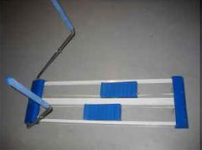
 

Attachments

  • ski_machine.png
    ski_machine.png
    56.4 KB · Views: 98
And I'm only asking for a very small and simple contribution from you: what is the weight of a 2 kg mass? Why won't you answer such a simple question? Nobody but you has this peculiar unwillingness to answer such questions. Hell, I'd even accept "I don't know" as an answer, so not even ignorance can excuse your reticence.

Three pies.
 
humber said:
The average velocity of the planet's surface is zero - its motion is circular - so the average KE of something traveling withe that the surface is zero.
This I don't get. The average velocity is zero, because velocity is a vector, but the average kinetic energy is not zero, because KE is a scalar, proportional by classical mechanics to the square of the velocity (~v^2). The massive surface of a rotating ring or sphere has a positive kinetic energy from the rotation.
 
This I don't get. The average velocity is zero, because velocity is a vector, but the average kinetic energy is not zero, because KE is a scalar, proportional by classical mechanics to the square of the velocity (~v^2). The massive surface of a rotating ring or sphere has a positive kinetic energy from the rotation.

True, but according to Heth and others, it is an infinite source of energy, but as you say, it's a fixed value. The average displacement is zero, so the KE of an object moving with the surface, is not diminished or increased. Only if the object moves independently of the surface does that happen..
 
True, but according to Heth and others, it is an infinite source of energy, but as you say, it's a fixed value. The average displacement is zero, so the KE of an object moving with the surface, is not diminished or increased.

I don't think this is correct. Even if the average displacement is zero (meaning it's moving in a circle), it's the instantaneous velocity of the object that determines its kinetic energy -- and, so, it's the change in velocity (acceleration) of the object that determines any change in kinetic energy. If the rotating ring were accelerating its rotation rather than rotating at a constant speed, the KE would be increasing.
 
Because it's nonsense. Mathematically, <x2> is not generally equal to <x>2, where <> brackets are used to denote averages (the mean). In fact, the difference between those quantities is rather important in statistics.

Complete straw man. What AvalonXQ meant was (-V)^2 = (V)^2 = V^2
 
Okay. So does anyone mind giving me a quick and accurate summary of exactly what we are arguing about?
 
Okay. So does anyone mind giving me a quick and accurate summary of exactly what we are arguing about?

humber has posted far too much contradictory nonsense to be summarized quickly. For example, he's confused about the distinction between force and acceleration, and cannot apply that distinction correctly to gravity. He is unable to give the force of gravity on a 2 kg mass, and simply posts nonsense in reply, as in post #1122. According to others, he seems unable to answer any direct and simple question in any meaningful way, and has refused to answer what 2+2 is equal to. I tried it and got no reply, you are welcome to do the same. Please don't provide the answers to him, though.

So basically, the thread is now about how humber is either terminally stupid, insane, or a troll, or some combination thereof. So I guess that's the closest to a summary I can provide.
 
Okay. So does anyone mind giving me a quick and accurate summary of exactly what we are arguing about?

It's quite simple. It has to do with Spork's claim to his treadmill, that placing a belt under the wheels of his cart, is exactly like his wind cart is traveling at the speed of the belt.
This is extended to all such things. A model plane, fixed in a wind tunnel, is said to have all of the dynamic qualities of the real flying object.
That is ludicrous. Apart from the obvious, that model does not have the KE associated with motion. And so it goes. Runner's treadmills have a "tailwind" pushing the runner along from behind, because there is belt moving the other way.
 
Last edited:
humber has posted far too much contradictory nonsense to be summarized quickly. For example, he's confused about the distinction between force and acceleration, and cannot apply that distinction correctly to gravity. He is unable to give the force of gravity on a 2 kg mass, and simply posts nonsense in reply, as in post #1122. According to others, he seems unable to answer any direct and simple question in any meaningful way, and has refused to answer what 2+2 is equal to. I tried it and got no reply, you are welcome to do the same. Please don't provide the answers to him, though.

So basically, the thread is now about how humber is either terminally stupid, insane, or a troll, or some combination thereof. So I guess that's the closest to a summary I can provide.

I have posted all the necessary calculations. Too bad if they disagree with you.
 
Ziggurat, humber hates to answer questions that are too specific. He would not even answer the simple question "What is 2 + 2?" for months on end. Good luck on yours:rolleyes:
 
Aww, poor NASA. Someone should have told them that it is not possible to test the dynamics of flight situations inside a wind tunnel.

They could have saved themselves a lot of money by simply not conducting test like:


or like:


or this:


But then, they already wasted money by doing free flight tests of models in windtunnels, for example:


or this:


or even this:


Really, there must be only stupid morons working at NASA, if they really think they could test aerodynamics of plane models in a wind tunnel. We all know that a plane can have such dynamics only if it moves at some speed relative to the ground. All that matters is the KE of the plane or the model thereof, stuff like airflow has absolutely no effect on airplanes.

<Edit> Oh, and since they do test in wind tunnels which, as we now know, ar unsuitable to test the dynamics of airplanes and such, we now know that the moon landing must have been a hoax! Yes! Really! They test their stuff in stupid, unusable windtunnels, so it must be clear that all that stuff would fail in the real world! How then should they have made it to the moon? Ha! </Edit>

Not.
 
Last edited:
But still symmetrical in each case.

(1) Take an idealized pontoon. Put two diametrically opposed plates of different areas about the axis.
(2) Float the pontoon, with one plate in the water and the other in the air
and calculate.
(3) Invert the pontoon, so the other plate is in the water and calculate.
(4) repeat for situation (4)

If (3) and (4) are the equivalent, then they should yield exactly the same results.
I already calculated that, except some constants will change. (3) and (4) will yield the same drag on any object that is transformed correctly to the new frame.

You set the velocity of the object to be that of the medium, so the relative velocity is zero.
Nope, sorry. Read it again. It says: Va = 10, Vw = -10, Vc= 0. That means they're all different. The object is not at rest relative to either medium.

When something acquires the characteristic of zero, it is removed.
Nope. You can remove them, but if you want to do the transformation correctly, you must remember what you tacitly removed, because otherwise your calculations will go wrong and people will die/get bad grades.

What ever the case, it is an oversimplified text book exercise. For example, you have not included the sheer effects of the water, but assumed it to be constant across the area. That approach will always lead to the answer you seek. That is not the point of my question. If you follow what was asked, you can use a simplification that is justified, because it applies equally to all cases.
Look, I could write you down the Navier-Stokes equations and show you that they are invariant under a Galilean transformation, but you don't even understand what adding velocities does, so I don't think I'll bother very soon.

Now please supply the equations that support the underlined claims
Tell me, what is the time derivative of

v(t) = dx/dt - vframe , where vframe is a constant?

What is the product of mass and the quantity you just calculated?

What does that tell you about mechanical power?

This is the silly "planet" idea, where we all have KE from the planet.
Actually you are quite wrong. The average velocity of the planet's surface is zero - its motion is circular - so the average KE of something traveling withe that the surface is zero.
Yes, keep hiding in the middle ages, humber. That'll do the trick.

The velocity of the earth is arbitrary. In fact, the velocity of 'X' is arbitrary, where 'X' = any word you can think of.
 
Okay. So does anyone mind giving me a quick and accurate summary of exactly what we are arguing about?

You will find a brief summary in the OP for part 2 and by reference, the OP for part 1 which was split from the parent thread DWFTTW which was just a local thread created to discuss the video of a cart built to settle the question: "Is it possible for a craft to travel directly down wind faster than the wind that is powering it?"

Through the corse of 3200 posts in the original thread, 4100 posts in part 1 and 1100 post to date in part 2, the original question was answered to everyones complete satisfaction with numerous models constructed and run on treadmills, turntables and in the wind; mathematical models presented and analyzed and lots of videos, pictures, charts, tables, alternate designs and a whole lot of fun for all.

[ETA: And that's just what happened here on JREF]
 
Last edited:
I already calculated that, except some constants will change. (3) and (4) will yield the same drag on any object that is transformed correctly to the new frame.

Nope, sorry. Read it again. It says: Va = 10, Vw = -10, Vc= 0. That means they're all different. The object is not at rest relative to either medium.
Of course that explains it (10)^2+ 10 = (10+10)^2, or should that be (10-10)^2. Get real.

ETA:
H'ethetheth said:
Originally Posted by H'ethetheth View Post
Humber, here's the example problem. It's essentially an inviscid 1D problem, but it'll works exactly like this for the Navier-Stokes equations, and it will illustrate how wrong you are.
I don't have a scanner handy so you'll have to imagine your diagram (3) with a circle drawn in the middle. I'm going to calculate the force on this cylinder cross-section, a force per unit cylinder width, where width is the dimension normal to the plane of the diagram.
So now we have three velocities: The velocity of the water Vw, of the air Va and of the cylinder Vc. We choose the reference frame of diagram 3, so that
Vw = 10 m/s (Wind to right)*
Va = -10 m/s (Water to left)*
and set Vc = 0. If you must.
I choose a cylinder diameter D of 1 m, making the Drag coefficients about 0.5 both in air and water (Based on Reynolds number and eyeballing the accompanying graph, not that it matters any.)
Now we sum the forces on the cylinder section: (Eq 1.)
Sf = -Cd,a1/2 ?a (Va-Vc)2 1/2D + Cd,w1/2 ?w (Vw-Vc)2 1/2D = ...
...= 0.5 1/4 1.225 (-10-0)2 + 0.5 1/4 1000 (10-0)2 = 12.5 kN/m.
OK, a limited answer to (3)

H'ethetheth said:
Now the good part, in which we transform to another frame of reference, namely one that travels at Vf = -10m/s.
The transformation looks like this.
For all V:
V' = V - Vf
i.e.:
V'a = Va - Vf = -10 - (-10)= 0 m/s
V'w = Vw - Vf = 10 - (-10)= 20 m/s
V'c = Vc - Vf = 0- (-10)= 10 m/s
We now plug these into Eq 1:
Sf = -Cd,a1/2 ?a (V'a-V'c)2 1/2D + Cd,w1/2 ?w (V'w-V'c)2 1/2D = ...
...= -0.5 1/4 1.225 (0-10)2 + 0.5 1/4 1000 (20-10)2 = 12.5 kN/m.
Referring to (4)
Wind = 0 so Va = 0
Water = -20 so Vw = -20
That is a simple linear transformation of -10 applied to * above
Vc = 0 ( as above)
Rewriting;
Sf = -Cd,a1/2 ?a (V'a-V'c)2 1/2D + Cd,w1/2 ?w (V'w-V'c)2 1/2D = ...
...= -0.5 1/4 1.225 (0-0)2 + 0.5 1/4 1000 (-20-0 )2 not equal to 12.5 kn/m

Nope. You can remove them, but if you want to do the transformation correctly, you must remember what you tacitly removed, because otherwise your calculations will go wrong and people will die/get bad grades.
Look, I could write you down the Navier-Stokes equations and show you that they are invariant under a Galilean transformation, but you don't even understand what adding velocities does, so I don't think I'll bother very soon.

Tell me, what is the time derivative of

v(t) = dx/dt - vframe , where vframe is a constant?

What is the product of mass and the quantity you just calculated?

What does that tell you about mechanical power?

Yes, keep hiding in the middle ages, humber. That'll do the trick.
Go ahead. Produce those calculations for your barrel. That should help you understand the matter of KE I mentioned.

The velocity of the earth is arbitrary. In fact, the velocity of 'X' is arbitrary, where 'X' = any word you can think of.

But there is no differential velocity of the object and the surface. Galilean Relativity says that the common motion of those objects makes no difference. None of the objects within his ship are affected by the motion of the ship itself, but you are arguing that for the planet. If you understand relative motion, I am sure you can appreciate the irony.

And what of the treadmill. Is there a "tailwind"? How is the ski machine different from the treadmill?
 
Last edited:

ISF - Join now!

Every member here is approved by hand. No bots, no spam, just people who care about evidence and honest debate.

Membership is free!

Create your free account

Back
Top Bottom