First of all, this set of equations has the wrong dimension, namely Jm2s.
Secondly, I have no idea how this is supposed to indicate that kinetic energy is frame independent, or whether work is or isn't.
The equations are correct. It is quite easy to see that there will always be energy lost from the body as long as V in non-zero. Frames or not.
Even water does not flow as 100% of the stream velocity, so it is unlikely that an object that creates drag would do the same.
To be at 100% water-speed, the object cannot be in dynamic equilibrium, but stasis, where no KE is exchanged with the water. The equations show that is not possible. I can supply the derivation, but I think that can wait.
Yeah, we're talking about classical mechanics in this thread though. Locality does not come into it.
Actually is does. Einstein late mentions The Moon.
No matter what, you cannot show that the runner's
energy consumption, occurs at anywhere else but the runner's location, and where
real ATP is produced and consumed. If you think you can do show otherwise, then do go ahead.
In the fact that the surface moves relative to the runner, just like outside.
And a belt running
next to it? If that one speeds up, does the runner go even faster? The bio mechanics of running explain the phenomenon without resort to voodoo.
The ski-machine is not helpful in this discussion. It has nothing to do with shifting frames of reference.
It is
very helpful in showing that belt may create the
illusion of motion, but that is all. How you justify the difference, is interesting. The matter has nothing to do with frames of reference.
The ski machine shows that bio-mechanical exercise of the limbs does not imply linear motion related to the speed of the belt.
With a little imagination, it can be seen that a
running machine of design similar to the ski-trainer could be constructed. Think also of the "stairmaster"'; simple pedals that emulate some of the aspects of climbing, but not actual gain in gravitational potential energy.
Since you claim to be an expert in this field I did not think it would be
necessary to resort to external references over matters of general knowledge, but here;
http://www.posetech.com/training/archives/000165.html
"While it doesn't matter for mechanics which of the interacting bodies is moving: the belt or the body, it is not so for biomechanics. It makes a big difference there. The major one lies in the fact that in treadmill running, unlike over ground running, our upper body is not moving forward, it's our feet that are moved backwards by the running belt. This difference creates a different bio-motor pattern of the movement, where we have to produce some (otherwise undesirable) activity of the upper body to keep it against tipping over the support foot on the belt of the treadmill in order to keep the body in balance. So we have to hold our body to keep it from falling forward and we have to catch the running belt instead of our falling body."
As I said, running is controlled falling. When walking, a considerable portion of energy is used as the torso moves up and down, periodically doing work against gravity, and then dissipating the resultant KE. The above author quite clearly agrees that the body does not move, and the belt moves back the feet, and that
obviously so with the ski-trainer.
No, I don't think there are. Just because they are conceivable does make them not marketable. You pretty much have to live with tailwind, or go run outside. It is there: It's the wind. Remember there was a tailwind in the equivalent outside situation? What happens when you stop running in a tail wind?
Marketing is irrelevant, and you have simply asserted the tailwind. Treadmills are
not models of a runner in a tailwind. If so, what sort of treadmill is the equivalent of running without a tailwind? A more rational explanation is that the belt has a motor, and the drives objects
attached to it through the air. The runner simple runs on the spot, and will therefore not be taken back with the belt. Only if he stops does he feel the tailwind, but that is true of belts at airports and escalators. It is drag and noting more.
Two unrelated phenomenon.
I think you'll fund that car manufacturers find the drag coefficient of their cars by putting them in a wind tunnel and measuring the drag as a function of wind speed.
They do, but they don't call it "wind", but drag. In the wind tunnel, the fan motor is the energy source that powers the air flow, and some of that energy is lost as drag and turbulence as it passes over the car's body.
When the car is in motion on the road, it is the car's engine that powers the process, and loses energy through drag with the air. I think you will find that car manufacturers know that.
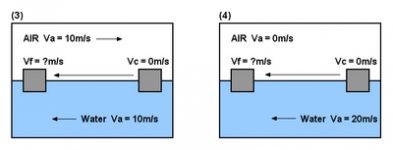
Incorrect. Vc was defined as 0 in the first scenario because someone had to do it. It just is. I could have picked any number, but 0 would better illustrate your error in thinking.
To make things clear to you, I have reworked the drawing.
In each case the barrel starts of a Vc= 0 and terminates at Vf.
What you have done is set Vc= 0 in one case, and Vc=10 in the other ! Symmetry about 10m/s
If that is done, it is quite obviously going to be the same (10m/s either way), thus supporting my remark that you have demonstrated that 10 -10 = 0.
This is a naive mathematical error. I will use a charging capacitor to show you that. Like the barrel, capacitor voltage rises to with an exponent to a final value, but that that is not the same as the sum of an exponent and a linear transform.
A capacitor charges as;
[latex] v(t) = V_0 \left( 1 - e^{\,^{\textstyle -t/\tau_0}}\right)[/latex]
Where:
V(t)= final capacitor voltage
Tau = R*C (time constant)
t= charging time
Vo = initial voltage.
Starting with the case for applied voltage of 10V, Tau =1 and t = 1 sec
Vo =10v
t = .5
tau =1
[latex]v(t) = 10\left( 1 - e^{\,^{\textstyle -0.5/\ 1}\right))[/latex] = 3.93V
Now we add your "transform" of 10V to get
13.93V
For Vo=20
t = .5
tau =1
[latex]v(t) = 20\left( 1 - e^{\,^{\textstyle -0.5/\ 1}}\right)[/latex]=
7.86V
The results are obviously different.




 So humber, admitting you are wrong is not necessarily a bad thing. You can learn more that way and sometimes you suffer no harm at all by fessing up.
