Moderated The validity of classical physics - Part 2

Finishing up the 2 cart problem:
  • Fwind = Cdwind * Asail * (Vwind - Vcart1)^2 [ wind on sail from post 1558]
  • Frr1 = Crr * Mcart1 * g [rolling resistance of cart 1 - from wiki]
  • Frr2 = Crr * Mcart2 * g [rolling resistance of cart 2 - from wiki]
  • Fwind = 2 * Frope + Frr1 [forces balanced on cart 1]
  • Frope = Frr2 [forces balanced on cart 2]
solved for the velocity of cart 1...
  • Vcart1 = Vwind - sqrt[Crr * g * (2 * Mcart2 + Mcart1) / (Cdwind * Asail)]
  • Vcart2 = 2 * Vcart1 [from mechanics of rope and pulley]
Solved for Vcart2 > Vwind:
  • Vwind > 2 * sqrt[Crr * g * (2 * Mcart2 + Mcart1) / (Cdwind * Asail)]
Proving that if the wind is blowing fast enough, cart 2 will be traveling faster than the wind.


Assigning some reasonable values for the physical parameters


and solving

  • Vwind > 0.501 ms^-1

So with good tires, light carts and a decent sail, just about any breeze will end up propelling the second cart faster than the wind (assuming that the rope is long enough).
 
No, it's not possible to accelerate cart 1 without accelerating cart 2.
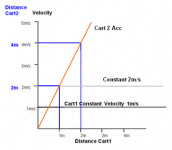
Try again. It is not possible to move Cart1 without accelerating Cart2. That is clear from the graph and a bit of calculus.
Figuratively, if the pulley moves forward 1m, then the rope is pulled such that Cart2 moves 2m. That is 1m more distance.
Do that in one second, and that is 1m/s more velocity, for every second, and that is acceleration of 1m/s-2

There can and there will, and it will be equal to the drag on the cart. Remember, for the cart not to accelerate you need zero net force, not just zero force.
You fail to see Cart2 has a constant acceleration as long as Cart1 is in motion. The final velocity will be limited by net force in the usual way, but Cart2 will not be 2V when that happens. I have given already the a partial solution to that. More details and the cart's masses must be included to complete that solution.

Cart 2 will always accelerate faster than cart 1, and by a factor of 2.
And cart 1 always applies a force on cart 2, as long as the force on the rope is tensile. But that is additional complexity irrelevant to the point of this model, which simply demonstrates a way to extract energy from the relative motion of air and a surface.
Not additional complexity, but a failure of the idea. When gearing is used to trade force for velocity or vice verse, that cannot simply "happen", as carteers so often believe; follow one formula, and all the rest just happens.

"Work is the amount of energy transferred into or out of a system,
not counting energy transferred by heat conduction"


Distance is the "most important" factor in gearing. A workman may lift many times his own mass, by pulling on the rope of a block and tackle for a longer distance. How fast he does that, is secondary.

Work= force*distance
Work= force*velocity*time
Power =work/time = energy/time

The tether ensures that Cart1 is always doing work on Cart2's mass, and transferring energy to it. Energy not stored as KE in Cart2, represents energy lost to heat via friction.

No. The velocities and acceleration are constrained so that there is a factor 2 between them, at all times. Firstly, again, this would be true in a situation of no net force. Since there is always a drag on the second cart, there is always a force on the rope.
When Cart1 moves, it applies a net force to Cart2 and so accelerates it.
If the tether were another cart, that would not happen, but the tether does not store KE.

Secondly, the carts are never at the same non-zero speed (relative to the ground). This simply cannot happen.

You missed the fact that the tether is a workless load, and that produces a constant acceleration in Cart2.

If restricted to one dimension, the final velocity of Cart2 will be that of Cart1, and that occurs when all of the extra work generated by the tether is dissipated, rather than transferred as KE to Cart 2.

Alternatively, the force can be discontinuously applied to achieve the same effect, but with much lower losses, so Cart2 will then travel at an average close to 2*Cart1

 
Let's see...
I did made a mistake in the graph, but it does not change the fact that Cart2
constantly accelerates.

Using your list:
Cart 1 travels 1 metre, cart 2 travels 2 metres.
Cart1 = 1m/s distance = 1m time = 1s
Cart2 = 2m/s
So that is 2m/s above zero?

Cart 1 travels another metre, cart 2 travels 2 more metres.
Cart1 = 1m/s distance = 2m time = 2s
Cart2 = 2m/s above 2m/s = 4m/s

Cart2 stores KE. Each meter of Cart1 travel, adds to that. That is why the speed cannot be constant, while the losses are low.

Cart 1 travels another metre, cart 2 travels 2 more metres.

...and so forth.

Now let's say it always takes cart 1 the same amount of time to travel each of these metres. We see then that cart 2 travels 2 metres every of those same amounts of time.
Physicists refer to this behaviour as "having a constant velocity".
The change over time of a "constant velocity" is widely agreed upon to be "not very large indeed", and is usually denoted by the number that signifies the absense of quantity.

It's not what physicists say, but what you say. As I said to Dan_O, he has ignored the cart's mass.
You accept that the rope divides the force from Cart1, but don't ask where the work implied by that other force must go.
 
Agreed. V2 is double V1.
No. The acceleration of Car2 is double that of Car1. And at a steady 1m/s, the acceleration of Car1 is zero, so the acceleration of Car2 is twice zero.

Cart2 will continue to accelarate, as long as Cart1 pulls it.

After 1 second, Car1 has moved 1m and Car2 has moved 2m.
Cart 1 =1m/s
Cart 2= 2m/s
2m/s over t = 0

After 2 seconds, Car1 has moved 2m and Car2 has moved 4m.
Cart 1 =1m/s
Cart 2= 4m/s
2m/s over t =1

Mass is an accumulator of KE. Unless there are losses, the mass continues to travel without losing that KE. Think of trying to pull a very free running cart with a string. Once you can no longer pull fast enough, it will over run the string. In the pulley version, half of that pulling force goes to the tether, but you are still pulling the same distance, and so doing more work. That work adds to the KE of Cart2, and accelerates it, as long as you continue to pull and the losses low enough.

And so on until you run out of rope. Note that Car2 is moving at a steady 2m/s.
This is really simple stuff. Don't overcomplicate it. If you get different numbers to the above, please consider what implications your version has for the length of the rope at each stage.

The rope is a serious problem. If the carts were free, and you held Cart2, what would happen to the pulley? It would move away from its currently neat position, and travel along the rope, until the forces on both strands were once again equal. If that can't happen, the pulley will jam against Cart2.
 
- A normal sail boat cannot sail directly downwind faster than the wind.

- An efficient sail boat can sail faster than the wind at an angle to the wind. It's even possible that the component of the boat's velocity in the direction of the wind is faster than the wind. So an efficient sail boat can actually "beat the wind" by tacking: it will go a certain distance at an angle across the wind, then reverse the angle before going the same distance again, so that it ends up at a point directly downwind from where it started, getting there faster than the wind itself does. This surprises many people, but it's a well-documented fact. The boat is using both the sail in the air and the keel in the water to convert the relative motion of air and water into a faster motion, in a different direction.

- Adding a propeller isn't enough to enable a boat to sail directly downwind faster than the wind. You need to replace the sail with a propeller, replace the keel with another propeller and link the motion of the two propellers together. You can see a description of such a direct downwind boat here.

The French propeller ships came out of the harbor and destroyed the British Fleet.................
 
Just to make sure I understand correctly (honestly - I'm not challenging anyone, I'm just late to this bunfight and doing my best to catch up) while the boat is sailing across the wind, its speed can considerably exceed the windspeed, but the downwind component of its velocity will always be less than the windspeed.

No, the downwind component can exceed windspeed. A "regular" sailboat isn't fast enough to do that, but a "regular" iceboat or land yacht can do it easily.

Then when it tacks, it can use its momentum to briefly carry it downwind at greater than windspeed, and an efficient craft can achieve this to the extent that it's possible for its average downwind velocity to outpace the wind. Is that right?
Not necessary, but I have used that argument to say "Even if the downwind component could not exceed windspeed ..."
 
Just to make sure I understand correctly (honestly - I'm not challenging anyone, I'm just late to this bunfight and doing my best to catch up) while the boat is sailing across the wind, its speed can considerably exceed the windspeed, but the downwind component of its velocity will always be less than the windspeed.

No, the downwind component can be greater than wind speed.

Then when it tacks, it can use its momentum to briefly carry it downwind at greater than windspeed, and an efficient craft can achieve this to the extent that it's possible for its average downwind velocity to outpace the wind. Is that right?

No, it can travel steady state with a downwind velocity component greater than the speed of the wind. This can seem weird at first, but a vector analysis will show it to be possible.

So the boat can actually power itself into what is effectively a light headwind, so long as the thrust from the (water) propeller exceeds the combined drag of the water and the (air) propeller? I must admit, this still sets my perpetual motion alarms jangling, but I'm sorta coming around to the idea. Slowly, though.

It does seem at first sight like perpetual motion, but it isn't. The boat exploits the energy from the relative motion of two media, air and water. It this relative motion is zero (no wind), the boat doesn't move.

I can imagine a cart with a fan geared to its wheels which would be able to crawl towards a stream of air directed at the fan. Going the extra step to the special case where the air is actually moving the other way but the cart is moving faster still in the same direction... My mind's eye is still having a load of trouble with that. :D

Yes, funnily enough an upwind boat/cart is more easily accepted than a downwind faster than the wind one. In fact the two are very similar: one is a sort of mirror image of the other. If you're happy with the idea that a boat can travel directly upwind by using a turbine in the air to power the propeller in the water, imagine this:

We have an upwind boat that can go at 3 km/h into a 10 km/h wind. Let's say the wind is blowing from east to west, and the boat moves from west to east. The velocity of the boat relative to the water is 3 km/h towards the east, and since the air is moving at 10 km/h towards the west, the velocity of the boat relative to the air is 13 km/h towards the east.

Now imagine that, instead of a 10 km/h wind over still water, we have water moving at 10 km/h under still air (a flowing river, for example). The water is flowing from west to east. What happens if we put the upwind boat on the water, pointing east? The boat sees a 10 km/h headwind, just as before, so it moves into this headwind. The velocity of the boat relative to the water is 3 km/h, as before. If we're standing on the bank of the river, we see the boat go past, faster than the stream of water. It's going downstream faster than the stream!

If you look at how a ddwfttw boat functions in the same situations, you'll see that a boat that goes downwind faster than the wind also goes "up-current" when it's placed on a river moving under still air.
 
After 2 seconds, Car1 has moved 2m and Car2 has moved 4m.
Cart 1 =1m/s
Cart 2= 4m/s

You might want to look at the above statements again.
After 2 seconds, Car2 has moved 4m. If Car2 moves 4 m in 2 s, how fast is that?
Look again. If Car1 is moving at a constant velocity of 1 m/s, then Car2 will move at a constant velocity of 2 m/s. Car2 is not accelerating.
 
Assigning some reasonable values for the physical parameters
You need to calculate the power.

and solving
  • Vwind > 0.501 ms^-1
So with good tires, light carts and a decent sail, just about any breeze will end up propelling the second cart faster than the wind
Only while Cart1 can accelerate Cart2. It is a question of power, and you have completely ignored that. Once Cart1 can no longer accelerate Cart2, it will follow Cart1 at a speed that is less than Cart1 alone.

(assuming that the rope is long enough).
When Cart2 can no longer supply more energy to Cart1, the pulley will move along the rope, until it reaches Cart2, so pulling it along at the same speed.
(You can imagine what happens if you hold Cart2 while pulling on Cart1.)
A terrible idea, but you carteers...

To proceed, you need to include the mass of the Cart2, or you have no idea if Cart1 can accelerate Cart2 to the speed you suggest. The KE must be provided for!
When you include the mass of Cart2, you will see that it has a constant demand for KE as it accelerates. It is an incremental system that relies on accumulated KE. If you only include the forces of of drag, you will miss the point. Chinese saying "egg on face good for carpet"
 

Attachments

  • twocarsgraph3.png
    twocarsgraph3.png
    23.3 KB · Views: 2
humber, you are mixing accelerating and non accelerating states indiscriminately. Dan O.'s original question was one of steady state where the force from the sail was equal to the various forces on the carts. There is no acceleration in the proper answer. Try again.
 
The rope is a serious problem. If the carts were free, and you held Cart2, what would happen to the pulley? It would move away from its currently neat position, and travel along the rope, until the forces on both strands were once again equal. If that can't happen, the pulley will jam against Cart2.

I feel as if we're not looking at the same diagram. The pulley is attached to the back of Cart1. The rope runs from a fixed anchor point, around the pulley and back to Cart2. Cart1 is pushed by the wind.

If you held onto Cart2, Cart1 would pull the rope tight, but then nothing would move. So what's this about the pulley travelling along the rope to Cart2? Maybe you'd better draw it, because I simply can't see what you mean.
 
You might want to look at the above statements again.
After 2 seconds, Car2 has moved 4m. If Car2 moves 4 m in 2 s, how fast is that?
Look again. If Car1 is moving at a constant velocity of 1 m/s, then Car2 will move at a constant velocity of 2 m/s. Car2 is not accelerating.

When does it happen with a normal cart, that the DISTANCE traveled increases the velocity? When accelerating.

You are ignoring that the inertial mass, will force an increase in acceleration along with that increase in velocity of 2m/s. Perhaps it will help to note that the velocity of Cart2, is the constant velocity of the pulley plus, the changing motion of the rope.

You are ignoring the mass and the KE demanded to accelerate the cart. You say that after 1m, Cart2 is traveling at 2m/s.

OK. There are two possibilities from that point.
(1) There are no drag forces. In that case, then any force from Cart1, will accelerate Cart2
(2) There are drag forces, and Cart1 needs to supply that to keep Cart2 at a constant 2m/s.
But what if the force from Cart1, is greater? Then it will continue to accelerate Cart2.

That is what happens to a normal towed cart. The force accelerates the cart, and when the opposing drag equals the applied force, the net force is zero, so the cart stops at a fixed velocity. There are two phases, acceleration and constant velocity. but the pulley means that Cart2 can not leave the acceleration phase. It always accelerates, until something stops it.

The 2:1 cart makes constant demand for acceleration, due to its effectively increased inertial mass.

In a 1:1 Cart, the increase in KE of Cart2 is 1/2mV^2

In a 2:1 Cart, the increase in KE of Cart2 is 1/2m(2V)^2.
Four times as much, over the same TIME. If the mass stays the same, the speed must double, and do so every meter of the given example.
 
I feel as if we're not looking at the same diagram. The pulley is attached to the back of Cart1. The rope runs from a fixed anchor point, around the pulley and back to Cart2. Cart1 is pushed by the wind.

If you held onto Cart2, Cart1 would pull the rope tight, but then nothing would move. So what's this about the pulley travelling along the rope to Cart2? Maybe you'd better draw it, because I simply can't see what you mean.


This is the diagram the discussion is about. I showed that just by considering the forces on the carts, we can solve for the velocities of the two carts in the steady state (not accounting for inertia):


​

The rope and pulley creates leverage so that the wind is acting on a point that is moving slower than the center of mass. We get a similar leverage if we put a sail part way up the lower spoke on a wheel as in:


​
Of course, this "big wheel with a sail" won't work because the sail will be pushing against the wind when the sail rotates around to the top of the wheel. But it's a good intermediate step in getting to understand how the ddwfttw cart works.
 
I feel as if we're not looking at the same diagram. The pulley is attached to the back of Cart1. The rope runs from a fixed anchor point, around the pulley and back to Cart2. Cart1 is pushed by the wind.

If you held onto Cart2, Cart1 would pull the rope tight, but then nothing would move. So what's this about the pulley travelling along the rope to Cart2? Maybe you'd better draw it, because I simply can't see what you mean.

It would, but perhaps it is better to look at it another way. It is Cart2's mass that controls the whole process, and not the drag of the wheels as suggested by Ft2 and Dano_O's analysis. If the mass is low, and the drag also low, then Cart1 will quickly drag Cart2 to the pulley as shown in my diagram, with the blue line being zero length.
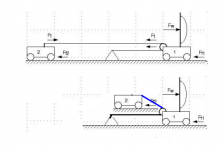
The only difference that mass makes, is the time it takes before that happens.

The rope to the anchor opposes the acceleration of the cart, as it moves in a circle around the anchor. But is the rope is very long, then the radius will be large, and the carts will then be traveling in an all but straight line at the same speed.
As I have said, it is Cart2's demand for KE that accelerates it. If Cart2 has a brake to dissipate that, then it can stay at a constant velocity, but of course that will be less that Cart1 alone.
If the force is available to constantly accelerate the cart at twice that of a normal cart, then this system offers a more rapid journey to the same final velocity as a simple towed cart (rope ignored)

attachment.php
 

Attachments

  • cartfinal.png
    cartfinal.png
    32.4 KB · Views: 75
When does it happen with a normal cart, that the DISTANCE traveled increases the velocity? When accelerating.

In this case, the distance traveled DOESN'T increase the velocity. If cart1 starts and ends at 1 m/s, than cart2 starts and ends at 2 m/s. There is a steady state where both of them are at constant velocity with zero acceleration.
 
Welcome to our little edge of reality Mac. It only takes 10 or 15 posts before you can post links so it won't be long.

I found the youtube video here: www DOT youtube DOT com/watch?v=E_fm9MI8sNI . Is there somewhere that we can find the stats for these racers?

Thanks,

I dont know whether the stats for the cars are given anywhere. The cars attended the Aeolus races for headwind powered vehicles using wind turbines. The event was invented by windenergyevents (go to www DOT windenergyevents DOT com where you can find the rules for the race, including the specifications of the cars), and you may find links to this years teams at www DOT windturbinerace DOT com. The website for the car I am involved in is www DOT windturbineracer DOT com, but it is not updated that often. If you havent been there there may still be some interesting stuff...

-Mac G
 
When does it happen with a normal cart, that the DISTANCE traveled increases the velocity? When accelerating.
That's fine. But you have not established to anyone else's satisfaction that Cart2 is accelerating. That is the point of contention and it makes discussion of inertia, mass and kinetic energy irrelevant until it's cleared up. Do not lose sight of the fact that the case everyone is discussing is a steady state where Cart1 moves at a constant 1m/s. For every 1m Cart1 advances, 1m of rope rolls over the pulley. So the remaining length of rope between the carts shortens by 1m. So for every 1m Cart1 advances, Cart2 advances 2m. It's just trivial geometry. Note that if Cart2 advanced by more than that, the rope would go slack and no forwards force would be applied to Cart2.

You say that after 1m, Cart2 is traveling at 2m/s.
Not only after 1m; Cart2 is always travelling at 2m/s. For the whole period we are discussing, Cart1 is travelling at 1m/s and Cart2 is travelling at 2m/s.
OK. There are two possibilities from that point.
(1) There are no drag forces. In that case, then any force from Cart1, will accelerate Cart2
(2) There are drag forces, and Cart1 needs to supply that to keep Cart2 at a constant 2m/s.
But what if the force from Cart1, is greater? Then it will continue to accelerate Cart2.

Yes, if the force from Cart1 is greater then it will accelerate Cart2, but only if it also accelerates Cart1. Cart1 cannot accelerate Cart2 while Cart1 itself is travelling at a constant rate - the rope would just go slack. But anyway that is not the case under discussion as we are considering a case where Cart1 travels at a constant 1m/s.
 
If the mass stays the same, the speed must double, and do so every meter of the given example.

Speed doubles every metre travelled. I refuse to believe you actually mean this.

Assuming a starting speed of 1m/s for cart2, in less than two seconds and after only 10m traveled, the cart would be at 1024m/s - i.e., it would be going as fast as a typical rifle bullet.
 

ISF - Join now!

Every member here is approved by hand. No bots, no spam, just people who care about evidence and honest debate.

Membership is free!

Create your free account

Back
Top Bottom