It does not follow that they must both accelerate. They could equally well both decelerate or each remain at a constant speed.
No. The velocity gain is not a simple multiplier. It is an
incremental gain of 2. That seems to be the sticking point.
The final velocity is determined in the usual way by the available power and drag losses. When that happens, there is no net force to accelerate Cart2 and provide the velocity gain, so they will assume the same velocity.
Speaking of things that don't follow - how above that chart from a few posts back? (I believe I'm still too new to repost it - sorry.)
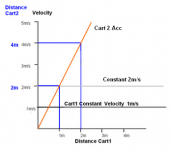
It has blue lines showing the relative positions of the carts at 1s and 2s, but then you use a red line to join the intersections of the blue lines and declare that to be the acceleration of Cart2. But why? What dimensions do you propose that line represents? Acceleration ought to be m/s² but to me it appears you've drawn a dimensionless line of slope +2 which actually represents the distance travelled by Cart2 in proportion to that travelled by Cart1. If you think otherwise, please explain what you think the red line represents and exactly why. Thanks.
This one?
That graph assumes a constant applied force. If the first meter accelerates the cart from 0 to 2m/s, then the second meter will accelerate it from 2m/s to 4m/s and so forth. Right?
A normal cart will accelerate if driven by a constant force, but
not if driven by a constant velocity. Agree?
The pulley cart differs, because Cart2 will accelerate, even if driven by a
constant velocity Cart1.
That is a result of the tether and pulley, and the doubling of the force that the two ropes cause...
The grey line represents
any cart traveling at a constant 2m/s, when driven by a constant velocity of 2m/s, whereas the red line, is the pulley cart driven by a
constant velocity Cart1 of 1m/s. The acceleration is the slope of that red line, so 2m/s²



 (This is not to say it isn't obvious a cow is not a hat.
 )