Moderated The validity of classical physics - Part 2

Ah, another concept humber does not understand: Instantaneous.

Either that, or something even more bizarre is going on. I'm not sure I want to know.

If Cart1 travels 1m, Cart2 travels 2m, that is indeed incremental.
dv/dt Cart2 = 2*dv/dtCart1

If Cart1 moves at all Cart2 must move twice that distance, so a constant velocity for Cart 2 is not possible. The 2:1, ratio can only be maintained while Cart2 can accelerate, but of course there is a limit to that.

If Cart1 moves at all, Cart2 moves twice the distance, but a constant average velocity can be maintained, if the force from Cart1 is discontinuously applied, allowing the cart to slow bit, and then accelerate again. Cart2's speed would hunt slightly are around the mean speed or Cart1

If the carts were on rails, that would be the only option, but with free carts on a long rope, the pulley can move along the rope, and so change the relative angle of travel of each cart, and so maintain a constant velocity by that means.
 
If Cart1 travels 1m, Cart2 travels 2m, that is indeed incremental.
dv/dt Cart2 = 2*dv/dtCart1

If Cart1 moves at all Cart2 must move twice that distance, so a constant velocity for Cart 2 is not possible. The 2:1, ratio can only be maintained while Cart2 can accelerate, but of course there is a limit to that.
No, that ratio is maintained for all velocities and all accelerations.

If Cart1 moves at all, Cart2 moves twice the distance, but a constant average velocity can be maintained, if the force from Cart1 is discontinuously applied, allowing the cart to slow bit, and then accelerate again. Cart2's speed would hunt slightly are around the mean speed or Cart1
You're adding irrelevant complexity to the model. Cart 2 will always travel at twice the speed of Cart 1. Real-life behavior will be identical within acceptable error margins.

If the carts were on rails, that would be the only option, but with free carts on a long rope, the pulley can move along the rope, and so change the relative angle of travel of each cart, and so maintain a constant velocity by that means.
Same thing here. The problem is modeled in one dimension, and your objections have nothing to do with it.

It appears you are slowly moving the goalposts to where we have to solve the cart's dynamics from the level of molecular interactions upward.
 
No, that ratio is maintained for all velocities and all accelerations.
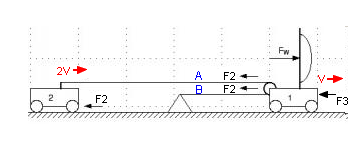
The pulley means that when Cart1 moves a distance d, Cart2 moves 2d. It is not possible to move Cart1 without accelerating Cart2.

You're adding irrelevant complexity to the model. Cart 2 will always travel at twice the speed of Cart 1. Real-life behavior will be identical within acceptable error margins.
That can't happen. Remember that the carts move in the same direction.
(1) If the velocities of Cart1 and Cart2 are constant, there can be no force on the rope, so Cart2 will slow.
(2) If Cart1 applies any force, Cart2 will accelerate faster than Cart1.
It is one or the other. That is why the velocity must be controlled by intermittent application of the force. Slowing slightly, then accelerating slightly, so that the average is more or less constant.

Same thing here. The problem is modeled in one dimension, and your objections have nothing to do with it.
It appears you are slowly moving the goalposts to where we have to solve the cart's dynamics from the level of molecular interactions upward.

(1) If in one dimension, the Cart2 will continue to accelerate even if the force keeps Cart1 at a constant speed.
(2) When the carts are at the same speed, no force can be applied to Cart2.

The pulley means that the system differs from a simple towed cart, because there is force in both strands A and B. There is no work done on strand B, so all the work is done on the cart. That means that even if a constant force is applied to Cart1, Cart2 will accelerate. It's a forced condition, similar to concentric gears.

attachment.php
 

Attachments

  • dano3.png
    dano3.png
    16.3 KB · Views: 95
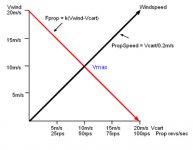
Even a hypothetical geared-cart cannot reach windspeed, because of the gearing.

(1) When the cart is stationary, the force of the wind is a maximum, but the gearing to the wheels does not allow the prop to substantially increase its angular velocity (AV).

(2) When the cart is at windspeed, the force of the wind is a minimum, but that prop's AV is at a maximum.

Let's say that one turn of the prop turns the wheels so that the cart travels
0.2m (200mm). At at speed of 20m/s, the prop's AV will be 20m-s/0.2m =100revs/sec.
The force on the prop is given by the approximation F= k(Vw-Vc)
where Vw= windspeeed and Vc= cart velocity.

Plotting these;
The plot is not of absolute prop power, but to show that there will be a point at which the falling driving force from the wind, sees a demand for a rising prop AV. A plot of the power (F*AV), would produce a parabola with a maximum at the Vmax point
No prop power profile can overcome the obstacle that must occur at 50% of the windspeed.


Plotting prop AV and prop force.

attachment.php
 

Attachments

  • doh.png
    doh.png
    22.2 KB · Views: 92
The pulley means that when Cart1 moves a distance d, Cart2 moves 2d. It is not possible to move Cart1 without accelerating Cart2.

No. Really, no. Not accelerating.

I don't want to get involved in this thread, but this misunderstanding is just wasting your time and everyone else's too: You can't move Cart 1 without moving Cart 2 twice as far. Not accelerating it, just moving it twice as far. If Cart 1 moves at a steady 1m/s, then Cart 2 moves at a steady 2m/s.
 
The pulley means that when Cart1 moves a distance d, Cart2 moves 2d. It is not possible to move Cart1 without accelerating Cart2.


That can't happen. Remember that the carts move in the same direction.
(1) If the velocities of Cart1 and Cart2 are constant, there can be no force on the rope, so Cart2 will slow.
(2) If Cart1 applies any force, Cart2 will accelerate faster than Cart1.
It is one or the other. That is why the velocity must be controlled by intermittent application of the force. Slowing slightly, then accelerating slightly, so that the average is more or less constant.


(1) If in one dimension, the Cart2 will continue to accelerate even if the force keeps Cart1 at a constant speed.
(2) When the carts are at the same speed, no force can be applied to Cart2.

The pulley means that the system differs from a simple towed cart, because there is force in both strands A and B. There is no work done on strand B, so all the work is done on the cart. That means that even if a constant force is applied to Cart1, Cart2 will accelerate. It's a forced condition, similar to concentric gears.

http://www.internationalskeptics.com/forums/attachment.php?attachmentid=15446&stc=1&d=1256154673

Edited by Gaspode: 
Edited moderated thread


Humber, you need to test this yourself. Get 2 toy cars, a pulley, and some string. Copy the setup that Dan O. has drawn for you. Move Car 1 at a steady speed and observe what happens to Car 2. Mark some lines on your table or floor so you can see the relative distances traveled by each car.

Here is what you'll see:

1) Car 2 will move at twice the speed of Car 1 when Car 1 is moving at a steady speed.
2) Car 2 will accelerate at twice the rate of Car 1 when Car 1 is accelerating.
 
Last edited by a moderator:
Edited by Gaspode: 
Edited moderated thread


Humber, you need to test this yourself. Get 2 toy cars, a pulley, and some string. Copy the setup that Dan O. has drawn for you. Move Car 1 at a steady speed and observe what happens to Car 2. Mark some lines on your table or floor so you can see the relative distances traveled by each car.
Here is what you'll see:

1) Car 2 will move at twice the speed of Car 1 when Car 1 is moving at a steady speed.
2) Car 2 will accelerate at twice the rate of Car 1 when Car 1 is accelerating.

So you say. Have you have done this test yourself?

You would need to watch Car2, and adjust the force to keep the speed constant.

The rope relates distance of Car1 to Car2. If Car1 is kept at a constant velocity, for every 1 meter Car1 travels, Car2 travels 2m. That is certainly 2V, but acceleration is change in velocity over time.
Even if Car1's velocity is constant, Car2's velocity will increase over time, because the velocity of Car2 is not related to the velocity of Car1, but to the distance of Car1.

For example;
If Car1 is traveling at 1m/s, for every 1 meter it travels, Car2 travels 2m. One meter more, every meter.
Therefore, the acceleration of Car2 is 1m/s per second per second over Car 1.
There is a constant acceleration of Car2, even though Car1 is at a constant velocity.

Gearing means not only a trade of force for velocity, but work over time.
 
For example;
If Car1 is traveling at 1m/s, for every 1 meter it travels, Car2 travels 2m. One meter more, every meter.
Therefore, the acceleration of Car2 is 1m/s per second per second over Car 1.

First off, your units are not an acceleration. Secondly, no. Car 2 doesn't accelerate unless car 1 accelerates.

Gearing means not only a trade of force for velocity, but work over time.

No. Gearing trades force for distance, so that work is constant. If gearing changed the amount of work done, it would violate conservation of energy. Epic fail, once again.
 
Uh huh. One cart can continue to travel at twice the speed of the other indefinitely?
Time Cart 1 Cart2 Change
t1 1m 2m 1m
t2 2m 4m 2m
t3 3m 6m 3m
t4 4m 8m 4m

It can never stop, because the rope relates the distance traveled by Cart1, to the velocity of Cart2. That is constant acceleration. Without that acceleration, you don't get the velocity gain. It later balances out so that both carts travel at the same speed. It should be obvious. Gears do not give power gain.

When cart2 becomes too much of a load for cart1, the pulley will begin to move up the rope, until the differential speed of cart1 and cart2 is zero. You need a long rope to make this work.

Humber, you are mistaking a change in distance between the two carts as a difference in acceleration. That simply isn't true. It is a difference in velocity only. If you plot the distance traveled by each of the carts, they will both be straight lines. The slope will be different but the velocity is constant for both.

A plot of a cart that is accelerating from zero will show a parabola, not a straight line. Try it.
 
So you say. Have you have done this test yourself?

You would need to watch Car2, and adjust the force to keep the speed constant.

The rope relates distance of Car1 to Car2. If Car1 is kept at a constant velocity, for every 1 meter Car1 travels, Car2 travels 2m. That is certainly 2V, but acceleration is change in velocity over time.
Even if Car1's velocity is constant, Car2's velocity will increase over time, because the velocity of Car2 is not related to the velocity of Car1, but to the distance of Car1.

For example;
If Car1 is traveling at 1m/s, for every 1 meter it travels, Car2 travels 2m. One meter more, every meter.
Therefore, the acceleration of Car2 is 1m/s per second per second over Car 1.
There is a constant acceleration of Car2, even though Car1 is at a constant velocity.

Gearing means not only a trade of force for velocity, but work over time.

If cart 2 was actually accelerating as you say while cart 1 was at a constant velocity, the rope would go slack. It is only a simple gearing system, humber. Try the test.
 
I am working this problem one step at a time to show you how it is done when the goal is to get the correct answer.

  • Fwind = Cdwind * Asail * (Vwind - Vcart1)^2 [ wind on sail from post 1558]
  • Frr1 = Crr * Mcart1 * g [rolling resistance of cart 1 - from wiki]
  • Frr2 = Crr * Mcart2 * g [rolling resistance of cart 2 - from wiki]
  • Fwind = 2 * Frope + Frr1 [forces balanced on cart 1]
  • Frope = Frr2 [forces balanced on cart 2]
Using the phisical formulas above, it is a simple process to solve for the velocity of cart 1...
  • Fwind = 2 * Frr2 + Frr1
  • Fwind = 2 * (Crr * Mcart2 * g) + (Crr * Mcart1 * g)
  • Fwind = Crr * g * (2 * Mcart2 + Mcart1)
  • Cdwind * Asail * (Vwind - Vcart1)^2 = Crr * g * (2 * Mcart2 + Mcart1)
  • (Vwind - Vcart1)^2 = Crr * g * (2 * Mcart2 + Mcart1) / (Cdwind * Asail)
  • Vwind - Vcart1 = sqrt[Crr * g * (2 * Mcart2 + Mcart1) / (Cdwind * Asail)]
  • Vcart1 = Vwind - sqrt[Crr * g * (2 * Mcart2 + Mcart1) / (Cdwind * Asail)]
(notice what happens in the simple case where Crr=0?)

We already know that Vcart2 = 2 * Vcart1.

The last step will be to find the range of Vwind such that Vcart2 > Vwind and show that the range is not empty.


Solving for Vcart2 > Vwind:

  • Vwind < 2 * Vcart1
  • Vwind < 2 * (Vwind - sqrt[Crr * g * (2 * Mcart2 + Mcart1) / (Cdwind * Asail)])
  • Vwind < 2 * Vwind - 2 * sqrt[Crr * g * (2 * Mcart2 + Mcart1) / (Cdwind * Asail)]
  • Vwind > 2 * sqrt[Crr * g * (2 * Mcart2 + Mcart1) / (Cdwind * Asail)]

This proves that if the wind is blowing fast enough, cart 2 will be traveling faster than the wind. We can also lookup typical values for the Crr and Cdwind to see if such a wind is reasonable for given cart masses and sail area.
 
No, the rope directly relates distance to velocity for cart2. If you used work instead of only forces, you would see why.

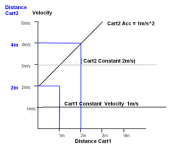
For every 1m that Cart1 travels Cart2 moves 2m. (Look at the pulley and the amount of rope, for every meter of Cart1)
In the graph below, Cart1 is traveling at a constant 1m/s. If Cart2 were a constant 2m/s, it would be the grey line.
But, for every 1m that Cart1 travels, Cart2 travels 2m (blue numbers) and that results in the changing velocity of the black line

attachment.php
 

Attachments

  • twocarsgraph.png
    twocarsgraph.png
    24.3 KB · Views: 92
I apologize for jumping in* but I have read a sail boat cannot sail faster downwind than the wind. Adding a propeller to it could allow it to do so?

*as I haven't the physics experience of most the posters here.
 
The pulley means that when Cart1 moves a distance d, Cart2 moves 2d. It is not possible to move Cart1 without accelerating Cart2.
No, it's not possible to accelerate cart 1 without accelerating cart 2.

That can't happen. Remember that the carts move in the same direction.
(1) If the velocities of Cart1 and Cart2 are constant, there can be no force on the rope, so Cart2 will slow.
There can and there will, and it will be equal to the drag on the cart. Remember, for the cart not to accelerate you need zero net force, not just zero force.

(2) If Cart1 applies any force, Cart2 will accelerate faster than Cart1.
Cart 2 will always accelerate faster than cart 1, and by a factor of 2. And cart 1 always applies a force on cart 2, as long as the force on the rope is tensile. But that is additional complexity irrelevant to the point of this model, which simply demonstrates a way to extract energy from the relative motion of air and a surface.

(1) If in one dimension, the Cart2 will continue to accelerate even if the force keeps Cart1 at a constant speed.
No. The velocities and acceleration are constrained so that there is a factor 2 between them, at all times.
(2) When the carts are at the same speed, no force can be applied to Cart2.
Firstly, again, this would be true in a situation of no net force. Since there is always a drag on the second cart, there is always a force on the rope.
Secondly, the carts are never at the same non-zero speed (relative to the ground). This simply cannot happen.
 
If Car1 is traveling at 1m/s, for every 1 meter it travels, Car2 travels 2m. One meter more, every meter.
Agreed. V2 is double V1.
Therefore, the acceleration of Car2 is 1m/s per second per second over Car 1.
No. The acceleration of Car2 is double that of Car1. And at a steady 1m/s, the acceleration of Car1 is zero, so the acceleration of Car2 is twice zero.

After 1 second, Car1 has moved 1m and Car2 has moved 2m.
After 2 seconds, Car1 has moved 2m and Car2 has moved 4m.
After 3 seconds, Car1 has moved 3m and Car2 has moved 6m.
After 4 seconds, Car1 has moved 4m and Car2 has moved 8m.

And so on until you run out of rope. Note that Car2 is moving at a steady 2m/s.

This is really simple stuff. Don't overcomplicate it. If you get different numbers to the above, please consider what implications your version has for the length of the rope at each stage.
 
... for every 1m that Cart1 travels, Cart2 travels 2m [...] and that results in the changing velocity of the black line

attachment.php
Let's see...

Cart 1 travels 1 metre, cart 2 travels 2 metres.
Cart 1 travels another metre, cart 2 travels 2 more metres.

...and so forth.

Now let's say it always takes cart 1 the same amount of time to travel each of these metres. We see then that cart 2 travels 2 metres every of those same amounts of time.
Physicists refer to this behaviour as "having a constant velocity".
The change over time of a "constant velocity" is widely agreed upon to be "not very large indeed", and is usually denoted by the number that signifies the absense of quantity.
 
I apologize for jumping in* but I have read a sail boat cannot sail faster downwind than the wind. Adding a propeller to it could allow it to do so?

*as I haven't the physics experience of most the posters here.

No, sailboats can outpace the wind by tacking, but it takes a very fast boat. It is easy for iceboats and land yachts.
 
I apologize for jumping in* but I have read a sail boat cannot sail faster downwind than the wind. Adding a propeller to it could allow it to do so?

*as I haven't the physics experience of most the posters here.

- A normal sail boat cannot sail directly downwind faster than the wind.

- An efficient sail boat can sail faster than the wind at an angle to the wind. It's even possible that the component of the boat's velocity in the direction of the wind is faster than the wind. So an efficient sail boat can actually "beat the wind" by tacking: it will go a certain distance at an angle across the wind, then reverse the angle before going the same distance again, so that it ends up at a point directly downwind from where it started, getting there faster than the wind itself does. This surprises many people, but it's a well-documented fact. The boat is using both the sail in the air and the keel in the water to convert the relative motion of air and water into a faster motion, in a different direction.

- Adding a propeller isn't enough to enable a boat to sail directly downwind faster than the wind. You need to replace the sail with a propeller, replace the keel with another propeller and link the motion of the two propellers together. You can see a description of such a direct downwind boat here.
 
- An efficient sail boat can sail faster than the wind at an angle to the wind. It's even possible that the component of the boat's velocity in the direction of the wind is faster than the wind. So an efficient sail boat can actually "beat the wind" by tacking: it will go a certain distance at an angle across the wind, then reverse the angle before going the same distance again, so that it ends up at a point directly downwind from where it started, getting there faster than the wind itself does. This surprises many people, but it's a well-documented fact. The boat is using both the sail in the air and the keel in the water to convert the relative motion of air and water into a faster motion, in a different direction.
Just to make sure I understand correctly (honestly - I'm not challenging anyone, I'm just late to this bunfight and doing my best to catch up) while the boat is sailing across the wind, its speed can considerably exceed the windspeed, but the downwind component of its velocity will always be less than the windspeed. Then when it tacks, it can use its momentum to briefly carry it downwind at greater than windspeed, and an efficient craft can achieve this to the extent that it's possible for its average downwind velocity to outpace the wind. Is that right?

- Adding a propeller isn't enough to enable a boat to sail directly downwind faster than the wind. You need to replace the sail with a propeller, replace the keel with another propeller and link the motion of the two propellers together.
So the boat can actually power itself into what is effectively a light headwind, so long as the thrust from the (water) propeller exceeds the combined drag of the water and the (air) propeller? I must admit, this still sets my perpetual motion alarms jangling, but I'm sorta coming around to the idea. Slowly, though.

I can imagine a cart with a fan geared to its wheels which would be able to crawl towards a stream of air directed at the fan. Going the extra step to the special case where the air is actually moving the other way but the cart is moving faster still in the same direction... My mind's eye is still having a load of trouble with that. :D
 

ISF - Join now!

Every member here is approved by hand. No bots, no spam, just people who care about evidence and honest debate.

Membership is free!

Create your free account

Back
Top Bottom