All agreed.
What is significant heating?
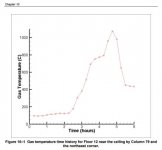
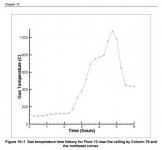
Well at 200C structural steel yeild strength is reduced by about 15%. ,and at 400C it is reduced by 45%. So if we look at the graph we note that gas temps were in the region of 200 to 400 for 30 minutes.
I would consider that significant.
Gas temps then spent two hours rising from 400C to 1000C.
I would consider that significant.
And, gas temps then remained over 850C for another 15 minutes.
I would consider that significant too.
So I am at a loss as to how Korol and Tony Szamboti can claim significant heating only occured over a 30 minute period.
Astounding.
The reason you are at a loss is that you don't seem to know much about heat transfer.
Heat from a fire is transferred three ways.
1. By radiation from the fire.
2. By radiation from the hot gas.
3. By convection from the hot gas.
The most significant portion is by radiation from the fire and when the fire burns out that is gone because a view is needed and the fire needs to be somewhat directly under the steel in question.
Heat transfer rate is dependent on the temperature difference. The smaller the difference the lower the rate.
It also takes time for heat to transfer through the fire protection. This time is significant and causes a lag. Once the fire burns out the air in the vicinity starts to cool. If the heating is not continuously applied to the fire protection for longer than the duration of its rating in hours it will not transfer much heat from the hot gas due to radiation and convection.
Most of the heating of fire protected steel occurs by direct radiation from the fire and once it burns out that method is no longer available. This coupled with the fact that the fires directly under the steel only burn for about 20 to 30 minutes is why the steel does not get to extremely high temperatures.
Another issue is that large steel members take a lot of energy to heat up. The specific heat of steel is 500 joules/kg-degK. This means that to heat up a structural member like girder A2001 to 800 C, which weighed about 2,650 kg, would take over a billion joules. If the fire is only under the steel for 30 minutes that would require nearly 600 Kw to go directly to the girder. The heat release rate for a 32 kg/m^2 fuel load is about 340 Kw, so it can't get anywhere near 800 C. Even under very efficient transfer the girder would only get to about 500 C.
Benthamitemetric is naively sticking his neck out again, like he did with the ARUP reports, and he is going to get humiliated again. I seriously doubt they will make the Beyler analysis public because they know we will find a serious problem with it which was used to generate extreme steel temperatures in an illegitimate way (similar to the illegitimate infinite stiffness used by Nordenson). However, it can be shown that the steel structural members on the 9th and 10th floors on the east side of WTC 7 could never get to the temperatures shown in the Weidlinger report without ever seeing that analysis.