Crazy Chainsaw
Philosopher

- Joined
- Aug 12, 2006
- Messages
- 8,339
He's not a real engineer.
 Exactly he has no confirmation of claim a real forensic engineering professional would have experimental confirmation.

He's not a real engineer.
Exactly he has no confirmation of claim a real forensic engineering professional would have experimental confirmation.In case you aren't aware, the 25 minutes came from NIST. The Korol paper even goes to a 30 minute time, but the protected steel temperatures are still far below what is claimed in Weidlinger.
The 25 to 30 minute time is an effective time where significant heat transfer is possible.
Not to say you are not capable of learning, but at present you do not seem to understand how temperature difference affects heat transfer rate and your attempt to say the Cardington tests show much more time is involved is silly on its face.
I hope Tony's fellow travelers are paying close attention. This is how 911 Truth really works: Tony and Robert Korol are friends and true believers. They claim to be interested in knowing the truth of what happened to the towers, but they are really just going patently flawed analyses and "research" in order to support a conclusion that fires couldn't have brought the buildings down (implying CD did). Because they are so disinterested in the actual truth and so invested in their fantasy, they cannot be even the slightest bit critical of their own theories and thought processes. And so you have the sad spectacle that is playing out before you--Korol writes a paper claiming fires couldn't bring down the building based on 25 min parametric heating curves, Tony cites that paper as evidence that fires couldn't down the building, it is repeatedly pointed out to Tony that Korol's magic 25 min burn times are entirely anachronistic to the experimental observations on traveling fires done to date, Tony lies and says the Cardington study does support such a burn time, I post that study and show it refutes Tony and Korol, and now Tony dodges the conversation.
Multiply this incident by 100 and you have the research methodologies and intellectual honesty of 911 Truth as a whole.
Cite exactly where in the NIST report.
Also, tell me exactly how many minutes of burn time led to "significant" heat transfer in the Cardington study and why you claimed it supported a 25 min burn time when there is heat transfer observed for at least 50 minutes.
Please try to define "significant" in this context in a way that is tethered to actual accepted fire science research methodologies.
Do you understand the term asymptotic?
Do you understand the term asymptotic?
It is during the 25 minute time during peak burn that about 99% of the heat transfer will take place. That is why it is used. The Korol paper even used 30 minutes to eliminate any chance that the 25 minutes was too low. You don't seem to want to talk about that.
How many minutes of heat transfer in the Cardington tests, Tony? Why'd you tell everyone there was only heat transfer for 25 minutes? There was only 5 minutes or so or arguable "asymptotic" temperature increases shown on the graph, and there was heating even during that phase, which you can see if you download the underlying data xls from Manchester U. Do I have to post that too and keep embarrassing you?

All I have to say about it is that your grasp of scansion is about as firm as your grasp of reality.
Dave
Where do you get that 99% figure? With even a rudimentary grasp of calculus, you can see from the graphs of the Cardington study that there is no 25 min period in which 99% of the heat transfer occurred. Why are you lying and making things up? And the 30 min timeframe is just as indefensible based on Cardington, NIST, or anything else. You know that Korol is deliberately leaving out a significant period of heating.
Tony's buddies mistake is hinted at in this.
"5 CONCLUSIONS
The statistical analysis of the fire tests examined shows that there is considerable
non-uniformity in the temperature field of real post-flashover fires. Peak local
temperatures range from 23% to 75% higher than the compartment average, with a
mean peak increase of 38%. Local minimum temperatures range from 29% to 99%
below the spatial average, with a mean local minimum temperature of 49% below the
compartment average. This is in contrast to the common assumption of a homogenous
temperature field often used in quantification and modelling of post-flashover
compartment fires.
The contradictions between the assumption of homogeneity and measured
heterogeneity means that (fire tests with limited spatial instrumentation, which are often
only reported as average temperature measurements,) may lead to( erroneous conclusions).
If fire tests are not well instrumented, it may be difficult to determine which portion of
the temperature distribution has been measured and which parts were not recorded. It
has been shown here with the data from the most densely instrumented experiments to
date, that this range is on the order of hundreds of degrees Celsius.
This heterogeneity can have a potentially non-negligible impact on the structural
fire resistance of steel or concrete beams. This is noticeable in increased structural
temperatures (up to 25% higher) and shorter times to failure (up to 31% faster) at the
80th percentile values compared to those that would be calculated assuming the average
compartment temperature. These results along with the recent studies showing some"
Doesn't sound to me that study supports Tony's buddy.
Again, you do not understand heat transfer and heat flow rate being dependent on the temperature difference. You are clearly an amateur here and talking way above your head.
How many minutes of heat transfer in the Cardington tests, Tony? Why'd you tell everyone there was only heat transfer for 25 minutes? There was only 5 minutes or so or arguable "asymptotic" temperature increases shown on the graph, and there was heating even during that phase, which you can see if you download the underlying data xls from Manchester U. Do I have to post that too and keep embarrassing you?
I am speaking about the heat transfer rate being asymptotic. In other words it trickles down to a small insignificant amount due to dropping fire temperatures and small temperature differences. You apparently don't know enough to realize what I was saying and seem to think if the temperature is higher for longer that it transfers the same amount of heat over that time frame.
Then identify for me, using the Cardington data set, the exact 25 or 30 min time frame in which 99% of the heat transfer occurred, Mr. Expert.
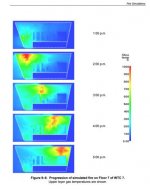
NIST tests and fire simulations apparently showed burnout after 20 to 30 minutes. See page 378 of the WTC 7 report where it says
Figure 9–9 displays hourly snapshots of the upper layer temperatures predicted by the model. The simulations indicated that the clusters of workstations burned out in about 20 min to 30 min.
So you're going to cite vaguely to the NIST simulation and not to the Cardington study data that is right in front of you? Come on, Tony. You claim there is 25-30 min period in the Cardington data in which 99% of the heat transfer occurs. When does it start and when does it end?
I'll pull up the NIST report to figure out how you are misrepresenting it in the mean time.
If anyone is misrepresenting anything it is you through not having an appreciation of how heat is transferred.
You seem to think that the heat transfer rate from a 900 C gas temperature into steel is the same whether the steel is at 20 C or 800 C and it is most certainly not.