Vixen
Penultimate Amazing

Good account of the hearing today by ILTA-LEHTI.
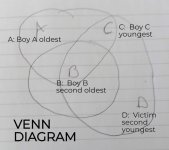
To sum up, the verdict and sentencing will be on 24 March 2021. The prosecutor demands 9years and six months for Boy B, 12 years for Boy A, and 11 years for Boy C.
Here are some excerpts of the legal arguments here:
9:45 a.m .: The prosecutor explains why the act is murder
So, it looks as though Boy A will likely get 12 years, Boy B, 9.5 years and Boy C, 11 years, if found guilty of murder. It will be a lot less if aggravated assault is accepted instead and/or manslaughter (second degree murder). On the other hand, even if the verdict and sentences are the maximum or the lesser ones, a further three years can be added on due to joint enterprise to commit the crime by more than one person (conspiracy). So Boy A could be looking at 15 years maximum, Boy B, 12 years six months and Boy C, 14 years.
To sum up, the verdict and sentencing will be on 24 March 2021. The prosecutor demands 9years and six months for Boy B, 12 years for Boy A, and 11 years for Boy C.
Here are some excerpts of the legal arguments here:
At 9:15 the session begins
At the beginning of the hearing, the alternative charges presented by the prosecutor and the answers to them are read.
Alternative charges include aggravated assault and aggravated death penalty. Alternative charges for one boy include aiding and abetting murder and aiding and abetting abuse.
9:20 a.m. Closing remarks begin
The final statements will now be read. Beginning deals with assault charges related to the other two accused violence perpetrated by the eldest boy. Evidence of this is, among other things, messages between the accused and medical statements.
9:30 a.m .: The prosecutor explains the consensus
The prosecutor is now going through a consensual process. Consensus can also be formed during the course of action. Central to this is knowledge of the crimes that are going to be committed. The prosecutor brings up the term "domination of the act," which means that everyone has been involved in the act and in control of the situation. In the opinion of the prosecutor, everyone has contributed to the act.
9:35 a.m .: Prosecutor presents messages
So now we are dealing with a murder charge. The prosecutor, on the other hand, reads messages between the accused, in which, according to the prosecutor, violence and watering of the victim are planned. The posts talk about beating and beating. The prosecutor describes the use of the words "beat" and "hack" in the messages, which means that the violence has been serious.
"Niidii will beat (the victim) tomorrow," one message said, among other things.
The messages also talked about the victim's "coldness", which, according to the prosecutor, indicates that the perpetrators knew that the victim had had a cold in the past because of light clothing. The prosecutor notes that despite this, the defendants left the victim lying out in the cold air in an uninformed state.
9:45 a.m .: The prosecutor explains why the act is murder
The prosecutor now explains why he thinks the act is murder. The key is that the act is particularly cruel and cruel to the prosecutor.
The prosecutor again describes the violence inflicted on the victim and its seriousness.
The prosecutor talks about the probability of probability, ie that the prosecutor believes that the perpetrators must have considered the death of the victim as a probable consequence. The prosecutor does not claim that this was intentional, that is, that the killing was the express intention of the accused.
9:54 a.m .: Loud defense of the victim's relatives
The victim's assistant agrees with the prosecutors' allegations. He stresses that all the boys were involved in the violence. Without their actions, the victim would not have died. Everything the respondents themselves have said is very serious violence and clear humiliation. In addition, the victim was left alone to die.
“The allegations that it would not have been entirely clear that the victim would die in that situation are utterly outrageous,” the relatives ’legal counsel says.
10 a.m.: Respondents' final statements
We now turn to the final statements of the respondents. First up is the defense of the youngest boy. His lawyer Jarkko Jaatela wants to present in the final statement something related to health information that is confidential. Therefore, the sound will be cut off at some point in the media hall when these things come up.
The defense reiterates that the boy admits an alternative charge, namely aggravated assault and aggravated death.
.The boy largely accepts the prosecutor's description of the violence he committed. However, the defense argues that the eldest boy was responsible for the most serious violence, and the youngest boy also sometimes tried to reassure the eldest. According to the defense of the youngest boy, it is a question of whether the youngest boy can also be held responsible for the violence perpetrated by the eldest boy. It is undisputed that the eldest boy committed the most serious violence against the victim.
However, the youngest boy does not admit that it was an intentional act. According to the defense, he did not accept or be involved in the most serious violence perpetrated against the victim. In addition, the boy's defense notes that the victim did not die until several hours after the accused left the scene
10:19 a.m .: The defense of the youngest boy continues
The defense of the youngest boy is still in the voice. He points out that when considering what the perpetrator should have understood from the consequences of the act, the young age of the accused must also be taken into account.
The defense also takes the view that it has not emerged that such serious violence was intended to be directed at the victim in advance.
The defense also alleges that the youngest boy tried to reassure the oldest boy but failed. The seriousness of the violence came as a surprise to the youngest boy, according to the defense. The defense therefore considers that there was no consensus, as an attempt was made to prevent and reassure the eldest boy.
10:58 a.m .: The session resumes
The sitting is resumed. The defense of the second eldest boy now gets into the voice. So this is a boy who has only admitted beating. He is defended by lawyer Dani Palviainen. He emphasizes that defendants cannot be required to understand an adult - let alone a criminal lawyer - about the consequences of the serious violence in question. According to him, the respondents have thought that the victim will at least get up on his own and go home.
The defense argues that the serious violence began after the second eldest boy had left the scene.
The defense reiterates its claim that the boy had hit the victim twice when he returned to the scene, and he is innocent of all other violence.
According to the defense, the boy has not played any part in the violence that has caused the death of the victim.
"Nothing he has done since arriving at the scene has contributed to the crime."
According to the defense, the real state of the matter only became clear to the boy the next morning when he listened to the voice message sent by the youngest boy. The youngest boy had visited the scene and realized the victim was dying.
11:20 a.m.: The eldest boy's defense out loud
The defense of the eldest boy can now give his final statement. The eldest boy is defended by lawyer Seppo Heikkilä.
He points out that other defendants have shifted responsibility to the oldest accused. Against this background, he believes that the accusations of the eldest boy of assaulting the other two boys should be rejected. There is a word against the word.
Then we talk about the murder charge. According to the defense, the beating with an iron pipe has come to light as told by the co-defendants, ie the two younger defendants. The defense of the eldest boy calls into question the reliability of these accounts precisely because, he says, an attempt has been made to roll the blame on the necks of the eldest boy.
"It is reasonable to think that my principal has been causing major injuries. It is not really possible to know whether they have all been caused by my principal," the lawyer says.
The defense's view is that no act has been used in the act in such a way that the defendant would have understood in the circumstances that the events would lead to death.
11:41 a.m .: Prosecutors' Sanctions Statement
Final statements have been received. The following is a discussion of punitive sanctions and prescribing for a state of mind examination.
Prosecutors point out that the accused could be sentenced to up to 15 years in prison. Under the age of 18, the penalty for murder is 2 to 12 years. However, this twelve-year limit may be exceeded by three years in the case of a joint offense involving several offenses.
Second, the prosecutor demands a term of imprisonment of at least 9 years and 6 months for the second eldest boy, a term of imprisonment of at least 12 years for the eldest boy, and a term of imprisonment of at least 11 years for the youngest boy. The prosecutor demands that the defendants remain detained.
11:53 a.m .: Defensive Sentences
Secondly, the defense of the eldest boy considers that the period of pre-trial detention already completed could possibly be sufficient to punish the boy for the act. The defense demands the second eldest boy be released from pre-trial detention. The eldest boy’s defense does not oppose being held captive.
The final discussion will now turn to prescribing a state of mind survey. This section is reviewed without being present in the audience.
12:10 pm: The sitting will continue in public
The sitting will continue in public. The session is followed immediately by a 10-minute break. During the break, the court is likely to consider a request for the release of at least one boy. It is not known whether a decision will be made to order a state of mind survey today.
12:21: Solution coming 24.3.
The judge says that the solution in the case will not be given today, but on March 24. It remains unclear whether this is a final decision or an interlocutory decision ordering a mental health test.
All respondents are still being held in custody.
So, it looks as though Boy A will likely get 12 years, Boy B, 9.5 years and Boy C, 11 years, if found guilty of murder. It will be a lot less if aggravated assault is accepted instead and/or manslaughter (second degree murder). On the other hand, even if the verdict and sentences are the maximum or the lesser ones, a further three years can be added on due to joint enterprise to commit the crime by more than one person (conspiracy). So Boy A could be looking at 15 years maximum, Boy B, 12 years six months and Boy C, 14 years.