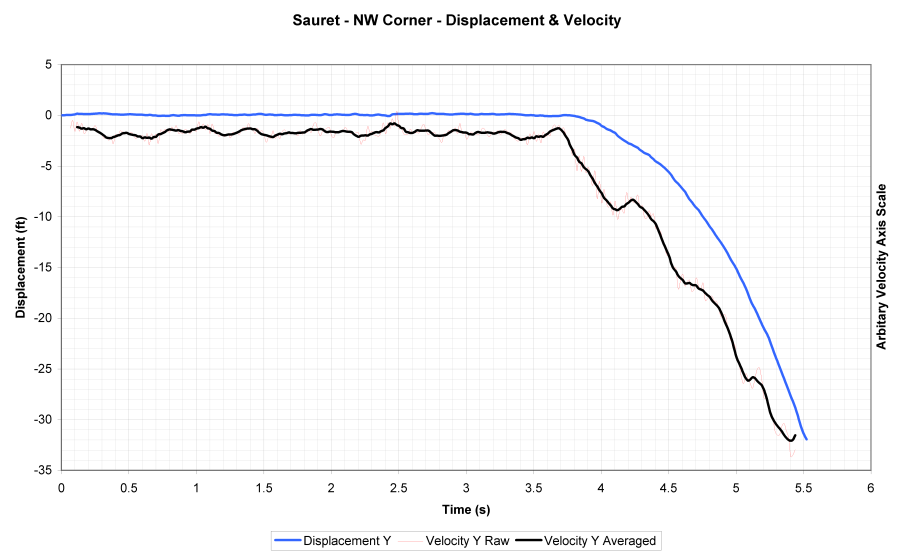
Great resource there W.D.C - thanks. A word of caution:
Don't lose sight of the fact that Tony Sz. is operating within a false context. Sure he blames it on Bazant and NIST but he is working on a base premise that impact of the top block onto the lower tower necessarily required one big jolt. From "The Missing Jolt" we see:
As Bazant has said, when the top part fell and struck the stories beneath it, there had to be a powerful jolt. While a jolt entails acceleration of the impacted object it requires deceleration of the impacting object. Even a hammer hitting a nail decelerates, and if the hammer is striking a strong, rigid body fixed to the earth its deceleration will be abrupt and dramatic.
Although NIST does not explicitly speak, like Bazant, of a “jolt”, and may therefore be thought to evade this paper’s refutation, it is impossible for NIST to escape the implications of its own assertions. The NIST report speaks of a strong, rigid structure (the upper structure or rigid block) falling freely onto another strong, rigid structure (the intact part of the building below the damaged area): the jolt cannot be avoided. [14]
This was a necessary jolt. Without it the required work could not have been done...
Well I doubt that many of us posting here would agree with that scenario. I certainly don't. The scenario can be seen as a necessary follow on to the assumptions that Bazant made in BZ. But that is a gross misuse of those simplifying assumptions. The falling ends of columns in the top block did not fall miraculously onto their bottom parts in the lower tower transferring the full strength/full load bearing therefore causing a jolt as the columns buckled or otherwise failed. The whole scenario is rubbish.
As therefore is Tony's conclusion:
Conclusions:
We have tracked the fall of the roof of the North Tower through 114.4 feet, (approximately 9 stories) and we have found that it did not suffer severe and sudden impact or abrupt
deceleration. There was no jolt. Thus there could not have been any amplified load. In the
absence of an amplified load there is no mechanism to explain the collapse of the lower portion of the building, which was undamaged by fire. The collapse hypothesis of Bazant and the authors of the NIST report has not withstood scrutiny....
Picking the bits:
"There was no jolt." - certainly there was no single big jolt. But lots of little ones.
"...there is no mechanism to explain the collapse of the lower portion of the building, which was undamaged by fire." Hogwash! My explanations and quite a few others have done so more than adequately.
"The collapse hypothesis of Bazant and the authors of the NIST report has not withstood scrutiny...." - Well, maybe. But Tony is switching objectives in mid stream. The objective is not "prove Bazant and NIST wrong". It is (or should be) explain why there was no single big jolt THEN use the learning to lead on to further analysis of what actually happened.
So what does this mean for the technical detailed work that newton3376 and W.D. Clinger are discussing?
Their work is still valid.
What we see is that there are two (at least) scenarios against which we can look for jolts:
1) The first is the false scenario adopted by Tony Sz. in "Missing Jolt"; OR
2) we can recognise the more valid scenario of the collapse that actually happened; no single rigid block on rigid tower causing a single big jolt; a multiplicity of separate impacts potentially each causing its own mini jolt.
How far we can realistically and usefully pursue the path of "mini-jolts" is something I would question. But the Clinger/newton enquiries should serve to get the measurement right or at least as good as can be achieved.