• Quick note - the problem with Youtube videos not embedding on the forum appears to have been fixed, thanks to ZiprHead. If you do still see problems let me know.

Szamboti's Missing Jolt paper

Once again.....

Here is my question...

I guess what I am asking is this....

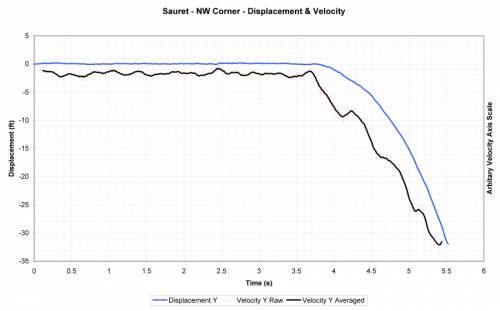
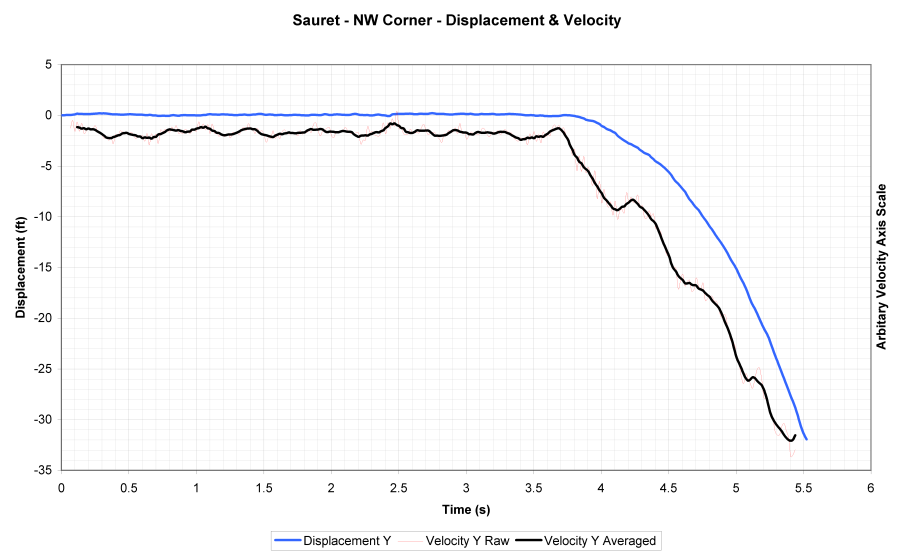
In the missing jolt paper the authors use "symmetric differencing" to approximate the velocity using the raw data...

W.D. Clinger is using a slightly different method from the raw data to calculate the velocity...

So my question is this.....since the two different methods appear to me to yield different results...which one is "more" correct?

Or are neither technically "correct" due to measurement error inherent in the raw data?


Now don't get me wrong....I don't think the real life "jolts" that caused the structure to fall at less than free fall acceleration would be measurable using Tony's method ANYWAY...so my question is more of a math one.

From what I remember using this equation:

(f(a+h)-f(a-h))/2h


Is generally more accurate of an approximation that this equation:

(f(a+h) -f(a))/h
 
Even with an ROOSD-type collapse, with building contents funneling through the perimeter and core structures, we would see pauses and punctuations in this kind of collapse.
We do, just not with the largely disconnected upper NW corner.

Initial moments of ROOSD are likely very "jolty" indeed.

"Mini jolts" are also present for the NW corner itself...


It would not proceed at the rapid and uniform pace we see.
It did. ROOSD-type internal descent explains the linear behaviour quite well.

Here's a primitive simulation in smearogram form...
417385938.png


Note the linear descent behaviour.

There are the MER floors
Do you think there's no change through the MER floors ?

as well as all manner of other widely ranging variables which will have a visible influence on the rate of destruction.
What ?

You guys know this. I don't why you would pretend otherwise.
Please provide the requested additional information.
 
Even with an ROOSD-type collapse, with building contents funneling through the perimeter and core structures, we would see pauses and punctuations in this kind of collapse. It would not proceed at the rapid and uniform pace we see. Twice. There are the MER floors, for one, as well as all manner of other widely ranging variables which will have a visible influence on the rate of destruction.

tee hee hee....

You say this based on what - the many other examples of buildings collapsing as in WTC1 and 2?
 
...2) The faulty premise of descent mechanism is based upon that proposed by Bazant and co. Yes, I'm fully aware of the scope of applicability of that. But without an "official" alternative mechanism, he's locked himself in....
If that statement is true therein lies his first mistake. He was trying to explain evidence for CD based on a mechanism. It is his fault if he adopts someone else's work without understanding whether or not it is appropriate or accurate or relevant. He has no clear understanding of the mechanism which underlies his maths. As I have said several times (ad nauseum :rolleyes: ) there is no point engaging maths unless you are clear what you are applying it to. Several recent posts also skirt dangerously close to that mistake if indeed they don't fall into the trap.

....Given the details of ROOSD he has been presented with, and the specific additional information given directly to him, there's really no excuse for him not to have re-done the calcs with the ROOSD mechanism,...
He measures over several storeys of collapse therefore he is into "ROOSD" territory but he was looking for the first big jolt. That jolt is either "initiation phase" or the boundary between "initiation/progression". (Yes - however we may define that :rolleyes:)

Yes there would be (lots of little) jolts through progression. Yes it is likely that the MER levels would have different sized jolts. But those considerations are strictly outside what Tony was looking for if my understanding is correct.
... i.e. but in the same breath I don't think it's entirely fair to point at faulty foundations without highlighting that they come not directly from Tony, but from Bazant and co...
Disagree with that. He was putting forward serious claims. His responsibility to gain sufficient understanding of the mechanisms he was attempting to explain to support his claim. The Missing Jolt paper reeks of lack of understanding of mechanisms. I have always seen that he was at or beyond his level of understanding of mechanisms - whether or not the maths is correct.
....What alternate "official" mechanism should he use ?
Why should he need an official mechanism? Why be limited? Why use Bazant et al with its known assumptions when those assumptions invalidate use of Bazant for the purpose Tony attempted?
I agree that there are "mini jolts" detectable from the NW corner traces of WTC1, but from prior discussion with Tony,I think his resistance stems from two very different positions...

1) He doesn't "want" to address the issues, as the jolts that have been found are not, in his opinion, big enough. I disagree....
In my interactions with him I carefully explained some of the areas of error to him and he stonewalled reasoned discussion with snide comments and personal slurs. Yes I was confronting in style - not trying to persuade by soft soaping.
 
...Even with an ROOSD-type collapse, with building contents funneling through the perimeter and core structures, we would see pauses and punctuations in this kind of collapse. It would not proceed at the rapid and uniform pace we see. Twice. There are the MER floors, for one, as well as all manner of other widely ranging variables which will have a[n] visible influence on the rate of destruction.....
Qualitatively correct ergo.

Quantitatively wrong. The greyed out bits are wrong.
 
Disagree with that. He was putting forward serious claims. His responsibility to gain sufficient understanding of the mechanisms he was attempting to explain to support his claim. The Missing Jolt paper reeks of lack of understanding of mechanisms.

The exact same thing can be said of BLGB.

Do you remember what I jokingly called HTFCPNST-class perimeter movement in the other forum?

They missed that and so much more. They claimed that there was little of use in the photo record for WTC1 after the first 3 seconds of visible movement.

They were way, way wrong. There were plenty of clues in the visual record during the entire collapse as some of us have been showing for the last few years. There was a mountain of overlooked information within the visual record. HTFCPNST-class objects are just one (really big) example.

All 4 observations in the original OOS Model were gathered from the same photo record that BLGB considers useless after the first 3 seconds.


He basically tossed out the photo record for WTC1 after the first 3 seconds, considering it useless, and few people seemed smart enough to verify whether useful, extractable information existed beyond that point. The few who looked carefully found enough information, such as HTFCPNST-class perimeter movement, to identify evidence for a different type of mechanism which I call ROOSD.
 
Last edited:
I guess what I am asking is this....

In the missing jolt paper the authors use "symmetric differencing" to approximate the velocity using the raw data...

W.D. Clinger is using a slightly different method from the raw data to calculate the velocity...

So my question is this.....since the two different methods appear to me to yield different results...which one is "more" correct?

Or are neither technically "correct" due to measurement error inherent in the raw data?
Most methods have advantages and disadvantages, so most methods are better suited to answering certain questions than others. That's why intelligent discussion of which methods are more correct must begin with the question(s) we're trying to answer.

From what I remember using this equation:

(f(a+h)-f(a-h))/2h


Is generally more accurate of an approximation that this equation:

(f(a+h) -f(a))/h
The first equation is more accurate is you're attempting to compute a smoothed average acceleration, where the smoothing interval is twice the duration between adjacent data points. The second equation is more appropriate if you're honestly trying to see whether there was a jolt whose duration was comparable to or less than the duration between two adjacent data points.

As I explained on 7 June 2010, balanced differencing hides the jolt that was apparent in the data reported by MacQueen and Szamboti in their original paper on the alleged missing jolt and in at least their first six revisions of that paper.

On 4 July 2010, I dissected the Chandler/MacQueen/Szamboti fallacy:
To summarize:
  • The Chandler-MacQueen-Szamboti fallacy is built upon failure to understand the fundamental theorem of sampling.
  • Most plausible reconstructions of the raw data published by Chandler and by MacQueen/Szamboti involve actual decelerations.
  • No competent scientist would argue that the sampled data rule out decelerations.
I do not know whether any jolts can be reliably inferred from the best available data. Tony Szamboti's persistent denials of the apparent jolt that's present in his own data are mainly important as a case study in how delusion begets incompetence and/or dishonesty.

Unfortunately, the history of Tony's denials are spread over a long period of time and many threads. Here's a partial history of my personal interactions with Tony, with asterisks indicating some of the more important posts:

Szamboti's Missing Jolt paper, 10-30 January 2010

http://www.internationalskeptics.com/forums/showthread.php?postid=5499933#post5499933
http://www.internationalskeptics.com/forums/showthread.php?postid=5500142#post5500142
http://www.internationalskeptics.com/forums/showthread.php?postid=5500674#post5500674
http://www.internationalskeptics.com/forums/showthread.php?postid=5502130#post5502130
http://www.internationalskeptics.com/forums/showthread.php?postid=5539626#post5539626 (*)
http://www.internationalskeptics.com/forums/showthread.php?postid=5544701#post5544701 (*)
http://www.internationalskeptics.com/forums/showthread.php?postid=5544749#post5544749
http://www.internationalskeptics.com/forums/showthread.php?postid=5544806#post5544806 (*)
http://www.internationalskeptics.com/forums/showthread.php?postid=5567556#post5567556 (*)

Care to Comment, 4-8 June 2010

http://www.internationalskeptics.com/forums/showthread.php?postid=5998163#post5998163
http://www.internationalskeptics.com/forums/showthread.php?postid=6000683#post6000683
http://www.internationalskeptics.com/forums/showthread.php?postid=6001634#post6001634 (*)
http://www.internationalskeptics.com/forums/showthread.php?postid=6005423#post6005423 (*)
http://www.internationalskeptics.com/forums/showthread.php?postid=6005642#post6005642 (*)
http://www.internationalskeptics.com/forums/showthread.php?postid=6006591#post6006591
http://www.internationalskeptics.com/forums/showthread.php?postid=6007716#post6007716 (*)
http://www.internationalskeptics.com/forums/showthread.php?postid=6010506#post6010506
http://www.internationalskeptics.com/forums/showthread.php?postid=6012676#post6012676 (*)
http://www.internationalskeptics.com/forums/showthread.php?postid=6014411#post6014411
http://www.internationalskeptics.com/forums/showthread.php?postid=6034519#post6034519 (*)

The physics toolkit, 2-8 July 2010

http://www.internationalskeptics.com/forums/showthread.php?postid=6087629#post6087629
http://www.internationalskeptics.com/forums/showthread.php?postid=6091381#post6091381
http://www.internationalskeptics.com/forums/showthread.php?postid=6091769#post6091769
http://www.internationalskeptics.com/forums/showthread.php?postid=6092716#post6092716
http://www.internationalskeptics.com/forums/showthread.php?postid=6094041#post6094041 (*)
http://www.internationalskeptics.com/forums/showthread.php?postid=6097612#post6097612
http://www.internationalskeptics.com/forums/showthread.php?postid=6097727#post6097727
http://www.internationalskeptics.com/forums/showthread.php?postid=6104949#post6104949
 
Last edited:
Most methods have advantages and disadvantages, so most methods are better suited to answering certain questions than others. That's why intelligent discussion of which methods are more correct must begin with the question(s) we're trying to answer.


The first equation is more accurate is you're attempting to compute a smoothed average acceleration, where the smoothing interval is twice the duration between adjacent data points. The second equation is more appropriate if you're honestly trying to see whether there was a jolt whose duration was comparable to or less than the duration between two adjacent data points.

As I explained on 7 June 2010, balanced differencing hides the jolt that was apparent in the data reported by MacQueen and Szamboti in their original paper on the alleged missing jolt and in at least their first six revisions of that paper.

On 4 July 2010, I dissected the Chandler/MacQueen/Szamboti fallacy:

Thanks for the links....I think I started reading those threads but never finished them....I've only just recently taken a serious look at the "missing jolt paper" and was wondering why they used the methods they did.....

I'll have a look through the threads you linked. It appears I missed the entire discussion about sampling rate...should prove a good read.
 
Great resource there W.D.C - thanks. A word of caution:

Don't lose sight of the fact that Tony Sz. is operating within a false context. Sure he blames it on Bazant and NIST but he is working on a base premise that impact of the top block onto the lower tower necessarily required one big jolt. From "The Missing Jolt" we see:
As Bazant has said, when the top part fell and struck the stories beneath it, there had to be a powerful jolt. While a jolt entails acceleration of the impacted object it requires deceleration of the impacting object. Even a hammer hitting a nail decelerates, and if the hammer is striking a strong, rigid body fixed to the earth its deceleration will be abrupt and dramatic.
Although NIST does not explicitly speak, like Bazant, of a “jolt”, and may therefore be thought to evade this paper’s refutation, it is impossible for NIST to escape the implications of its own assertions. The NIST report speaks of a strong, rigid structure (the upper structure or rigid block) falling freely onto another strong, rigid structure (the intact part of the building below the damaged area): the jolt cannot be avoided. [14]
This was a necessary jolt. Without it the required work could not have been done...

Well I doubt that many of us posting here would agree with that scenario. I certainly don't. The scenario can be seen as a necessary follow on to the assumptions that Bazant made in BZ. But that is a gross misuse of those simplifying assumptions. The falling ends of columns in the top block did not fall miraculously onto their bottom parts in the lower tower transferring the full strength/full load bearing therefore causing a jolt as the columns buckled or otherwise failed. The whole scenario is rubbish.

As therefore is Tony's conclusion:
Conclusions:
We have tracked the fall of the roof of the North Tower through 114.4 feet, (approximately 9 stories) and we have found that it did not suffer severe and sudden impact or abrupt
deceleration. There was no jolt. Thus there could not have been any amplified load. In the
absence of an amplified load there is no mechanism to explain the collapse of the lower portion of the building, which was undamaged by fire. The collapse hypothesis of Bazant and the authors of the NIST report has not withstood scrutiny....
Picking the bits:
"There was no jolt." - certainly there was no single big jolt. But lots of little ones.
"...there is no mechanism to explain the collapse of the lower portion of the building, which was undamaged by fire." Hogwash! My explanations and quite a few others have done so more than adequately.
"The collapse hypothesis of Bazant and the authors of the NIST report has not withstood scrutiny...." - Well, maybe. But Tony is switching objectives in mid stream. The objective is not "prove Bazant and NIST wrong". It is (or should be) explain why there was no single big jolt THEN use the learning to lead on to further analysis of what actually happened.

So what does this mean for the technical detailed work that newton3376 and W.D. Clinger are discussing?

Their work is still valid.

What we see is that there are two (at least) scenarios against which we can look for jolts:
1) The first is the false scenario adopted by Tony Sz. in "Missing Jolt"; OR
2) we can recognise the more valid scenario of the collapse that actually happened; no single rigid block on rigid tower causing a single big jolt; a multiplicity of separate impacts potentially each causing its own mini jolt.

How far we can realistically and usefully pursue the path of "mini-jolts" is something I would question. But the Clinger/newton enquiries should serve to get the measurement right or at least as good as can be achieved.
 
BV figure 3:

buckle_phases.gif


The first spike in resistance is as the column starts to buckle, then the resistance drops off.

At the point marked "rehardening", there is a collision and hence a second spike in resistance.

Tony seems to be looking for proof of the "rehardening" spike in resistance, the second spike.

........................

I am just showing how one misrepresentation leads to another.
 
Last edited:
BV figure 3:

buckle_phases.gif


The first spike in resistance is as the column starts to buckle, then the resistance drops off....
None of which occurred in the actual collapse as a buckling of a single element which was big enough to cause a single jolt. The classic buckling probably occurred for quite a few individual columns in the collapse initiation phase BUT all staggered in time sufficient to ensure that there was no single big jolt.

And very few if any columns failed in buckling in the global collapse/progression stage.

....I am just showing how one misrepresentation leads to another.
That is a truism. I'm not sure how your comments support it however.
 
Don't lose sight of the fact that Tony Sz. is operating within a false context. Sure he blames it on Bazant and NIST but he is working on a base premise that impact of the top block onto the lower tower necessarily required one big jolt.
Agreed.

On 10 January 2010, over a year and a half ago, I cited R.Mackey's explanation of this:
You have repeatedly refused to address the margin of error in your measurements and its consequences for your argument. You have also refused to recognize that a slightly tilted and structurally compromised upper section will smear the jolt over a longer period of time, as compared to a perfectly vertical upper section with uncompromised rigidity, which reduces the effect you are trying to see.

...snip...

I've seen several people attempt to draw your attention to these matters in several different threads, without success. At this point, I think it's fair to conclude you really don't understand these matters at all and have no intention of understanding them.


The following day, I wrote:
Well, Tony's right if you accept his assumptions. He's modelling the impact of the upper section on the floor below as two perfectly rigid bodies undergoing a perfectly inelastic collision (meaning they stick together and move as one body after the collision). In that model, the falling body does lose some velocity when it hits the stationary body, and that is Tony's jolt. Tony's been ignoring the question of whether that jolt would be observable (even if his idealized model were applicable), but he's right about the physics of his idealized model.

Another idealized model is a ball rolling down an inclined plane. For that model, there is no jolt.

The WTC collapse was more chaotic than either of those idealized models, and belongs somewhere within the large gap between them.
I was actually quite surprised by the fact that Tony Szamboti's own data contain jolts summing to the magnitude predicted by MacQueen and Szamboti.

I didn't take that too seriously because Tony's data weren't very good. femr2's data, which I believe to be far better than Tony's, show smaller jolts that are more in line with what I expected, but the reality of those jolts is not entirely beyond question either. We can, however, say this with complete certainty:
  • Both the MacQueen/Szamboti data and femr2's data reveal apparent decelerations (jolts).
  • No competent scientist would argue that the data rule out decelerations.
 
Interesting background there W. D. Clinger. I comprehend and agree with your comments including those which address theoretical situations as opposed to the reality of what happened at WTC on 9/11

When I first engaged Tony over "Missing Jolt" here on JREF I noted for other members the introduction to my first ever post on the Internet. 13 Nov 2007 on the now defunct Richard Dawkins net where my second paragraph was:
The paper referenced as Engineering Reality by Tony Szamboti is typical of many which look impressive in detail to the non-engineer. The complex calculations may even be correct but the base premises are faulty and the resulting conclusions can readily be demonstrated to be totally wrong.
It seems once again that nothing changes. :) I tried some months back to locate the "Engineering Reality" paper but it seems it is no longer available, at least in the original form, So I cannot recall or reconstruct the basis for my objections stated in 2007. However "Missing Jolt" has the same generic problems - whether or not the maths is correct it is not sitting on a valid model of WTC 9/11.
 
We do, just not with the largely disconnected upper NW corner.

Initial moments of ROOSD are likely very "jolty" indeed.

"Mini jolts" are also present for the NW corner itself...

"Mini jolts"? Undetectable to the human eye? Due to the mini steel columns? Who are you trying to kid?

Seriously, what kind of game is this?
 

Back
Top Bottom