Summary of WTC tower collapses

Nonsense.

https://youtu.be/y9-owhllM9k?t=28

The buildings were not hermetically sealed between floors.

What anyone can see in this video, if they choose to open their eyes, does not match your claims that air did this. Some of you claim the collapsing floors pulverized the office furnishings, and now you're claiming air. Which one is it? You really should get together and try to be consistent with your fantasies.

I made this greyscale, to not let the blurred colors distract the view of blast-formations and small flashes. It can also be seen that just before the antenna starts to drop, something blast-like happens in the upper left corner.


:dl:

Something "blast-like"
Can't make this stuff up. Whoever uploaded that video with that description is a freakin moron. Have you ever heard of a bellows? Have you no common sense?
Nobody is claiming air pulverized the contents. Air is what's being ejected.

Man. just. wow.
This is a game for you isn't it? Nobody with intelligence enough to tie their shoes, much less operate a computer, can think explosives are responsible for the collapse of the twin towers. It is literally THAT stupid.
 
Unlike your sheet of plywood, the collapse mechanism generated the dust.

Unlike your dropping concrete block, there was no body of water being impacted.

Surely you can't deny this?
The fact that plywood does not create more dust that what is already on them, and the fact that nothing at WTC was dropped into water, are not important( to the point JSO was making).
,,,and stop calling him "Shirley"
 
Last edited:
:dl:

Something "blast-like"
Can't make this stuff up. Whoever uploaded that video with that description is a freakin moron. Have you ever heard of a bellows? Have you no common sense?
Nobody is claiming air pulverized the contents. Air is what's being ejected.

He cannot envision air coming out of the building so its unsurprising that he csn't envision the effect of moving vast quantity of air into a volume of burning material.
 
At the conclusion of all three collapses there was a outward blast of hot air laden with dust... basically the same phenomena... the collapse pulled a low pressure behind (above ) it which created a huge downdraft when upon hitting the hit pile of debris radiated outward in all directions full of hot dust and larger bits. There are films of this!

And the CD explanation for it would be????????????????????????

:bigclap:
 
I am satisfied, with this revision, that the description below is a solid, easy to read, generic summary of the collapses of the two WTC towers. It does not, and need not, go into either technical details such as temperature/yeild strength graphs, FEA parameters, etc., nor details of the differences in the towers themselves.
Anyone is free to link to it or quote it in whole or in part. Credit is not asked for. Note that the graphic at the end is not mine but gumboot's. It does however illustrate some of the aspects described in the text and fits well with the nature of this summary.

Revision 4a (Final):

Generic Description of the Collapse Progression of the Two WTC Towers:

Video evidence demonstrates aircraft impact destroyed or bent a number of perimeter columns. A lesser amount of core column severance or damage is expected. Some floor spans also directly damaged.

Aircraft fuel spread through several vertically adjacent floors of the structure and ignited. This created a condition of very large area office contents fire on those floors with various levels of "rubblization" of the contents. This is a fire condition well beyond design expectations for fire spread. Office fires are expected to usually begin small, in a waste basket, or an electrical fault in a device or circuit, for instance.

Aircraft impact debrided spray on fire insulation in varying degree, on a significant number of structural components on impact floors. This reduced fire resistance of those structural steel components.

Structural response to impact was a redistribution of loads previously carried by missing or foreshortened ( due to being bent) columns. Load redistribution was not even across all remaining columns.

Fire spread and movement was similar, but not identical, on each involved level and also spread to higher levels. Heat began affecting steel structural components, both vertical and horizontal, and the connecting components between them on all fire involved levels.

Floor spans had long trusses with their lower chords exposed to the heat and the trusses in several areas began sagging. A few areas had already seen truss or truss to perimeter connection failure at impact.

Perimeter columns and truss to perimeter connecting components heated less than the core columns and truss to core structure components. The interface between long span trusses and core was a belt truss rather than direct connection to core columns.

Core columns are subject to heating basically from all sides, over the several floors fully involved in the fires, and over the course of fire spread around each level.
( that is to say a column at level x may heat more on one face than that same column at level x-1 or x+1 but that over the several levels involve , and over the time period between impact and collapse, many core columns are heated on all sides.
The capability of the structure to resist any collapse was being eroded. One very obvious indication of this is the inward bowing of part of the perimeter. Each tower also twisted and tilted noticeably up to collapse. These demonstrate that the structure was responding to further weakening due to the heat. Loads were continually changing and redistributing during this time. At some point a redistribution caused one or more columns to exceed its capacity. Column capacity in this case does not necessarily mean it original engineered load bearing ability. Loads were not necessarily on axis (due to impact or heat unduced creep, or expanding floor beams) and many columns were subjected to significant heating, both of which would tend to lower any individual column's strength.

At one point a rapid progression of column failures occurs. A column or columns fail and in redistributing the load, cause other columns to exceed capacity, causing another rapid load shift. Column failures rapidly progressed to all columns over one or more levels

With all columns now having failed over one or more adjacent levels, a large section of the upper building is now falling, accelerating to next contacts. A combination of factors result in few, if any, buckled columns impacting on lower parts of themselves. Upper falling section column ends are, in many locations, the first contacts with lower structure. That contact would be proximate to the lower section columns and thus the greatest impact occurs near or directly on lower floor truss to column connecting components immediately failing the lateral support provided by those trusses. This is occurring both to long span truss to column connecting components, at perimeter and belt truss, as well as with the core's beams running between core columns.

As upper mass continues its lowest floor begins contacting floorspace below the initial failure level. This first contact is between floor systems that are already severely compromised. They are among those that have been affected by impact and heat and one has suffered loss of connections to columns as per last paragraph.

With columns largely being bypassed by the vast majority of falling upper section, they contribue very little in opposing collapse.

Concrete floor pans shatter.

Both upper structure and lower structure now have major connection failures, both in the vertical/horizontal connections as well as connections between column sections. The later is due to both the destruction of lateral support and the buffeting collisions from the falling mass.

Perimeter column "trees" peel away, the first to do so are on the order of 1000 feet above ground as they pivot away.

Collapse continues with a relatively small amount of falling mass being ejected at the collision interface. Since initial contact was an order of magnitude greater than that which the long span open floors could absorb, little effect is seen on the falling mass. This means that the still intact portion of upper mass will continue to accelerate.

Further contact of falling upper mass with lower structure will have mutual destruction of both. As collapse continues lower levels will be impacted by more mass , albeit more rubblized, that is necessarily moving faster than first contact. Those floor spans must also be hit by an order of magnitude greater load than they can withstand, and indeed greater than at that earlier, first contact impact.

There existed no mechanism by which this floor pan, truss and perimeter peel, destruction could be arrested as this continues.

The core area beam destruction may well have lagged that of the long span destruction since those beams are heavier and shorter. Evidence for this is the so called "spire" of core structure that existed momentarily after the rest of one tower had fully collapsed. Perimeter peel necessarily lags long span destruction as it is a direct result of that long span truss destruction.

Core columns stripped of inter-core lateral support succumb to a combination of slender column buckling and heavy buffeting from falling debris. A relatively small, heavily damaged, portion of the core remains after long span floor and perimeter destruction (no longer being buffeted by debris impact) but cannot remain intact and it comes apart as well


This graphic, by poster "gumboot", illustrates some of the features described in this summary.
 
Last edited:
I am satisfied, with this revision, that the description below is a solid, easy to read, generic summary of the collapses of the two WTC towers.
Agreed.
It does not, and need not, go into either technical details such as temperature/yeild strength graphs, FEA parameters, etc., nor details of the differences in the towers themselves.
Understood and agreed - it is "fit for purpose" as a summary and does not pretend to be a detailed critique.

Well done.

clap.gif
clap.gif
 
Last edited:
Agreed.
Understood and agreed - it is "fit for purpose" as a summary and does not pretend to be a detailed critique.

Well done.

[qimg]http://conleys.com.au/smilies/clap.gif[/qimg] [qimg]http://conleys.com.au/smilies/clap.gif[/qimg]

Thank you , ozeco. A few bits and pieces edited while you were typing. A sentence I wasn't happy with and some paragraph housekeeping.
 
Thank you , ozeco. A few bits and pieces edited while you were typing. A sentence I wasn't happy with and some paragraph housekeeping.
You've been copying T Sz "posting style" with post posting edits. :D

There's a spellin erer
With columns largely being bypassed by the vast majority of falling upper section, they contribute very little in opposing collapse.
- may be more I'm not a good proof reader at that level of detail.
 
I still have a problem with some of this... columns were 3 stories and makes no sense to refer to a core column failing on "one level"...a core column failure involved 3 levels of connected structure and floors.

The floor trusses on the core side were carried on a rolled steel "belt" girder which was cantilevered from/off of the 24 perimeter core columns... OOS bar trusses did not align with the core columns... the belt girder was a "transfer" structure not a truss and it's local failure could involve a large portion of the OOS floor slabs.

Please look at my "edit" in red above...

I think dented / bent columns can still support the applied loads as long as their connections to the column are sound. Bent is shorter perhaps and this can warp the frame, stress joints and fracture slabs.

"debrided" needs to change:


Definition of debridement

: the usually surgical removal of lacerated, devitalized, or contaminated tissue
 
Last edited:
I still have a problem with some of this... columns were 3 stories and makes no sense to refer to a core column failing on "one level"...a core column failure involved 3 levels of connected structure and floors.
Not sure where in the summary you are referring to. I rewrote the bit concerning column failure, and several times I make the case that failures occurred over several levels.

The floor trusses on the core side were carried on a rolled steel "belt" girder which was cantilevered from/off of the 24 perimeter core columns... OOS bar trusses did not align with the core columns... the belt girder was a "transfer" structure not a truss and it's local failure could involve a large portion of the OOS floor slabs.
Yes, the belt girder is included. Its a summary, intricate detail of the belt girder is not required.

I think dented / bent columns can still support the applied loads as long as their connections to the column are sound. Bent is shorter perhaps and this can warp the frame, stress joints and fracture slabs.

If a column is shorter, vertically, then loads must spread to adjacent columns.

Definition of debridement

: the usually surgical removal of lacerated, devitalized, or contaminated tissue
Noted, change to "abraded".
 
I am again.... (spelling errors corrected, changed "debrided" to "abraded")satisfied, with this revision, that the description below is a solid, easy to read, generic summary of the collapses of the two WTC towers. It does not, and need not, go into either technical details such as temperature/yeild strength graphs, FEA parameters, etc., nor details of the differences in the towers themselves.
Anyone is free to link to it or quote it in whole or in part. Credit is not asked for. Note that the graphic at the end is not mine but gumboot's. It does however illustrate some of the aspects described in the text and fits well with the nature of this summary.
Yes ozeco, there were a couple other spellin erers. My tablet only 'sees' spelling as I type. (My work computer spell checks the entire page and underlines them in red for me)

Revision 4b (Final):

Generic Description of the Collapse Progression of the Two WTC Towers:

Video evidence demonstrates aircraft impact destroyed or bent a number of perimeter columns. A lesser amount of core column severance or damage is expected. Some floor spans also directly damaged.

Aircraft fuel spread through several vertically adjacent floors of the structure and ignited. This created a condition of very large area office contents fire on those floors with various levels of "rubblization" of the contents. This is a fire condition well beyond design expectations for fire spread. Office fires are expected to usually begin small, in a waste basket, or an electrical fault in a device or circuit, for instance.

Aircraft impact abraded spray on fire insulation in varying degree, on a significant number of structural components on impact floors. This reduced fire resistance of those structural steel components.

Structural response to impact was a redistribution of loads previously carried by missing or foreshortened ( due to being bent) columns. Load redistribution was not even across all remaining columns.

Fire spread and movement was similar, but not identical, on each involved level and also spread to higher levels. Heat began affecting steel structural components, both vertical and horizontal, and the connecting components between them on all fire involved levels.

Floor spans had long trusses with their lower chords exposed to the heat and the trusses in several areas began sagging. A few areas had already seen truss or truss to perimeter connection failure at impact.

Perimeter columns and truss to perimeter connecting components heated less than the core columns and truss to core structure components. The interface between long span trusses and core was a belt truss rather than direct connection to core columns.

Core columns are subject to heating basically from all sides, over the several floors fully involved in the fires, and over the course of fire spread around each level.
( that is to say a column at level x may heat more on one face than that same column at level x-1 or x+1 but that over the several levels involve , and over the time period between impact and collapse, many core columns are heated on all sides.)
The capability of the structure to resist any collapse was being eroded. One very obvious indication of this is the inward bowing of part of the perimeter. Each tower also twisted and tilted noticeably up to collapse. These demonstrate that the structure was responding to further weakening due to the heat. Loads were continually changing and redistributing during this time. At some point a redistribution caused one or more columns to exceed its capacity. Column capacity in this case does not necessarily mean it original engineered load bearing ability. Loads were not necessarily on axis (due to impact or heat induced creep, or expanding floor beams) and many columns were subjected to significant heating, both of which would tend to lower any individual column's strength.

At one point a rapid progression of column failures occurs. A column or columns fail and in redistributing the load, cause other columns to exceed capacity, causing another rapid load shift. Column failures rapidly progressed to all columns over one or more levels

With all columns now having failed over one or more adjacent levels, a large section of the upper building is now falling, accelerating to next contacts. A combination of factors result in few, if any, buckled columns impacting on lower parts of themselves. Upper falling section column ends are, in many locations, the first contacts with lower structure. That contact would be proximate to the lower section columns and thus the greatest impact occurs near or directly on lower floor truss to column connecting components immediately failing the lateral support provided by those trusses. This is occurring both to long span truss to column connecting components, at perimeter and belt truss, as well as with the core's beams running between core columns.

As upper mass continues its lowest floor begins contacting floorspace below the initial failure level. This first contact is between floor systems that are already severely compromised. They are among those that have been affected by impact and heat and one has suffered loss of connections to columns as per last paragraph.

With columns largely being bypassed by the vast majority of falling upper section, they contribute very little in opposing collapse.

Concrete floor pans shatter.

Both upper structure and lower structure now have major connection failures, both in the vertical/horizontal connections as well as connections between column sections. The later is due to both the destruction of lateral support and the buffeting collisions from the falling mass.

Perimeter column "trees" peel away, the first to do so are on the order of 1000 feet above ground as they pivot away.

Collapse continues with a relatively small amount of falling mass being ejected at the collision interface. Since initial contact was an order of magnitude greater than that which the long span open floors could absorb, little effect is seen on the falling mass. This means that the still intact portion of upper mass will continue to accelerate.

Further contact of falling upper mass with lower structure will have mutual destruction of both. As collapse continues lower levels will be impacted by more mass , albeit more "rubblized", that is necessarily moving faster than first contact. Those floor spans must also be hit by an order of magnitude greater load than they can withstand, and indeed greater than at that earlier, first contact impact.

There existed no mechanism by which this floor pan, truss and perimeter peel, destruction could be arrested as this continues.

The core area beam destruction may well have lagged that of the long span destruction since those beams are heavier and shorter. Evidence for this is the so called "spire" of core structure that existed momentarily after the rest of one tower had fully collapsed. Perimeter peel necessarily lags long span destruction as it is a direct result of that long span truss destruction.

Core columns stripped of inter-core lateral support succumb to a combination of slender column buckling and heavy buffeting from falling debris. A relatively small, heavily damaged, portion of the core remains after long span floor and perimeter destruction (no longer being buffeted by debris impact) but cannot remain intact and it comes apart as well


This graphic, by poster "gumboot", illustrates some of the features described in this summary.
 
Last edited:
Not sure where in the summary you are referring to. I rewrote the bit concerning column failure, and several times I make the case that failures occurred over several levels.


Yes, the belt girder is included. Its a summary, intricate detail of the belt girder is not required.


If a column is shorter, vertically, then loads must spread to adjacent columns.


Noted, change to "abraded".


I refer to my edit in post #285.

I am not sure I understand why a dented column no longer carries the loads it formerly had and that they are redistributed. Admittedly the damaged column's yield strength has been reduced.... same as when you slice a chunk out of it. Think of felling a tree.. as you saw the notch the weight above has not changed.... but the notch part has a reduced "strength" when as the notch is made larger reaches the point where it cannot support the weight.

We don't know if this was the case with respect to the dented columns. You are asserting that there were columns which "shortened"... but that does not mean that the load on them was reduced and that load moved to other columns. I simply don't understand this mechanism or think we can know this was what happened.

We do know that capacity was being destroyed over time by the heat of fires. Heat acts in two relevant ways... weakens the steel and expands it. This includes the bracing and the columns. It seems unlikely that the heat was the driver of loss of OAL capacity. And more importantly as Ozzie has pointed out many times... when the top started moving down... the alignment was gone.. column ends were no longer meeting... To me this means that it was BOTH a loss of capacity AND a loss of alignment. The loss of capacity resulted in buckling and the literal initiation of drop and this was present in the remaining in line columns... which had assumed more load than they could support... because the other columns were "taken" out of service... and the most likely mechanism was lateral displacement of their end connections... and the most likely mechanism for that was lateral displacement from beam expansion and torquing when floor slab sections broke free and dropped... levering the columns out of alignment.... moving the load still attached to other columns.

Maybe
 
I refer to my edit in post #285.

I am not sure I understand why a dented column no longer carries the loads it formerly had and that they are redistributed. Admittedly the damaged column's yield strength has been reduced.... same as when you slice a chunk out of it. Think of felling a tree.. as you saw the notch the weight above has not changed.... but the notch part has a reduced "strength" when as the notch is made larger reaches the point where it cannot support the weight.

We don't know if this was the case with respect to the dented columns. You are asserting that there were columns which "shortened"... but that does not mean that the load on them was reduced and that load moved to other columns. I simply don't understand this mechanism or think we can know this was what happened.

The column section between floors is x, the column is bent, therefore the vertical distance that column section now covers is less than x. How can the column now be carrying the load of the above floor?
weakens the steel and expands it. This includes the bracing and the columns.

Yes, covered in the summary as per your suggestion earlier
Heat began affecting steel structural components, both vertical and horizontal, and the connecting components between them on all fire involved levels.
 
Last edited:
The column section between floors is x, the column is bent, therefore the vertical distance that column section now covers is less than x. How can the column now be carrying the load of the above floor?

Depends on the amount of bend and the deflection... maybe the floor system connected to said column sags 1"? Who knows? Do the math/geometry and since the frame is all connected a dented column will still see the full load UNLESS it separates.
 
JDH

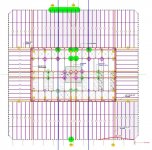
I attach a framing plane of 1wtc showing the destroyed columns (green)... the path of the engines - thick blue vertical lines. They probably ricocheted into some other columns and dented them...the one inside of diamonds????

The core weakening / failure radiated east, west and south from the zone of destroyed columns (and dented ones) until it reached the center under the antenna... large green hatched square... and finally involved the green diamonds... THEN the top dropped... led by the antenna. This pulled all the remaining OOS floors inward and torqued or pulled the remaining connected frame likely to the north????

What do you think?
 

Attachments

  • core framng.jpg
    core framng.jpg
    113.8 KB · Views: 3
Depends on the amount of bend and the deflection... maybe the floor system connected to said column sags 1"? Who knows? Do the math/geometry and since the frame is all connected a dented column will still see the full load UNLESS it separates.

If a floor sags down at the core end due to one column being shorter, then some load must be greater on adjacent truss connections.
Its a minor point. Damaged columns are simply not the same as pristine ones.
 
Last edited:
JDH

I attach a framing plane of 1wtc showing the destroyed columns (green)... the path of the engines - thick blue vertical lines. They probably ricocheted into some other columns and dented them...the one inside of diamonds????

The core weakening / failure radiated east, west and south from the zone of destroyed columns (and dented ones) until it reached the center under the antenna... large green hatched square... and finally involved the green diamonds... THEN the top dropped... led by the antenna. This pulled all the remaining OOS floors inward and torqued or pulled the remaining connected frame likely to the north????

What do you think?
Yes. However I think its a level of detail that does not fit in this generic summary of both collapses.

Collapse ensued when columns lost the ability to hold the upper section up. Which column or subset of columns failed first is detail that is somewhat different between the two collapses.
 

ISF - Join now!

Every member here is approved by hand. No bots, no spam, just people who care about evidence and honest debate.

Membership is free!

Create your free account

Back
Top Bottom