Okay, let's grunge through this
I'm actually surprised at how long it's been since I've looked at this in depth. Also, the "Updated Version III" of the
whitepaper that started it all looks quite a bit different than the Version II that I originally read.
1. Definitions
Let's use "origin time" to exclusively mean the time at which the seismic event actually started. Time to propagate to any sensor is not included in this time, so any given sensed time will be later than the origin time.
2. Background
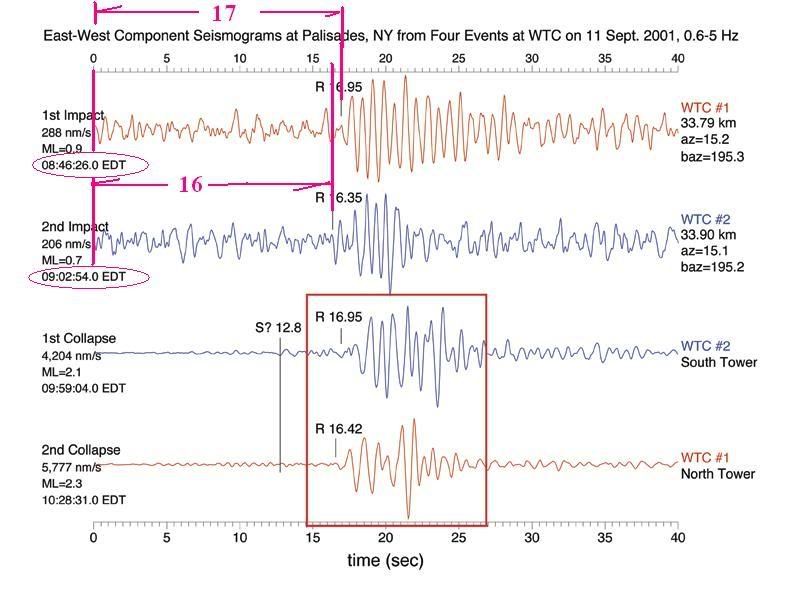
NIST reports on impact times as determined from video of the events, and compares these to the LDEO results, stating that the revised LDEO origin time is 8:46:29 for WTC 1 and 9:02:57 for WTC 2. These measurements have shifted slightly (~ 3 seconds) from earlier analyses. NIST also reports these measurements are solid to +/- 1 second and 2 seconds respectively, on page 23 of NCSTAR1-5A. Furthermore, NIST reports that LDEO is 21 miles from the impact site, not 16 miles as I estimated above.
It is not yet entirely clear how LDEO estimated these times, given that the
apparent seismic signal at their location was later, 8:46:43 and 9:03:10 respectively, but we must accept that they corrected for propagation time, and their computed origin times happen to correspond well with the video timing of the events as established by NIST.
The
9/11 Commission Report cites a time of 8:46:40 for WTC 1 on Page 285, and 9:03:11 for WTC 2 on Page 293, both in Chapter 9. Let's accept that both of these times are wrong, 11 seconds high for WTC 1 and 14 seconds high for WTC 2. What remains is trying to explain why these times are wrong.
3. Examining the 9/11 Commission
In the
9/11 Commission Report, footnotes 30 and 79 of Chapter 9 are given for the two passages above. Relevant parts of these notes read as follows:
9/11 Commission Report pg. 543 said:
30. For the exact time of impact, see FAA analysis of American 11 radar returns and Commission analysis of FAA radar data and air traffic control software logic.
9/11 Commission Report pg. 546 said:
79. For the time of impact, see FAA analysis of United Airlines Flight 175 radar returns and Commission analysis of FAA radar data and air traffic control software logic.
So the
9/11 Commission is the outlier, and it isn't going by seismic signals at all. It appears the offset in the radar data just happens to correspond to the
uncorrected offset in the seismic data -- about 12 seconds average here, versus about 16 seconds in the seismic. That's an unusual coincidence, and that's what I homed in on before.
4. Raw Radar Data
We can go to the original radar data in the NTSB reports, which are archived for
American 11 and
United 175. The impact termination is shown in Figure 2 of each report. The figures are different, and Figure 2 of the AA-11 report is the more valuable, because it shows individual points, whereas the curve in the UA-175 report is smoothed.
Looking at Figure 2 of the AA-11 report, we see that there are no radar returns after approximately 8:46:10, which showed the aircraft at an altitude of approximately 1,800 feet. There is one final point at 8:46:40, and that is what the
Commission apparently used, but that is at altitude zero. The points leading up to 8:46:10 show nontrivial scatter in the data, and occasionally unmistakable outliers as well. It also seems to indicate an average descent rate of nearly 4,000 feet per minute, or about 65 feet per second.
5. Discussion
Now recall that AA-11
did not impact at zero altitude. It hit on the 97th floor, or approximately 1,000 feet of altitude. Using our estimate of 65 feet per second, this is 800 feet below or about 13 seconds after the next-to-last reading. This gives us a
radar impact estimate of 8:26:23, not 8:26:40. I must point out, however, that the graph is not the easiest to read, and I would estimate the time of sweep is +/- 3 seconds, altitude +/- 200 feet, so our final estimate is perhaps +/- 7 seconds. However, this time coincides nicely with the NIST result.
What about the 8:26:40 measurement? Well, it's at zero altitude, so it can't be our bird unless it's an artificially low reading. But if it's not our bird, what could it be? I can think of several possibilities. In particular, this is
primary radar and is basically a "blip" stronger than background returned to the receiver. Aircraft are not the only things that send traces. I speculate that the final return wasn't from the aircraft at all, but instead from the huge cloud of debris that emerged
after impact -- pieces of aircraft, aluminum cladding from WTC 1, and the thermal bubble, all spreading to create a much larger and brighter radar reflector than the aircraft itself. This could, perhaps, be seen well down in the clutter whereas the smaller aircraft signal was lost before impact.
While I like this hypothesis, I must admit that it is also possible that the 8:46:40 radar blip is nothing but a phantom return generated somewhere in software. The fact that it intersects at exactly 0 altitude is suspicious.
The radar return graph for UA-175 is not as detailed, and unfortunately I cannot replicate this analysis for it as a result, but we may assume that something similar could have happened there as well. UA-175 struck at a slightly lower altitude but still about 800 feet above ground level, so a similar artifact may have occurred.
6. Findings
So, in summary, my findings are as follows:
- The LDEO origin time (time of actual seismic event) does appear to be 8:46:29 and 9:02:57, not a slightly later number that corresponds to the 9/11 Commission Report. I therefore must update my whitepaper.
- The 9/11 Commission Report time is wrong. The strongest evidence for this is the NIST analysis of photographic records, which confirms finding 1. above and conflicts with the Commission regardless of seismic data interpretation.
- The discrepancy in the Commission appears to be solely based on radar, not seismic results.
- While we do not fully understand the delay between origin time and graphical time of arrival in the LDEO data, we believe it is due to seismic propagation between origin point and seismograph. Followup is needed to confirm this hypothesis.
- The discrepancy in the Commission happens to be similar to the delay mentioned in finding 4. above, but this appears to be coincidence. It is this coincidence that I focused on, incorrectly, in previous analyses.
- We further hypothesize that the Commission discrepancy, at least for WTC 1, can be traced to insufficient analysis of primary radar data. The final radar return time was used as the impact time, and this appears to be too simplistic, as we have no reason to believe the final return was in fact coming from an intact aircraft.
- More careful analysis of the final few radar returns for AA-11 gives us an impact estimate of 8:46:23 +/- 7 seconds, which is consistent with NIST and the LDEO origin time, and inconsistent with the Commission. All of our findings are therefore self-consistent.
- We cannot confirm the above radar argument also applies to UA-175, though we have reason to believe a similar artifact occurred. If data for UA-175 with individual radar returns become available, this should be verified.
I think it all fits together nicely now. Again, we should still verify the ~16 second propagation time from the WTC to LDEO, but that appears to be the result that they calculated, so I'm comfortable with it until proven otherwise.
DISCLAIMER: The above is my opinion only and does not reflect the position of any agency, public or private. All work done with my own materials on my own time. Measure twice, cut once.