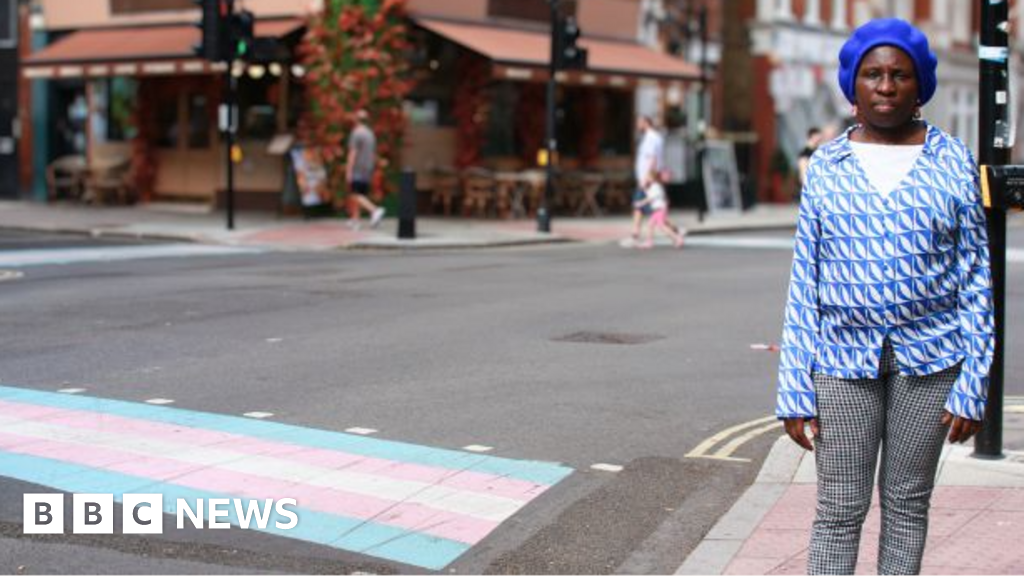
Side note, I'd almost believe the "we shouldn't politicize our streets" thing except we name streets and such after all sorts of political figures. I doubt any of the folks would give a crap about Donny Trump BLVD.
Our city has a Harvey Milk Blvd. The more snowflaky members of our state legislature are working as hard as possible to get it changed, over and above the wishes of the citizens, the city council, and the mayor. The Utah legislature chafes constantly under the burden of convening their red-state supermajority in a city that hasn't had a Republican mayor since the 1970s. Our previous mayor was lesbian.
Apropos to my previous comment, the crosswalks in my city are not alternating stripes. They're just wide white boundary lines on either side of the intended pedestrian right of way. In some places, the right of way is set in cobblestones contrasting with the surrounding concrete. Consequently in other places the interior is set in textured concrete painted to resemble cobblestones. To my knowledge we have only one rainbow crosswalk—at the corner of 3rd Avenue and K Street, if you want to look it up on your favorite aerial photo app. You have to squint because the colors are faded, just hints of stripes between the boundary stripes out there in front of the 7-Eleven. I don't recall any objection to it when it was first painted, nor do I know what (if anything) it is meant to commemorate.
My proposal: Only non-partisan, apolitical, standardized street markings should be used. These markings are exclusively to be used for traffic and safety management.
That's the no-brainer solution—just don't allow anything that isn't purely utilitarian. But some communities want to present street markings and traffic controls in a way that fits their overall desired aesthetic. The public apparatus is a big part of what makes certain places fun to visit. The rainbow crosswalks at Castro and 18th in San Francisco are overtly political, and that's an appropriate message for that place. Conversely the center of our city is a grand plaza celebrating the seat of Mormonism. I wouldn't be offended if the street markings in that part of the city were made to fit into that carefully crafted image. It's an important part of our city, whether I choose to participate in it or not.
In theory you can have identity without identity politics, although that's getting very hard to achieve in practice. The rainbow is a symbol of a group that has every right to associate, identify, express their identity, and be publicly recognized by it. But that also injects it into political discourse. It would be sad if the only way to defuse political divisiveness is to reduce all public expression to that which has no meaning.
Politics pervades everything that politicians want to pervade it with, even if that wasn't the original intent. And ostensibly de-politicizing public discourse doesn't seem to fix it. Our state legislature passed a law forbidding all flags from public spaces that weren't strictly representative of a government entity. Previously the city flew a rainbow flag alongside the government flags during Pride month, a BLM flag on Juneteenth, and various other commemorative flags on the appropriate occasions. This was deemed too "political"—by politicians who obsess over identity politics to the tune of passing a law that literally affected
one person in our state. But our city council in short order approved all those commemorative flags as alternative city flags, allowing them to be flown in conformance with the law. And then every 24th of July our city shuts down for what is an overtly Mormon religious celebration, but our lawmakers don't balk in the least at those politics. So the point is that no matter what law you pass to restrict expression in public spaces, there will always seem to be a way around it. Maybe the better path is to allow a diversity of expression rather than requiring a paucity of it.