Radiation and the atomic bombing of Japan.

The repetitive claim that the US dropped the bombs despite the Japanese wanting to surrender just to test the effects of residual radiation on human beings came up in another forum and I responded with the information in the OP. Then I thought I would pass it along to a few other forums where the topic has come up before.

Marshall and most other Allied commanders saw the atomic bombs as just big fire bombs, "Tall Boys" and "Grand Slams" writ large. Radiation was not an understood thing and "fall-out" wasn't even a term yet. It would be a few years before we even considered the after-effects of an atomic bomb to be long lasting, except among specialists. The Japanese, being an interested party, were quicker on the uptake, as this quote from "Gojira" illustrates.

l

Ah, now I see, I was confused the same way theprestige was.
 
Gawdzilla, "How bad were the effects if the person was shielded from the direct effects of the bomb, say inside a building or shelter? "

"However to highlight the variability in the real world, and the effect that being indoors can make, despite the lethal radiation and blast zone extending well past her position at Hiroshima,[43] Akiko Takakura survived the effects of a 16 kt atomic bomb at a distance of just 300 meters from the hypocenter, with only minor injuries, due mainly to her position in the lobby of the Bank of Japan, a reinforced concrete building, at the time.[44][45] In contrast, the unknown person sitting outside, fully exposed, on the steps of the Sumitomo Bank, next door to the Bank of Japan, received lethal third degree burns and was then likely killed by the blast, in that order, within two seconds.[46]" Wikipedia, "Effects of nuclear weapons"

Thanks.
 
It sounds like they intended to use the bomb to create a wave of radiation to cause acute radiation poisoning, but didn't realize the lingering effects of the radioactive material left. Is that correct?
Nope. As Wellerstein's article details, the knowledge of the radioactive effects never made it from the scientific side of the Manhattan project to the military/operational side.

Yep, mostly coming from the anti-war folks in the '60s. "Every war the US has ever fought has been immoral, illegal and fattening!" :D
Yeah, Newman's book was a response to the nonsense being spouted about the bombings.

It's likely that anyone protected from the blast wave/heat pulse to that extent would also be shielded from much of the radiation.
 
Air bursts have negligible fallout. This was the case in Nagasaki and Hiroshima and have been understood for a very long time. The bomb components get finely atomized and float around the Earth, decaying and being diluted.

Ground level bursts, as would be required for a hardened target like a rail yard or a missile silo, suck up dust, dirt and sand, which mixes with and partially melts in the fire ball, and is infused with fission products from the bomb. These grains may be so large that they fall out immediately down wind, within hours.

Due to the mix of fission products, from short-lived very radioactive, to long lived weakly active, the dose rate decreases from its peak value in a way that's slower than exponential. To a rough approximation, for every factor 7 increase in time since blast sees a factor 10 decrease in radiation.

I.e. if the peak dose rate is 1000 R/hr at 1 hour downwind of a blown up missile silo(very dangerous. ~10 Sv/hr in open air), it will be only 100 R/hr at 7 hours, 10 R/hr at 2 days, 1 R/hr at 2 weeks. 0.5 R/hr is "survivable indefinitely", which means, no matter how long you spend in 0.5 R/hr, it won't cause any of the symptoms of even mild radiation sickness. This is what fallout shelters were for. 3 feet of a packed dirt gives you a factor 1000 reduction in dose rate from fission product gammas. They were not for air bursts over cities.
 
They knew that radiation was dangerous,what they did not know was how long lasting it was.
The "We used the bomb on Hiroshima to test the effects of residual radiation" is pure crap.
The amount of nonsense on the bombing of Hiroshima and Nagasaki stagger the mind,and a lot of it is driven by ideology, frankly.

As are so many things........
 
Yep, mostly coming from the anti-war folks in the '60s. "Every war the US has ever fought has been immoral, illegal and fattening!" :D

I wonder how Americans would have reacted to news after the war that Truman had a weapon that could have won the war, but let a couple of hundred thousand servicemen be killed or injured instead
 
Nope. As Wellerstein's article details, the knowledge of the radioactive effects never made it from the scientific side of the Manhattan project to the military/operational side.

When I was at school (The 1970's) I recall reading a book made up of accounts of survivors of the bombings. One mentioned the confusion from Japanese doctors trying to get information from their US counterparts about the strange symptoms survivors where displaying, and American doctors being totally clueless :(
 
The repetitive claim that the US dropped the bombs despite the Japanese wanting to surrender just to test the effects of residual radiation on human beings came up in another forum and I responded with the information in the OP.

Wow, some people actually believe that ?

What am I saying ? For every crazy theory, you'll find at least one true believer.
 
I wonder how Americans would have reacted to news after the war that Truman had a weapon that could have won the war, but let a couple of hundred thousand servicemen be killed or injured instead
Given the projected death tolls for Olympic and Coronet being discussed in advance (one quarter to one Allied casualties each) I'd say he'd have been in big trouble.

When I was at school (The 1970's) I recall reading a book made up of accounts of survivors of the bombings. One mentioned the confusion from Japanese doctors trying to get information from their US counterparts about the strange symptoms survivors where displaying, and American doctors being totally clueless :(
Many years ago I picked up an issue of the BMJ from 1948 that discussed the issue, and the lack of understanding of the radiation hazard.

I know one group that believes this deeply. :rolleyes:
Indeed, a few have posted here.
 
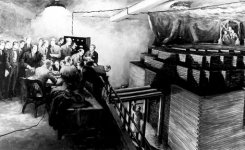
I remember back in High School our physics teacher addressed this subject with a photograph of a large number of Manhattan Project personnel standing around a test reactor. Everyone in the photo would die of cancer.

Heck, if those didn't know, who would?

Sorry, can't cite a reference for this.
 
I remember back in High School our physics teacher addressed this subject with a photograph of a large number of Manhattan Project personnel standing around a test reactor. Everyone in the photo would die of cancer.

Probably the first chain reaction in the reactor under the soccer fields at University of Chicago.
 

Attachments

  • 20121210_manhattan_ss01 (1).jpg
    20121210_manhattan_ss01 (1).jpg
    39.5 KB · Views: 20
It is true that in he early days of atomic weapons and atomic research, there was little appreciation for the effects of radioactivity on humans. It was known that there was a real danger of such things, but there was still a great deal of disregard for the dangers.

However, if I recall, in 1945 there was only enough nuclear weapon grade material for three nuclear weapons. One was used for the 'Trinity' test and the other two were used in Japan.

Therefore, it would be necessary for the war with Japan to be dragged on for several more months in order to give the USA the time needed to produce additional nuclear weapons.

We planned to have around 10 atomic bombs ready for operation Olympic (planned for November 1945). Catsmate1 can provide more details I'm sure, since he did in another post.
 
I wonder how Americans would have reacted to news after the war that Truman had a weapon that could have won the war, but let a couple of hundred thousand servicemen be killed or injured instead

Not only that, but some Marines were pretty pissed off that the invasion of Okinawa went ahead, what with the bomb being nearly ready. Although, maybe I'm confusing Eugene Sledge's actual war diary with the somewhat fictionalized TV show, The Pacific.
 
I think you forgot the word "million".
Don't knock the loss of Private Mayhew's arm, the most tragic event in all the hypothetical scenario!
:o Bugger...

However, if I recall, in 1945 there was only enough nuclear weapon grade material for three nuclear weapons. One was used for the 'Trinity' test and the other two were used in Japan.

Therefore, it would be necessary for the war with Japan to be dragged on for several more months in order to give the USA the time needed to produce additional nuclear weapons.
No. Plutonium production was in full swing and series production (though still hand built) of the MK3 bombs was ready. The Xenon problem was fixed by early August, after Trinity but before the Japanese surrender.

The fourth shot was scheduled to be in theatre ready for delivery on 19AUG1945 with a fifth ready later in August. Seven more bombs would have been ready before "X-Day", Olympic's scheduled start on 01NOV1945, with 7-8 more ready before the end of the year and 8-10 more before "Y-Day", Coronet's start date of 01MAR1946. That's 24-27 weapons for tactical use, depending on production and any further city busting. Plus thousands of tonnes of poison gases.

If Downfall had dragged on, enhanced reactor capacity would have come online in 1946, along with assembly line production of the improved bomb designs in development (what would become the MK4). The Hanford B, D and F reactors were productive by the middle of 1945 with additional units (H and DR) nearly complete.

Between Y-Day and the end of June 1946 there was the capacity for at least twenty plutonium bombs along with probably two uranium bombs. By then the new implosion lens system would have been tested and some of the technology that was historically introduced in the MK5 design would have been in production, with bomb yields increasing substantially to over 120kT (pretty much the limit for safe unboosted fission). The baseline MK3 yield was ~20kt, the MK3MOD2 and MK4 about 32kT.

If nuclear bombing had continued into the second half of 1945 the problem would have been finding eligible targets, not bombs.

Not only that, but some Marines were pretty pissed off that the invasion of Okinawa went ahead, what with the bomb being nearly ready. Although, maybe I'm confusing Eugene Sledge's actual war diary with the somewhat fictionalized TV show, The Pacific.
I remember some discussions, though I don't think the details of the production schedule were commonly known until the sixties.
There was definitely disgruntlement over the lack of use of poison gas, which Marshall had requested fro Okinawa.
 
It is true that in he early days of atomic weapons and atomic research, there was little appreciation for the effects of radioactivity on humans. It was known that there was a real danger of such things, but there was still a great deal of disregard for the dangers.

However, if I recall, in 1945 there was only enough nuclear weapon grade material for three nuclear weapons. One was used for the 'Trinity' test and the other two were used in Japan.

Therefore, it would be necessary for the war with Japan to be dragged on for several more months in order to give the USA the time needed to produce additional nuclear weapons.
Able and Baker Tests were done with atomic bombs that had made it to the Pacific before the end of hostilities. Gen. Marshall was to be given nine atomic bombs for the invasion of Kyushu in November, 1945.
 

ISF - Join now!

Every member here is approved by hand. No bots, no spam, just people who care about evidence and honest debate.

Membership is free!

Create your free account

Back
Top Bottom