• Quick note - the problem with Youtube videos not embedding on the forum appears to have been fixed, thanks to ZiprHead. If you do still see problems let me know.

Photography today , whats wrong with it, my struggles

BTW I love my new camera with a viewfinder. How did I live without it. No more fumbling with glasses and trying to shade the screen with my hand to see what the heck I am shooting. Can't wait to go out and do some shooting - if it would quit raining at least .
 
Good responses. I appreciate them.
I pulled this off the front page of flikr. It somewhat illustrates my personal dissatisfaction.

It is not terrible or anything, but there's something very cliche-dramatic for me (though certainly there are more extreme examples). And there's a synthetic 'smoothness' to it that I'm just a bit tired of seeing. And the tones and lighting, it is kind of unreal, a characterization of what it probably really looked like.

Not a fan.

What do you all think?

A person wanting to be Ansel Adams is my best guess!!!!!
 
I'm interested in playing around with a macro lens.

I have a Nikon D5300, really not sure where to start. Any recommendations?
 
I was wondering about the utility of shooting HD video in an iPhone vs. just taking a regular (or burst) photo. Seems the quality should be the same, and you could even choose a better composition from the video rather than a static shot. Especially on an action shot?
 
I was wondering about the utility of shooting HD video in an iPhone vs. just taking a regular (or burst) photo. Seems the quality should be the same, and you could even choose a better composition from the video rather than a static shot. Especially on an action shot?

Well, even 4K would be a slightly lower resolution than the camera can produce in stills mode, but it's also the way a lot of dedicated cameras are going, letting you shoot 4K video and select stills from it. For some subjects it would be ideal, but you have to be wary of getting too trigger-happy.
 
I'm interested in playing around with a macro lens.

I have a Nikon D5300, really not sure where to start. Any recommendations?

Nikon makes a 40mm micro lens (what they call macro) that is good glass at a relatively low price. But... avoid it. I have one, but never use it for macro shooting - its simply become another prime lens.

It is such a short lens that you have to get *very* close to your subject. That can be a problem with lighting, shooting bugs, etc.. There are a number of good macro lenses in the 100mm range that are much easier to use. Tamron makes a 90mm one that gets great reviews... but its around $650.
 
With regard to the D5300 and macro, there are several options depending on how much you want to spend, and how seriously you intend to worry about some of the finer points of image quality.

The 40 mm. lens mentioned above has a good reputation as a sharp lens, reasonably fast, and its focal length is such that it makes a very good normal lens. If you don't already have a normal length prime lens, this might be a very good choice, even though its macro capabilities are less than ideal. The closeness to objects makes nature macro difficult, though not impossible, and also can compromise lighting. But these things can be lived with, and remember too that many shots will be close up but not truly macro, and for those 40 is not so bad. If you want, for example, a whole butterfly on a flower head, you won't need to get all the way in.

There are other macro lenses,of course, which are more expensive. That one is pretty affordable, and versatile.

A very cheap alternative that can work well within limits is a diopter lens. Mounted to the end of a normal lens like a filter, these range from fairly expensive and high quality to very cheap and poor quality. These lenses tend to introduce some distortion and to be soft at the edges, but for many uses that does not matter. You don't need perfect linearity for a bug, and most of the time the edges aren't in focus anyway. The advantage of these lenses is that they are cheap, easily carried, and that the don't interfere with metering or auto focus. Raynox makes a clip on one that's fairly decent in quality and fits various sized lenses. Other makers make screw in ones, often in sets. Consider something like this as a starter, because even if you go to something else later, you can throw one in your bag when you're traveling.

Extension tubes and bellows used to be very common macro accessories, but are less so now that lenses need electronic communication to work right. An extension tube goes between the lens and camera, and effectively makes it a macro. You lose some light, but a good lens on a tube works very well, and this allows you to use a non-macro lens closer up. Some tubes used to come in sets of varying length that could be stacked for different combinations. Included in this general class are lens reversal rings, too. On a tube or bellows, or even alone, you can get a mount that turns the outer end of a lens into a bayonet for mounting. Reversed lenses can provide very good linear macro. But the operation of a reversed lens is 100 percent manual.

If you are willing to go entirely manual, the D5300 will accept just about anything with a Nikon mount, including old uncoupled extension tubes, manual lenses, reversers, etc. You'll get a no-lens error in any mode but M, and no metering, but you can use the post-shot histogram to correct metering errors. ON a D3200, I've used all sorts of odd things, including a microscope mount with typesetting lenses, old pre-AI telephotos with a stack of extension tubes, a bellows, and so forth. If you are willing to go all manual, you might check out older macro lenses such as the 55/3.5 micro, which, while suffering a bit from the distance problem of the 40, is often dirt cheap, and eye-slicingly sharp.

The one thing you can't readily do on this camera is to use one of the AFG lenses in reverse, or with a non-electronic extension, because the aperture will close down completely. If you want to reverse mount the kit lens you'll have to manually jam the aperture actuation lever, not really recommended. You're better off finding an old lens with an aperture ring.

Just for grins, here's a macro I did a couple of years ago with a D3200 and a compugraphic typesetting lens (no aperture, no meter, no focus except to move the camera).
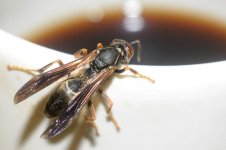

morning buzz.jpg
 
I would go for the extension tubes first. They're cheap and then you can see if you actually like doing macro photography. I'm not a Nikon expert but something like this should work:

https://www.amazon.com/Mcoplus-MK-N...rd_wg=ahMvH&psc=1&refRID=H9WG8MZSSQXWC6XAA04J
Sorry, but no, those will not work. The set shown is for Nikon 1 lens mount, which is the mirrorless camera, not the Nikon F mount.

You can also get similar tubes for the F mount. Make sure, if you're using the AFS kit lens, that they are fully compatible with AFS and G (no aperture ring) lenses. Quality may of course also vary with these, but at least an extension tube has no glass in it, so that is not a worry.

Extension tubes can be really nice if you have a telephoto lens or a telephoto zoom, because you can use them at any focal length, and the result with a telephoto is that you can get great closeups at a distance. For shy things like flying insects this is a great advantage.

Extension tubes will decrease the overall light. Your meter should still work, but AF might be compromised and may not work at all. Most macro work is best done with manual focus anyway, but this is something that needs to be considered.

e.t.a. not a lot handy at this laptop, but here's a shot made with a very old 200 mm. lens on extension tubes on the D3200. I think I may have cropped this as well, but in any case, that lens, though not focusing at all close, works well on extensions, and allows one to shoot things that are otherwise out of reach, like this cicada case at the edge of a pond.

cicada case 200.jpg
 
Last edited:
Extension tubes can be really nice if you have a telephoto lens or a telephoto zoom, because you can use them at any focal length, and the result with a telephoto is that you can get great closeups at a distance. For shy things like flying insects this is a great advantage.
Speaking of zooms, I found that the Nikon super zoom I had in my kit worked surprisingly well at macro shooting (I had pretty low expectations). Its an 18-300mm zoom, and at the 300mm length it focuses surprisingly close to the lens. It has sort of the opposite problem as the 40mm micro lens in that its a little unwieldy fully extended. But the VR is also excellent, so you can do a passable job freehanding the camera to capture bugs and such in nature that tend to move around too much for a tripod.

Its a spendy lens. But, a wonderful all-in-one. It's locked onto my dx camera body more than any other lens - coming off primarily for low-light situations. So, since it replaces a few other lenses its worth considering.
 
Speaking of zooms, I found that the Nikon super zoom I had in my kit worked surprisingly well at macro shooting (I had pretty low expectations). Its an 18-300mm zoom, and at the 300mm length it focuses surprisingly close to the lens. It has sort of the opposite problem as the 40mm micro lens in that its a little unwieldy fully extended. But the VR is also excellent, so you can do a passable job freehanding the camera to capture bugs and such in nature that tend to move around too much for a tripod.

Its a spendy lens. But, a wonderful all-in-one. It's locked onto my dx camera body more than any other lens - coming off primarily for low-light situations. So, since it replaces a few other lenses its worth considering.

I often use a plain vanilla 55-300 DX zoom for closeups, not exactly macros. But at its closest distance and at or near 300, it does a nice job on things like butterflies. It is a bit unwieldy, but decent with VR.

Faydra's D5300, if she gets a sharp shot, has a very dense sensor - 24 megapixels and no anti-aliasing filter - and that also gives a lot of room for cropping, especially if one shoots in Raw format to start with.

Even if you do want to go to true macro in the future, you'd do well to experiment with the closest view you can now get, shot carefully and cropped. Of course some depends on how large you expect to show or print your results, but you may be surprised at how far you can go.

Here, for example, is a shot I took for a different purpose, mainly to demonstrate the superb vibration reduction in Nikon's 200-500 zoom (my super indulgent birthday present a couple of years ago). This was taken with a D3200, which has a 24 megapixel sensor, but is not quite as sharp as the D5300, at 500 millimeters and a crazy shutter speed of 1/25 of a second, hand held. It is a crop from the original 6000 x 4000 pixels to 980 x 652 with no post processing, including sharpening, at all. Now of course this is not the shot you get every time, but as you can see, it's possible to crop pretty hard....


soc twenty fifth.jpg
 
...Sorry, but no, those will not work. The set shown is for Nikon 1 lens mount, which is the mirrorless camera, not the Nikon F mount...

Oops. Nice catch, Bruto!

Faydra, that's a negatory on my original link, good sister.

Everything Bruto says here applies

...You can also get similar tubes for the F mount. Make sure, if you're using the AFS kit lens, that they are fully compatible with AFS and G (no aperture ring) lenses. Quality may of course also vary with these, but at least an extension tube has no glass in it, so that is not a worry.

Extension tubes can be really nice if you have a telephoto lens or a telephoto zoom, because you can use them at any focal length, and the result with a telephoto is that you can get great closeups at a distance. For shy things like flying insects this is a great advantage...

And I will add that I think your kit lens doesn't have an aperture ring? So make sure the extension tubes allow the aperture connection. Otherwise, you won't be able to adjust the aperture.

Also, when you put them on a lens you will loose infinity focus (you won't be able to focus on things far away just stuff up close).

And depending on your zoom lens, different focal lengths can have profoundly different effects on whats in focus. You might have to be more interactive with your head and camera distance for the focus to lock.

...e.t.a. not a lot handy at this laptop, but here's a shot made with a very old 200 mm. lens on extension tubes on the D3200. I think I may have cropped this as well, but in any case, that lens, though not focusing at all close, works well on extensions, and allows one to shoot things that are otherwise out of reach, like this cicada case at the edge of a pond.

Very Nice!

Nikkor AI 200mm f4.0? I have the pre-AI K-mount version. Very sharp lens and great with extension tubes.
 
...

Nikkor AI 200mm f4.0? I have the pre-AI K-mount version. Very sharp lens and great with extension tubes.
Yes, more or less, but even earlier, this is the pre-AI Q version, one of the earliest. I got it for $5 from a bargain bin, and it's turned out to be very nice, despite its radical lack of close focusing in normal use. Like many old Nikon lenses it renders things beautifully in ways that are hard to quantify.
 

Back
Top Bottom