The Sparrow
Graduate Poster



Weird and weirder... not only is that link not what I originally posted, but it's also something I never even clicked to reply to or copied to paste anywhere... and on top of that, my first subsequent response to correct it is gone! Anyway, obviously, that link to a post I never quoted is not the picture I was referring to; this is. (Unless it vanishes again. Or gets replaced by some random other thing again.)I tend to take at least one of the area around my tent, while standing away from the tent so the tent is in the picture. This, for example, is not just any picture of the gravel bar at Redwood Creek; it's my picture of the gravel bar at Redwood Creek, from my experience there. My favorite pictures are the ones that don't just look the best in some abstract sense, but also anchor my memories of what I was doing at the time
I'm the opposite. I have one of those with the big built-in lens, but I've found multiple occasions on which I throw it out as far as it goes and still need more range and can't believe how tiny the thing I'm pointing at still looks, or I'm as close as I can get to something small and can't zoom the opposite way any farther when I want to. Plus, at the small end, I can't figure out how to get the focus to behave consistently, which I presume a more serious camera and a dedicated close-up/macro lens would have a solution to. And at both ends, if I blow up the image, sometimes I'm disappointed with the detail (less real picture information than what the number of pixels would seem to indicate, like a small picture blown up with an algorithm that adds faint random noise dots instead of being as smooth as possible), and I can't tell whether it's because the lens system gets smudgy because it's just trying to handle too much range, or because the sensor, although bigger than in compact cameras, is still just not big enough for its number of pixels. Either way, the solution would apparently be to go SLR. (And its old NTSC video resolution just reminds me how thoroughly I've gotten used to HDTV.I've been pretty happy with fixed lens digital cameras with high-ratio zooms. Image quality isn't quite as good as DSLR's or mirrorless cameras, but it's pretty damn good, and you can go from wide angle to extreme telephoto without changing lenses, so the bird or other critter isn't gone by the time you get the lens changed.
 ) And any place where I'm taking out my big current camera in the first place, I'm already taking a tripod anyway, so including another lens or 2 with the tripod is no real difference.
I think that anyone serious about photography would buy a digital Hasselbald H5D-200C medium format DSLR camera. 50 MP 23.8 x 32,9 mm sensor. Only $44,995 for the body- a lens will set you back at least $7000 more. Plus given the file sizes generated you will probably need to upgrade your computer and buy a lot of external hard drive capacity. And it is kind of heavy and big to carry around. But why do a hobby only half way??

You're not rambline. You're "contributing"...
I'm rambling - I like this thread.

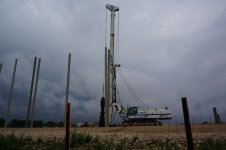
It was raining, I liked the colour, and I like construction equipment.
That picture scrolled into view and my brain saw a trebuchet!


I am contemplating an equipment upgrade - new camera body, mostly because my existing does not have a view finder. As I age, it is becoming a pain to have to use progressives to see my subject in real life far away, then to try and line it up on a 3" screen on a sunny day, holding my hand over it to shade it, looking through the bottom of my glasses.
I've played with the 'upgrade' model and I am like the viewfinder. Has adjuster to compensate for my 'old man' vision.
You think all too correctly.I'm thinking you see trebuchets everywhere
Weird and weirder... not only is that link not what I originally posted, but it's also something I never even clicked to reply to or copied to paste anywhere... and on top of that, my first subsequent response to correct it is gone! Anyway, obviously, that link to a post I never quoted is not the picture I was referring to; this is. (Unless it vanishes again. Or gets replaced by some random other thing again.)
[qimg]http://www.internationalskeptics.com/forums/attachment.php?attachmentid=28729[/qimg]
I'm the opposite. I have one of those with the big built-in lens, but I've found multiple occasions on which I throw it out as far as it goes and still need more range and can't believe how tiny the thing I'm pointing at still looks, or I'm as close as I can get to something small and can't zoom the opposite way any farther when I want to. Plus, at the small end, I can't figure out how to get the focus to behave consistently, which I presume a more serious camera and a dedicated close-up/macro lens would have a solution to. And at both ends, if I blow up the image, sometimes I'm disappointed with the detail (less real picture information than what the number of pixels would seem to indicate, like a small picture blown up with an algorithm that adds faint random noise dots instead of being as smooth as possible), and I can't tell whether it's because the lens system gets smudgy because it's just trying to handle too much range, or because the sensor, although bigger than in compact cameras, is still just not big enough for its number of pixels. Either way, the solution would apparently be to go SLR. (And its old NTSC video resolution just reminds me how thoroughly I've gotten used to HDTV.
I've been checking out the choices at both Canon and Nikon. I'm sure I'll end up going for the cheapest body one company or the other makes just because of the expense because there's no sense in replacing my current camera without getting at least 2 lenses (one for long shots and one for close-ups) if not 3 (if the first 2 don't overlap). The ones that come with even one lens at all come with a lens with a very small zoom range. I don't know how to pick between those companies or whether any other might even be worth considering, but I'm tempted to go Nikon just because they also have field-scopes (essentially portable modern telescopes) to which you can attach a Nikon SLR camera at the eyepiece...

I'd like to get to that point!I have sold 3 in a gallery. I don't say this as a money making proposition. Frankly, the prints (metal prints look great by the way) are expensive, there was also commission on the pieces, and the vast amounts of beer I drank on opening night, basically mean I made $0. The reward, I guess, was that I created something that touched someone. I communicated. I think that's 1 reason to "do it".
I'm still trying to work it out, and what I'm going to do with them, too.Photojournalism has a valid function. Any kind of documentary photography arguably has a function. Capturing beauty that you and others can look at and feel pleasure from serves a function I think.
This is all making me think, in a good way, about why I take pics.
One other advantage of a proper viewfinder is the ability to hold the camera and sight it well, and to see the image in bright light. A live view screen is poor in direct sunlight, and hard for some to hold steady.
so all in all, I'd heartily recommend a proper viewfinder, even if it's an electronic one, and would suggest looking carefully at auto focus systems if you plan to shoot wildlife or sports.
I do have a couple of big and expensive zoom lenses, but I can also still put a prime lens on and stick the camera in my coat pocket. I mostly do things in manual mode.

Go ahead and click "home" on either of those Ken Rockwell Links. Or, here, I'll do it for you.Unfortunately, Photography is one subject that fascinates all of those "Engineer with Gears" types. Cycling has its fair share of them too. There's something about endlessly talking about ratios, f-stops that they find soothing.
Perhaps, its better to remember that most people on DPreview don't actually own the lens they say is the best. They're just talking about their dream set-up that they never got around to buying because the tech is always getting better.
Check out
Equipment Measurbator: Bottom Level 1 or Level 0:
http://www.kenrockwell.com/tech/7.htm
Bonus material.
http://www.kenrockwell.com/tech/2-kinds-of-photographers.htm
Go ahead and click "home" on either of those Ken Rockwell Links. Or, here, I'll do it for you.
That's a really good example of the oversaturated unrealistic colors complained about upthread. It makes my eyes bleed. Or want to bleed, anyhow. Even the B&W one.
Yeah, it's Ken Rockwell. So take anything he says (or does) with a grain of salt.
If I worked in an office and could waste my employer's time researching personal hobbies on the Internet, I'd rather look at pornography than research other people's cameras.
Go ahead and click "home" on either of those Ken Rockwell Links. Or, here, I'll do it for you.
That's a really good example of the oversaturated unrealistic colors complained about upthread. It makes my eyes bleed. Or want to bleed, anyhow. Even the B&W one.