• Security incident: ISF was recently accessed by intruders. Please change your password, and change it anywhere else you used it. Read more

Official Bedini 10 Coil Kit Infomercial

kalen

Your Daddy
Joined
Mar 11, 2004
Messages
933
Here's a free energy machine that you can build yourself:

Youtube link

Yes, now you can order a kit, and build the Bedini machine yourself - and charge the batteries in your electric car!!

It might be interesting to get one to see how it really works.
 
Some quotes from the video...

... you can get 23% mechanical energy, which is about the same as a combustion engine. Because it's not a motor, I want to make that quite clear. This is not a motor; this is an energizer. This collects energy, and then sends the potential energy to the secondary battery, so that the battery charges itself.

If you gear this correctly, you can run a water-pump all day long. You're not gunna run a high-speed water-pump, but you're gunna pump water, and you're gunna pump it for no extra energy in this deal.

If it was a perpetual-motion machine it wouldn't it pump water forever, not just for a day. It also claims 23% mechanical energy, 23% of what???


Their website is: http://johnbedini.net
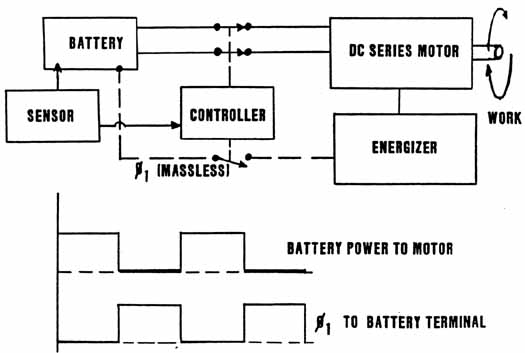
Here's a diagram from their website:
simplemotor11.jpg


Looks to me like it's a motor/generator combo. The motor spins a disk with magnets on it, which generates power in the coils around the disk. You might end up with a lot higher voltage coming out than you put in, but this would come at a cost of less current, so you'd still be getting less energy out of it than you're putting in.

But here's the explanation from their website:
On this slide, we show a theoretical scheme which several researchers have discovered and used to build simple free energy motors.
In this scheme, we drive an ordinary d.c. series motor by a two wire system from an ordinary battery. The motor produces shaft horsepower, at -- say -- some 30 or 40 percent efficiency, compared to the power drained from the battery. This much of the circuit is perfectly ordinary.
The trick here is to get the battery to recharge itself, without furnishing normal power to it, or expending work from the external circuit in the process.
To do this, recall that a charged particle in a "hooking" del-phi river moves itself. This is true for an ion, as well as for an electron. We need only make the del-phi in correct fashion and synchronize it; specifically, we must not release the hose nozzles we utilize to produce our del-phi river or waves.


The inventors who have discovered this have used various variations, but here we show a common one.
First, we add an "energizer" (often referred to by various other names) to the circuit. This device makes the del-phi waves we will utilize, but does NOT make currents of electron masses. In other words, it makes pure Ø-dot. It takes a little work to do this, for the energizer circuit must pump a few charges now and then. So the energizer draws a little bit of power from the motor, but not very much.
Now we add a switching device, called a controller, which breaks up power to the motor in pulses. During one pulse, the battery is connected and furnishes power to the motor; during the succeeding pulse, the battery is disconnected completely from the motor and the output from the energizer is applied across the terminals of the battery.
If frequency content, spin-hole content, etc. are properly constructed by the energizer, then the ion movements in the battery reverse themselves, recharging the battery. Again, remember that these ions MOVE THEMSELVES during this recharge phase. Specifically, we are NOT furnishing ordinary current to the battery, and we are not doing work on it from the energizer.
If things are built properly, the battery can be made to more than recover its charge during this pulse cycle.
To prevent excess charge of the battery and overheating and destroying it, a sensor is added which senses the state of charge of the battery, and furnishes a feedback signal to the controller to regulate the length of recharge time per "power off" pulse. In other words, the system is now self-regulating.


The relation between power pulses and recharge pulses is shown on the graphs at the bottom. Note that regulation may decrease the time of recharge application of the del-phi river.
This system, if properly built and tuned, will furnish "free shaft energy" continually, without violating conservation of anenergy. Remember that the del-phi condition across the battery terminals means that spacetime is suddenly curved there, and conservation of energy need no longer apply.
Again, this system is consistent with general relativity and with the fact that Ø-field alone can drive a situation relativistic. We have deliberately used these facts to do direct engineering. Our "extra energy" comes from shifting phi-flux -- the energy of the universal vacuum spacetime -- directly into ordinary energy for our use. Thus we draw on an inexhaustible source, and our device is no more esoteric than a paddlewheel in a river. The only difference is that, in this case, we have to be clever enough to make and divert the river in the right timing sequency.
This is a free energy device which an ordinary person, who knows a little electronics, can experiment with in the basement. To develop it, one is talking several thousands of dollars and a lot of persistence and tinkering; one is not talking millions.

:eek:
 
Last edited:
Deliberately deceitful technobabble. These people are crooks, aiming to rip money from people with no technical background. (And people who are unable to think logically, since if devices like this worked, they would be all over the place, any place).

Hans
 
I'll offer him the same deal I offered a dozen times before;

Sell me one to heat my house.

Terms are these; You name your price. Assuming I agree, you install it in my home. When it has run successfully for 6 months, and required no fuel or electricity of any kind, and worked without your intervention, I will pay your price plus bank-rate interest on that price for the six months of the trial period.

As a bonus, upon payment, I will make an endorsement of your product so you can sell it.
 
One thing I always notice about this sort of gizmo (motor spinning a magnet against a coil and claimed overunity generation) is that there's no mention of the corrections for pulsating voltage and current, phase angle, waveform and all the things that make alternating current or pulsed DC hard to measure unless you do a lot of math, and impossible to measure accurately just by sticking a meter on it.

Example case: I make a gizmo that converts a steady DC current at one amp and one volt to very short pulses of ten amps and ten volts. Not that hard. Then I stick a meter on it, and read off ten amps and ten volts. Overunity! Fame! Fortune! They doubted Galileo! Etc.!

It's not till I put it on an occiloscope and integrate the area under the waveform that I realize that I'm losing almost all my power, and there's nowhere near enough left to do much, let alone charge the battery. If I'm honest, I go back out to the garage and hammer on it some more, and eventually conclude that the laws of physics are self enforcing. If I'm not honest, I bury the data, make a press release and start looking for investors.

A
 
Very good point! Even nice sine-wave AC will do that to you, if you have a phase-shift. It is perfectly possible to have, say, 1.2V 1A AC and still only have 1W. All it takes is a moderate phase-shift.

So it is possible that some of these overunity people are, at least initially, in some kind of good faith.

This does not go for the guys with this mashine, however, since they have been busy inventing non-existing physical phenomenon ('del-phi waves', indeed :rolleyes: ) to try to explain away its impossibility.

Hans
 
I'll offer him the same deal I offered a dozen times before;

Sell me one to heat my house.

Terms are these; You name your price. Assuming I agree, you install it in my home. When it has run successfully for 6 months, and required no fuel or electricity of any kind, and worked without your intervention, I will pay your price plus bank-rate interest on that price for the six months of the trial period.

As a bonus, upon payment, I will make an endorsement of your product so you can sell it.


Even if they genuinely believe their own claims, this this deal probably isn't worth their while because: a) they can't be sure you're not trying to rip them off, and b) the device in question is only producing (supposedly) a small amount of energy, nowhere near enough to heat a house.

Make them a better offer... like a million dollars. See if their interested in taking the MDC.
 
I'm afraid I don't follow their technobabble. I'm not sure if The claim is that they can get more efficiency out of a battery, or that the battery will never lose it's charge.

If it's the latter, I would like to make a control mass around the battery, "energizer" and whatever other gizmos they want to put in there with the shaft coming out. The shaft is doing work, but the control mass isn't losing energy, therefore there needs to be an equal amount of energy going into the system. What is that energy?

If it's an efficiency thing I would like to know what energy is being wasted by a battery powering a motor that can be reclaimed by hooking up an "energizer" to the shaft. I don't necessarily care how the "energizer" works. I want to know what would otherwise be lost that's being re-claimed.

I love thermo.
 
The Bedini process explained

There is a lot of misunderstanding about the Bedini system and about what it does.
I have built many Bedini motors and chargers over the last few years. They range from a simple computer fan that is modified to run off a Bedini circuit to my largest machine with a 20pound aluminum rotor and the capacity to charge a 100 amp hour battery bank in just a few hours.

First, it is NOT an overunity or perpetual motion machine. No one has ever claimed that. Bedini calls it an energizer, and that is exactly what it is. The interesting effects happen mostly inside the batteries.
Then there is the fact that Bedini made many machines and they all work differently or serve to demonstrate a different principle. Yet they are all mushed into one and this results in a lot of confusion.
The one we talk about here is referred to by insiders as the SSG machine. Stands for "Simplified school girl" because a school girl built one several years ago and won a science fair prize with it. It is that simple and yet does many interesting things that would be well worth looking into.
The basic SSG uses the back emf or counter electromagnetic force created inside a coil when you cut the current flowing through it sharply. This self-induction effect has been described in detail by Faraday and therefore is nothing new at all.
The NEW idea is to use this normally wasted energy, take it out of the system and charge a secondary battery with it. Normally the self induction spike is shorted to ground by using a diode. Or it manifests itself as a braking force or simply heats up the machine. Bedini and his associates are among the first to use this energy.
The effect of short, sharp high voltage pulses on flooded lead acid batteries is something that only begins to be explored. Lead acid batteries suffer from "sulphation" when they are left unused for a longer time. The sulfate crystals build up on the battery plates , increase the interior resistance (impedance) of the battery and therefore it becomes impossible to charge. Anyone who has stored a motorcycle or car battery for a longer time will have seen this effect. an automatic battery charger will turn off imediately because the battery voltage will go up to 15-16 volts without any charge going into the battery. This effect is responsible for 50 % of the "battery failures" and perfectly useable batteries get thrown out . The rest of the failures are due to internal shorts or loss of electrolyte, warping of the plates and so on and cannot be repaired by the Bedini machine.
If you hook up a sulphated battery to a powerful Bedini machine, the crystals in the battery will be literally smashed by the high voltage pulses. Within minutes, the stone dead battery will be able to hold a small charge or power a small light. If you leave the battery on the machine for some time it will be returned to normal or near normal condition. I have done this many times and most of my batteries come from my local car repair shop where they were ready to be thrown out.
This alone is a good reason to explore the Bedini system. How much wasting of money and pollution of the environment could be avoided?
John's own 1800 amp hour battery banks that he uses for demonstrations come from power supply systems for cell phone masts and the elements were bought as trash for 60 $ a cell. Normally they are several thousands of $ a cell. John brought them back to life and can draw 2500 Watts off them continuously for 10 hours. To get this far is a long and slow process but for someone who wants to power a home with battery power its worth looking into. All these processes are in the experimental stage now and there is no off the shelf system that will take the work out of it. There is no "free" energy-one has to work for it.
Beyond the regeneration effect there seems to be a change in the battery chemistry if it is run on the Bedini system for a longer time. The battery charges faster and holds a higher charge when run by the energizer. This only shows after 50-100 charge-recharge cycles and that is why many experimenters never get that far. It takes patience and persistence to see this effect happen.
The second effect is running time of the Bedini system when it is run by two battery banks. My simple bike-wheel experimental motor draws about 100 mA out of a gel cell battery when it is running. Normally the battery is depleted after about 10 to 12 hours. I then simply swap it for the other battery that is being charged and get another 10 to 12 hour run. This can be repeated several times before both batteries are depleted. In time both batteries are drained but the machine runs about 3 to 4 times longer than it would run if I used both batteries together to power it. That is because the normally wasted back emf is recovered in the second battery. I don't know if there is an overunity effect in this as the mechanical energy furnished by the wheel is hard to measure. But the thing definitely runs a lot longer than with a normal operation. This can be confirmed with a simple stopwatch and needs no exotic measuring equipment.
Now take this concept to an electric vehicle. If you could use two smaller batteries instead of a big one and swap them back and forth you could get more miles out of the car per pound or kilogram of battery weight, and that would be a BIG issue indeed. We have not violated any law of Nature we simply made a much better use of the available energy. No miracle here but a definite progress.
Or use the Bedini with a solar panel. Fewer solar panels could charge a bigger battery. And the bane of solar systems is that the current drops on an overcast or rainy day so the battery won't charge at all. The Bedini system uses high voltage to charge the batteries remember? well the batteries will still charge even when the current of the solar panels will drop to 10 or 20% of their nominal current in bright sunshine. Plus your batteries will stay in shape due to the high voltage process.
The Bedini process can be made to work without moving parts or rotors. The rotor is simply there in the machines because it is a way to demonstrate that it is possible to extract energy out of a RUNNING motor system. The other reason for the rotor is that the impedance of the battery under charge changes, it is lowered. The Bedini system automatically adapts to this and the rotor will run slightly faster or slower according to the shape of the battery. This way the system always stays tuned and furnishes the optimum pulse lengths to charge the battery. All this with only a bunch of transistors and some other cheap parts.
 
There is a lot of misunderstanding about the Bedini system and about what it does.

Okay, I'm listening.

The basic SSG uses the back emf or counter electromagnetic force created inside a coil when you cut the current flowing through it sharply. This self-induction effect has been described in detail by Faraday and therefore is nothing new at all.
The NEW idea is to use this normally wasted energy, take it out of the system and charge a secondary battery with it. Normally the self induction spike is shorted to ground by using a diode. Or it manifests itself as a braking force or simply heats up the machine. Bedini and his associates are among the first to use this energy.

Umm... what the hell are you talking about? The back-emf in a motor is not wasted energy. A flyback diode is there to prevent occasional huge spikes from damaging the equipment. When the motor is running normally very little power is shorted out, certainly not enough to make a difference (if there was, the diode would burn out). You can avoid the need to use one by placing a large value capacitor in parallel with the motor, which also has the benefit of smoothing out the pulses from the motor controller.

Drawing current from the coils between pulses from the motor controller will cause the magnetic field to collapse faster, which results in the motor running slower and less smoothly. What you're doing is putting power into the motor, and taking it back out again. Sure, the total length of time the motor will be able to run may end up being longer, but that's because the motor is running on less power. You could get the same result with even more efficiency by simply turning the motor controller down to a lower pulse setting.

If you hook up a sulphated battery to a powerful Bedini machine, the crystals in the battery will be literally smashed by the high voltage pulses. Within minutes, the stone dead battery will be able to hold a small charge or power a small light. If you leave the battery on the machine for some time it will be returned to normal or near normal condition.

If all you want is high voltage pulses to attempt to desulphate the battery, why would you need a Bendini machine? Why not just build a circuit that makes exactly the kind of high voltage pulses you want? Google desulphator, you'll find heaps of circuit diagrams for this. Like this one: http://www.siliconchip.com.au/cms/A_30292/article.html

The second effect is running time of the Bedini system when it is run by two battery banks. My simple bike-wheel experimental motor draws about 100 mA out of a gel cell battery when it is running. Normally the battery is depleted after about 10 to 12 hours. I then simply swap it for the other battery that is being charged and get another 10 to 12 hour run. This can be repeated several times before both batteries are depleted. In time both batteries are drained but the machine runs about 3 to 4 times longer than it would run if I used both batteries together to power it. That is because the normally wasted back emf is recovered in the second battery. I don't know if there is an overunity effect in this as the mechanical energy furnished by the wheel is hard to measure. But the thing definitely runs a lot longer than with a normal operation. This can be confirmed with a simple stopwatch and needs no exotic measuring equipment.

But if it works like you claim it does, your "simple bike-wheel experimental motor" will most likely be running with less power, which is why it lasts longer. If you tried that in an electric car, drivers would notice a huge reduction in power.

Or use the Bedini with a solar panel. Fewer solar panels could charge a bigger battery. And the bane of solar systems is that the current drops on an overcast or rainy day so the battery won't charge at all. The Bedini system uses high voltage to charge the batteries remember? well the batteries will still charge even when the current of the solar panels will drop to 10 or 20% of their nominal current in bright sunshine. Plus your batteries will stay in shape due to the high voltage process.

WTF? Wouldn't it be far more efficient to use a simple DC to DC switch-mode power supply to boost the voltage of the solar cells to a point where the battery charges? In fact, such things already exist, like this one: http://powerelectronics.com/mag/power_chip_boosts_solar/

The Bedini process can be made to work without moving parts or rotors.

So, the moving parts and rotor are unnecessary? It just works by putting low voltage DC pulses DC into an inductor and getting high voltage DC pulses out? That is a switch mode power supply. If I'm understanding this correctly, then the Bedini process is simply a type of crude unregulated switch-mode power supply known as a Boost Converter. These things have been around for over 50 years. All he's done is use a crude DC motor for the inductor, and a motor controller to switch the current on and off.
 
Sigh- I knew it would not be that easy.

The problem is you fellas simply never made one of these machines. Sitting in an armchair and theorizing is not the same as trying it out ....
I am not saying that similar effects can't be had with other methods. Of course you can make a battery desulphator very simply. Why is it not used more then?
Why does not every car have a circuit like this so we don't end up with messed up batteries all the time? The idea that pisses me off is that things are made these days to be ineffective and wasteful. The battery company intentionally weakens the connectors between the plates so the battery will die earlier. The plates are thinner and so on.This keeps the wheel turning they say. And we suffocate in all the waste.
Of course you can short the back emf out with a flyback diode. That is a waste of energy nonetheless. Why not charge a second bat with it? When the machine runs you can connect a volt meter to see the sum voltage of both batteries and usually this goes up while the machine runs. I can add an induction coil and light a long fluorescent tube to high brightness all while the motor is running and the batteries are charging. to someone with little or no access to energy this could make a huge difference.Run a small water pump, light the hut, and charge a battery if you want to watch tv at night--of course here in our saturated world we just flip a switch or plug in something.

I know you can make a switched power supply and a step up voltage converter, but hardly with as few electronic parts and all in one machine.
Still I know quite a few guys here with solar installations on their roofs and none of the principles I mentioned is used in their setups. The batteries die, the inverter cuts off when there is a cloud going by and so on.
Call the stuff crude - I think it works amazingly well crude or not.
I won't tell you about the amplifier effect- charging an 1800 amp hour battery that weighs in at 2 tons with a mere 10 amps from another battery setup and getting four or five times the energy back that you put in before.
The red light goes on and it is impossible. Yet people all over the world do just that regularly every day and more will do it. Airplanes heavier than air fly everyday around the globe and all this was impossible before.
 
I won't tell you about the amplifier effect- charging an 1800 amp hour battery that weighs in at 2 tons with a mere 10 amps from another battery setup and getting four or five times the energy back that you put in before.
The red light goes on and it is impossible.
That is because it is impossible. Getting more energy out of a system than you put into it is the definition of over-unity, and is a violation of thermodynamics. If it was possible, physics as we know it couldn't exist.
 
I won't tell you about the amplifier effect- charging an 1800 amp hour battery that weighs in at 2 tons with a mere 10 amps from another battery setup and getting four or five times the energy back that you put in before.
That defies the laws of physics.
But if it works like you claim it does, your "simple bike-wheel experimental motor" will most likely be running with less power, which is why it lasts longer. If you tried that in an electric car, drivers would notice a huge reduction in power.
Whe describes sounds like regenerative braking with a bit off woo thrown in. I don't know why he thinks this is some weird new discovery.
 
Last edited:
Like everyone here, I read about the Bedini kit with a lot of skepticism. I searched all over the internet (and in actual books) to figure out just exactly what the scam was. I had some ideas, but to confirm it I had to actually build the kit.

So I did.

I began metering and testing to prove exactly where the device was losing energy, as conventional wisdom demanded it would. That's when I started to see something amazing. The energy loss, where I could measure it, was less than the total energy returned. In fact, the theoretical maximum energy that could be expected from the system with no loss along the way was still less than the energy returned.

And it continued that way not just for a couple of hours or days .... It continued that way for years.

I've installed the Bellini makers everywhere in my own house. Then I started building them for friends and neighbors, charging only for the parts. Everyone says the same thing - their energy costs are down. Some of my neighbors used the money they saved to buy parts for a larger version for our church.

Since we finished it, the church has not paid more than $100.00 a month for electricity. In fact, the utility company came out to make sure they weren't tampering with the meter. They were so amazed, the utility company asked me to make a presentation.

Plans are underway to produce an institutional model for hospitals and schools in the region. The utility company has asked me to head up a division to adapt it for industrial use. And the small versions that we have so far implemented have cut power needs in the southern part of our state by almost 18% in six months.

Engineers from the Department of Energy and the Department of Commerce are working alongside us and we are in line for a DARPA grant of $400 million to move on to the next step.

The President is interested in touring the factory and the one-car garage where I started it all.

This morning, I gave an interview to Newsweek and they took pictures. They said it was for the cover, but you know how it is.

Tomorrow, I am supposed to fly to England to give the first in a series of four lectures about the Blinis at Cambridge and receive an honorary appointment to the Lucasian Chair. From there, I have a meeting with the Vatican, where they are establishing a committee to verify whether the machine qualifies as miraculous.

Next week, at The Hague, I am expected to be crowned Emperor, God-King Defender of Earth and Its Surrounding Environs.

I heartily endorse the Bill Murray Machine.
 
Last edited:
"The NEW idea is to use this normally wasted energy"

Same **** as steorn.

I have an hint for you. Do you know what mean zero BEMF ?

That means the motor put out no power out at all.
 
I am not saying that similar effects can't be had with other methods. Of course you can make a battery desulphator very simply. Why is it not used more then?
Why does not every car have a circuit like this so we don't end up with messed up batteries all the time?

Firstly I drive a lot, and I almost never have troubles with my batteries. They last for many, many years without any trouble. Maybe that's because I drive enough that my battery is kept almost constantly charged, so sulfate crystals don't form in the first place? If you have constant trouble with this, you might want to check the voltage produced by your alternator. Around 14.4 volts is is good. (See here for more info.)

Most people don't have trouble with their batteries, so why would car manufacturers include a circuit that's unnecessary? They wouldn't sell any more cars by including it.

If you want to attempt to desulphate your batteries by applying high voltage pulses to it, you can use a much simpler electronic circuit for that. This machine seems to be an unnecessarily complicated way to do it.

The battery company intentionally weakens the connectors between the plates so the battery will die earlier. The plates are thinner and so on.This keeps the wheel turning they say. And we suffocate in all the waste.

I'd argue that they probably aren't intentionally weakening these things to force you to buy more, especially batteries with long-life guarantees. However, if they can use less materials, they lower costs and increase profit, therefore make more money. Since car batteries now last longer than ever, with an average life span of over 5 years (longer if you get a good quality battery and look after it properly), I think the quality of batteries is pretty good.

(Click here for some tips on extending car battery life.)

Of course you can short the back emf out with a flyback diode. That is a waste of energy nonetheless. Why not charge a second bat with it?

The diode is only there to short out brief spikes that would otherwise damage your equipment. The amount of power wasted is usually only a very, very tiny percentage of what the motor is using. It's just not worth the effort to save this minuscule amount of power.

By deliberately drawing power from the coils between pulses from the motor controller, for those brief moments the motor is acting as a generator. You're not using wasted energy at all, you're sucking energy out of the motor.

When the machine runs you can connect a volt meter to see the sum voltage of both batteries and usually this goes up while the machine runs.

A battery, a good battery, should have little or no voltage drop when a moderate amount of power is being used. Voltmeters only measure average voltage, not power. If you have tiny pulses of high voltage being applied to the terminal of a battery, the voltmeter will show an increase in voltage at the battery terminals, even if more power is being drawn from the battery than being returned to it.

A voltmeter will not tell you how much power is being used/returned.

I can add an induction coil and light a long fluorescent tube to high brightness all while the motor is running and the batteries are charging. to someone with little or no access to energy this could make a huge difference.Run a small water pump, light the hut, and charge a battery if you want to watch tv at night--of course here in our saturated world we just flip a switch or plug in something.

:confused::confused::confused:
WTF are you on about?

You claim the machine is making use of wasted energy from a DC motor, which it stores in a second battery. From the circuit diagram, it can only be possibly work with a motor using pulsed speed control.

Someone with little or no access to electricity would have no need for a motor controlled this way. This is mostly used for industrial applications and electric cars. If they don't have a pulse-controlled DC motor, they can't make use of the "wasted" power saved by this machine. If they're only getting the machine to use the power that would otherwise be "wasted" by the motor portion, then all the power used by the machine is wasted power, and they'd be much better off not using it at all.

I know you can make a switched power supply and a step up voltage converter, but hardly with as few electronic parts and all in one machine.

If all you want to do is step-up voltage, you can get DC-DC converters as a single component. You don't need this complicated machine to do that.

If you want to do exactly the same thing this machine does, all you need is a basic flip-flop circuit, a power transistor, a power diode, and a coil. Less than 15 components, simple enough for a beginner to make, and will all fit inside a small case. Far smaller than a battery charger. This machine of yours makes everything unnecessarily complicated, inefficient and bulky.

Still I know quite a few guys here with solar installations on their roofs and none of the principles I mentioned is used in their setups. The batteries die, the inverter cuts off when there is a cloud going by and so on.

If the inverter cuts out when a cloud goes by, that's because the batteries are flat. If the batteries are flat, that's because they're trying to use more power than the solar cells are providing. Your machine won't fix that.

Batteries can be damaged by allowing them to go completely flat. If those guys are having trouble with the batteries on their solar setups, tell them to use deep cycle batteries instead. They're more expensive, but designed for that kind of treatment.

Devices to step-up the voltage of solar cells so they will charge a battery even on cloudy days do exist, and will do the job far more efficiently than that machine.

Call the stuff crude - I think it works amazingly well crude or not.
I won't tell you about the amplifier effect- charging an 1800 amp hour battery that weighs in at 2 tons with a mere 10 amps from another battery setup and getting four or five times the energy back that you put in before.
The red light goes on and it is impossible. Yet people all over the world do just that regularly every day and more will do it. Airplanes heavier than air fly everyday around the globe and all this was impossible before.

This is impossible. I don't mean the 10 amps part, you could do that with far less than 1 amp if you had enough time. But getting more energy out than you put in, that is by definition a perpetual motion machine.

Or did you mean that the battery can store "four or five times the energy" than it did before? Because that's a different thing altogether.
 
There is a lot of misunderstanding about the Bedini system and about what it does.
I have built many Bedini motors and chargers over the last few years. They range from a simple computer fan that is modified to run off a Bedini circuit to my largest machine with a 20pound aluminum rotor and the capacity to charge a 100 amp hour battery bank in just a few hours.

Well, such machines can be built.

First, it is NOT an overunity or perpetual motion machine. No one has ever claimed that.


Mmmm, actually you are claiming just that later in this post.

Bedini calls it an energizer, and that is exactly what it is.

That may be so, but the term 'energizer' doesn't really mean anything in itself.

The interesting effects happen mostly inside the batteries.

Unlike what you are trying to claim, batteries are VERY well explored.

The basic SSG uses the back emf or counter electromagnetic force created inside a coil when you cut the current flowing through it sharply. This self-induction effect has been described in detail by Faraday and therefore is nothing new at all.

Indeed, it is very well known and widely utilized. The HT of your old CRT TV is derived using it. Till the wide introduction of electronic ignition systems, the spark in practically every spark plug in the world was derived using it.

The NEW idea is to use this normally wasted energy, take it out of the system and charge a secondary battery with it.

No, not even that is new, although it is usually a capacitor that is charged.

Normally the self induction spike is shorted to ground by using a diode.

That is sometimes so, but that does not necessarily mean that the energy is wasted.

Or it manifests itself as a braking force or simply heats up the machine.

That is patently wrong.

Bedini and his associates are among the first to use this energy.

Wrong again. Numerous conventional devices utilize the energy.

The effect of short, sharp high voltage pulses on flooded lead acid batteries is something that only begins to be explored.

Wrong. Intensive research has been going on for decades on how to best exploit all kinds of storage batteries.

Lead acid batteries suffer from "sulphation" when they are left unused for a longer time. The sulfate crystals build up on the battery plates , increase the interior resistance (impedance) of the battery and therefore it becomes impossible to charge.

Only if they are left discharged (and then it does not take long time):

Anyone who has stored a motorcycle or car battery for a longer time will have seen this effect.

That is because they tend to self-discharge with time.

an automatic battery charger will turn off imediately because the battery voltage will go up to 15-16 volts without any charge going into the battery. This effect is responsible for 50 % of the "battery failures" and perfectly useable batteries get thrown out .

It is certainly a common problem, yes.

If you hook up a sulphated battery to a powerful Bedini machine, the crystals in the battery will be literally smashed by the high voltage pulses. Within minutes, the stone dead battery will be able to hold a small charge or power a small light. If you leave the battery on the machine for some time it will be returned to normal or near normal condition. I have done this many times and most of my batteries come from my local car repair shop where they were ready to be thrown out.

There are several ways to revive a sulfated battery. One is chock-charging (as you describe). The most effective is flushing it out with distilled water and refill with new electrolyte.

This alone is a good reason to explore the Bedini system. How much wasting of money and pollution of the environment could be avoided?

Not a lot. You see, although you can revive such a battery, it will usually suffer from other age-related problems and will soon fail again. Much better to recycle the lead.

John's own 1800 amp hour battery banks that he uses for demonstrations come from power supply systems for cell phone masts and the elements were bought as trash for 60 $ a cell. Normally they are several thousands of $ a cell. John brought them back to life and can draw 2500 Watts off them continuously for 10 hours.

You are mentioning watts and amperes. They can't be compared.

To get this far is a long and slow process but for someone who wants to power a home with battery power its worth looking into. All these processes are in the experimental stage now and there is no off the shelf system that will take the work out of it. There is no "free" energy-one has to work for it.

Exactly. What you have been talking about so far is battery revival methods. That is interesting, perhaps, but no free, or cheap, energy is coming from that.

Beyond the regeneration effect there seems to be a change in the battery chemistry if it is run on the Bedini system for a longer time. The battery charges faster and holds a higher charge when run by the energizer. This only shows after 50-100 charge-recharge cycles and that is why many experimenters never get that far. It takes patience and persistence to see this effect happen.

Nevertheless, you should be able to document it. However, still no cheap energy.

The second effect is running time of the Bedini system when it is run by two battery banks. My simple bike-wheel experimental motor draws about 100 mA out of a gel cell battery when it is running. Normally the battery is depleted after about 10 to 12 hours. I then simply swap it for the other battery that is being charged and get another 10 to 12 hour run. This can be repeated several times before both batteries are depleted. In time both batteries are drained but the machine runs about 3 to 4 times longer than it would run if I used both batteries together to power it.

THAT is a claim of overunity. Earlier you said you were not claiming that.

That is because the normally wasted back emf is recovered in the second battery.

Ehr, if you have a motor that normally wastes back EMF, and compare with that, then you should be able to get up to 100% better efficiency (but not more), but then you wild be comparing to a very poor motor. Normal motors don't waste back EMF.

I don't know if there is an overunity effect in this as the mechanical energy furnished by the wheel is hard to measure.

No, that is not difficult to measure.

But the thing definitely runs a lot longer than with a normal operation. This can be confirmed with a simple stopwatch and needs no exotic measuring equipment.

So you are now admitting that all your claims build on inferior measuring methods? Fine. Come back when you have some real data.

Now take this concept to an electric vehicle. If you could use two smaller batteries instead of a big one and swap them back and forth you could get more miles out of the car per pound or kilogram of battery weight, and that would be a BIG issue indeed.

Nonsense. This is SO naive; why should we swap batteries? If we can tap some energy, why not feed it directly back to the system?

We have not violated any law of Nature we simply made a much better use of the available energy. No miracle here but a definite progress.
Or use the Bedini with a solar panel. Fewer solar panels could charge a bigger battery. And the bane of solar systems is that the current drops on an overcast or rainy day so the battery won't charge at all.

Since modern charging systems already have very high efficiencies, any considerable improvement WILL be overunity.

The Bedini system uses high voltage to charge the batteries remember?

No. You cannot use high voltage to charge a battery. Only current. Any voltage higher than that needed to drive that current is simply wast. Learn some basic physics.

well the batteries will still charge even when the current of the solar panels will drop to 10 or 20% of their nominal current in bright sunshine.

Easily obtained with conventional methods. A very simple inverter can charge a battery from a wide range of input voltages, including voltages far lower than that of the battery.

Seems we have a case of rudimentary knowledge coupled with inferior measuring methods, augmented by naive beliefs.

Hans
 
Sigh- I knew it would not be that easy.

The problem is you fellas simply never made one of these machines. Sitting in an armchair and theorizing is not the same as trying it out ....

Applying theory is better than just believing. You obviously don't understand the theory behind your claims, but we do.

You obviously don't know how to measure these things, but we do.

As long as your claims don't make sense in theory, there is really no reason to waste time and money trying them in practice.

I am not saying that similar effects can't be had with other methods. Of course you can make a battery desulphator very simply. Why is it not used more then?

Because at the time a battery is seriously sulfated, it is normally dead anyway. Of course if you accidentially left a new battery discharged, it might be cost-effective, but otherwise.....

Why does not every car have a circuit like this so we don't end up with messed up batteries all the time?

It has. It is called a generatorl

The battery company intentionally weakens the connectors between the plates so the battery will die earlier.

In a fiercely competitive business? Don't be silly!

The plates are thinner and so on.

Because YOU don't wanna pay for a high-quality battery.

Of course you can short the back emf out with a flyback diode. That is a waste of energy nonetheless. Why not charge a second bat with it?

Because a normal motor does NOT create a fly-back spike.

When the machine runs *SNIIIP* , light the hut, and charge a battery if you want to watch tv at night--of course here in our saturated world we just flip a switch or plug in something.

Now, are you claiming over unity or are you not? Make up your mind.

I won't tell you about the amplifier effect- charging an 1800 amp hour battery that weighs in at 2 tons with a mere 10 amps from another battery setup and getting four or five times the energy back that you put in before.

As long as you say you are not claiming over unity, right, don't tell us about that. :rolleyes:

Airplanes heavier than air fly everyday around the globe and all this was impossible before.

Nonsense. It was always possible.

Hans
 

ISF - Join now!

Every member here is approved by hand. No bots, no spam, just people who care about evidence and honest debate.

Membership is free!

Create your free account

Back
Top Bottom
