kalen
Your Daddy

- Joined
- Mar 11, 2004
- Messages
- 933


... you can get 23% mechanical energy, which is about the same as a combustion engine. Because it's not a motor, I want to make that quite clear. This is not a motor; this is an energizer. This collects energy, and then sends the potential energy to the secondary battery, so that the battery charges itself.
If you gear this correctly, you can run a water-pump all day long. You're not gunna run a high-speed water-pump, but you're gunna pump water, and you're gunna pump it for no extra energy in this deal.
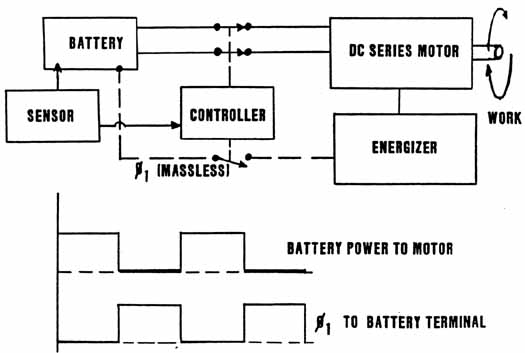
On this slide, we show a theoretical scheme which several researchers have discovered and used to build simple free energy motors.
In this scheme, we drive an ordinary d.c. series motor by a two wire system from an ordinary battery. The motor produces shaft horsepower, at -- say -- some 30 or 40 percent efficiency, compared to the power drained from the battery. This much of the circuit is perfectly ordinary.
The trick here is to get the battery to recharge itself, without furnishing normal power to it, or expending work from the external circuit in the process.
To do this, recall that a charged particle in a "hooking" del-phi river moves itself. This is true for an ion, as well as for an electron. We need only make the del-phi in correct fashion and synchronize it; specifically, we must not release the hose nozzles we utilize to produce our del-phi river or waves.
The inventors who have discovered this have used various variations, but here we show a common one.
First, we add an "energizer" (often referred to by various other names) to the circuit. This device makes the del-phi waves we will utilize, but does NOT make currents of electron masses. In other words, it makes pure Ø-dot. It takes a little work to do this, for the energizer circuit must pump a few charges now and then. So the energizer draws a little bit of power from the motor, but not very much.
Now we add a switching device, called a controller, which breaks up power to the motor in pulses. During one pulse, the battery is connected and furnishes power to the motor; during the succeeding pulse, the battery is disconnected completely from the motor and the output from the energizer is applied across the terminals of the battery.
If frequency content, spin-hole content, etc. are properly constructed by the energizer, then the ion movements in the battery reverse themselves, recharging the battery. Again, remember that these ions MOVE THEMSELVES during this recharge phase. Specifically, we are NOT furnishing ordinary current to the battery, and we are not doing work on it from the energizer.
If things are built properly, the battery can be made to more than recover its charge during this pulse cycle.
To prevent excess charge of the battery and overheating and destroying it, a sensor is added which senses the state of charge of the battery, and furnishes a feedback signal to the controller to regulate the length of recharge time per "power off" pulse. In other words, the system is now self-regulating.
The relation between power pulses and recharge pulses is shown on the graphs at the bottom. Note that regulation may decrease the time of recharge application of the del-phi river.
This system, if properly built and tuned, will furnish "free shaft energy" continually, without violating conservation of anenergy. Remember that the del-phi condition across the battery terminals means that spacetime is suddenly curved there, and conservation of energy need no longer apply.
Again, this system is consistent with general relativity and with the fact that Ø-field alone can drive a situation relativistic. We have deliberately used these facts to do direct engineering. Our "extra energy" comes from shifting phi-flux -- the energy of the universal vacuum spacetime -- directly into ordinary energy for our use. Thus we draw on an inexhaustible source, and our device is no more esoteric than a paddlewheel in a river. The only difference is that, in this case, we have to be clever enough to make and divert the river in the right timing sequency.
This is a free energy device which an ordinary person, who knows a little electronics, can experiment with in the basement. To develop it, one is talking several thousands of dollars and a lot of persistence and tinkering; one is not talking millions.


 ) to try to explain away its impossibility.
I'll offer him the same deal I offered a dozen times before;
Sell me one to heat my house.
Terms are these; You name your price. Assuming I agree, you install it in my home. When it has run successfully for 6 months, and required no fuel or electricity of any kind, and worked without your intervention, I will pay your price plus bank-rate interest on that price for the six months of the trial period.
As a bonus, upon payment, I will make an endorsement of your product so you can sell it.
There is a lot of misunderstanding about the Bedini system and about what it does.
The basic SSG uses the back emf or counter electromagnetic force created inside a coil when you cut the current flowing through it sharply. This self-induction effect has been described in detail by Faraday and therefore is nothing new at all.
The NEW idea is to use this normally wasted energy, take it out of the system and charge a secondary battery with it. Normally the self induction spike is shorted to ground by using a diode. Or it manifests itself as a braking force or simply heats up the machine. Bedini and his associates are among the first to use this energy.
If you hook up a sulphated battery to a powerful Bedini machine, the crystals in the battery will be literally smashed by the high voltage pulses. Within minutes, the stone dead battery will be able to hold a small charge or power a small light. If you leave the battery on the machine for some time it will be returned to normal or near normal condition.
The second effect is running time of the Bedini system when it is run by two battery banks. My simple bike-wheel experimental motor draws about 100 mA out of a gel cell battery when it is running. Normally the battery is depleted after about 10 to 12 hours. I then simply swap it for the other battery that is being charged and get another 10 to 12 hour run. This can be repeated several times before both batteries are depleted. In time both batteries are drained but the machine runs about 3 to 4 times longer than it would run if I used both batteries together to power it. That is because the normally wasted back emf is recovered in the second battery. I don't know if there is an overunity effect in this as the mechanical energy furnished by the wheel is hard to measure. But the thing definitely runs a lot longer than with a normal operation. This can be confirmed with a simple stopwatch and needs no exotic measuring equipment.
Or use the Bedini with a solar panel. Fewer solar panels could charge a bigger battery. And the bane of solar systems is that the current drops on an overcast or rainy day so the battery won't charge at all. The Bedini system uses high voltage to charge the batteries remember? well the batteries will still charge even when the current of the solar panels will drop to 10 or 20% of their nominal current in bright sunshine. Plus your batteries will stay in shape due to the high voltage process.
The Bedini process can be made to work without moving parts or rotors.

That is because it is impossible. Getting more energy out of a system than you put into it is the definition of over-unity, and is a violation of thermodynamics. If it was possible, physics as we know it couldn't exist.I won't tell you about the amplifier effect- charging an 1800 amp hour battery that weighs in at 2 tons with a mere 10 amps from another battery setup and getting four or five times the energy back that you put in before.
The red light goes on and it is impossible.

That defies the laws of physics.I won't tell you about the amplifier effect- charging an 1800 amp hour battery that weighs in at 2 tons with a mere 10 amps from another battery setup and getting four or five times the energy back that you put in before.
Whe describes sounds like regenerative braking with a bit off woo thrown in. I don't know why he thinks this is some weird new discovery.But if it works like you claim it does, your "simple bike-wheel experimental motor" will most likely be running with less power, which is why it lasts longer. If you tried that in an electric car, drivers would notice a huge reduction in power.

I am not saying that similar effects can't be had with other methods. Of course you can make a battery desulphator very simply. Why is it not used more then?
Why does not every car have a circuit like this so we don't end up with messed up batteries all the time?
The battery company intentionally weakens the connectors between the plates so the battery will die earlier. The plates are thinner and so on.This keeps the wheel turning they say. And we suffocate in all the waste.
Of course you can short the back emf out with a flyback diode. That is a waste of energy nonetheless. Why not charge a second bat with it?
When the machine runs you can connect a volt meter to see the sum voltage of both batteries and usually this goes up while the machine runs.
I can add an induction coil and light a long fluorescent tube to high brightness all while the motor is running and the batteries are charging. to someone with little or no access to energy this could make a huge difference.Run a small water pump, light the hut, and charge a battery if you want to watch tv at night--of course here in our saturated world we just flip a switch or plug in something.

I know you can make a switched power supply and a step up voltage converter, but hardly with as few electronic parts and all in one machine.
Still I know quite a few guys here with solar installations on their roofs and none of the principles I mentioned is used in their setups. The batteries die, the inverter cuts off when there is a cloud going by and so on.
Call the stuff crude - I think it works amazingly well crude or not.
I won't tell you about the amplifier effect- charging an 1800 amp hour battery that weighs in at 2 tons with a mere 10 amps from another battery setup and getting four or five times the energy back that you put in before.
The red light goes on and it is impossible. Yet people all over the world do just that regularly every day and more will do it. Airplanes heavier than air fly everyday around the globe and all this was impossible before.
There is a lot of misunderstanding about the Bedini system and about what it does.
I have built many Bedini motors and chargers over the last few years. They range from a simple computer fan that is modified to run off a Bedini circuit to my largest machine with a 20pound aluminum rotor and the capacity to charge a 100 amp hour battery bank in just a few hours.
First, it is NOT an overunity or perpetual motion machine. No one has ever claimed that.
Bedini calls it an energizer, and that is exactly what it is.
The interesting effects happen mostly inside the batteries.
The basic SSG uses the back emf or counter electromagnetic force created inside a coil when you cut the current flowing through it sharply. This self-induction effect has been described in detail by Faraday and therefore is nothing new at all.
The NEW idea is to use this normally wasted energy, take it out of the system and charge a secondary battery with it.
Normally the self induction spike is shorted to ground by using a diode.
Or it manifests itself as a braking force or simply heats up the machine.
Bedini and his associates are among the first to use this energy.
The effect of short, sharp high voltage pulses on flooded lead acid batteries is something that only begins to be explored.
Lead acid batteries suffer from "sulphation" when they are left unused for a longer time. The sulfate crystals build up on the battery plates , increase the interior resistance (impedance) of the battery and therefore it becomes impossible to charge.
Anyone who has stored a motorcycle or car battery for a longer time will have seen this effect.
an automatic battery charger will turn off imediately because the battery voltage will go up to 15-16 volts without any charge going into the battery. This effect is responsible for 50 % of the "battery failures" and perfectly useable batteries get thrown out .
If you hook up a sulphated battery to a powerful Bedini machine, the crystals in the battery will be literally smashed by the high voltage pulses. Within minutes, the stone dead battery will be able to hold a small charge or power a small light. If you leave the battery on the machine for some time it will be returned to normal or near normal condition. I have done this many times and most of my batteries come from my local car repair shop where they were ready to be thrown out.
This alone is a good reason to explore the Bedini system. How much wasting of money and pollution of the environment could be avoided?
John's own 1800 amp hour battery banks that he uses for demonstrations come from power supply systems for cell phone masts and the elements were bought as trash for 60 $ a cell. Normally they are several thousands of $ a cell. John brought them back to life and can draw 2500 Watts off them continuously for 10 hours.
To get this far is a long and slow process but for someone who wants to power a home with battery power its worth looking into. All these processes are in the experimental stage now and there is no off the shelf system that will take the work out of it. There is no "free" energy-one has to work for it.
Beyond the regeneration effect there seems to be a change in the battery chemistry if it is run on the Bedini system for a longer time. The battery charges faster and holds a higher charge when run by the energizer. This only shows after 50-100 charge-recharge cycles and that is why many experimenters never get that far. It takes patience and persistence to see this effect happen.
The second effect is running time of the Bedini system when it is run by two battery banks. My simple bike-wheel experimental motor draws about 100 mA out of a gel cell battery when it is running. Normally the battery is depleted after about 10 to 12 hours. I then simply swap it for the other battery that is being charged and get another 10 to 12 hour run. This can be repeated several times before both batteries are depleted. In time both batteries are drained but the machine runs about 3 to 4 times longer than it would run if I used both batteries together to power it.
That is because the normally wasted back emf is recovered in the second battery.
I don't know if there is an overunity effect in this as the mechanical energy furnished by the wheel is hard to measure.
But the thing definitely runs a lot longer than with a normal operation. This can be confirmed with a simple stopwatch and needs no exotic measuring equipment.
Now take this concept to an electric vehicle. If you could use two smaller batteries instead of a big one and swap them back and forth you could get more miles out of the car per pound or kilogram of battery weight, and that would be a BIG issue indeed.
We have not violated any law of Nature we simply made a much better use of the available energy. No miracle here but a definite progress.
Or use the Bedini with a solar panel. Fewer solar panels could charge a bigger battery. And the bane of solar systems is that the current drops on an overcast or rainy day so the battery won't charge at all.
The Bedini system uses high voltage to charge the batteries remember?
well the batteries will still charge even when the current of the solar panels will drop to 10 or 20% of their nominal current in bright sunshine.
Sigh- I knew it would not be that easy.
The problem is you fellas simply never made one of these machines. Sitting in an armchair and theorizing is not the same as trying it out ....
I am not saying that similar effects can't be had with other methods. Of course you can make a battery desulphator very simply. Why is it not used more then?
Why does not every car have a circuit like this so we don't end up with messed up batteries all the time?
The battery company intentionally weakens the connectors between the plates so the battery will die earlier.
The plates are thinner and so on.
Of course you can short the back emf out with a flyback diode. That is a waste of energy nonetheless. Why not charge a second bat with it?
When the machine runs *SNIIIP* , light the hut, and charge a battery if you want to watch tv at night--of course here in our saturated world we just flip a switch or plug in something.
I won't tell you about the amplifier effect- charging an 1800 amp hour battery that weighs in at 2 tons with a mere 10 amps from another battery setup and getting four or five times the energy back that you put in before.
Airplanes heavier than air fly everyday around the globe and all this was impossible before.
