Non-baryonic cold dark matter ("CDM"), the observational evidence

Why did you think that?

As you point out, such a density profile is obviously not valid at small r. But it is equally obviously not valid at large r (because otherwise the total mass would be infinite). So at most such a behavior could be valid over an intermediate range of radii (and evidently is, or close, for DM halos).

As I said, I'm not aware of an explanation of why that should be the profile (other than the results of simulations), but perhaps there is one?

I should point out that I am assuming hydrostatic equilibrium. For the DM halo, that may or may not be the case, but it seems like a reasonable firs step.

From my point of view, the density, as a function of radius, for a DM halo is non-trivial. From where I stand, the more non-trivial the density function gets, the harder it becomes to explain the density function in terms of gravity and massive particle dynamics alone.

Also, as I begin to understand and read about this further, it appears as if the galaxy rotation curves, at small r, show v proportional to r, like you would see in a rigid rotating body. Pretty cool, lots of stuff going on in an innocent looking galaxy. No wonder they call them 'grand design' spirals....there is a lot of physics at work behind the pretty pictures!
 
I should point out that I am assuming hydrostatic equilibrium. For the DM halo, that may or may not be the case, but it seems like a reasonable firs step.

Two questions:

a) Why would hydrostatic equilibrium produce a 1/r^2 density profile? It doesn't do that in stars, for example.

b) How could a DM halo be in hydrostatic equil.? By definition there would have to be a pressure that balances gravitational force, but DM only interacts gravitationally (at least that's the usual assumption, and there are good reasons for it) so there cannot be any such pressure.

Could you please elaborate? I'm not trying to be a pain - I'd genuinely like to know if there's some general reason why DM should have a 1/r^2 profile.

From my point of view, the density, as a function of radius, for a DM halo is non-trivial. From where I stand, the more non-trivial the density function gets, the harder it becomes to explain the density function in terms of gravity and massive particle dynamics alone.

Rather than speculate, why not have a look at the results of numerical simulations? They assume almost nothing - they simply model DM as a non-interacting gas of massive particles with some small density inhomogeneities in the initial condition - and the results match observations quite well.
 
Last edited:
DRD is correct (as usual), and you are wrong in a particularly smarmy way (as usual).

I plead guilty your (robinson) Honour; I did not, in this sentence, clearly distinguish (normal, or giant) ellipticals from dwarf ellipticals.

No worries mate. We all make mistakes and such. I hoped you would have a chance to expand your statement, with a simple nudge from my humble self, but alas, Sol jumped in and made it worse.

The difficulty with blanket statements about the Universe, is those odd structures and luminous bodies that don't follow our rules.

Galaxies, those abundant glowing sources of so much energy and wonder, are notorious for not fitting our categories and predictions.

Especially (getting back on topic) when it comes to rotation, "Dark Matter" halos, acceleration, even red shifts and number of supernovas. They almost seem set on confounding our best efforts.

Did you see the latest? Another damn mystery. It seems almost every time we do a new exposure with the Hubble, we are faced with yet another object that doesn't fit the theory.

It really is a pain at times.
 
No worries mate. We all make mistakes and such. I hoped you would have a chance to expand your statement, with a simple nudge from my humble self, but alas, Sol jumped in and made it worse.

Ah, the smarmy wrongness is back again... how refreshing.

DRD's statement was completely correct in its context.
 
DeiRenDopa said:
cold gas: no; no 21 cm emission (from H), the spectra of distant sources show no 'local' (absorption) lines
Hey, don't some people, who think that EM could explain the galaxy rotation curves, assume these gas clouds are subject to EM forces, because they are ionized, or charged? DIscounting any polar effects due to the charge distribution in the H atom/molecule itself.

But, isn't the 21cm emission from neutral hydrogen, so EM fields wouldn't affect this gas the same way it would affect truly ionized gas?
Not sure I follow ...

I was, very briefly, going through a list of possible baryonic components of the MW halo (and, by extension, halos of other galaxies), and ruling them out.

Note there is certainly some cold gas, just nowhere near enough to account for the estimated mass in the halo.

Detection, or non-detection, of most things in my list relies on atomic physics (mostly), which is extremely well-understood, for the kinds of baryonic matter examined.

Gases, for example, will emit and absorb at very distinct frequencies, based on the populations in particular states (singly ionised He, for example), giving rise to line spectra, band spectra (molecules), and so on. If you don't see any such lines, then there are no such populations along the line of sight. To get absorption spectra, simply look at a bright, distant source.

Other forms of baryonic matter will emit more or less like a blackbody, which has its own, very distinctive, spectrum.

Fully ionised gas (a plasma) will emit a different kind of spectrum (look up 'bremsstrahlung').

Now if you add magnetic fields (enter caveat, for robinson, here, about the necessary strength of such), you will get another kind of spectrum (look up 'synchrotron radiation').

I wasn't aware than any PC proponent, or anyone for that matter, had proposed that large masses of baryonic matter could be completely invisible, in the environment of the MW halo (enter caveat here about the need to be consistent with all the other relevant observations, such as the fact that we are not being bombarded by hypervelocity bowling balls made of a rhenium-bismuth alloy).

But maybe that's not what you meant ...
 
What is the expected distribution of CDM in a galaxy halo? What constraints can be put on the distribution of CDM in galaxy halos, from observations?

This is big, big topic! :D

Very quickly you will come across 'NFW halos' (after Navarro, Frenk & White), 'cored halos' (halos with constant density cores), 'stellar polytrope' halos, tidally truncated halos, isothermal halos, ... interestingly, here is a page from PhysicsForums on two different types (note that the latex formatting is lost).

I'd rather leave it for now ... not only do I plan to come back to it when I address the last point (cosmology - some of the simulations sol refers to are very relevant!), but also it's not directly relevant to the observational evidence for CDM in galaxy halos.
 
OK, I can't resist ... CONSTRAINTS ON FIELD GALAXY HALOS FROM WEAK LENSING AND SATELLITE DYNAMICS, by Tereasa G. Brainerd presents an excellent review of one small part of what I've covered, and is of direct relevance to some of Wrangler's recent posts (it also, I hope, satisfies robinson, in terms of depth and provenance of source).

I'll quote from Section 5, leaving out the references and formulae (note that these provide all the depth you could ask for, if you wanted to follow up on what sol wrote ...; I've added some bolding):
High-resolution CDM simulations have established the existence of a "universal" density profile for dark matter halos which results from generic dissipationless collapse [...]. This density profile fits objects that span roughly 9 orders of magnitude in mass (ranging from the masses of globular star clusters to the masses of large galaxy clusters) and applies to physical scales that are less than the "virial" radius, r200. Conventionally, r200 is defined to be the radius at which the spherically-averaged mass density reaches 200 times the critical mass density [...].

Navarro, Frenk & White [...] showed that the universal density profile for dark matter halos was fitted well by a function of the form

[Equation 11 (11)]

and halos having such a density profile are generally referred to as "NFW" halos. Here [...] is the critical density of the universe at the redshift, z, of the halo, H(z) is Hubble's parameter at that same redshift, and G is Newton's constant. The scale radius rs [...] is a characteristic radius at which the density profile agrees with the isothermal profile [...], c here is a dimensionless number known as the concentration parameter, and

[Equation 12 (12)]

is a characteristic overdensity for the halo.

Formally, the above fitting function for the radial density profiles of CDM halos converges to a steep, cuspy profile: [...]. The NFW fitting formula, however, was never intended to be extrapolated to very small radii (i.e., radii smaller than the practical resolution limits of the simulations) and much fuss has been made over whether observed galaxies actually show such cuspy inner density profiles [...]. More recent numerical work has shown that the density profiles of CDM halos do not, in fact, converge to a well-defined asymptotic inner slope [...], and it has become increasingly clear that fair and direct comparisons of simulated galaxies with observed galaxies on very small physical scales is an extremely challenging thing to do [...].

Weak lensing and satellite dynamics do not have the ability to provide any information whatsoever on the cuspiness (or lack thereof) in the central regions of galaxies. Instead, both are governed by the large-scale properties of the halos (i.e., the regime in which the NFW profile is known to be an excellent description of the density profiles of CDM halos) and, at least in principle, both have the potential to discriminate between NFW halos and simpler singular isothermal sphere halos.
 
No, as he pointed out. Try to keep up.

He's just extremely accommodating and quite polite. He also hasn't had to deal with you as much as I have, so he's a little more patient.

Anyway, the physics is quite well explained in DRD's posts. Anyone can read them and draw their own conclusions.
 
But maybe that's not what you meant ...

I think it is; my point was that some folks say that the rotation curves can be explained by EM effects alone, but I think the information you present says otherwise.

I was speaking from the angle that a lot of the gas that would be expected to interact with galactic EM fields seems to be of the neutral variety.
 
Two questions:

a) Why would hydrostatic equilibrium produce a 1/r^2 density profile? It doesn't do that in stars, for example.

I thought that one of the fundamental solutions to a self-gravitating sphere of gas or dust, for example, is one that results in a 1/r^2 density profile. I could probably present my understanding of this solutions governing equations in another post, if needed.

b) How could a DM halo be in hydrostatic equil.? By definition there would have to be a pressure that balances gravitational force, but DM only interacts gravitationally (at least that's the usual assumption, and there are good reasons for it) so there cannot be any such pressure.

Could you please elaborate? I'm not trying to be a pain - I'd genuinely like to know if there's some general reason why DM should have a 1/r^2 profile.

A pain? I am enthused that you all are willing to discuss this stuff, even when my understanding is off a bit..............

I thought that a cloud of dust or gas, as it collapses under self-gravity, will eventually see some pressure, unless we are talking about collisionless cases.

As far as a general reason why DM should have a 1/r^2 profile, isn't that what the rotation curve tells us? Didn't we cover this earlier?


Rather than speculate, why not have a look at the results of numerical simulations? They assume almost nothing - they simply model DM as a non-interacting gas of massive particles with some small density inhomogeneities in the initial condition - and the results match observations quite well.

DRD has provided some links, so I will take a look, thanks!
 
Last edited:
OK, I can't resist ... CONSTRAINTS ON FIELD GALAXY HALOS FROM WEAK LENSING AND SATELLITE DYNAMICS, by Tereasa G. Brainerd presents an excellent review of one small part of what I've covered, and is of direct relevance to some of Wrangler's recent posts (it also, I hope, satisfies robinson, in terms of depth and provenance of source).

I'll quote from Section 5, leaving out the references and formulae (note that these provide all the depth you could ask for, if you wanted to follow up on what sol wrote ...; I've added some bolding):

Thanks, DRD.

This looks like a good start for examining the analytical models for the DM halo mass distributions.
 
I think it is; my point was that some folks say that the rotation curves can be explained by EM effects alone,
They do?!?!? :eye-poppi

Who are these people? Where have they presented such an explanation? I mean, one that also explains (or at least is not inconsistent with) all other relevant observations ...
.
but I think the information you present says otherwise.
.
I don't think it does.

Nothing that I presented says that spiral galaxy rotation curves cannot "be explained by EM effects alone"; in fact, I don't think I even hinted at any such explanation, much less said it could be ruled out by anything I presented.

Maybe you are referring to my earlier statement, to the effect that I wasn't aware of any explanation, other than the one I presented, based on textbook physics? or any alternative, based on physics not found in standard textbooks?

One can never say never ... someone may come up with a truly amazing explanation, based on textbook physics, that no one had even considered before, and they may do so tomorrow.

However, to the extent that the following story is indicative, I doubt it.

As you know, Fermat's Last Theorem was solved, by Andrew Wiles, over 300 years after it was written. No doubt there were hundreds of (failed) attempts during that time. Not so well known is that n = 5 and n = 7 proofs were established by the 1840s, by what we'd call, today, professional mathematicians (n = 3 and n = 4 fell much earlier to Euler and Fermat, respectively). Despite the apparent simplicity of the theorem, and despite vast numbers of attempts by amateurs, it seems no amateur even came up with an n = 7 proof, independently, much less any other more powerful proofs.

It's a powerful myth that outsiders can come up with truly revolutionary ideas in mathematics, physics, etc (in a form that is capable of being worked on; i.e. not word salad), but while there are undoubtedly many people who could come up with such ideas, it seems there are essentially no examples of any such success, at least in the last century or three.
.
I was speaking from the angle that a lot of the gas that would be expected to interact with galactic EM fields seems to be of the neutral variety.
I don't understand this; would you mind saying a bit more?
 
I thought that one of the fundamental solutions to a self-gravitating sphere of gas or dust, for example, is one that results in a 1/r^2 density profile. I could probably present my understanding of this solutions governing equations in another post, if needed.

Yes, please do.

I thought that a cloud of dust or gas, as it collapses under self-gravity, will eventually see some pressure, unless we are talking about collisionless cases.

I don't think so. Conservation of energy and angular momentum will probably prevent the density at the center from ever getting very large, and I would expect that together with the weakness of DM interactions means the pressure is never significant. But I could be wrong.

As far as a general reason why DM should have a 1/r^2 profile, isn't that what the rotation curve tells us? Didn't we cover this earlier?

Sorry for the miscue - I meant apart from that. In other words, if we simply posit that DM exists, can we predict that it will form halos with a 1/r^2 profile?
 
Last edited:
They do?!?!? :eye-poppi

Who are these people? Where have they presented such an explanation? I mean, one that also explains (or at least is not inconsistent with) all other relevant observations ...
..
I don't think it does.

Nothing that I presented says that spiral galaxy rotation curves cannot "be explained by EM effects alone"; in fact, I don't think I even hinted at any such explanation, much less said it could be ruled out by anything I presented.

Maybe you are referring to my earlier statement, to the effect that I wasn't aware of any explanation, other than the one I presented, based on textbook physics? or any alternative, based on physics not found in standard textbooks?

One can never say never ... someone may come up with a truly amazing explanation, based on textbook physics, that no one had even considered before, and they may do so tomorrow.

However, to the extent that the following story is indicative, I doubt it.

As you know, Fermat's Last Theorem was solved, by Andrew Wiles, over 300 years after it was written. No doubt there were hundreds of (failed) attempts during that time. Not so well known is that n = 5 and n = 7 proofs were established by the 1840s, by what we'd call, today, professional mathematicians (n = 3 and n = 4 fell much earlier to Euler and Fermat, respectively). Despite the apparent simplicity of the theorem, and despite vast numbers of attempts by amateurs, it seems no amateur even came up with an n = 7 proof, independently, much less any other more powerful proofs.

It's a powerful myth that outsiders can come up with truly revolutionary ideas in mathematics, physics, etc (in a form that is capable of being worked on; i.e. not word salad), but while there are undoubtedly many people who could come up with such ideas, it seems there are essentially no examples of any such success, at least in the last century or three.
.I don't understand this; would you mind saying a bit more?

I am sorry, it appears as if I am confusing both you, and Sol.

First for my confusion with you: on one of these "alternate cosmology" websites, or techncial papers, they mentioned that the galaxy rotation curves could be explained by interactions of a gas halo with a galactic EM field.

I took the following post sentences:

DRD said:
hot gas/plasma: no; x-ray emission from galaxy halos is too small, and the x-ray spectra of distant sources show no 'local' (absorption) lines

cold gas: no; no 21 cm emission (from H), the spectra of distant sources show no 'local' (absorption) lines

small clumps of cold gas: no; they'd collide to form bigger clumps, they'd form stars, and too few micro-lensing events (see below)

to mean that the gas is in neither abundance or form that would make that position viable.

I may have read to much in these sentances on my own account.
 
Yes, please do.

I will do that, and post later this evening. It feels like an oral exam! :D


I don't think so. Conservation of energy and angular momentum will probably prevent the density at the center from ever getting very large, and I would expect that together with the weakness of DM interactions means the pressure is never significant. But I could be wrong.

We will dissect my later post, and see!

Sorry for the miscue - I meant apart from that. In other words, if we simply posit that DM exists, can we predict that it will form halos with a 1/r^2 profile?

Maybe, or maybe not. I was taking a simplistic approach. I know that the mass distribution for galaxies is sometimes modeled as superpositions of simpler cases: spherical for the bulge, and spheroidal for the disk.

I was just thinking of adding another simplistic distribution for the dark matter.

One of my reasons for this is because the spherical assumtion for the bulge, and the spheroidal assumption for the disk both make intuitive sense for me.

So, with the dark matter, what makes sense is a large, spherical distribution of gravitating matter. Obviously, a 1/r^2 distribution will not hold for r->0 or r->infinity, but it seems to make for a good starting point.

Note that the way that I think about it, the more complex the model for the mass distribution (for either luminous or dark matter), the less desirable from my point of view.
 
Yes, please do.

Sol,

the solutions I have seen start like so:

We have, of course, the gravitational potential:

[latex] \bigtriangledown ^ 2\phi = 4\pi G\rho [/latex]

and the equation for hydrostatic equilibrium:

[latex]\bigtriangledown P + \rho \bigtriangledown \phi = 0 [/latex]

These are tied together by the equation of state, which I believe relates the speed of sound in the mass distribution to the pressure:

[latex] P = \rho {{c}_{s}}^{2} [/latex]

If we begin assuming that:

[latex] \rho = \rho (r) [/latex]

Then I can barely understand how to get to:

[latex]\left (\frac{{{c}_{s}}^{2}}{\rho (r)} \right)\left(\frac{d \rho (r)}{d r} \right) = - \frac {4 \pi G}{{r}^{2}}\int_{r}^{0}{r}^{2} \rho (r) dr [/latex]

Now, I can integrate the expression on the far right, and descriptions of this integral that I have seen in on-line versions of these calculation steps often just call this M(r).

This equation overall is too complex for me, and on-line versions of this calculation use numerical methods to solve this.

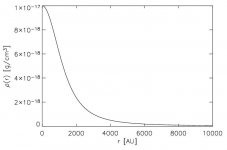
A typical numerical solution looks like the attached graph, solution1 (from reference #1).

A typical numerical solution also takes the form of:

[latex] \rho (r) = \frac {{{c}_{s}}^{2}}{2 \pi G {r}^{2}} [/latex] (from reference #1)

Now, I cannot do the numerical solutions, or solve the equation further myself.

I did however, try to get "further along" by assuming the following forms for [latex] \rho (r) [/latex], and seeing how far I got:

[latex] \rho (r) = \frac {\alpha }{{r}^{2}} [/latex]

and:

[latex] \rho (r) = \frac {\alpha }{r} [/latex]

where [latex] \alpha [/latex] is just an arbitrary constant.

I hope that this math does not make you shudder, but here goes.

First, plugging in [latex] \rho (r) = \frac {\alpha }{{r}^{2}} [/latex], we have:

[latex] \left (\frac{{{c}_{s}}^{2} {r}^{2}}{\alpha} \right)\left(\frac{-2 \alpha}{{r}^{3}} \right) = - \frac {4 \pi G}{{r}^{2}}\int_{0}^{r}\alpha dr [/latex]

Combinations, and evaluation of the integral leads to:

[latex] \left (\frac{- 2{{c}_{s}}^{2}}{r} \right) = - \frac {4 \pi G \alpha} {r} [/latex]

This reduces to a solution for my arbitrary constant of:

[latex] \alpha = \frac {{{c}_{s}}^{2}}{2 \pi G} [/latex]

This seems to me to confirm the validity of the numerical solution.

If I try plugging in [latex] \rho (r) = \frac {\alpha }{r} [/latex], I get:

[latex] \left (\frac{{{c}_{s}}^{2}{r}}{\alpha} \right)\left(\frac{- \alpha}{{r}^{2}} \right) = - \frac {4 \pi G}{{r}^{2}}\int_{0}^{r}\alpha r dr} [/latex]

Combinations, and evaluation of the integral, provides:

[latex] \left (\frac{- {{c}_{s}}^{2}}{r} \right) = - 2 \pi G \alpha [/latex]

Which gives:

[latex] \alpha = \frac {{{c}_{s}}^{2}}{2 \pi G r} [/latex]

So, in this case, my arbitrary constant is forcing the density to be dependent upon [latex] {r}^{-2} [/latex] again!

Now, my funky checks of the density function do not prove the uniqueness of the solution that is dependent upon [latex] {r}^{-2} [/latex], but I think that it shows that for these equations, it is a viable solution.

I am sorry if my calculus is so poor, this is the best way I could present the solution, and try to work through at least some checks of the numerical solution on my own.

Hopefully I haven't done anything too outrageous, although I know I played fast and loose with my integrands and differential variables, I think.

References:

#1 http://www.mpia-hd.mpg.de/homes/dullemon/lectures/starplanet/chap_05_cloudcores.pdf

#2 Primordial Stellar Evolution, E.K.L. Upton, as presented in Stars and Stellar Systems Vol. VII: Nebulae and Interstellar Matter, U of Chicago Press, 1968

 

Attachments

  • solution1.jpg
    solution1.jpg
    22 KB · Views: 1
Last edited:
DeiRenDopa said:
They do?!?!?

Who are these people? Where have they presented such an explanation? I mean, one that also explains (or at least is not inconsistent with) all other relevant observations ...
..
I don't think it does.

Nothing that I presented says that spiral galaxy rotation curves cannot "be explained by EM effects alone"; in fact, I don't think I even hinted at any such explanation, much less said it could be ruled out by anything I presented.

Maybe you are referring to my earlier statement, to the effect that I wasn't aware of any explanation, other than the one I presented, based on textbook physics? or any alternative, based on physics not found in standard textbooks?
... snip ...
I am sorry, it appears as if I am confusing both you, and Sol.

First for my confusion with you: on one of these "alternate cosmology" websites, or techncial papers, they mentioned that the galaxy rotation curves could be explained by interactions of a gas halo with a galactic EM field.

I took the following post sentences:
hot gas/plasma: no; x-ray emission from galaxy halos is too small, and the x-ray spectra of distant sources show no 'local' (absorption) lines

cold gas: no; no 21 cm emission (from H), the spectra of distant sources show no 'local' (absorption) lines

small clumps of cold gas: no; they'd collide to form bigger clumps, they'd form stars, and too few micro-lensing events (see below)
to mean that the gas is in neither abundance or form that would make that position viable.

I may have read to much in these sentances on my own account.
OK, thanks; I think I can see where the confusion is coming from!

Assuming it's Peratt's 'pair of cosmic/giant Birkeland currents can create spiral forms and rotation curves' that you are referring to (if not, please say more) ...

As far as I can tell, Peratt's idea is consistent with all the interpretations of observations of the MW halo, in terms of its baryonic mass content.

But that's not saying very much, because (a far from complete list):

* Peratt didn't publish anything about the expected baryonic content of the MW halo (or that of any spiral galaxy, or any galaxy at all), as far as I know (so {silence} is consistent with anything!)

* only charged objects are included in Peratt's model (i.e. the motions of uncharged objects, in the gravitational field of all masses, is not considered), so observations of the motion of uncharged objects have no bearing on his model

* the simulation codes he used were not, as far as I know, published (so, among other things, no one can independently check his stated conclusions, nor run them again, using different parameters)

* his model is strongly inconsistent with a wide range of (other) astronomical observations; for example, stars could not possibly hold enough charge for their motions to be dominated by the electrical and magnetic fields Peratt requires (either as inputs in the model, or as observed; the ISM magnetic fields, for example).

In short, this is not, and cannot be, an alternative explanation for the observed spiral galaxy rotation curves, based on textbook physics ... because it is not consistent with other, highly relevant, astronomical observations.

No doubt there are hundreds, possibly millions, of such alternatives, some seemingly based on good physics (like Peratt's model), some from the furthest regions of woo-land, and most (no doubt) in between; I see no point at all in even considering them: if they are inconsistent with well-established astronomical observations, why waste time on them?
 
Thanks, Wangler. I'll think about this and respond later.


Thanks Sol.

As always, your opinion will be valued.

One thing that I forgot to re-iterate:

1) My current understanding is that it is very likely that the DM halo cannot be represented by a simplistic density-radius relationship, as shown here. Just like the luminous matter density function is not simplistic.

2) The more complex the density-radius relationship, the more burdens are placed on our understanding of the DM halo. Our luminous matter functions are complex, true, but in my opinion they have as their basis many observations of the behaviour of this luminous, baryonic matter which we at least think we understand well.

Basically, if we posit a "low density core" spherical density-radius relationship (for example), we need to have a very good reason to do so, that can be explained by the expected behaviour of the DM material. If we just curve-fit to fit the data, then such a solution ends up being, well, MOND-ish.
 

ISF - Join now!

Every member here is approved by hand. No bots, no spam, just people who care about evidence and honest debate.

Membership is free!

Create your free account

Back
Top Bottom