• Quick note - the problem with Youtube videos not embedding on the forum appears to have been fixed, thanks to ZiprHead. If you do still see problems let me know.

Mystery of a Lead Coffin Discovered Beneath Notre-Dame Solved...?

No, I meant west. Look at the floorplan you posted:


From your citation:
"Du Bellay was interred at the foot of a large cross that was once displayed on the now-destroyed rood screen"

How do you get 'buried on the rood screen axis' from that?


Well yes, they would be. The spire is above the transept crossing.


ETA: the rood screen runs across the width of the nave, so the 'rood screen axis' would be north-south.


The caption says, 'Floor plan of Notre Dame' but I see what you mean about the rood screen seeming to be west of the nave/transept crossing. But then it might actually be correct, as this diagram showing the 'collapsed section' after the 2019 fire seems to show the same area. Yet all the press releases say the coffins are at the nave/transept intersection and also state it is where the rood screen used to be. (See plain white section with dotted lines showing the collapsed section.)

1731795033216.png


Source: https://www.researchgate.net/figure/Ground-plan-of-Notre-Dame-de-Paris_fig4_341917087

As for the 'du Bellay' coffin lying on the axis of the former rood screen, I read it in an article. I'll see if I can find it.
 
One of the links Vixen provided on page 1
...has some good quality photos and showed the coffin in situ.

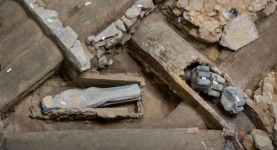
We can see the head is to the left and we can orient ourselves by inferring that's west since the researchers don't think he was a priest. The location is thus quite close to the centre line of the nave, and at the west side of the transept crossing, away from where the rood screen would have been at the time, on the right of the photo.
May I enquire as to how you know which aspect the photo was taken from? Whilst it's left to right in the photo, it doesn't follow it reflects west to east.

But the initial perception was that he was a high up priest
 
...why would a poet be buried with priestly flowers and leaves as though he was high clergy, with the coffin not being marked with any ID at all?


You appear to be assuming that this:

"The team put a small camera into a hole of one of the 700-year-old sarcophagi to examine its contents. They found (surprise!) human remains, as well as “pieces of fabric, hair and above all a pillow of leaves on top of the head, a well-known phenomenon when religious leaders were buried,” as one expert told Reuters at the time."
(Source: https://gizmodo.com/archaeologists-crack-460-year-old-notre-dame-lead-coffin-mystery-2000505001) 

Refers to the unmarked coffin. I would argue that this is unlikely, mostly because the next sentence in that article is this:

"Later in the year, one set of the remains was identified as Antoine de la Porte, a church authority with “extraordinarily good teeth” who died in 1710. (The identification wasn’t difficult—de la Porte had a plaque on his coffin.) But identifying the remains in the other sarcophagus proved more difficult."

I would be very surprised if the one burial with the holy dude leaves was the one that wasn't marked as being a holy dude. If you have some other source to support your claim that the blessed leaf-litter was observed in the posited poet's coffin, and not that of the priest who was identified as such on his coffin.
 
The caption says, 'Floor plan of Notre Dame' but I see what you mean about the rood screen seeming to be west of the nave/transept crossing. But then it might actually be correct, as this diagram showing the 'collapsed section' after the 2019 fire seems to show the same area. Yet all the press releases say the coffins are at the nave/transept intersection and also state it is where the rood screen used to be. (See plain white section with dotted lines showing the collapsed section.)

View attachment 57766


Source: https://www.researchgate.net/figure/Ground-plan-of-Notre-Dame-de-Paris_fig4_341917087

As for the 'du Bellay' coffin lying on the axis of the former rood screen, I read it in an article. I'll see if I can find it.

As I have previously noted, I was looking at the wrong floorplan. Comunication breakdown, it happens, let's move on.

"all the press releases say the coffins are at the nave/transept intersection" Do they? This appears to be a new or altered claim, what happened to the burials being special because they were in the trancept crossing?

You said that they were directly beneath the spire (implying that this was important). If they are in the "nave/transept intersection", then they aren't directly beneath the spire, because the transept crossing is directly beneath the spire.

"As for the 'du Bellay' coffin lying on the axis of the former rood screen, I read it in an article. I'll see if I can find it." Thank you, that would be very helpful, I look forward to reading it.
 
May I enquire as to how you know which aspect the photo was taken from? Whilst it's left to right in the photo, it doesn't follow it reflects west to east.

But the initial perception was that he was a high up priest
I thought I explained: the fact that researchers propose this is the grave of a particular lay person and not a priest allows us to infer he was not buried as a priest.

Whose "initial perception" was it that he was a "high up priest"? Got a reference?
 
...These days, people bandy around words such as sarcophagus or tomb...when they really mean coffin.

These days people bandy around words such as axis or pew, when what they really mean is anyone's guess.

ETA: Maybe this was petty, but I was going back over the thread in case I had made any more embarassing mistakes akin to looking at the wrong floorplan, and this comment struck me as rather ironic.

I regret nothing (for now).
 
Last edited:
You appear to be assuming that this:

"The team put a small camera into a hole of one of the 700-year-old sarcophagi to examine its contents. They found (surprise!) human remains, as well as “pieces of fabric, hair and above all a pillow of leaves on top of the head, a well-known phenomenon when religious leaders were buried,” as one expert told Reuters at the time."
(Source: https://gizmodo.com/archaeologists-crack-460-year-old-notre-dame-lead-coffin-mystery-2000505001) 

Refers to the unmarked coffin. I would argue that this is unlikely, mostly because the next sentence in that article is this:

"Later in the year, one set of the remains was identified as Antoine de la Porte, a church authority with “extraordinarily good teeth” who died in 1710. (The identification wasn’t difficult—de la Porte had a plaque on his coffin.) But identifying the remains in the other sarcophagus proved more difficult."

I would be very surprised if the one burial with the holy dude leaves was the one that wasn't marked as being a holy dude. If you have some other source to support your claim that the blessed leaf-litter was observed in the posited poet's coffin, and not that of the priest who was identified as such on his coffin.
Definitely refers to the unmarked coffin. See the GUARDIAN Dec 2022

While most of the treasures were discovered barely 20cm (8in) under the cathedral floor, a body-shaped lead sarcophagus was buried one metre deep.

Once opened by specialists in Toulouse, it was found to contain what was left of a man, probably in his 30s, who researchers have named “Le Cavalier”, as his pelvic bones suggest he was an experienced horseman.

There was no name plaque on the coffin, which was moulded around the shape of the body, and holes in the lead around the head meant the remains had been exposed to the air and severe deterioration.

Scientists are continuing to examine fragments of cloth and plant material found inside the coffin and say he was embalmed – a rare practice in the middle ages – and appears to have been buried with a crown of flowers.
 
I thought I explained: the fact that researchers propose this is the grave of a particular lay person and not a priest allows us to infer he was not buried as a priest.

Whose "initial perception" was it that he was a "high up priest"? Got a reference?
Please refer to post #52 which has the following reference:

From the GUARDIAN 15 March 2022

Among the tombs was a “completely preserved, human-shaped sarcophagus made of lead”.

It is thought the coffin was made for a senior dignitary in the 1300s – the century after the cathedral’s construction.
<snip>
As well as the tombs, elements of painted sculptures were found just beneath the current floor level of the cathedral, identified as parts of the original 13th-century rood screen – an architectural element separating the altar area from the nave.
<snip>
“You can glimpse pieces of fabric, hair and a pillow of leaves on top of the head, a well known phenomenon when religious leaders were buried,” said Christophe Besnier, the lead archaeologist.
 
Definitely refers to the unmarked coffin. See the GUARDIAN Dec 2022
Maybe. A 'pillow of leaves' and a 'crown of flowers' may be references to the same thing (especially given possible translation errors). Is putting a camera into a small hole the same as cutting the coffin open and examining the contents? I wouldn't like to say, again possible translation errors, simplifying archaeological methods for popular consumption, I wouldn't be brave enough to say 'definitely', but I will concede possibly.

It would be helpful if we had the archaeologists' original work, rather than second-hand media reports. Maybe one day.
 
Yes the stilted robot voice was excruciating. Pronouncing lead (the metal) as "leed" was a particular low point. Nevertheless, that video repeated the view that the older burial was not a priest.

So we have one comment from the lead archaeologist in the Guardian in 2022 that the leaves (crown of flowers/pillow of leaves?) were common for "religious leaders". But that doesn't necessarily mean it's a particular indication this was a priest's coffin. Now in 2024 you get things like this: https://www.bbc.co.uk/news/articles/cn4z2krmnkvo "Scientists say they are nearly certain a lead coffin found beneath the transept is that of Joachim du Bellay..." who was not, of course, a religious leader.
 
"all the press releases say the coffins are at the nave/transept intersection" Do they? This appears to be a new or altered claim, what happened to the burials being special because they were in the trancept crossing?

You said that they were directly beneath the spire (implying that this was important). If they are in the "nave/transept intersection", then they aren't directly beneath the spire, because the transept crossing is directly beneath the spire.
The crossing is the nave/transept intersection (or rather, it's the area between the nave and the transept).
 
Yes the stilted robot voice was excruciating. Pronouncing lead (the metal) as "leed" was a particular low point. Nevertheless, that video repeated the view that the older burial was not a priest.

So we have one comment from the lead archaeologist in the Guardian in 2022 that the leaves (crown of flowers/pillow of leaves?) were common for "religious leaders". But that doesn't necessarily mean it's a particular indication this was a priest's coffin. Now in 2024 you get things like this: https://www.bbc.co.uk/news/articles/cn4z2krmnkvo "Scientists say they are nearly certain a lead coffin found beneath the transept is that of Joachim du Bellay..." who was not, of course, a religious leader.
They did an isotope and discovered the guy was from Paris except du Bellay grew up in Anjou for his first eight years. They are now awaiting the results to determine the age of the remains once and for all. Complicated by the fact the age of the lead coffin might differ from the age of the body owing to a possible Middle Age practice off removing old bones and sticking in a new occupant. I suspect we might never know who the real incumbent is. It could be a massively inspired correct guess, though.
 
Having never heard of du Bellay previously I have no dog in the fight over whether it's him. I'm only curious about whether the photographed burial is at the west side of the crossing with its head to the west or the east side with head to the east (in what we're told would be the manner for a priest).
 
Vixen do you know what the isotope test actually tested? If they tested the mineral content of a tooth, that shows the region where the person lived while their adult teeth grew. Also I gather the location can be fairly vague, maybe covering a range the size of several possible countries rather than a particular town.

What I mean is, did they really say he came from Paris, or did they only say the results were consistent with his coming from Paris?
 
Having never heard of du Bellay previously I have no dog in the fight over whether it's him. I'm only curious about whether the photographed burial is at the west side of the crossing with its head to the west or the east side with head to the east (in what we're told would be the manner for a priest).

I think I might have solved this - the body orientation - from looking at the youtube video as mentioned, above. Here's what I looked at, at the 2:24 mark:

1731851689009.png

as the resolution isn't very clear, here's a close up of what to look for:

1731851813798.png


Noticing the odd diamond shape, I assume the position is as on the white dotted line bit of this floor plan:

1731851882278.png

Which means OMG OMG OMG he is lying feet facing east: a congregation member and not a priest.

UNLESS the area is rather, the collapsed area shown in pale blue, in which case CRIKEY he really is literally lying on a north - south position, so literally on the rood screen axis and not perpendicular across it.
 
Vixen do you know what the isotope test actually tested? If they tested the mineral content of a tooth, that shows the region where the person lived while their adult teeth grew. Also I gather the location can be fairly vague, maybe covering a range the size of several possible countries rather than a particular town.

What I mean is, did they really say he came from Paris, or did they only say the results were consistent with his coming from Paris?

From Euronews 18 Sept 2024 it quotes Monsieur Besnier, head archeological digger:

Christophe Besnier, one of the people in charge of the excavations at Notre-Dame, has mentioned an “isotope analysis” which “shows that we are dealing with a person who lived in the Paris region or in the Rhône-Alpes region until he was ten years old.”


Joachim du Bellay was born in Anjou, in the lower Loire Valley of western France.

“Additionally, just because his grave wasn't found during the 1758 excavations of the Saint-Crépin chapel, it doesn't mean his remains weren't there,” added Besnier.

Further studies will be undertaken, including one to determine the precise age of the deceased. However, without comparative DNA, a formal identification will be impossible – something Dominique Garcia, President of Inrap, confirmed to Le Monde.
 
Noticing the odd diamond shape, I assume the position is as on the white dotted line bit of this floor plan:
? There isn't a white dotted line on the plan. The diagonal feature is previously hidden underground drainage. It won't be indicated on that floor plan.

Anyway, we already know the burial is in the green transept crossing area; we were told straight away this is one of two burials found in the crossing. It won't have been buried oriented north-south because that would have been so exceptionally unusual that there is no chance they wouldn't have mentioned it. So the coffin was either lain head to the east or to the west but there's no clue I can see in the photo to confirm which is correct. I only infer it's west because the researchers don't think the buried person was a priest.
 

Back
Top Bottom