• Quick note - the problem with Youtube videos not embedding on the forum appears to have been fixed, thanks to ZiprHead. If you do still see problems let me know.

Mystery of a Lead Coffin Discovered Beneath Notre-Dame Solved...?

Why? Why does this seem unlikely to you?

  1. Only the Big Chief Canon de la Porte and the mysterious other were found in the transept/nave intersection - in a place chocabloc with >20,000 graves below the floors.
  2. It was found the incumbent grew up in Paris based on nutrient studies yet du Bellay grew up in Anjou.
  3. In mediaeval churches, chapels and cathedrals and churchyards, people are buried feet facing east (because come the Resurrection, they rise up to see Jesus, is the theory) whilst the clergy are buried feet facing west to face their congregation together with Jesus, come Judgement Day.
  4. It was known from records that du Bellay was buried in Notre-Dame, where he had served as a minor clerical official. But his coffin which was buried in his uncle's family grave was not found, last time they looked in C18 [IIRC[; it doesn't follow it is he now at the nave/transept with Fr de la Porte.
  5. The incumbent of the earlier coffin was buried right at the rood screen axis so it is almost certainly:
    • a) a member of the ecclesiastical class or close relative of same (conventionally a wife, except priests then were not allowed to marry)
    • b) facing towards the congregation, as it were, because otherwise he would be flat faced against the rood screen, taken down in de la Porte's day and the shards from it surrounds his coffin.
That is why I am not convinced the body in the mystery coffin is Joachim du Bellay. It's a nice romantic idea.
 
Why? Why does this seem unlikely to you?
Isn't it the usual practice, when burying a coffin, to dig down "a couple of metres further below" to see if there are any earlier burials there so that the coffins can be placed in the same orientation?
 
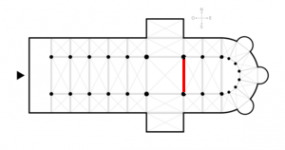
Usual location of a rood screen (wikimedia):

1731752077833.png
So the mystery coffin, said to be that of Joachim du Bellay lies on its axis, indicating a similar high church status to Antoine de la Porte, except his coffin isn't labelled, despite his presumed noble status (being in a relatively rare ultra expensive coffin with a crown of flowers and similar across his abdomen in a prime location).

The word rood is derived from the Saxon word rood or rode, meaning "cross". The rood screen is so called because it was surmounted by the Rood itself, a large figure of the crucified Christ. Commonly, to either side of the Rood, there stood supporting statues of saints, normally Mary and St John, Wiki https://en.wikipedia.org/wiki/Rood_screen
 
Is there a citation for that, as I haven't seen one? Re Monsieur du Bellay being a former 'canon', actually he does not appear to have been ordained but rather just someone who worked a while at Notre Dame as some kind of official or assistant. It seems unlikely to me that Fr de la Porte who was buried about 20cm below the vault floor and the other coffin which was a couple of metres further below, would each be facing in different directions. These two coffins are the only ones located in that general area. I'd like to see more evidence the earlier one is Joachim du Bellay, although it is a nice idea.
It appears the only reason you got it in your head the two coffins were buried side by side in the same orientation is the photo showing the two coffins placed side by side for a press conference. You just assumed that was how they were buried.

It's presumably how you also decided the burials did not use a sarcophagus, but that's wrong too as there are photos showing one coffin in its stone sarcophagus.
 
  1. Only the Big Chief Canon de la Porte and the mysterious other were found in the transept/nave intersection - in a place chocabloc with >20,000 graves below the floors.
  2. It was found the incumbent grew up in Paris based on nutrient studies yet du Bellay grew up in Anjou.
  3. In mediaeval churches, chapels and cathedrals and churchyards, people are buried feet facing east (because come the Resurrection, they rise up to see Jesus, is the theory) whilst the clergy are buried feet facing west to face their congregation together with Jesus, come Judgement Day.
  4. It was known from records that du Bellay was buried in Notre-Dame, where he had served as a minor clerical official. But his coffin which was buried in his uncle's family grave was not found, last time they looked in C18 [IIRC[; it doesn't follow it is he now at the nave/transept with Fr de la Porte.
  5. The incumbent of the earlier coffin was buried right at the rood screen axis so it is almost certainly:
    • a) a member of the ecclesiastical class or close relative of same (conventionally a wife, except priests then were not allowed to marry)
    • b) facing towards the congregation, as it were, because otherwise he would be flat faced against the rood screen, taken down in de la Porte's day and the shards from it surrounds his coffin.
That is why I am not convinced the body in the mystery coffin is Joachim du Bellay. It's a nice romantic idea.
1. The links in this thread say the archaeologists studied something over 100 graves, not 20,000
3. A majority were facing west, so most were probably not clergy.
5. You appear to have absolutely no justification whatsoever to claim this burial was "almost certainly" facing the congregation. You keep taking about the "rood screen axis" but all I can see is that the burial was within the transept crossing. What is your reference for its relation to the rood screen (the east side of the crossing)?

None of the information linked in this thread describes the orientation of the burial, but several describe how east versus west orientation indicates whether the deceased was clergy or not. The fact that researchers think du Bellay is a plausible candidate and do not mention any puzzling anachronism in the orientation should be all the information we need to infer there is no puzzle. If he had been buried facing east they would be searching for a plausible clergy candidate instead.
 
1. The links in this thread say the archaeologists studied something over 100 graves, not 20,000
3. A majority were facing west, so most were probably not clergy.
5. You appear to have absolutely no justification whatsoever to claim this burial was "almost certainly" facing the congregation. You keep taking about the "rood screen axis" but all I can see is that the burial was within the transept crossing. What is your reference for its relation to the rood screen (the east side of the crossing)?

None of the information linked in this thread describes the orientation of the burial, but several describe how east versus west orientation indicates whether the deceased was clergy or not. The fact that researchers think du Bellay is a plausible candidate and do not mention any puzzling anachronism in the orientation should be all the information we need to infer there is no puzzle. If he had been buried facing east they would be searching for a plausible clergy candidate instead.
1. It is generally held true there are some 20K bodies under the Notre Dame.
3. See the wikipaedia description of the rood screen, above. Generally it separates the holy part of the church from the hoi-pollloi part.
5. It is where Antoine de la Porte is buried. If that is the hot spot for the chief prelate of Notre Dame - and he funded a whole bunch of paintings for the various King Louies and gave them 'donations' of money - he didn't just get buried there except he was in favour with the monarch, who would have been Louis XV as of 1710. Ditto the earlier decedent re an earlier Louie.
 
It appears the only reason you got it in your head the two coffins were buried side by side in the same orientation is the photo showing the two coffins placed side by side for a press conference. You just assumed that was how they were buried.

It's presumably how you also decided the burials did not use a sarcophagus, but that's wrong too as there are photos showing one coffin in its stone sarcophagus.

I concurred they were either one on top of the other or not quite on top but side by side but on different levels, one over a hundred years older than the other (archeological biologists originally dated the older one as being 14th century and seem to have revised it to fit in with the du Bellay theory).

As for being in a sarcophagus, I don't think it was. There is a moulded stone base to contain the coffin but it isn't a sarcophagus in the true sense of the word. These days, people bandy around words such as sarcophagus or tomb (or maybe it is a rough translation from what the French mean) when they really mean coffin.
 
My point about 20,000 burials is you implied it was incredible and therefore significant that only two were found in the transept crossing. The archaeologists found remains of a hundred or so under the floor, so whatever the locations of the other 19,000+ burials were we can't say.

If the transept crossing is so prestigious and holy that only chief prelates can be buried there, why aren't there a score more chief prelates buried there?

I know what a rood screen is but what was the meaning of your repeated point about the burial's relation to the "rood screen axis"?

I'm not going to quibble over whether the sarcophagus had a lid because neither of us has that information, and I'm definitely not going to get into an argument about whether a lidless sarcophagus is technically a sarcophagus, which is just a fresh manifestation of your compulsion to find a way to show you weren't wrong about something.
 
The point being about the rood screen is that it was a pointed spot to place someone, cf Antoine de la Porte, hence the attempts by French researchers to identify who this mystery person is.

As for why there aren't more chief prelates buried there, I don't know, but I do know from Turku Cathedral as a personal example, they stopped burying under the floor after a certain date as it was getting a little crowded, plus there was an unpleasant stench emanating upwards to the congregation. The vaults containing all these lead coffins are accessed via trapdoors, so even with the thickest stone flooring the smell escapes. From wiki, it seems French monarchs were buried at St Denis, so I am guessing the archbishops would be there, too, up until 1793.

All but three of the monarchs of France from the 10th century until 1793 have their remains here. The remains of some monarchs, including Clovis I (465–511), were moved to St. Denis from other churches. https://en.wikipedia.org/wiki/Basilica_of_Saint-Denis
 
The point being about the rood screen is that it was a pointed spot to place someone, cf Antoine de la Porte, hence the attempts by French researchers to identify who this mystery person is.

As for why there aren't more chief prelates buried there, I don't know, but I do know from Turku Cathedral as a personal example, they stopped burying under the floor after a certain date as it was getting a little crowded, plus there was an unpleasant stench emanating upwards to the congregation. The vaults containing all these lead coffins are accessed via trapdoors, so even with the thickest stone flooring the smell escapes. From wiki, it seems French monarchs were buried at St Denis, so I am guessing the archbishops would be there, too, up until 1793.

You keep saying that the un-named body was buried "on the rood screen axis". Where does this info come from, please?

I ask because the burials were/are considered significant because they were found in the transept crossing, but the floorplan of Notre Dame that  you provided in post #33 shows the site of the rood screen to be some 40-50 feet west of the transept crossing.
 
The point being about the rood screen is that it was a pointed spot to place someone, cf Antoine de la Porte, hence the attempts by French researchers to identify who this mystery person is.
But what information are you referring to about this burial's position relative to the rood screen (or "rood screen axis", whatever that is) which makes it in any way significant whether the burial was east-west or west-east? You suggested the burial wouldn't likely be facing west because of something to do with the rood screen, but I couldn't work out what you were trying to say.
 
You keep saying that the un-named body was buried "on the rood screen axis". Where does this info come from, please?

I ask because the burials were/are considered significant because they were found in the transept crossing, but the floorplan of Notre Dame that  you provided in post #33 shows the site of the rood screen to be some 40-50 feet west of the transept crossing.

Did you mean east? Here is one citation of the location of the coffins.

Du Bellay was interred at the foot of a large cross that was once displayed on the now-destroyed rood screen that separated the chancel and nave (clergy and choir) from the congregation (poor people with diseases). Cloths and organic plant materials discovered in this burial suggest he was embalmed, which the archaeologists say was “a rare practice in the Middle Ages.” Moreover, he was buried with a crown of flowers. https://www.ancient-origins.net/news-history-archaeology/notre-dame-sarcophagi-0017646

Also, in addition the pair were directly under the spire above.

This 19th century spire reached a height of 315 feet (96 meters), which was 59 feet (18 meters) higher than the original 12th century spire, but it came crashing down in the aftermath of the 2019 blaze.

It was directly beneath the spire that researchers identified several tombs containing hundreds of fragmented hands, feet, faces, and plants from stone statues. It was among these shattered artifacts that two well-preserved lead sarcophagi were also discovered, buried at what represents the holiest site in all of medieval and Renaissance France. ibid

What is interesting that when the unknown tomb was first discovered it was identified as being from the fourteenth century and a typical high-ranking priest burial.

From the GUARDIAN 15 March 2022

Among the tombs was a “completely preserved, human-shaped sarcophagus made of lead”.

It is thought the coffin was made for a senior dignitary in the 1300s – the century after the cathedral’s construction.
<snip>
As well as the tombs, elements of painted sculptures were found just beneath the current floor level of the cathedral, identified as parts of the original 13th-century rood screen – an architectural element separating the altar area from the nave.
<snip>
“You can glimpse pieces of fabric, hair and a pillow of leaves on top of the head, a well known phenomenon when religious leaders were buried,” said Christophe Besnier, the lead archaeologist.
Notandum: Besnier is the guy who is - or was - sceptical it was du Bellay based on the forensic finding the chap grew up in Paris.

So, now it seems to be shoe-horned into being a poet who died in mid-sixteenth century in 1660 - du Bellay, due to the remains showing hip wear and tear, indicating a keen horseman, and being a male aged about 40 who died of tuberculosis and bacterial menningitis - not a rare combination - as well as having an elongated skull, which was a custom of some noble classes in early mediaeval ages, so not unique in itself. The clincher appears to be, when they looked at records hoping to find a clue, they came across a reference to du Bellay's coffin not being found when his uncle's family vault was examined a couple of centuries ago. But that doesn't mean it must therefore be the one found at the rood..? And if so, why would a poet be buried with priestly flowers and leaves as though he was high clergy, with the coffin not being marked with any ID at all?
 
But what information are you referring to about this burial's position relative to the rood screen (or "rood screen axis", whatever that is) which makes it in any way significant whether the burial was east-west or west-east? You suggested the burial wouldn't likely be facing west because of something to do with the rood screen, but I couldn't work out what you were trying to say.

Only the clergy would be buried facing west.

No point being buried in a cathedral unless you are hoping for resurrection on Judgement Day. Why would a noble type of person be facing away from Jesus unless he was one of the ordained priests facing his risen congregation. A poet wouldn't be quite proper, no?
 
Did you mean east?

No, I meant west. Look at the floorplan you posted:


Here is one citation of the location of the coffins.

From your citation:
"Du Bellay was interred at the foot of a large cross that was once displayed on the now-destroyed rood screen"

How do you get 'buried on the rood screen axis' from that?

Also, in addition the pair were directly under the spire above.

Well yes, they would be. The spire is above the transept crossing.

material irrelevant to my question snipped


ETA: the rood screen runs across the width of the nave, so the 'rood screen axis' would be north-south.
 
Last edited:
I caused confusion by saying "facing west". I meant buried with his head to the west.

So, there's nothing describing the burial's location in relation to the rood screen. It was at the foot of a large cross which was once upon a time attached to a now-destroyed rood screen, but we don't know its location now.

My question is can you please explain what you meant about the burial's orientation likely being "facing towards the congregation, as it were, because otherwise he would be flat faced against the rood screen".
 
I have just realised that the floorplan Vixen posted with the caption "floorplan of Notre Dame Cathedral" is not a floorplan of Notre Dame Cathedral.

I think it might be Tewkesbury Abbey (based on Gilbert de Clare being buried there).
 
Unless "axis" means a line drawn perpendicular to the screen through its centre, perhaps.

That would just be the centre line through the east-west axis of the whole edifice. If one were to attach relevance of that line to a part of the cathedral, then the obvious choice would be the nave. The rood screen is aligned north-south. It runs transverse to the east-west axis of the church.
 
One of the links Vixen provided on page 1
...has some good quality photos and showed the coffin in situ.

We can see the head is to the left and we can orient ourselves by inferring that's west since the researchers don't think he was a priest. The location is thus quite close to the centre line of the nave, and at the west side of the transept crossing, away from where the rood screen would have been at the time, on the right of the photo.
 

Back
Top Bottom