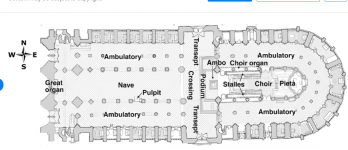
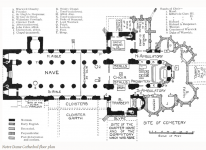
I recently saw instructions on where an ancestor was buried at Turku Cathedral and how to find his floor stone, which was under the second arch from the front of the cathedral (it said), so a couple of months ago, I went to have a look by following the instructions that it was under the second vaulted ceiling star from the front and in front of a side chapel gate. The instructions were in Swedish and in 'jargon' language, so I see now it might have referred to the pillars, whilst I was looking up at the ceiling and that is how I located the flagstone.
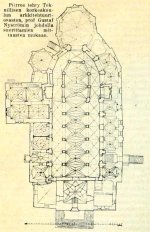
As you can see below, west to east, the side chapel in question is the former Holy Cross Chapel, now called Agricola Chapel (so renamed when veneration of saints became disapproved of).
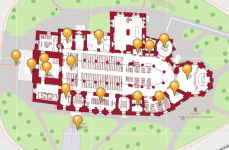
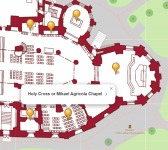
(As an aside, the Holy Cross referred to Saints Anne, Barbara, Ursula and Catherine, and was then amalgamated with St. Batholomew's Chapel which was the next along. Now used as a playroom for bored kids).
The point I am making here is that this tomb (under the cathedral floors in a family vault) is only second furthest east (aside from the frontmost dedicated to the Virgin Mary at the eastern point), the first being occupied by Tott, who was a military leader who helped Gustavus Adolphus to victory spreading the Swedish empire, and grandson - or was it the son - of former King Erik XIV's concubine Karin who had quite a high status despite never being royal, as they never married. (Another aside: Tott led his army into battle as the Hakkapelit after their battle cry of '
Hakka!' ('Hack'em down!'). The first chapel on the other, north side, contains the sarcophagus of the only monarch ever buried in Finland, Karin Månsdottir, King Erik's teenage bride, who was only Queen for barely two months before Erik was deposed by his own brother, John III. As you can see, it is quite far forward in the cathedral from the transept/nave crossing. The cathedral was consecrated in 1300 but had been constructed some years prior to that and had even prior to that been built slightly further down stream, so is a close copy of the Notre Dame template for cathedrals in their day.
So I found the tomb by finding the flagstone, immediately in front of the wrought iron gate of the Holy Chapel/Agricola Chapel by following the ceiling plan. (Note the wheel of Catherine wrought on it, indicating her manner of death.) What do you immediately notice otherwise about the position of the stone? Clue: The picture is taken with me standing at its head facing east, or almost at the head.
 Eneskjiold - Turku Cathedral
 by
Username Vixen, on Flickr
Do you see? It means the incumbent,
Englebrekt Eneskiold (= 8th g-g-f) had his feet facing east and his head to the west, meaning he was
a member of the congregation, so to speak, even in death, not the priesthood. He was a Swedish guy from Filipstad in Varmland, a Chamberlain (basically an accountant) who got knighted.
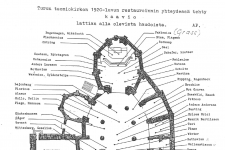 Turku Cathedral underfloor graves
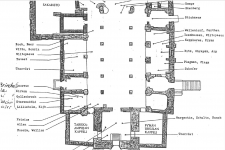
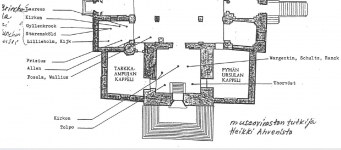
Hence my scepticism that a poet no matter how widely renowned or noble would have been buried as a priest, with his feet facing west. But I am willing to accept that maybe Joachim du Bellay having once been some kind of a 'canon' might have retained that priestly status. I am still struggling to understand why he would have had his coffin moved to lie on the axis of the old rood screen as whilst poets are cool, surely they are not that cool. And as mentioned there is no record of his having been moved.