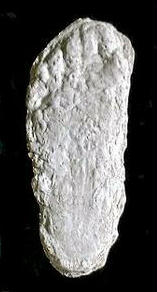
Matt Crowley shoots down Bigfoot dermal ridges?

tube said:
The photograph that accompanies the text on the webpage entitled "The Paul Freeman Footprints" at http://www.bigfootencounters.com/images/freemantracks.htm is not one of Paul Freeman's, it is the Onion Mountain cast. I have written an e-mail to Bobbie Short so that she is made aware of this.

Before we get the notion that "dermal ridges are round while casting artifacts are flat" carved into Internet stone, let's be clear here. Indeed, the test coupons I sent to Jimmy Chilcutt last February had small, flat ridges. Later, when I figured out how casting artifact ridges could get big, I discovered something else interesting; small ridges, flat ridges, large ridges round ridges. Casting artifact ridges CAN be round, and I have the test casts to prove it.

I would suggest caution to anyone who claims that Freeman's Elk Wallow cast contains casting artifacts. How do you know this? I certainly don't know this. I have not seen the cast. I have no idea of what soil conditions it was made under. Having learned the hard way, I would not guess about these things from photographs alone. I don't deny it is a valid question, given that we now know more about what casting artifacts can look like, but I don't believe we know the answer yet. I suspect we will all know more after the upcoming Jefferson Sasquatch conference.
THis page is supposed to be about the Elk Wallow tracks.. Includes pictures..

http://www.rfthomas.clara.net/papers/dermal.html
 
Diogenes said:
So, it's lame to say a hoaxer would not be discovered in a remote area, but perfectly acceptable that a Bigfoot has not been discovered at all?

I find it difficult to believe a hoaxer would go to a mountain in B.C. to plant tracks in fresh snow without leaving any trace of human activity. Shouldn't there have been tire tracks somewhere? And how was the stride accomplished. Those tracks were spotted by a helicopter pilot.

"Bigfoot" has certainly been discovered, just not by mainstream science as yet.

While I'm at it, I've already addressed the toes. The peas-in-a-pod look is due to them being clenched. In other tracks, they're splayed. Half tracks indicate the bend. Why do you keep bringing this up? Are you unable to understand it?
 
Diogenes said:
THis page is supposed to be about the Elk Wallow tracks.. Includes pictures..

http://www.rfthomas.clara.net/papers/dermal.html

I posted that and a quote from it regarding the type of soil in reply to your post where you said I was ignoring the issue of particle size and have a lack of understanding of basic science. I'm beginning to wonder why I bother to reply if you don't even read the replies or follow the links. I've posted that article several times, in fact. Has anyone actually read it?
 
RayG said:
You don't see it?

RayG

I see both bunionettes, the twisted little toe printing less deeply and the toes in the snow appearing more slender. The tracks by the dump may have been on a harder substrate, which would make the toe pads spread out more. On my copies, the plaster extends beyond the outlines of the toes, muddling things a bit. I don't see how you can't see the match.
 
Krantz noted an arch on juvenile tracks and wondered if the loss of the arch was due to weight or was genetically determined.
So, when they don't fit the ( made up ) Bigfoot morphology, we can always make up a reason why they don't.. Now it's not that bigfeet don't have arches, they collapse at the bigfoot gets older..


Doesn't it make more sense that Wallace, or Mullens, if he carved the feet as he claimed, used a Titmus cast for a model?
I'm sure it does you you... Who'da thunk it?
 
Diogenes said:
Au Contraire !

You keep ignoring the fact that there are two kinds of evidence.. The kind that supports your position and the kind that doesn't..

You consistantly ignore the latter..


Trying to justify your position by blaming poor, dead Ray Wallace for stuff he had nothing to do with isn't evidence at all, IMO. I try to ignore absurdities. What's wrong with that?

What is the explanation for the ridges in the heel of the Bluff Creek track ?


Since it's the Onion Mountain cast, some of that may be casting artifacts, which Green suspected all along. It's the only cast, so far, that may have been shown to be affected. The artifacts were caused by a "wicking" in the substrate causing the medium to start setting up too fast. Not all soils do this. Right, Matt?

What makes Chilcutt qualified to come to the conclusion that a set of tracks are from the same species of animal?


How many times have I gone over his credentials? He has a data base of a thousand primate prints for comparison. He's stated his reasons. Got your copy of LMS yet? He points out the rich texture and the flow. He saw this same type of flow on the Elkins Creek, Ga., cast.

From the article with the wrong picture:

"Fingerprint expert J. Chilcutt in Conroe, Texas determined the ridge flow pattern in this cast is natural and coherent with itself and also consistent with other Sasquatch tracks where the ridge lines flow unlike the human ridge flow. Areas of 'friction skin' are visible on the cast as well."

Here is a track examined by Chillcut and proclaimed to bear the dermal ridges characteristic of Bigfoot..

from:http://www.bigfootencounters.com/images/freemantracks.htm

Paul%20Freeman%20cast2.jpg


Where is the mid tarsal break ?


It was customary to cast the "best" tracks. They are frequently the ones that don't show the movement that is most informative to an anatomist. Not all tracks show the bending, but some do. Compliant gait, remember? The foot usually lands flat and is picked up about the same way.

Apparently Dr. Meldrum is impressed by the Wallace evidence..

From: http://www.isu.edu/~meldd/crypto.html

Titmus_01_BG.jpg


Already posted the article and so has Bill. What are you trying to imply here? That the photo in the background is of a fake and Meldrum somehow endorses this? I've posted a photo of Wallace's fake casts. That isn't one of them. It looks like a Titmus 1968 Bluff Creek track cast to me. Meldrum has exposed fakes. What makes you think an expert in primate locomotion can't spot a Wallace fake from 2 miles away? And there's nothing to indicate Wallace faked any tracks at Bluff Creek.

Where is the mid tarsal break ? The long toes ?

We do have the double ball though ? Where is it documented that the double ball is a distinguishing characteristic of Bigfoot feet ?

It's not exactly a "double ball". I'll get back to that when I find what I'm looking for on it. I've explained the toe thing 'til I'm blue in the face. Try bunching your own toes up and see how long they look. The plantar pad was forward in the picture you posted. The toes don't look that short in other pictures and casts from the same trackway.
 
Diogenes said:
Do you think he is going to bother to get the Wallace casts out of his collection, and the pictures off of the Web pages with his name on them ?

There are no Wallace casts in his collection and that isn't a Wallace cast. He wasn't fooled by a much better fake than anything Wallace produced for his souvenier shop. It took him less than a minute to spot it and determine how it was made. Trying to portray Meldrum as a half-wit isn't making your wits look too whole, IMO.

This is getting old. Why don't you move on to something even more ridiculous, like claiming Mrs. Wallace starred in the Patterson/Gimlin film? She said she wore an ape suit didn't she? Ray claimed he told Patterson where to look. She was in California in 1967, wasn't she?

That's the kind of "evidence" you've been presenting isn't it? The kind I ignore?
 
LTC8K6 said:
Sorry, Lu. Try as I might, I can't make the print match the cast. I can't believe anyone would even try to match them.

10_Bossburgsnow.jpg


032_1.jpg

You had no trouble stretching your imagination to make a Wallace wooden foot fit a track it clearly doesn't fit and then you stretch it to make a mismatch out of something that clearly is a match. Interesting. There must be a name for that.

Did you try out for the roll of Prince Charming in a school play and lose out when it got to the glass slipper?
 
Diogenes said:
So, when they don't fit the ( made up ) Bigfoot morphology, we can always make up a reason why they don't.. Now it's not that bigfeet don't have arches, they collapse at the bigfoot gets older..
Evidently they don't have rigid arches. Neither did Australopiths. Rigid arches are a Homo trait.

I'm sure it does you you... Who'da thunk it?

Are you really this stupid or are you just trying to bait me?

"Ray Wallace is connected to all this in only two ways that have been established. The men who first reported the 16" tracks were his employees, and it was the Bluff Creek events that started him on his long career, mainly after he moved to Washington, of producing and trying to sell crudely-faked track casts and photographs and telling outrageous whoppers about his adventures with "Bigfoots."

Ray wasn't around any of the times I went to Bluff Creek and I never met him, but I was told right from the beginning of his reputation as a practical joker and yarn spinner, the latter being was amply confirmed when he phoned me and wrote letters to me over the years.

There were people in California, of course, who were sure the footprints had to be faked, and some of them fingered Ray Wallace as the person they "knew" had done it, but I have outlined the massive task that would have been involved, and no evidence was ever brought forward of any way that anyone could have done it."

http://www.rfthomas.clara.net/papers/bctracks.html


"Then, after a decade of experience on city newspapers, I bought a small weekly paper in the area where many of the sasquatch stories originated, and in 1957 I was quite abruptly confronted with the fact that people I had come to respect took the sasquatch very seriously indeed. The stories I heard then were not myths or legends, but first- hand accounts of inspecting giant, human-like tracks, or close observations of huge, bipedal, hair-covered creatures that looked more like upright apes than humans. In one case I was told that a deputy sheriff from Bellingham, Washington had cast one print from a series of 16-inch bipedal tracks that had been made by something so heavy that it crushed potatoes in the ground.

At the time I thought that was surely stretching the truth, and perhaps it was, but I have since read that large bears can do the same. In any case it turned out that the deputy was real, although he had since died and the cast had been broken. His son gave me a tracing of the cast, and told me that his father had researched sasquatch reports for years and had accumulated a great deal of material, but they had not kept it. Note that the tracing, which is on display here, has been in my possession since 1957, the year before a man named Ray Wallace supposedly started making all the Bigfoot tracks in the world, and that the 16-inch footprints had been observed, investigated, measured, and cast in 1941, sixteen years earlier (Figure 1).

jgreen1.jpg


Fig. 1. Tracing of deputy's cast from Bellingham, WA, 1941.

Further investigation quickly established that a number of people had done considerable research into the subject in the past, although none were doing so currently, and that there had been some very well-publicized incidents in British Columbia around the end of the 19th century, and in Washington state in 1924.

In the fall of 1958, when newspapers pictured a cast of a 16-inch footprint from a dirt road under construction in the Bluff Creek valley in northwest California, I drove there to see for myself. All the recent tracks had been destroyed by the time I got there, but some old ones were still impressive, and I met a taxidermist named Bob Titmus who had studied fresh tracks and had become completely convinced that they were genuine, made by some giant human or animal. A few weeks later I got a letter from Bob saying that he and another man had found perfect tracks of a second individual, an inch shorter than those of the original Bigfoot and of a distinctly different shape, and that these tracks were not in dirt on the road but at the bottom of the steep, brush- covered side-hill, in a hard-packed sandbar beside the creek. I made a second trip to California, and this time what I saw changed the course of my life. Where those huge tracks sank an inch into the ground, my boot prints hardly showed at all. Tremendous weight was obviously required to make the tracks, and the location was such that we could see no possible way that machinery could have been used there undetected. Copies of casts of two of those tracks are on display here, along with a picture taken on another occasion showing a deep track on a different Bluff Creek sandbar with a boot print beside it hardly discernible (Figures 2 and 3).

jgreen2.jpg


Fig. 2. Casts from Bluff Creek valley, 1958.

jgreen3.jpg


Fig. 3. A deep track on a different Bluff Creek sandbar with a boot print beside it hardly discernible.

I was a newspaperman, not any sort of scientist, so I took my information to the zoology department at the University of British Columbia, expecting that they would be enthusiastic to take over the investigation of something of such obvious importance in their field. What a joke. The department head's response was a condescending explanation of how the tracks of a bear's hind feet can overlap his front feet, making imprints of the shape I described. A cast of just such an imprint is on display. There is a resemblance in general shape, but on examination it would fool nobody.

jgreen4.jpg


http://www.rfthomas.clara.net/papers/jgreen.html

 
Fig. 1. Tracing of deputy's cast from Bellingham, WA, 1941.
That tracing is really interesting. Unlike any other tracks we've seen before..

Yet another species ?


So you still think Wallace carved out a model of a real track, right down to a longitudinal crack in one of the heels?


You do realize, don't you, that there is more of a case for Wallace tracks than there are for Sasquatch tracks? In case you don't, here is a hint..

We have an actual foot that made the Wallace tracks ?

Oh I'm sure you wan't us to produce more fake feet, that match a variety of tracks, that we haven't matched to Wallace feet; so let me remind you:

One Wallace track with a matching foot is more than the Bigfootologists have !


Why didn't Patterson ever go back to Bluff Creek to search for patty ?
 
Did you try out for the roll of Prince Charming in a school play

Oh nevermind..... :D

Again we have bigfooters cherry picking Wallace casts. We know for sure that Ray had more than one set, so deliberately picking one that doesn't match won't wash.

I just saw that Nat'l Geo special again. I was very interested in the footage of Patty that seems to be before the footage we usually see. Patty is clear and steady for a few seconds before all of the shaking starts and the camera steadies up again. The footage we usually see starts with the shaky part.

Is this "pre shake" footage on the LMS dvd?

That, and there are at least two different sets of Wallace fake feet visible in the back of the Wallace pickup truck. No doubt Ray had many more.

I have thought all along that we keep seeing a left and a right from different sets of Wallace feet. I believe that in the pic of the son holding up 2 fake feet, he is holding up a mismatched pair.

I could have done without the section about Janice Carter and her fantasies, though. I think that time could have been better used on something else.
 
Is this image only supposed to show one faked foot, or are all three considered fakes?

jgreen2.jpg


Although the second and third ones are somewhat similar, the first and third ones look nothing alike.

RayG
 
RayG, I think they are just deliberately using the wrong fake right foot.

Here I think Dale is holding a mismatched pair.
Wallace2.jpg


Here I think is the right that matches the left in Dale's hand. It would be a better match for the Titmus 1958 cast.
CrewVsWallaceIcon2.jpg
 
RayG said:
Is this image only supposed to show one faked foot, or are all three considered fakes?

jgreen2.jpg


Although the second and third ones are somewhat similar, the first and third ones look nothing alike.

RayG
Also note the crack in the Wallace foot..

That crack is apparent in some tracks presented as genuine..

I don't fee like digging them up.. We've been there before..


Of course we now know the Wallace foot was modeled after the track..: rolleyes:
 
LTC8K6 said:
This is probably a mismatched "pair" of Wallace feet. The right and left are probably from different sets.


You don't understand.. This is obviously a matched set; modeled after the actual tracks left by a Bigfoot with one foot that bound during infancy, and therefore stunted.. It also suffered from a foot deformity known as ' heelus spliticus '... This was confirmed by Kranze, while Meldrum remained unconvinced.
 
While I'm at it, I've already addressed the toes. The peas-in-a-pod look is due to them being clenched. In other tracks, they're splayed. Half tracks indicate the bend. Why do you keep bringing this up? Are you unable to understand it?
I keep bringing it up because it doesn't wash.. There is nothing natural about clenching the toes when walking on level terain as depicted in the trackways we have seen. Certainly not to the extent, where only the pad of the first joint leaves an impression..

Why can't we see long toes in the PGF ?
 
When I clench my toes, the ball of my foot also clenches. Clenched toes should alter the appearance of the ball of the foot.

The half track story is silly. Patty walks just like a girl with a human foot. There is no evidence of any tarsal break with Patty at all.

Meldrum's misidentified fake foot print doesn't count.
 

ISF - Join now!

Every member here is approved by hand. No bots, no spam, just people who care about evidence and honest debate.

Membership is free!

Create your free account

Back
Top Bottom