
You are using an out of date browser. It may not display this or other websites correctly.
You should upgrade or use an alternative browser.
You should upgrade or use an alternative browser.
Lockerbie: London Origin Theory
- Thread starter Caustic Logic
- Start date
-
- Tags
- lockerbie bombing

Rolfe
Adult human female

Reading all this stuff the thing I'm missing is anyone sending out the Eurekagrams when they realise an apparently mystery suitcase has been loaded in exactly the position they first thought the explosion had happened at. It's really quite bizarre.
The investigators mainly described the primary suitcase as bronze. Bedford's first description was just "brown", but it's certainly close enough to bronze for any sleuth hot on the trail. The amount of evidence they had by the end of January 1989 should have been enough to send any budding Sherlock into ecstasies. The position of the explosion looks as near as bloody damn it the position of the left-hand one of Bedford's two front-loaded suitcases. These suitcases, or one of them at least, were brown Samsonite-type hardshells. They appeared in the container while he was on his tea break, he didn't put them there. Neither of the other two people present remembered putting them there. Bedford thought there were six cases in the container before these two appeared. Although estimates of the number of cases in the container varied, they averaged significantly more than six. None of the six legitimate cases was a dark brown Samsonite. Sidhu didn't move these cases when he loaded the Frankfurt stuff. And everybody concerned admitted freely that anyone could come and go as they pleased in the area, and suitcases were often left lying around overnight, sometimes for two or three days.
Oh yes and bear in mind how these containers were loaded. Bedford and Sidhu concur. The angled overhang section was generally reserved for holdalls and other smaller, softer stuff. They said a suitcase might occasionally be put in there, but the SOP was sack the suitcases vertically, and toss the holdalls in the angle. Look at the BBC's mock-up. Clearly if you're going to build a vertical stack on top of that left-hand flat case, and you want it, if anything, leaning on the right-hand stack, you do not push the second case in the stack right into the angle as far as it will go. A particularly wide case would maybe reach that far, but the bomb suitcase was not particularly wide. Sidhu would have placed the first case on top of the right-hand Bedford case, then the second case on top of the left-hand Bedford case. And he would not have left a gap between them. He would be leaving the angle for the holdalls. One of Karen's went there, I think that's why her undies figured so prominently in the early investigation. If the bomb suitcase was only 26" wide, then there's really no way one side would have been in the angle. (Not that I think anyone actually asked either of the loaders that.)
So why on earth are we seeing repeated denials from the investigators that the bomb went on at Heathrow? It's completely bizarre. It's down to a couple of inches in the positioning of the explosion? Who would let that put them off what looks like an incredibly promising lead? Especially at such an early stage, before the explosives bods have had a chance to firm up the estimates? And I totally take your point about the turbulence that night, and the possibility of luggage shifting a few inches within a container.
You know, I'm sure I remember - was it your newspaper cuttings? - that at an early stage the published estimates for the height of the explosion were higher than 10 inches. But look at that BKA sketch - it's right on the bottom.
There's something very fishy going on here.
Rolfe.
The investigators mainly described the primary suitcase as bronze. Bedford's first description was just "brown", but it's certainly close enough to bronze for any sleuth hot on the trail. The amount of evidence they had by the end of January 1989 should have been enough to send any budding Sherlock into ecstasies. The position of the explosion looks as near as bloody damn it the position of the left-hand one of Bedford's two front-loaded suitcases. These suitcases, or one of them at least, were brown Samsonite-type hardshells. They appeared in the container while he was on his tea break, he didn't put them there. Neither of the other two people present remembered putting them there. Bedford thought there were six cases in the container before these two appeared. Although estimates of the number of cases in the container varied, they averaged significantly more than six. None of the six legitimate cases was a dark brown Samsonite. Sidhu didn't move these cases when he loaded the Frankfurt stuff. And everybody concerned admitted freely that anyone could come and go as they pleased in the area, and suitcases were often left lying around overnight, sometimes for two or three days.
Oh yes and bear in mind how these containers were loaded. Bedford and Sidhu concur. The angled overhang section was generally reserved for holdalls and other smaller, softer stuff. They said a suitcase might occasionally be put in there, but the SOP was sack the suitcases vertically, and toss the holdalls in the angle. Look at the BBC's mock-up. Clearly if you're going to build a vertical stack on top of that left-hand flat case, and you want it, if anything, leaning on the right-hand stack, you do not push the second case in the stack right into the angle as far as it will go. A particularly wide case would maybe reach that far, but the bomb suitcase was not particularly wide. Sidhu would have placed the first case on top of the right-hand Bedford case, then the second case on top of the left-hand Bedford case. And he would not have left a gap between them. He would be leaving the angle for the holdalls. One of Karen's went there, I think that's why her undies figured so prominently in the early investigation. If the bomb suitcase was only 26" wide, then there's really no way one side would have been in the angle. (Not that I think anyone actually asked either of the loaders that.)
So why on earth are we seeing repeated denials from the investigators that the bomb went on at Heathrow? It's completely bizarre. It's down to a couple of inches in the positioning of the explosion? Who would let that put them off what looks like an incredibly promising lead? Especially at such an early stage, before the explosives bods have had a chance to firm up the estimates? And I totally take your point about the turbulence that night, and the possibility of luggage shifting a few inches within a container.
You know, I'm sure I remember - was it your newspaper cuttings? - that at an early stage the published estimates for the height of the explosion were higher than 10 inches. But look at that BKA sketch - it's right on the bottom.
There's something very fishy going on here.
Rolfe.
Last edited:
There's an interesting discussion at Zeist between Kean and the Judges after the prosecution had called Claiden and started taking testimony. Kean interrupts the proceedings and Claiden is asked to step out the court. It seems Kean and the defence have been attempting to obtain agreement with the Crown to ensure all the primary evidence, in this instance the two containers 4041 and 7511, are brought into, produced or assembled in the well of the court. Initially the crown refused on the grounds that Claiden had reconstructed the containers on wooden frames, that were also given evidence prod numbers, which could not be disassembled.
Naturally, Kean objected to this and argued the various larger sections of the container could removed from Claiden's wooden frame and be brought in piece by piece. Otherwise, Kean contested, primary evidence that was available for the court to view in person would be produced as secondary evidence by way of photographs and diagrams. In his view, and I certainly agree, this would be unacceptable for the defence and would imply other items viewed as primary evidence would not then be required to be produced for the court.
The defence were in discussions over this matter with the crown, and were awaiting a reply to the suggestion that since Claiden had reconstructed the containers on the wooden frames, and was available at Kamp Zeist for the previous week, while the prosecution went ahead and called Claiden as a witness without any resolution to the matter.
Reluctantly the judges and crown finally acceded to Kean's motion.
Naturally, Kean objected to this and argued the various larger sections of the container could removed from Claiden's wooden frame and be brought in piece by piece. Otherwise, Kean contested, primary evidence that was available for the court to view in person would be produced as secondary evidence by way of photographs and diagrams. In his view, and I certainly agree, this would be unacceptable for the defence and would imply other items viewed as primary evidence would not then be required to be produced for the court.
The defence were in discussions over this matter with the crown, and were awaiting a reply to the suggestion that since Claiden had reconstructed the containers on the wooden frames, and was available at Kamp Zeist for the previous week, while the prosecution went ahead and called Claiden as a witness without any resolution to the matter.
Zeist Transcript pp435 said:435
Now, I regret that I am raising this in open court. I sought to raise it directly with the Crown at the beginning of this week, but I've had absolutely no response from them whatsoever, so I don't even know what their position is on this matter.
LORD MACLEAN: Could I just ask you one other question, Mr. Keen; and that is, do I understand [1368] it to be necessary for you to put to this witness individual component parts --
MR. KEEN: If the terms of the precognition he has provided are correct, then that is the case, My Lord. That is very much the case.
And I can only add that I have seen the real evidence, and it does present a very different picture to any photograph and to any diagram, particularly in the context of this witness's evidence, My Lords.
Reluctantly the judges and crown finally acceded to Kean's motion.
Rolfe
Adult human female
Heh, poor Charles and his theory. Bedford's free choice of container kinda puts paid to any idea that 4041 was earmarked for that flight. This was the proposition that the device was attached to 4041 but not contained inside any of the bags, wasn't it?
Ah, Charles. The Malcolm Kirkman of Lockerbie. Yes, he had a complicated fantasy involving a "dark-suited Iranian gent" sneaking into the interline area at midnight and sticking the IED on to the actual baggage container. Which was already there at that time, and already pre-ordained to be used for the interline luggage for PA103A.
Never mind that the visible damage to the structure of the container wasn't compatible with an explosive charge having been fixed to it, never mind the near-inevitability of one of the baggage handlers noticing something like that, Charles's little grey cells deduced it, and therefore it must be so!
I seem to remember his theory also relied on the baggage container reaching earth more or less in one piece, still containing its luggage, and the CIA coming along and planting the "primary suitcase" inside it, again more or less in one place, if not exactly in one piece. When we pointed out to him that the bits of the container and the bits of the assorted luggage and the shards of the suitcase were collected together having been found strewn across several square miles, he seemed to sail on regardless.
I was really quite sorry he got himself banned when he did, because I was only getting started on the demolition job. He just couldn't keep a civil tongue in his head, and it was the same on Robert Black's blog where he's been banned for a while. His "theory" was so bonkers it really did deserve slow and complete dismantling.
I recall telling him that Maid of the Seas flew in at noon that day from San Francisco. He didn't seem to realise the implications of this fact at all. His idea was that each individual aeroplane had its own personal designated luggage containers, I think he may have said three sets - one at each end and one in the air at any one time. He couldn't understand that this would only work if every plane simply yo-yoed back and forwards between two airports. I remember saying, Charles, aeroplanes aren't cable cars! As soon as you realise that each machine flies to a dozen or more airports, not always predictably either, it falls flat on its face. And even in Charles's scenario, the large numbers of containers that would have to be stored empty at each airport, and the logistics of finding the right ones at the right time, make it an economic nonsense and a logistical nightmare.
I've read quite a few of the baggage handlers' statements, and actualy Sahota's talks quite a lot about the containers (he was a "No. 1 loader" in charge of a team). He mentions each flight being allocated a certain number of containers, and they weren't supposed to exceed that number, but in all the varied and various accounts, there isn't a syllable about being required to find a plane's "own" containers, or even to find any particular container. They're just shuttling around like shopping trolleys. Bedford was of course asked if there was any requirement to select that particular container and he said no, I could have taken any one of half a dozen that were sitting there.
Another point that struck me just after he got banned. His scenario also involved Robert Baer and someone else, I forget who, lurking in the dark storm-drenched Scottish countryside half way between Lockerbie and Prestwick, with a radar speed gun, poised and ready to trigger some other bomb immediately after the detonation of the baggage-container IED, by remote control in a plane still at 31,000 feet. A couple of people who knew about radar tried to explain the impossibility of this, but he wasn't listening. Except, why would they have been in Scotland at all? Heathrow to JFK flights usually fly over Ireland. It's the quickest way, close to the Great Circle linking the two airports. (In reality the possible routes form a wedge shape, with the most southerly crossing Land's End and missing Ireland entirely to the south, while the one PA103 took was almost as far north as they would go, out over the Outer Hebrides. But the normal route is over the middle of Ireland.)
How would the conspirators have known which route the flight was going to take that particular night, in time to get into position? If you got a protractor and stuck one pin in Heathrow and set the compass to the distance of Lockerbie, the places where the plane might have been at that time form an arc over a pretty big area - some of it over water. I missed the bit where the CIA had a spy in the air traffic control centre who was radioing the course set for the flight as soon as it was decided, and the helicopter and fast cars that were standing by to get the saboteurs to the right place in time! It woudl have been a bit of a bummer if the "right place" had been somewhere west of the Scilly Isles....
Really, I think Charles must have some sort of mental health issue or personality disorder - whatever Malcolm Kirkman had, I imagine it's the same thing. The mind-sets are remarkably similar. I suppose we shouldn't mock the afflicted, but sometimes the temptation is too severe. Maybe it's just as well he was banned after all.
Rolfe.
Rolfe
Adult human female
There's an interesting discussion at Zeist between Kean and the Judges after the prosecution had called Claiden and started taking testimony. Kean interrupts the proceedings and Claiden is asked to step out the court. It seems Kean and the defence have been attempting to obtain agreement with the Crown to ensure all the primary evidence, in this instance the two containers 4041 and 7511, are brought into, produced or assembled in the well of the court. Initially the crown refused on the grounds that Claiden had reconstructed the containers on wooden frames, that were also given evidence prod numbers, which could not be disassembled.
Naturally, Kean objected to this and argued the various larger sections of the container could removed from Claiden's wooden frame and be brought in piece by piece. Otherwise, Kean contested, primary evidence that was available for the court to view in person would be produced as secondary evidence by way of photographs and diagrams. In his view, and I certainly agree, this would be unacceptable for the defence and would imply other items viewed as primary evidence would not then be required to be produced for the court.
The defence were in discussions over this matter with the crown, and were awaiting a reply to the suggestion that since Claiden had reconstructed the containers on the wooden frames, and was available at Kamp Zeist for the previous week, while the prosecution went ahead and called Claiden as a witness without any resolution to the matter.
Reluctantly the judges and crown finally acceded to Kean's motion.
I'll need to read that in more detail. Did he manage to convince anyone the estimate from the condition of the baggage container was wrong?
I do remember that he was the one who caught Claiden out with the Mach Stem calculation. That entire argument went whooshing right over my head, but I refuse to believe I can't understand it if Keen could, so I'll go back and have another look. Fundamentally I believe the judges took the view that the condition of the wreckage showed that the explosion had been inside the baggage container, so what the hell. If you followed Keen's correction though, the point you end up with is outside the actual baggage container.
What I think this illustrates though, is that the calculations weren't infallible. You correct an error, and then you get a result which is manifestly impossible. Wut? I remain to be convinced that anyone can be so precise about the centre of that explosion, or that the condition of the recovered wreckage excludes the explosion having been in a case on the bottom layer, albeit in the extreme left-hand side of the case.
I'm thinking this is what the switching of Patricia's case to the bottom layer is all about. If we acknowledge that Bedford's shiny maroon hardshell Samsonite was still where he last saw it when the bomb went off, we have to exclude that case as the bomb bag if we are going to get a conviction. Insisting that these estimates and calculations were so exact that we can absolutely swear the explosion happened a whole two inches outside this mysterious suitcase is probably not going to cut it. So better to decide the case was moved, and hope by some sleight of hand to move it well out of the way. I think.
Rolfe.
Rolfe
Adult human female
Zeist judgement said:It was accepted, for the purposes of this argument, that the effect of forensic evidence was that the suitcase could not have been directly in contact with the floor of the container. It was submitted that there was evidence that an American Tourister suitcase, which had travelled from Frankfurt, fragments of which had been recovered, had been very intimately involved in the explosion and could have been placed under the suitcase spoken to by Mr Bedford.
That would have required rearrangement of the items in the container, but such rearrangement could easily have occurred when the baggage from Frankfurt was being put into the container on the tarmac at Heathrow.
It is true that such a rearrangement could have occurred, but if there was such a rearrangement, the suitcase described by Mr Bedford might have been placed at some more remote corner of the container, and while the forensic evidence dealt with all the items recovered which showed direct explosive damage, twenty-five in total, there were many other items of baggage found which were not dealt with in detail in the evidence in the case.
This is (one of the) the parts of the judgement that makes no sense. If you accept that it was impossible for the bomb suitcase to have been in direct contact with the floor of the container, and the Heathrow suitcases were not moved, then surely that's job done? No matter how suspicious that mysterious suitcase was, it couldn't have been the bomb.
But the investigators themselves backtracked on that fundamental assumption, and placed Patricia's case on the bottom layer. As soon as they did that, surely they introduced exactly the possibility they wanted to avoid, which was that Bedford's case had then been replaced on top of Patricia's? Which could have completely scuppered the prosecution, and in fact should have completely scuppered the prosecution.
It was only because the judges themselves took it upon themselves to declare, "ah, but if it was moved, it might have been moved right over the far side. So that's OK, we've thought up a scenario that favours the prosecution, so that's the one we'll go with!" It's jawdropping. It's also monstrous. It's right up there with, "OK so it definitely rained on 23rd November, but Joseph Mifsud said he was only 90% sure a few spots didn't fall on 7th December, so we'll go with 7th December." It's a complete reversal of the burden of proof.
How could the forensics investigators have known that the judges would be essentially batting for the prosecution like that? If the judges had been even moderately even-handed, the obvious possibility of the Bedford suitcase being replaced on top of Patricia's would have introduced sufficient reasonable doubt at least to go for "not proven". Why did they not think it was acceptable to go with the actual evidence and acknowledge that Bedford's suitcase hadn't been moved, and rely on the assertion that the bomb suitcase couldn't have been in the bottom layer?
There's something here I'm not getting.
Rolfe.
Last edited:
Yeah, its an adventure into some sort of horrible parallel reality. Where either inconsistent and unreliable evidence are accepted while far more persuasive and convincing evidence is ignored or waved away by concluding its irrelevance to matters at hand.
The judges at Zeist were content to postulate that, although Bedford's bag was according to the prosecution moved from its position on the base and replaced by Ms Coyle's, it must've been put elsewhere, anywhere, in the container, but definitely not on the second layer!
Why? Well because we already know the primary bag came from Malta. Who cares about any uncertainties over the precise location, it wasn't Bedford's brown samsonite. Why? Well, we know the bomb bag was on 103a because B8849 was unaccompanied and Megrahi bought the clothes and put it on KM180.

I think the pressure would have been immense on the judges from the very outset. Before any of the evidence was even presented. Before Giaka, before Claiden, Hayes or the elusive Feraday. No one seemingly batted an eyelid (well, apart from Hans Köchler) when defence witnesses were dropped, critical witnesses not called at all, and Colin Boyd led everyone a merry dance over the CIA cables. Cables that, despite the best efforts of the Crown to withhold them, proved absolutely pivotal to the whole case and devastating to the case against the two Libyans.
I don't believe for one second the Lordships weren't perfectly aware that the case was wholly inept and formed by an accumulation of, at times absurd, guesses assumptions and conjecture.
Nonetheless, it was never a realistic possibility that both charged would not be found guilty. A threadbare case would not perhaps warrant both convicted, but at least one would need to be found guilty come what may. It would incomprehensible, after years of investigation, allegations and international sanctions, for not just the Scottish court and investigators, but more significantly the UK and US governments to contemplate the storm if both Libyans were found not guilty or even not proven. That would signify, even if just symbolically, a huge victory for Gaddafi over the evil-doers and liars of the West.
There was only ever one conclusion possible: Libya and Gaddafi were guilty, it was Megrahi's bad luck to be caught up in this process.
The judges at Zeist were content to postulate that, although Bedford's bag was according to the prosecution moved from its position on the base and replaced by Ms Coyle's, it must've been put elsewhere, anywhere, in the container, but definitely not on the second layer!
Why? Well because we already know the primary bag came from Malta. Who cares about any uncertainties over the precise location, it wasn't Bedford's brown samsonite. Why? Well, we know the bomb bag was on 103a because B8849 was unaccompanied and Megrahi bought the clothes and put it on KM180.
I think the pressure would have been immense on the judges from the very outset. Before any of the evidence was even presented. Before Giaka, before Claiden, Hayes or the elusive Feraday. No one seemingly batted an eyelid (well, apart from Hans Köchler) when defence witnesses were dropped, critical witnesses not called at all, and Colin Boyd led everyone a merry dance over the CIA cables. Cables that, despite the best efforts of the Crown to withhold them, proved absolutely pivotal to the whole case and devastating to the case against the two Libyans.
I don't believe for one second the Lordships weren't perfectly aware that the case was wholly inept and formed by an accumulation of, at times absurd, guesses assumptions and conjecture.
Nonetheless, it was never a realistic possibility that both charged would not be found guilty. A threadbare case would not perhaps warrant both convicted, but at least one would need to be found guilty come what may. It would incomprehensible, after years of investigation, allegations and international sanctions, for not just the Scottish court and investigators, but more significantly the UK and US governments to contemplate the storm if both Libyans were found not guilty or even not proven. That would signify, even if just symbolically, a huge victory for Gaddafi over the evil-doers and liars of the West.
There was only ever one conclusion possible: Libya and Gaddafi were guilty, it was Megrahi's bad luck to be caught up in this process.
Last edited:
Rolfe
Adult human female
I'm not so sure acquittals were actually unthinkable. I understand the press were expecting acquittals, and the Foreign Office was briefing about a new and better relationship with Libya after both accused had gone home.
I had the chance to ask Robert Black about this, once. It's not just that he's a Scots lawyer, he knows the personalities involved personally. He said that two of the judges were of the mindset that if someone was up before them, they were guilty. Normally there would be a jury in the way, but not this time. There was some talk about objecting to at least one "hanging judge", but the third judge was believed to be a reasonable man and they thought he would swing it because they would need a unanimous verdict for political reasons. Then, he says, it actually ended up as a compromise, with two judges wanting two convictions and the third two acquittals, and they split the difference on one acquittal and one conviction.
Black also says he believes the role of the Lord Advocate was crucial. Boyd was leading the prosecution, and by nature of his position he was also responsible for all judicial appointments. This has always seemed a strange reason to me, but then you need to be a Scots lawyer to understand the sociodynamics of Scottish lawyers.
At least one of the judges has gone on record as saying he's absolutely confident they got the right verdict. You could put that down to "he would say that wouldn't he", but I think it goes back to the mindset I noticed in Ming Campbell. It's not about looking at the whole picture through the lens of common sense, it's about process and the rules of evidence. They look at points one at a time, and make a blinkered decision, then that influences the next decision, and so on. In the end I think they convince themselves they are right. Or else, they believe that their decision creates reality - because they say it happened that way, it did happen that way.
Of course that's just a fancy way of saying they were playing for the prosecution team, but I think they didn't see it that way. The prosecution was putting the police case, and the police are Our People and must be right, while the defence was basically hired to represent these Libyan wog scum, so of course they'll try to twist things.
So then instead of "proven beyond reasonable doubt", it somehow morphs into, if there's any possible scenario in which the police version happened, never mind how unlikely, then we'll go for it. And the burden of proof is reversed.
First, the date of the clothes purchase. Definite light rain on 23rd November, no record at all of rain on 7th December. We know it rained on the night of the purchase. But look, the meteorologist said he was only 90% sure it was completely dry on the 7th, maybe 10% chance of a couple of drops. That's fine, the police scenario is possible, so that's the one we'll go for.
Second, the invisible levitating suitcase. Borg spent hours if not days in the witness box patiently explaining how the security system worked, how there was no way round it, and how there had in fact been no breach on that day. Then someone said, can you say absolutely 100% it would be impossible to circumvent that system, and Borg said, well, anything's possible, but I can't see how it could have happened. So the judges said, "Mr. Borg's evidence did not exclude a security breach". The invisible levitating suitcase happened, even though there was precisely no evidence of that.
Then third there was the Bedford suitcase. It was originally on the bottom of the container, but we know the bomb suitcase was not on the bottom of the container. It was removed, and another suitcase put in that position. The bomb suitcase was on top of that suitcase. So, what about the possibility the Bedford suitcase was put back on top of the case that replaced it (a perfectly reasonable assumption). Oh no, if it was moved at all then it could have been moved to the other side of the container, so we'll just decide that's what happened.
I think that's what makes me so angry about the whole thing. That judgement is an affront to simple reason, even as it is presented by the judges themselves. It's blatant circular reasoning, the burden of proof is demonstrably reversed, and they seem to have appointed themselves honorary prosecution advocates.
And then you're not supposed to criticise them, and every amateur ignorant woo-basher queues up to parrot "he was found guilty by three judges, so he must have done it, who do you think you are to disagree?"
Someone with a brain, and the capacity for reason, that's who.
Rolfe.
I had the chance to ask Robert Black about this, once. It's not just that he's a Scots lawyer, he knows the personalities involved personally. He said that two of the judges were of the mindset that if someone was up before them, they were guilty. Normally there would be a jury in the way, but not this time. There was some talk about objecting to at least one "hanging judge", but the third judge was believed to be a reasonable man and they thought he would swing it because they would need a unanimous verdict for political reasons. Then, he says, it actually ended up as a compromise, with two judges wanting two convictions and the third two acquittals, and they split the difference on one acquittal and one conviction.
Black also says he believes the role of the Lord Advocate was crucial. Boyd was leading the prosecution, and by nature of his position he was also responsible for all judicial appointments. This has always seemed a strange reason to me, but then you need to be a Scots lawyer to understand the sociodynamics of Scottish lawyers.
At least one of the judges has gone on record as saying he's absolutely confident they got the right verdict. You could put that down to "he would say that wouldn't he", but I think it goes back to the mindset I noticed in Ming Campbell. It's not about looking at the whole picture through the lens of common sense, it's about process and the rules of evidence. They look at points one at a time, and make a blinkered decision, then that influences the next decision, and so on. In the end I think they convince themselves they are right. Or else, they believe that their decision creates reality - because they say it happened that way, it did happen that way.
Of course that's just a fancy way of saying they were playing for the prosecution team, but I think they didn't see it that way. The prosecution was putting the police case, and the police are Our People and must be right, while the defence was basically hired to represent these Libyan wog scum, so of course they'll try to twist things.
So then instead of "proven beyond reasonable doubt", it somehow morphs into, if there's any possible scenario in which the police version happened, never mind how unlikely, then we'll go for it. And the burden of proof is reversed.
First, the date of the clothes purchase. Definite light rain on 23rd November, no record at all of rain on 7th December. We know it rained on the night of the purchase. But look, the meteorologist said he was only 90% sure it was completely dry on the 7th, maybe 10% chance of a couple of drops. That's fine, the police scenario is possible, so that's the one we'll go for.
Second, the invisible levitating suitcase. Borg spent hours if not days in the witness box patiently explaining how the security system worked, how there was no way round it, and how there had in fact been no breach on that day. Then someone said, can you say absolutely 100% it would be impossible to circumvent that system, and Borg said, well, anything's possible, but I can't see how it could have happened. So the judges said, "Mr. Borg's evidence did not exclude a security breach". The invisible levitating suitcase happened, even though there was precisely no evidence of that.
Then third there was the Bedford suitcase. It was originally on the bottom of the container, but we know the bomb suitcase was not on the bottom of the container. It was removed, and another suitcase put in that position. The bomb suitcase was on top of that suitcase. So, what about the possibility the Bedford suitcase was put back on top of the case that replaced it (a perfectly reasonable assumption). Oh no, if it was moved at all then it could have been moved to the other side of the container, so we'll just decide that's what happened.
I think that's what makes me so angry about the whole thing. That judgement is an affront to simple reason, even as it is presented by the judges themselves. It's blatant circular reasoning, the burden of proof is demonstrably reversed, and they seem to have appointed themselves honorary prosecution advocates.
And then you're not supposed to criticise them, and every amateur ignorant woo-basher queues up to parrot "he was found guilty by three judges, so he must have done it, who do you think you are to disagree?"
Someone with a brain, and the capacity for reason, that's who.
Rolfe.
Rolfe
Adult human female
It seems to me there are two distinct phases to a criminal investigation. The first one involves evidence-gathering and open minds. Then at some point someone in charge formulates a theory they like, and that they think flies, and the investigation shifts into "pin it on that guy" mode.
Obviously the time scale varies from case to case. If you watch Life on Mars, I suppose there are investigators who jump to a conclusion right at the start and set about "proving" it, but this wasn't in that category. Indeed, the PFLP-GC were in the frame at an early stage, but I would honestly have given the investigators the benefit of the doubt that they were genuinely gathering evidence with an open mind in the early months.
In the early spring of 1989, the investigators had never heard of Megrahi, thought Malta was a nice place for a summer holiday, and had discovered this amazing type of bomb timer, that would have caused an explosion at or about 38 minutes into a flight - and a bunch of people obviously actively plotting to use these things. And a bomb using this sort of timer would have had to have been loaded at Heathrow (certainly if you want to assume the transatlantic flight to the USA was the target).
They have discovered that although the explosion happened in the container holding the Frankfurt luggage, there were some cases from Heathrow in there as well. They have discovered Heathrow security was a joke. (In fact they have discovered Heathrow was actually broken into not long before the doomed plane departed.) They have discovered that the baggage container was unattended more than once during the afternoon. They have discovered that at least one mysterious suitcase appeared in that container during the afternoon, and nobody admitted having put it there. They have discovered that the suitcase fit the description of the bomb suitcase. They have discovered that none of the suitcases which would legitimately have been in that container matched that description. They should have realised that the combined evidence of the baggage handlers indicated there was a supernumerary suitcase in the container. And they have discovered (or should have discovered if they asked Bedford at the time which of the suitcases was the one he was sure was brown) that the apparent rogue suitcase that answered the description of the bomb bag was RIGHT THERE, just where the explosion seemed to have happened.
It should have been an investigator's wet dream.
The early history of the inquiry is documented contemporaneously by Johnston (June 1989), Emerson and Duffy (early 1990) and Leppard (early 1991). All written before Megrahi was in the frame. Leppard in particular, although he had some details wrong, obviously had an inside source in the inquiry. Plus plenty newspaper articles. Not the slightest hint of anyone shouting "eureka!" Constant holding to the party line that Heathrow was in the clear.
The documents I'm looking at are weird. Lots of primary evidence from the baggage handlers, and putting together the passenger movements to figure out exactly whose cases were in the container. Careful reconciliation to match up the luggage found on the ground with the passengers, and note which items showed explosion damage. And all the speculation is saying, this is all pointing to Frankfurt.
I haven't found a single page asking, well whose was that suitcase then, that Bedford saw in the container, and must have been right underneath the bomb if it wasn't the bomb. Not a single solitary suggestion that this is a possibility that at least needs to be considered. Absolutely nobody saying, well why isn't that the bomb? And this at a time when nobody could possibly have said it was impossible for the explosion to have happened exactly where Bedford saw that suitcase, and indeed the Germans are drawing little pictures showing the explosion exactly there.
This is completely back to front. Any normal human being looking at that lot would be way convinced they were on to something. They would be sure the explosion must have happened inside that case, and if they were leaning on the forensics people at all, it would be to point out how extremely likely it was that the explosion was there. If it had finally turned out that the forensics ruled that case out, this would have been greeted with extreme disappointment verging on disbelief by any normal investigation.
But all I can see is, "pay no attention to that brown Samsonite behind the curtain!" No no, it's not that case, the explosion was too high up. And this line is held with absolute unanimity, in spite of a mountain of compelling evidence screaming "look at me!"
I'm still looking for anyone saying, hey, that looks promising, we need to look at that case. I'm still looking for anyone saying, why isn't that the bomb? I don't even see anyone saying, dammit, the forensics say the primary suitcase can't possibly have been on the bottom layer, there goes that theory!
I can't believe they dismissed and ignored that case completely, comprehensively and absolutely, from the moment they found out about it, just because of a possible 2" discrepancy in the position of an explosion estimated from a bunch of wreckage scattered across the landscape. A discrepancy that doesn't even seem to have been there in a document neatly typed on 7th January, which was possibly written/dictated before the main investigation found out that a Heathrow case had been in that position. A discrepancy that eventually needed a bunch of people blowing stuff up in Maryland to test, and then complicated mathematical modelling.
What the hell was going on?
Rolfe.
Obviously the time scale varies from case to case. If you watch Life on Mars, I suppose there are investigators who jump to a conclusion right at the start and set about "proving" it, but this wasn't in that category. Indeed, the PFLP-GC were in the frame at an early stage, but I would honestly have given the investigators the benefit of the doubt that they were genuinely gathering evidence with an open mind in the early months.
In the early spring of 1989, the investigators had never heard of Megrahi, thought Malta was a nice place for a summer holiday, and had discovered this amazing type of bomb timer, that would have caused an explosion at or about 38 minutes into a flight - and a bunch of people obviously actively plotting to use these things. And a bomb using this sort of timer would have had to have been loaded at Heathrow (certainly if you want to assume the transatlantic flight to the USA was the target).
They have discovered that although the explosion happened in the container holding the Frankfurt luggage, there were some cases from Heathrow in there as well. They have discovered Heathrow security was a joke. (In fact they have discovered Heathrow was actually broken into not long before the doomed plane departed.) They have discovered that the baggage container was unattended more than once during the afternoon. They have discovered that at least one mysterious suitcase appeared in that container during the afternoon, and nobody admitted having put it there. They have discovered that the suitcase fit the description of the bomb suitcase. They have discovered that none of the suitcases which would legitimately have been in that container matched that description. They should have realised that the combined evidence of the baggage handlers indicated there was a supernumerary suitcase in the container. And they have discovered (or should have discovered if they asked Bedford at the time which of the suitcases was the one he was sure was brown) that the apparent rogue suitcase that answered the description of the bomb bag was RIGHT THERE, just where the explosion seemed to have happened.
It should have been an investigator's wet dream.
The early history of the inquiry is documented contemporaneously by Johnston (June 1989), Emerson and Duffy (early 1990) and Leppard (early 1991). All written before Megrahi was in the frame. Leppard in particular, although he had some details wrong, obviously had an inside source in the inquiry. Plus plenty newspaper articles. Not the slightest hint of anyone shouting "eureka!" Constant holding to the party line that Heathrow was in the clear.
The documents I'm looking at are weird. Lots of primary evidence from the baggage handlers, and putting together the passenger movements to figure out exactly whose cases were in the container. Careful reconciliation to match up the luggage found on the ground with the passengers, and note which items showed explosion damage. And all the speculation is saying, this is all pointing to Frankfurt.
I haven't found a single page asking, well whose was that suitcase then, that Bedford saw in the container, and must have been right underneath the bomb if it wasn't the bomb. Not a single solitary suggestion that this is a possibility that at least needs to be considered. Absolutely nobody saying, well why isn't that the bomb? And this at a time when nobody could possibly have said it was impossible for the explosion to have happened exactly where Bedford saw that suitcase, and indeed the Germans are drawing little pictures showing the explosion exactly there.
This is completely back to front. Any normal human being looking at that lot would be way convinced they were on to something. They would be sure the explosion must have happened inside that case, and if they were leaning on the forensics people at all, it would be to point out how extremely likely it was that the explosion was there. If it had finally turned out that the forensics ruled that case out, this would have been greeted with extreme disappointment verging on disbelief by any normal investigation.
But all I can see is, "pay no attention to that brown Samsonite behind the curtain!" No no, it's not that case, the explosion was too high up. And this line is held with absolute unanimity, in spite of a mountain of compelling evidence screaming "look at me!"
I'm still looking for anyone saying, hey, that looks promising, we need to look at that case. I'm still looking for anyone saying, why isn't that the bomb? I don't even see anyone saying, dammit, the forensics say the primary suitcase can't possibly have been on the bottom layer, there goes that theory!
I can't believe they dismissed and ignored that case completely, comprehensively and absolutely, from the moment they found out about it, just because of a possible 2" discrepancy in the position of an explosion estimated from a bunch of wreckage scattered across the landscape. A discrepancy that doesn't even seem to have been there in a document neatly typed on 7th January, which was possibly written/dictated before the main investigation found out that a Heathrow case had been in that position. A discrepancy that eventually needed a bunch of people blowing stuff up in Maryland to test, and then complicated mathematical modelling.
What the hell was going on?
Rolfe.
Last edited:
Rolfe
Adult human female
It's very hard to place Carlsson's case under the bomb bag actually, from Bedford's own statements. He talks about "a couple of cases" that came off the carousel for PA103 before he selected and labelled the container. He did that just after 2pm. The cases can't have been anything from the Cyprus flight, because that didn't land until 1.30, and Bedford said it generally took 45 minutes for luggage to get to him after the oncoming flight landed - often longer than that. He implies the early case(s) had been lying around for some little time before he went for the container.
Obviously there can only have been one case, because Carlsson with his single case was the only passenger who got in early enough to have had luggage there by that time. And indeed, Bedford did change to "one or two cases" in later statements. This is extremely strong evidence that Carlsson's case was in the interline shed first, before 2 o'clock, and was the first one into the container at the back. As Bedford said he started loading from the left, this puts it immediately behind the IED.
In addition, Kamboj remembers the Larnaca cases coming in, because he fetched one from the carousel himself, and it's plain this is something that happens later in the story. So again, not the Larnaca cases as the early arrival(s).
None of the Larnaca cases can have been under the bomb bag, because they were all found, not in smithereens like Patricia's case. Same thing for Bernstein's two cases. Indeed his cases might have been described as brown, but they were tan - light brown. Bedford must have been thinking dark brown, to change that to maroon later, and of course Sidhu who also saw the cases originally thought they were black, then revised that to "dark". Not tan, then.
It just doesn't work. None of these six cases can have been under the bomb bag, when you look at the evidence in detail. Carlsson's was behind it, and may have been as smashed as Patricia's, but from the side, and the bits never reassembled. The rest weren't damaged enough. And the wrong colour. No other item of luggage was identified that might have been in that container, in that position. We already said it couldn't have been Hubbard's case, even if that did fly early to Heathrow (which the evidence says it didn't), because again that was recovered without catastrophic damage.
So if you factor in that Sidhu didn't move the Heathrow cases, there's nothing left for the Bedford case to be, but the bomb itself. Is this realisation why the forensics guys decided they had to move the cases?
I wish I knew who took that decision, and when.
Rolfe.
Obviously there can only have been one case, because Carlsson with his single case was the only passenger who got in early enough to have had luggage there by that time. And indeed, Bedford did change to "one or two cases" in later statements. This is extremely strong evidence that Carlsson's case was in the interline shed first, before 2 o'clock, and was the first one into the container at the back. As Bedford said he started loading from the left, this puts it immediately behind the IED.
In addition, Kamboj remembers the Larnaca cases coming in, because he fetched one from the carousel himself, and it's plain this is something that happens later in the story. So again, not the Larnaca cases as the early arrival(s).
None of the Larnaca cases can have been under the bomb bag, because they were all found, not in smithereens like Patricia's case. Same thing for Bernstein's two cases. Indeed his cases might have been described as brown, but they were tan - light brown. Bedford must have been thinking dark brown, to change that to maroon later, and of course Sidhu who also saw the cases originally thought they were black, then revised that to "dark". Not tan, then.
It just doesn't work. None of these six cases can have been under the bomb bag, when you look at the evidence in detail. Carlsson's was behind it, and may have been as smashed as Patricia's, but from the side, and the bits never reassembled. The rest weren't damaged enough. And the wrong colour. No other item of luggage was identified that might have been in that container, in that position. We already said it couldn't have been Hubbard's case, even if that did fly early to Heathrow (which the evidence says it didn't), because again that was recovered without catastrophic damage.
So if you factor in that Sidhu didn't move the Heathrow cases, there's nothing left for the Bedford case to be, but the bomb itself. Is this realisation why the forensics guys decided they had to move the cases?
I wish I knew who took that decision, and when.
Rolfe.
Rolfe
Adult human female
It's a weird tale of two contrasting investigations, the British and the German. And of course the word is that there was no love lost between the two groups. (I've seen almost no mention of the Americans, only one slightly apologetic note about LH177 coming in months after the BKA eventually realised LH177 was the Wrong Tree.) But on one side we have an investigation (the British one) faced with very strong, indeed compelling evidence of the bomb being introduced into the baggage container, and they're ignoring it. Wilfully ignoring it, apparently. On the other side we have the German investigation with a single tenuous lead which bears all the hallmarks of simply being an anomaly among several anomalies in the baggage records that day, and they're going after it like a pack of terriers. Not very competent terriers, but still....
The time scale is intriguing. In the spring of 1989 the Brits knew nothing about the Frankfurt evidence, and managed to ignore all the Heathrow evidence anyway. With Bedford's case sitting there screaming "hey, I'm really suspicious!" they deliberately turned away without as far as I can see ever confronting it. The mood music was all, "not one of the cases loaded at Heathrow," but I haven't found a single word where anyone actually asks themselves, "how do we know it wasn't that case?" Instead they found reasons to insist the bomb must have come off the feeder flight, even without knowing anything at all about the circumstances of the feeder flight's loading.
At the same time the Germans were coming to the right conclusion about the transfer luggage, as recorded on Bogomira's souvenir. It was a dog's breakfast. Their premises may have been faulty (PA647 instead of LH1071 and AI165/LH177 instead of a coding gap), but their conclusion was sound. Garbage in, garbage out. More than half the transfer items on the printout couldn't be matched to legitimate luggage movements. Nothing to see here folks. So they buried it.
The Brits suspected Karen. She had a Jordanian boyfriend while she was in Vienna. Maybe he gave her a deadly "going-away present" to pack in her luggage. Her blast-damaged undies were among the items picked up off the wet grass. But that lead didn't go anywhere. The boyfriend was eventually traced, and turned out to be perfectly innocent. They were quite taken with the idea that Khaled Jaafar had been an unwitting mule, carrying a bomb when he thought he was carrying heroin, but I get the strong impression the Americans didn't like that line of inquiry one tiny little bit. (Possibly because he was a drugs mule, and they knew that.)
I think these leads had petered out by late summer 1989, leaving them nowhere to go. The experimental detonations somehow supported the notion of a second-layer explosion, even though they didn't manage to carry out a successful bottom-layer detonation. Nobody went back and reconsidered the Heathrow evidence and said, look, there's a real chance that was the bomb. I just don't understand it.
The reactions of the two groups to the Malta connection also seems to have been different. I'm not clear that the Brits ever looked back after the BKA produced the list of incoming flights including KM180. It's the huge coincidence that nobody seemed to be able to get over, except apparently the Germans, who were aware of how flaky the transfer-baggage tracing was. Good grief, the "rogue bag" on the printout actually came from the place the clothes in the bomb bag had been purchased!
It was a huge coincidence, but not quite such a huge coincidence as all that. There were seven untraceable items on that printout, not one. There were three flights with unexplained luggage coded for PA103A, not one - from Malta, Warsaw and Bombay. There were three more items coded in Central Hall and nobody knows what they were. It also wasn't the slam-dunk they seemed to think it was. If you're a Terrorist Mastermind, and you have the Perfect Plan to get a bomb past security at Malta that is so good you not only succeed, but you leave no trace it was done at all (which is pretty close to impossible, actually), do you buy brand new, locally manufactured, easily-traceable clothes in a small shop only three miles from the airport in question, only a few weeks before the Big Day?
The Germans seem to have gone on doubting. Their reports show continuing efforts to figure out the transfer luggage, including 8849. That's where the Damascus theory came in. Taylor didn't come up with that himself. That was what the BKA analysts thought 8849 might have been. (Though of course that still made it an unidentified "rogue bag", just not from Malta, so it wasn't that great an idea.) They were still trying in the summer of 1990. But the momentum of the Malta investigation just seems to have taken over, and although it remained the case that the "Malta" item was just one of seven anomalous entries, the others were forgotten about. And once the investigation got a sniff of wrong-place-wrong-time Megrahi, that was that. God only knows how it held up in court.
But it's the British investigation that's the biassed one. The German one may have been bungling and inept, but they saw that baggage transfer evidence for what it was and remained sceptical until quite a late date.
Rolfe.
The time scale is intriguing. In the spring of 1989 the Brits knew nothing about the Frankfurt evidence, and managed to ignore all the Heathrow evidence anyway. With Bedford's case sitting there screaming "hey, I'm really suspicious!" they deliberately turned away without as far as I can see ever confronting it. The mood music was all, "not one of the cases loaded at Heathrow," but I haven't found a single word where anyone actually asks themselves, "how do we know it wasn't that case?" Instead they found reasons to insist the bomb must have come off the feeder flight, even without knowing anything at all about the circumstances of the feeder flight's loading.
At the same time the Germans were coming to the right conclusion about the transfer luggage, as recorded on Bogomira's souvenir. It was a dog's breakfast. Their premises may have been faulty (PA647 instead of LH1071 and AI165/LH177 instead of a coding gap), but their conclusion was sound. Garbage in, garbage out. More than half the transfer items on the printout couldn't be matched to legitimate luggage movements. Nothing to see here folks. So they buried it.
The Brits suspected Karen. She had a Jordanian boyfriend while she was in Vienna. Maybe he gave her a deadly "going-away present" to pack in her luggage. Her blast-damaged undies were among the items picked up off the wet grass. But that lead didn't go anywhere. The boyfriend was eventually traced, and turned out to be perfectly innocent. They were quite taken with the idea that Khaled Jaafar had been an unwitting mule, carrying a bomb when he thought he was carrying heroin, but I get the strong impression the Americans didn't like that line of inquiry one tiny little bit. (Possibly because he was a drugs mule, and they knew that.)
I think these leads had petered out by late summer 1989, leaving them nowhere to go. The experimental detonations somehow supported the notion of a second-layer explosion, even though they didn't manage to carry out a successful bottom-layer detonation. Nobody went back and reconsidered the Heathrow evidence and said, look, there's a real chance that was the bomb. I just don't understand it.
The reactions of the two groups to the Malta connection also seems to have been different. I'm not clear that the Brits ever looked back after the BKA produced the list of incoming flights including KM180. It's the huge coincidence that nobody seemed to be able to get over, except apparently the Germans, who were aware of how flaky the transfer-baggage tracing was. Good grief, the "rogue bag" on the printout actually came from the place the clothes in the bomb bag had been purchased!
It was a huge coincidence, but not quite such a huge coincidence as all that. There were seven untraceable items on that printout, not one. There were three flights with unexplained luggage coded for PA103A, not one - from Malta, Warsaw and Bombay. There were three more items coded in Central Hall and nobody knows what they were. It also wasn't the slam-dunk they seemed to think it was. If you're a Terrorist Mastermind, and you have the Perfect Plan to get a bomb past security at Malta that is so good you not only succeed, but you leave no trace it was done at all (which is pretty close to impossible, actually), do you buy brand new, locally manufactured, easily-traceable clothes in a small shop only three miles from the airport in question, only a few weeks before the Big Day?
The Germans seem to have gone on doubting. Their reports show continuing efforts to figure out the transfer luggage, including 8849. That's where the Damascus theory came in. Taylor didn't come up with that himself. That was what the BKA analysts thought 8849 might have been. (Though of course that still made it an unidentified "rogue bag", just not from Malta, so it wasn't that great an idea.) They were still trying in the summer of 1990. But the momentum of the Malta investigation just seems to have taken over, and although it remained the case that the "Malta" item was just one of seven anomalous entries, the others were forgotten about. And once the investigation got a sniff of wrong-place-wrong-time Megrahi, that was that. God only knows how it held up in court.
But it's the British investigation that's the biassed one. The German one may have been bungling and inept, but they saw that baggage transfer evidence for what it was and remained sceptical until quite a late date.
Rolfe.
Last edited:
Rolfe
Adult human female
This is very strange
During my examination of the Frankfurt luggage records I came across something distinctly weird, which is probably the first thing I've seen that could argue against the Bedford suitcase being the bomb. I don't think it flies, but it's worth including for completeness, and also to wonder at why the prosecution didn't make use of it.
I remember reading somewhere the suggestion that the Bedford suitcase might in fact have been Hubbard's unaccompanied case, flown into Heathrow on an earlier flight and so finding its way into AVE4041. I discounted this suggestion because I thought it was established that Hubbard's case had been on PA637, and was thus virtually certain to be one of the 11-item batch coded at HM4. Why would a single case from that batch be routed differently?
The meme has always been that it was Hubbard's other case, the one that got to Seattle undamaged, that was misrouted. However, that's obviously wrong. PA103 didn't connect with a flight to Seattle. By any version of the story, Hubbard's luggage was supposed to fly direct from Heathrow to Seattle on a different flight. Which the other suitcase duly did.
Here's the original 1992 Roy Rowan article which seems to be the main source for the Hubbard bag story.
Ashton and Ferguson repeat much the same thing, citing Rowan as their source.
This seems clear enough. Hubbard expected his luggage to go PA637 to Frankfurt, then PA107 to Heathrow, then PA123 to Seattle. If that had been the case, then it's a racing certainty the case that travelled on PA103 was one of the 11-item batch. The thing is, this is all wrong.
First, it's wrong in that even including Hubbard's case, only six items could be identified that were (or might have been) on PA637, missed PA107A and so were presumably re-tagged for PA103A. The batch coded was 11 items, but five of them were something else. Nobody knows what.
Second, it's wrong in that Hubbard didn't expect his luggage to pass through Frankfurt at all. Here's his statement. He first tells of a family crisis (the illness of his father-in-law) which caused him and his wife to change their Christmas plans and him to arrange to fly home to Seattle at short notice.
So basically Hubbard expected his cases to fly on PA122 from Heathrow to Seattle on 22nd December, not 21st. He thought the sensible way for them to get there was via Hamburg, not via Frankfurt, and marked the tags appropriately. But he was there in time for them to catch PA637, and it seems the check-in lady was thinking that would be the way to send them - presumably to get to Heathrow on PA107A. Hubbard more or less said, suit yourself. He was expecting the cases to lie overnight in Heathrow, and then be loaded on to PA122 the following day, and of course the check-in lady was right, it was six and half a dozen.
It's absolutely clear that the second case did what Hubbard expected. It lay overnight at London, and caught the right flight on 22nd December. Somehow, the Lockerbie case was misrouted on to PA103 the same evening. However, there are quite a few permutations as regards how they got to Heathrow.
Maybe the check-in lady sent them both on PA637, just as she suggested. PA637 was late, and the luggage for PA107A missed it. Then, maybe one suitcase was sent on PA103A while the other was left behind, to make its way to London later, as Rowan suggests. However, I doubt that. I don't know what time PA122 left, but it's far more likely that the correctly-routed case lay overnight at Heathrow as it had always been intended to, and as the case (indeed both of them) were destined for Heathrow with PA107A, why the hell not send them both on PA103A? It makes sense.
If they both went to Frankfurt at all, I think they both then went on PA103A. That was the sensible thing to do. The idea being they would wait at Heathrow overnight. I think in that case the glitch was on the tarmac, and Sandhu's baggage handling crew. Both should have been sent to the terminal with the Heathrow luggage. However, I think someone on the 727 has misunderstood the US destination on the rush tag of the larger case, and sent it down the rocket to Sidhu. And he dutifully loaded it on AVE4041 - nowhere near the bomb as it happens. The smaller case was correctly identified as something that should go to the terminal. In the rush to get that plane unloaded, it's not surprising something like that happened.
The other possibility though is that they went to Heathrow via Hamburg as Hubbard instructed. They would have got there mid-afternoon I think. If that happened, the larger case again must have been accidentally thought by someone to be best sent the same day to New York, and been directed to PA103. In that case it would have been sent to the interline shed, to Bedford's container.
A brown Samsonite hardshell, making a 7th suitcase in AVE4041, possibly arriving after 4 o'clock.
Maybe time for a new post.
Rolfe.
During my examination of the Frankfurt luggage records I came across something distinctly weird, which is probably the first thing I've seen that could argue against the Bedford suitcase being the bomb. I don't think it flies, but it's worth including for completeness, and also to wonder at why the prosecution didn't make use of it.
I remember reading somewhere the suggestion that the Bedford suitcase might in fact have been Hubbard's unaccompanied case, flown into Heathrow on an earlier flight and so finding its way into AVE4041. I discounted this suggestion because I thought it was established that Hubbard's case had been on PA637, and was thus virtually certain to be one of the 11-item batch coded at HM4. Why would a single case from that batch be routed differently?
The meme has always been that it was Hubbard's other case, the one that got to Seattle undamaged, that was misrouted. However, that's obviously wrong. PA103 didn't connect with a flight to Seattle. By any version of the story, Hubbard's luggage was supposed to fly direct from Heathrow to Seattle on a different flight. Which the other suitcase duly did.
Here's the original 1992 Roy Rowan article which seems to be the main source for the Hubbard bag story.
On Dec. 21, 1988, the day of the bombing, one of Pan Am's Berlin-based pilots was about to head home to Seattle, Washington, for Christmas when he received orders to fly to Karachi first. He had with him two identical Samsonite suitcases full of presents. At the Berlin airport, he asked Pan Am to send them directly to Seattle. "Rush" tags, marked for Flights 637 to Frankfurt, 107 to London and 123 to Seattle, were affixed to the bags.
It so happened that the flight from Berlin to Frankfurt was delayed. While all the passengers ultimately made the connection to London, 11 suitcases, including the pilot's two bags, remained behind in Frankfurt. They were entered into the airport computer system and rerouted via the Pan Am flight. But only one of the pilot's suitcases was recovered at Lockerbie. The other had been mysteriously left behind in Frankfurt, and arrived safely in Seattle a day later.
Ashton and Ferguson repeat much the same thing, citing Rowan as their source.
[A] Samsonite case which should have been sent on flight 103 was mysteriously left behind at Frankfurt. [....] The Samsonite which was left behind belonged to a Pan Am pilot, Captain John Hubbard, and was one of two identical cases he was sending from Berlin back to his home town of Seattle. The airline had fixed the cases with so-called ‘rush tags’, special labels designed to speedily reunite bags which had become separated from their owners. Hubbard’s rush tags were marked for Pan Am flight 637 from Berlin to Frankfurt, flight 107 from Frankfurt to London and flight 123 from London to Seattle. When flight 637 was delayed, 11 of the cases destined for flight 107 were left behind, including Hubbard’s two Samsonites. At Frankfurt airport they were therefore re-routed via Pan Am 103. However, only one of the suitcases ended up among the debris at Lockerbie, with the other remaining in Frankfurt and being forwarded to Seattle the next day.
This seems clear enough. Hubbard expected his luggage to go PA637 to Frankfurt, then PA107 to Heathrow, then PA123 to Seattle. If that had been the case, then it's a racing certainty the case that travelled on PA103 was one of the 11-item batch. The thing is, this is all wrong.
First, it's wrong in that even including Hubbard's case, only six items could be identified that were (or might have been) on PA637, missed PA107A and so were presumably re-tagged for PA103A. The batch coded was 11 items, but five of them were something else. Nobody knows what.
Second, it's wrong in that Hubbard didn't expect his luggage to pass through Frankfurt at all. Here's his statement. He first tells of a family crisis (the illness of his father-in-law) which caused him and his wife to change their Christmas plans and him to arrange to fly home to Seattle at short notice.
There were some clothes and other things which I knew we would need for Christmas at home, so I packed two suitcases and on the morning of Wednesday 21st December 1988 I took them to Berlin (Tegel) Airport. This would be just before 9 am.
I first of all went to the Pan AM desk in the main hall of the (Berlin Tegel) airport where I obtained two "Rush Tags" which are labels which go on transit luggage and these labels have a red border on them which indicated to the baggage handlers that it must get to its destination by the quickest possible route by any airline. This is part of an agreement to which all airlines subscribe in order to get lost baggage repatriated with passengers and any airline will fly such a bag with a label on it, irrespective of who the passenger flew with originally, in fact I think, but I'm not certain, that the "Rush Tag" does not even specify the name of the airline which issued it.
I asked the receptionist at the counter to write the following information on the tags: "PA101 Berlin/Hamburg/London PA122 London/Seattle" which was the most direct route for my luggage to go to Seattle Airport. .... I was fully aware that although that's the way the bags were labelled they would not necessarily have gone to Seattle by that route, it was ultimately up to the baggage handler, but to me that was the most logical way for them to go. Once I had put these labels onto the luggage it would be immediately obvious to the baggage handler that this was transit luggage going to its destination without a passenger. I do not know what security measures if any are taken in respect of this Luggage. I checked in the luggage at Gate Number 10 at Berlin Airport just before 9am. This was in time for it to catch the Berlin/Frankfurt flight. I told the lady at the check in counter that it would be better going on the later Hamburg flight but she said as long as it got to London for tomorrow in time for the London/Seattle flight it did not really matter what way it went. .... The Berlin/Frankfurt flight is flight number 637. I do not know whether it left on time.
I caught the 10am flight PA639 Berlin/Frankfurt as a passenger along with the rest of my Karachi flight crew. We took up flight number 88 Frankfurt/Karachi leaving Frankfurt at 12.30 on time. I heard about the flight 103 incident in Karachi on 23 December 1988 just before we left to return to Frankfurt on 23 December. I did not suspect that any of my luggage would have been on that flight because there are no direct connecting flights from New York to Seattle, although a Heathrow baggage handler probably wouldn't know that.
I was picked up in Seattle on 24 December by my wife. She told me that only one of the two bags I had sent to Seattle [the smaller of the two] had arrived and had been picked up on 22 December at Seattle by my daughter, Lacy Hubbard, who lives at my house. By 30 December 1988 I decided that the second bag must have been lost somewhere and I mailed the tear off tag in respect of it to the Pan Am Office at Seattle Airport, who sent me a claim form which I completed and sent back to them. It was not until February 1989 that I learned from the Police in Berlin that my missing bag had been aboard the crashed flight 103 aircraft.
So basically Hubbard expected his cases to fly on PA122 from Heathrow to Seattle on 22nd December, not 21st. He thought the sensible way for them to get there was via Hamburg, not via Frankfurt, and marked the tags appropriately. But he was there in time for them to catch PA637, and it seems the check-in lady was thinking that would be the way to send them - presumably to get to Heathrow on PA107A. Hubbard more or less said, suit yourself. He was expecting the cases to lie overnight in Heathrow, and then be loaded on to PA122 the following day, and of course the check-in lady was right, it was six and half a dozen.
It's absolutely clear that the second case did what Hubbard expected. It lay overnight at London, and caught the right flight on 22nd December. Somehow, the Lockerbie case was misrouted on to PA103 the same evening. However, there are quite a few permutations as regards how they got to Heathrow.
Maybe the check-in lady sent them both on PA637, just as she suggested. PA637 was late, and the luggage for PA107A missed it. Then, maybe one suitcase was sent on PA103A while the other was left behind, to make its way to London later, as Rowan suggests. However, I doubt that. I don't know what time PA122 left, but it's far more likely that the correctly-routed case lay overnight at Heathrow as it had always been intended to, and as the case (indeed both of them) were destined for Heathrow with PA107A, why the hell not send them both on PA103A? It makes sense.
If they both went to Frankfurt at all, I think they both then went on PA103A. That was the sensible thing to do. The idea being they would wait at Heathrow overnight. I think in that case the glitch was on the tarmac, and Sandhu's baggage handling crew. Both should have been sent to the terminal with the Heathrow luggage. However, I think someone on the 727 has misunderstood the US destination on the rush tag of the larger case, and sent it down the rocket to Sidhu. And he dutifully loaded it on AVE4041 - nowhere near the bomb as it happens. The smaller case was correctly identified as something that should go to the terminal. In the rush to get that plane unloaded, it's not surprising something like that happened.
The other possibility though is that they went to Heathrow via Hamburg as Hubbard instructed. They would have got there mid-afternoon I think. If that happened, the larger case again must have been accidentally thought by someone to be best sent the same day to New York, and been directed to PA103. In that case it would have been sent to the interline shed, to Bedford's container.
A brown Samsonite hardshell, making a 7th suitcase in AVE4041, possibly arriving after 4 o'clock.
Maybe time for a new post.
Rolfe.
Last edited:
Rolfe
Adult human female
As I said, there are permutations. Maybe the Berlin-Tegel lady was mischievous, and after that little exchange she decided to send one of the cases on PA637 and the other on the Hamburg-Heathrow flight. Maybe she sent both via Frankfurt, maybe she sent both via Hamburg. Who knows?
If the larger case went to Frankfurt, it wasn't the Bedford case. If it went to Frankfurt, the intention would have been PA107A, and once that had been missed, PA103A was the logical move, along with the rest of the stuff. The glitch was at Heathrow, during the rushed transfer, when someone saw the rush tag, thought "that one's for the USA", and sent it to Sidhu.
If the larger case went via Hamburg, it could have been the Bedford case. It was supposed to lie overnight at Heathrow, but perhaps someone thought, oh there's a USA flight tonight, I'll just send it there. And there you are. If I'd been the prosecution, I'd have gone after that like a Rottweiler. And it could have cast sufficient doubt on the Bedford case to make that judgement seem a little bit less perverse than it was.
They didn't. I wonder why not? But here are the reasons that wasn't the bomb suitcase.
None of the three baggage handlers dealing with that flight said a word about a suitcase bearing a whacking big red-bordered rush tag. They were all questioned closely about what they remembered about the luggage that went into that container, and none of them had perfect recall compared to what the passenger records revealed, but all three were fairly close - Kamboj remembered the Cyprus Air items, and Parmar remembered that the other items were all British Airways. None of the three remembered a rush tag. Parmar said specifically he was pretty sure there wasn't anything from a Pan Am flight.
What about the second mystery case? Only one of Hubbard's pair went into that container, not both. We don't have a candidate for an eighth case, and indeed the evidence suggests there were only seven in the container. If one of the row at the back was moved down, who moved it and why? Bedford, Kamboj and Parmar didn't.
And the real killer is, Hubbard's case was not under the bomb. We know Sidhu didn't move the cases on the tarmac, so if the left-hand Bedford case was Hubbard's, it should have been blown to Kingdom Come, like Patricia's. It was recovered, with no explosion damage recorded.
Thinking about this as I typed (that's what's so good about this forum, actually presenting the theory forces you to think more clearly and can produce new insights), it seems clear to me that the most probable explanation for the two cases being separated is just what I said about the unloading of the 727. They were in a hurry to get the US luggage across to the 747, someone saw a case with a rush tag with a US destination, and just threw it in Sidhu's direction. The alternative, that the case got to London as intended, probably along with its mate, and someone at the airport erroneously sent one case but not the other to PA103, seems much less likely.
But hey, if you're the prosecutors, you've ditched Sidhu's evidence and decreed that the Bedford case had been moved, and replaced "in some more remote corner of the container". Which is where Hubbard's case almost certainly travelled. I wonder why they didn't try that one?
Rolfe.
If the larger case went to Frankfurt, it wasn't the Bedford case. If it went to Frankfurt, the intention would have been PA107A, and once that had been missed, PA103A was the logical move, along with the rest of the stuff. The glitch was at Heathrow, during the rushed transfer, when someone saw the rush tag, thought "that one's for the USA", and sent it to Sidhu.
If the larger case went via Hamburg, it could have been the Bedford case. It was supposed to lie overnight at Heathrow, but perhaps someone thought, oh there's a USA flight tonight, I'll just send it there. And there you are. If I'd been the prosecution, I'd have gone after that like a Rottweiler. And it could have cast sufficient doubt on the Bedford case to make that judgement seem a little bit less perverse than it was.
They didn't. I wonder why not? But here are the reasons that wasn't the bomb suitcase.
None of the three baggage handlers dealing with that flight said a word about a suitcase bearing a whacking big red-bordered rush tag. They were all questioned closely about what they remembered about the luggage that went into that container, and none of them had perfect recall compared to what the passenger records revealed, but all three were fairly close - Kamboj remembered the Cyprus Air items, and Parmar remembered that the other items were all British Airways. None of the three remembered a rush tag. Parmar said specifically he was pretty sure there wasn't anything from a Pan Am flight.
What about the second mystery case? Only one of Hubbard's pair went into that container, not both. We don't have a candidate for an eighth case, and indeed the evidence suggests there were only seven in the container. If one of the row at the back was moved down, who moved it and why? Bedford, Kamboj and Parmar didn't.
And the real killer is, Hubbard's case was not under the bomb. We know Sidhu didn't move the cases on the tarmac, so if the left-hand Bedford case was Hubbard's, it should have been blown to Kingdom Come, like Patricia's. It was recovered, with no explosion damage recorded.
Thinking about this as I typed (that's what's so good about this forum, actually presenting the theory forces you to think more clearly and can produce new insights), it seems clear to me that the most probable explanation for the two cases being separated is just what I said about the unloading of the 727. They were in a hurry to get the US luggage across to the 747, someone saw a case with a rush tag with a US destination, and just threw it in Sidhu's direction. The alternative, that the case got to London as intended, probably along with its mate, and someone at the airport erroneously sent one case but not the other to PA103, seems much less likely.
But hey, if you're the prosecutors, you've ditched Sidhu's evidence and decreed that the Bedford case had been moved, and replaced "in some more remote corner of the container". Which is where Hubbard's case almost certainly travelled. I wonder why they didn't try that one?
Rolfe.
Very interesting details Rolfe. I wonder, does this seemingly straighforward system of 'rush tags' invariably then lead to the possibility of a rather convoluted process when the labeled itinerary can be altered by a baggage handler at a whim at any stage without being detailed in any documentation?
I do wonder too if there is some method or pattern emerging in the apparent madness of the Prosecution (or Defence) at Zeist not calling either Henderson, Sidhu and the prosecution avoiding the possibility to offer an passenger match to Bedford's bag with the stray Hubbard bag?
Bedford provided details very early into the investigation that one or perhaps two unidentified suitcases, of the hardshell variety, were introduced into the container 4041 he was responsible for loading. Weeks before it was confirmed by the investgation, Bedford has given statements to police alluding to a mysterious brown/bronze samsonite suitcase appearing in 4041 at around 1600hrs and positioned in the left hand side near the outboard slope on the base of the container.
Throughout 1989 the investigation manages to pinpoint the container that held the explosion, AVE4041, which was contained in the now remnants of a bronze/brown samonsite suitcase with the actual device housed in a Toshiba radio cassette recorder.
During this period DC Henderson collates known baggage on PA103 with passengers, seperating the interline passengers at Heathrow in this process, and concluding with his testimony at the FAI that in reaspect of this specific group of interline passengers none were in possession of or owned a brown samsonite suitcase. This testimony and correlation by Henderson illustrates that if John Bedford is correct in his statements and memory of baggage loaded into 4041 that this samsonite was never identified or associated with a interline passenger at Heathrow or someone who boarded PA103 and therefore was of the unaccompanied variety.
Meanwhile, the last baggage loader to deal with container 4041 before loaded on PA103, Sidhu has provided irrefutable evidence to investigators that on the arrival of 103A from Frankfurt the bags as described by Bedford were not rearranged with Bedford's brown samsonite remaining on the base of the container for the last 38mins duration of PA103.
So Sidhu or any other handler doesn't recall handling any 'rush tag' luggage from the Frankfurt flight going into 4041? That is odd given that we know one bag definitely did go into 4041 and according to Hubbard himself, "Once I had put these labels onto the luggage it would be immediately obvious to the baggage handler that this was transit luggage going to its destination without a passenger."
We know nobody seemed bothered that he never made an appearence at Zeist, but we never knew he had told investigators that the baggage in 4041 was not rearranged, which would have completely destroyed any notion that the judges could simply handwave away Bedford's bag as they did at Zeist, placing it anywhere else in the container except for on the base or even second layer.
This testimony, had it been offered at Zeist, would have also presented a serious challenge to the conclusions and evidence presented by forensics that the primary suicase must have been on the second layer of luggage, thus one from Frankfurt, and that Ms Coyles bag was below this bag.
I do wonder too if there is some method or pattern emerging in the apparent madness of the Prosecution (or Defence) at Zeist not calling either Henderson, Sidhu and the prosecution avoiding the possibility to offer an passenger match to Bedford's bag with the stray Hubbard bag?
Bedford provided details very early into the investigation that one or perhaps two unidentified suitcases, of the hardshell variety, were introduced into the container 4041 he was responsible for loading. Weeks before it was confirmed by the investgation, Bedford has given statements to police alluding to a mysterious brown/bronze samsonite suitcase appearing in 4041 at around 1600hrs and positioned in the left hand side near the outboard slope on the base of the container.
Throughout 1989 the investigation manages to pinpoint the container that held the explosion, AVE4041, which was contained in the now remnants of a bronze/brown samonsite suitcase with the actual device housed in a Toshiba radio cassette recorder.
During this period DC Henderson collates known baggage on PA103 with passengers, seperating the interline passengers at Heathrow in this process, and concluding with his testimony at the FAI that in reaspect of this specific group of interline passengers none were in possession of or owned a brown samsonite suitcase. This testimony and correlation by Henderson illustrates that if John Bedford is correct in his statements and memory of baggage loaded into 4041 that this samsonite was never identified or associated with a interline passenger at Heathrow or someone who boarded PA103 and therefore was of the unaccompanied variety.
Meanwhile, the last baggage loader to deal with container 4041 before loaded on PA103, Sidhu has provided irrefutable evidence to investigators that on the arrival of 103A from Frankfurt the bags as described by Bedford were not rearranged with Bedford's brown samsonite remaining on the base of the container for the last 38mins duration of PA103.
So Sidhu or any other handler doesn't recall handling any 'rush tag' luggage from the Frankfurt flight going into 4041? That is odd given that we know one bag definitely did go into 4041 and according to Hubbard himself, "Once I had put these labels onto the luggage it would be immediately obvious to the baggage handler that this was transit luggage going to its destination without a passenger."
We know nobody seemed bothered that he never made an appearence at Zeist, but we never knew he had told investigators that the baggage in 4041 was not rearranged, which would have completely destroyed any notion that the judges could simply handwave away Bedford's bag as they did at Zeist, placing it anywhere else in the container except for on the base or even second layer.
This testimony, had it been offered at Zeist, would have also presented a serious challenge to the conclusions and evidence presented by forensics that the primary suicase must have been on the second layer of luggage, thus one from Frankfurt, and that Ms Coyles bag was below this bag.
Last edited:
Rolfe
Adult human female
Very interesting details Rolfe. I wonder, does this seemingly straighforward system of 'rush tags' invariably then lead to the possibility of a rather convoluted process when the labeled itinerary can be altered by a baggage handler at a whim at any stage without being detailed in any documentation?
Yes, I think so. Susan Costa's rush-tag case was properly documented, but even so I think it was just documented that it was sent to Frankfurt for onward travel to New York. I think they knew it had been sent on a flight that connected with PA103, but I'm not sure that PA103 was specifically prescribed.
Hubbard seems to be saying that a rush tag really instructed "get me from here to there by the most expeditious route", and the baggage handlers had a degree of discretion about how to achieve this. I think there were enough records that you could mostly work out what happened, but principally in retrospect. Certainly,
Mind you, there's a reason for that. Bear in mind the item from AZ422 was identified immediately, and inquiries were made with Al Italia only 4 to 6 weeks later. They had all the bumph. As far as the 11-item batch goes, Fuhl repeatedly blames the absence of documentation of re-booked baggage for his inability to figure it out. Of course he didn't start trying to trace these items as re-booked baggage until the spring of 1990 at the earliest, well over a year after the event. That's how long he spent fruitlessly following up AI165 and LH177. And when he got there the cupboard was bare.
I do wonder too if there is some method or pattern emerging in the apparent madness of the Prosecution (or Defence) at Zeist not calling either Henderson, Sidhu and the prosecution avoiding the possibility to offer an passenger match to Bedford's bag with the stray Hubbard bag?
They didn't call Sidhu, who would have exploded the "shuffled luggage" theory they were presenting. This is difficult to understand at first sight, because if the Bedford bag wasn't moved and the explosion could be proved to have been in the second layer (as they repeatedly insisted), then you'd think that absolved the Bedford bag.
The shuffled luggage theory would have allowed the stray Hubbard case to be the Bedford case, but they never tried to make that point at all.
They didn't lead the Fuhl Frankfurt baggage report, although obviously Taylor had read it, because that's where he got the Damascus theory from. Why not? Possibly because it would have been very clear that 8849 was only one of seven unidentified items, and there was no reason to single it out as important other than the circular reasoning of "the clothes were made on Malta."
They didn't lead Henderson, or try to give any account of the Heathrow interline luggage. When you see how clearly that was investigated and confirmed, six items from Carlsson, McKee, Gannon and Bernstein, with known arrival times, and descriptions of the luggage and the damage it sustained, it beggars belief that it wasn't led at Zeist. I think this is the key. If you know about these six items and when they arrived and what they looked like, the Bedford case looks increasingly rogue. If you know the cases weren't moved, the possibilities narrow down very uncomfortably.
They had a choice, if they were really aware of it. Insist that Hubbard's luggage went via Hamburg, and someone erroneously sent one of his cases to PA103 instead of waiting overnight for PA122. Then insist that the luggage was shuffled, and that explains why that case was "in some more remote corner of the container" when the bomb went off. They decided not to do that. Did they not spot it as a possibility? Maybe they didn't - Fuhl's report muses about Hubbard's case possibly going to Heathrow independent of Frankfurt, then metaphorically shrugs its shoulders and says, well the Scottish cops want to treat it as PA103A baggage. That was in July 1990.
I think they preferred maximum vagueness, in order to give an impression of a scenario they wanted to paint, but not enough detail to allow it to be forensically challenged, and not enough detail to allow the defence to construct an equally detailed and possibly even more plausible scenario that wasn't the one they wanted. It's the only rationale I can think of, anyway.
Bedford provided details very early into the investigation that one or perhaps two unidentified suitcases, of the hardshell variety, were introduced into the container 4041 he was responsible for loading. Weeks before it was confirmed by the investgation, Bedford has given statements to police alluding to a mysterious brown/bronze samsonite suitcase appearing in 4041 at around 1600hrs and positioned in the left hand side near the outboard slope on the base of the container.
Throughout 1989 the investigation manages to pinpoint the container that held the explosion, AVE4041, which was contained in the now remnants of a bronze/brown samonsite suitcase with the actual device housed in a Toshiba radio cassette recorder.
During this period DC Henderson collates known baggage on PA103 with passengers, seperating the interline passengers at Heathrow in this process, and concluding with his testimony at the FAI that in reaspect of this specific group of interline passengers none were in possession of or owned a brown samsonite suitcase. This testimony and correlation by Henderson illustrates that if John Bedford is correct in his statements and memory of baggage loaded into 4041 that this samsonite was never identified or associated with a interline passenger at Heathrow or someone who boarded PA103 and therefore was of the unaccompanied variety.
Meanwhile, the last baggage loader to deal with container 4041 before loaded on PA103, Sidhu has provided irrefutable evidence to investigators that on the arrival of 103A from Frankfurt the bags as described by Bedford were not rearranged with Bedford's brown samsonite remaining on the base of the container for the last 38mins duration of PA103.
The wilful blindness to the possibilities of Bedford's case during 1989 and 1990 is absolutely palpable. I've found a memo from Hayes in mid January 1989 declaring that the explosion was 18 inches off the base of the container. That's in spite of the BKA memo, with its little diagram, showing the bang right on the bottom. Dated 7th January.
There's a report that's only partial in the files I have, saying of course we have never excluded the possibility it was one of the Heathrow bags (not Bedford's bag, just one of the Heathrow transfer items), but the more we look at it the more we see evidence it came from Frankfurt. And then the writer is sure forensics are going to say the bomb was on the second layer. But this evidence that the bomb wasn't in the Heathrow luggage is like the Positive Case for the Union. Everybody is talking about it and saying how clear and obvious it is, but nobody actually spells it out.
So Sidhu or any other handler doesn't recall handling any 'rush tag' luggage from the Frankfurt flight going into 4041? That is odd given that we know one bag definitely did go into 4041 and according to Hubbard himself, "Once I had put these labels onto the luggage it would be immediately obvious to the baggage handler that this was transit luggage going to its destination without a passenger."
No, nobody asked Sidhu if he remembered a rush tag case. Nobody seemed to be thinking about Hubbard's bag at all when they were interviewing Sidhu. They were thinking about the carton of wine, because they asked him if he noticed that (no he didn't), but they didn't ask about rush tags. I think Sidhu would have noticed a rush tag, but considered it unremarkable because it was marked for a destination in the USA. Nobody asked him about it, so he didn't mention it.
I do think Kamboj or (especially) Parmar would have mentioned a rush tag, because they were questioned in a lot more detail about the items they remembered in the interline shed. Neither of them said anything about a rush tag, and Parmar said specifically he didn't think there was any luggage with a Pan Am tag.
We know nobody seemed bothered that he never made an appearence at Zeist, but we never knew he had told investigators that the baggage in 4041 was not rearranged, which would have completely destroyed any notion that the judges could simply handwave away Bedford's bag as they did at Zeist, placing it anywhere else in the container except for on the base or even second layer.
This testimony, had it been offered at Zeist, would have also presented a serious challenge to the conclusions and evidence presented by forensics that the primary suicase must have been on the second layer of luggage, thus one from Frankfurt, and that Ms Coyles bag was below this bag.
I'm still moderately baffled by this, but I think they must have been playing the vague game to prevent the defence getting their teeth into the nitty-gritty. The defence could have thought about calling some of that evidence themselves, but without the benefit of hindsight I can see it might have appeared too risky to them. They thought once Giaka was destroyed that there wasn't a case that would satisfy "beyond reasonable doubt". So calling in a lot more detailed evidence about luggage transfers might have seemed a potential hostage to fortune.
And Bill Taylor was a lazy bastard, too (in my opinion, in case he's reading this).
Rolfe.
Rolfe
Adult human female
All these conspiracy theories. Protected drugs shipments and a substituted bag and a plot to assassinate Tiny McKee because he knew about them, and giving Syria and Iran a free pass and going after Libya because of the Gulf War. Suspicions that the Frankfurt baggage records were faked, (rather stronger) suspicions that the PCB fragment was a plant. And the radio manual. Ruminations that Megrahi's presence at Luqa was known about from the get-go and it was all engineered to frame him. And that's just the sane and reasonable ones.
And they all start way too early or way too late. Who is introducing fabricated evidence in the early weeks of an investigation like this? In what universe does a disaster of this magnitude happen, and the CIA or whoever is in there planting misleading clues almost before all the funerals have been held? But even that's too slow, since we see a deliberate turning away from Heathrow within days of the crash.
It takes a lot of time and a lot of background information to get a feel of how this investigation developed, and the path the investigators took to get to their conclusions. And the one completely irrational thing that keeps coming through is, Not Heathrow!!! Said while making the sign against the evil eye. The "Not Heathrow" meme is there before there is any suspicion of anything else dubious about the inquiry. It's there in the very teeth of the mounting evidence, before even the turn of the year.
I had an email from John Ashton about this, but I don't think he really answered my questions, and we haven't been able to continue the correspondence as yet.
I don't know what he means by the FAI/Sidhu argument being unsustainable. I don't think there was any compelling evidence to decide his memory must have been faulty and he took the time to shuffle the things like a pack of cards. I also don't see why the argument that the cases hadn't been moved would have been untenable in the sense of being damaging to the prosecution.
I also don't see the logic for the early theory that the bombing was the work of the PFLP-GC compelling a conclusion that the bomb was introduced at Frankfurt. I mean, it's not as if a bunch of thugs can't travel from Germany to London. And the Gobel report was simply factual about a Khreesat bomb blowing up on the feeder flight. Feraday was really reaching with his nine possible ways such a bomb might not have done that.
You've got a really, really insecure airport. You've got a sighting of a mysteriously-appearing suitcase in virtually the exact position of the explosion (certainly for all you know at that point, before all the tests and the Mach Stem calculations), and it matches the description of the bomb bag. And you've got a 38-minute explosion, which is exactly right for a Khreesat device loaded at Heathrow, and nobody ever caught the PFLP-GC with any tricksy electronics to delay the detonation until the second (or third) takeoff. And surely nobody imagines the feeder flight was the primary target for the revenge for IR655, with only 49 passengers heading for the USA.
Any normal investigator should have been positively orgasmic. Even if it had so happened that later information showed this was wrong, and misleading, and the theory had to be regretfully abandoned, it's just unnatural not to have been enthusiastic about it in the spring of 1989. If they wanted to pin it on the PFLP-GC, Heathrow was at least as logical a starting point as Frankfurt, and it had all that really lovely evidence. That they ignored.
Where could the pressure have come from to say, "Not Heathrow"? Orr said it on 30th December. What happened to the open-minded consideration of the Bedford bag? What happened when anyone said, "can we be absolutely sure that wasn't it?" I can't believe nobody ever said it.
Of course they had to hold that line from 1991 to Camp Zeist, because they had Megrahi and of course if the bomb went on at Heathrow Megrahi was innocent. So all the twisting and turning like a really twisty-turny thing from 1991 on makes some sort of twisty-turny sense. But before that, before they even had a sniff that Malta was anything more than a nice place for a holiday, Why?
Was it really more important to someone that Heathrow shouldn't be blamed, than that the crime was solved? Who could have been in a position so powerful as to make that happen? Is that the real, fundamental conspiracy theory?
And they all start way too early or way too late. Who is introducing fabricated evidence in the early weeks of an investigation like this? In what universe does a disaster of this magnitude happen, and the CIA or whoever is in there planting misleading clues almost before all the funerals have been held? But even that's too slow, since we see a deliberate turning away from Heathrow within days of the crash.
It takes a lot of time and a lot of background information to get a feel of how this investigation developed, and the path the investigators took to get to their conclusions. And the one completely irrational thing that keeps coming through is, Not Heathrow!!! Said while making the sign against the evil eye. The "Not Heathrow" meme is there before there is any suspicion of anything else dubious about the inquiry. It's there in the very teeth of the mounting evidence, before even the turn of the year.
I had an email from John Ashton about this, but I don't think he really answered my questions, and we haven't been able to continue the correspondence as yet.
Heathrow is, I think, rather easier to explain. By the time of the trial I suspect that Crown counsel were aware that the FAI/Sidhu argument, that the Heathrow bags had not been moved, was unsustainable. This, together with the Bedford bag, was a major problem, so they had to gamble on the combination of the Frankfurt documents and Maltese clothes being a trump card, which, in the event, it was.
As for the police's early disinterest in the Bedford bag and keenness to prove that the bomb was in the second layer, this was because their case theory, almost from day one, was that the PFLP-GC in Germany was responsible. In this scenario, the bomb arrived on PA103A, which, of course, ruled out the Bedford bag. The Germans, it seems, were equally keen to demonstrate that the GC's German cell was not to blame, hence the Gobel report's assertion that a Khreesat bomb would have blown up on PA103A. Feraday, ever willing to help the police, countered this with his nine-point memo. A few weeks after he wrote that memo attention had shifted to Malta and the case theory changed, but, of course, still relied on the bomb having arrived on PA103A.
I don't know what he means by the FAI/Sidhu argument being unsustainable. I don't think there was any compelling evidence to decide his memory must have been faulty and he took the time to shuffle the things like a pack of cards. I also don't see why the argument that the cases hadn't been moved would have been untenable in the sense of being damaging to the prosecution.
I also don't see the logic for the early theory that the bombing was the work of the PFLP-GC compelling a conclusion that the bomb was introduced at Frankfurt. I mean, it's not as if a bunch of thugs can't travel from Germany to London. And the Gobel report was simply factual about a Khreesat bomb blowing up on the feeder flight. Feraday was really reaching with his nine possible ways such a bomb might not have done that.
You've got a really, really insecure airport. You've got a sighting of a mysteriously-appearing suitcase in virtually the exact position of the explosion (certainly for all you know at that point, before all the tests and the Mach Stem calculations), and it matches the description of the bomb bag. And you've got a 38-minute explosion, which is exactly right for a Khreesat device loaded at Heathrow, and nobody ever caught the PFLP-GC with any tricksy electronics to delay the detonation until the second (or third) takeoff. And surely nobody imagines the feeder flight was the primary target for the revenge for IR655, with only 49 passengers heading for the USA.
Any normal investigator should have been positively orgasmic. Even if it had so happened that later information showed this was wrong, and misleading, and the theory had to be regretfully abandoned, it's just unnatural not to have been enthusiastic about it in the spring of 1989. If they wanted to pin it on the PFLP-GC, Heathrow was at least as logical a starting point as Frankfurt, and it had all that really lovely evidence. That they ignored.
Where could the pressure have come from to say, "Not Heathrow"? Orr said it on 30th December. What happened to the open-minded consideration of the Bedford bag? What happened when anyone said, "can we be absolutely sure that wasn't it?" I can't believe nobody ever said it.
Of course they had to hold that line from 1991 to Camp Zeist, because they had Megrahi and of course if the bomb went on at Heathrow Megrahi was innocent. So all the twisting and turning like a really twisty-turny thing from 1991 on makes some sort of twisty-turny sense. But before that, before they even had a sniff that Malta was anything more than a nice place for a holiday, Why?
Was it really more important to someone that Heathrow shouldn't be blamed, than that the crime was solved? Who could have been in a position so powerful as to make that happen? Is that the real, fundamental conspiracy theory?
Rolfe
Adult human female
You know, in an entire memory stick and a bit of primary evidence, original reports and witness statements and so on, I haven't seen any mention of the Bedford suitcase so far outside his own statements. People discuss the position of the explosion, or whether the condition of the floor suggests the bomb suitcase was in contact with it, and they solemnly declare it doesn't look as if it was "one of the Heathrow items".
It's as if they don't know about Bedford's statement. (Leppard knew though, so it wasn't a state secret.)
Fuhl doesn't seem to have known. He discusses the possibility that Hubbard's case might have flown to London via Hamburg, and then says, in effect, well the Scottish cops want it to have come in on PA103A, so be it. No mention that there was a sighting of a case at London, before PA103A landed, that was consistent with Hubbard's case.
Leppard knew. So Leppard's source knew, and didn't mind telling Leppard. They led Bedford at the FAI, I have no idea why. They led him at Zeist. Why? Did they have to? If they managed to leave Sidhu off the stand, why call Bedford? They could have just called Kamboj.
Can anybody make any sense of this?
Rolfe.
It's as if they don't know about Bedford's statement. (Leppard knew though, so it wasn't a state secret.)
Fuhl doesn't seem to have known. He discusses the possibility that Hubbard's case might have flown to London via Hamburg, and then says, in effect, well the Scottish cops want it to have come in on PA103A, so be it. No mention that there was a sighting of a case at London, before PA103A landed, that was consistent with Hubbard's case.
Leppard knew. So Leppard's source knew, and didn't mind telling Leppard. They led Bedford at the FAI, I have no idea why. They led him at Zeist. Why? Did they have to? If they managed to leave Sidhu off the stand, why call Bedford? They could have just called Kamboj.
Can anybody make any sense of this?
Rolfe.
Rolfe
Adult human female
OK, I realise nobody is paying a blind bit of attention to this, but sometimes its helpful to post things here anyway.
(Might even entice a troll to play with....)
I think I know why the Zeist evidence contradicted the FAI evidence about the baggage arrangement, and failed to lead any detail at all about the Heathrow interline luggage. And I think it adds up to perversion of the course of justice, actually.
There were six legitimate items in the container. (I think the Hubbard case came in on the feeder flight, for a couple of sensible reasons, but even if it didn't, it can be ruled out as being the Bedford bag on exactly the same grounds as I'm about to rule out the McKee luggage and so on.)
Bedford said he started loading from the left, and continued the row as the luggage came in. There were "one or two" items already there when he set up the container at 2 o'clock. Must have been just one, as only the Carlsson case got in early enough - it took 40 minutes or more for the luggage to get from the arrival gate to the interline shed. Therefore the Carlsson case was the left-hand one of the row at the back.
Bernstein's cases got in early enough to have got to the shed before Bedford went for his break at 4.10 or whenever. They are however the obvious candidates for the extra two at the front, if we assume the row at the back only contained four cases.
Except Bernstein's cases were tan simulated leather soft-sided things, and one of them was quite small. Maybe tan could be "brown", but it ain't "maroon" (which was Bedford's more considered description of the left-hand front case), and in fact Sidhu said the two front cases were dark - so dark he originally used the word black to describe them.
Also, the lock of the bomb suitcase was found embedded in one of the Bernstein cases, and this pretty definitely places that case in the row at the back (as well as placing the bomb suitcase with its handle to the rear of the container), as there's no other available orientation that would achieve that.
Also, the Bernstein luggage is eliminated in the same way the McKee/Gannon cases can be eliminated.
McKee's cases were grey hardshells, and some have suggested that these could be the two dark hardshells at the front. Kamboj remembered unloading the Larnaca luggage from the carousel, and this rather argues against that interpretation, but then again there's this all-encompassing point.
The forensics narrow the location of the bomb suitcase to the left-hand front of the container, either the case on the floor of the container or the one above it. The left-hand front case Bedford saw was therefore either the bomb, or it was directly under the bomb. If it was under the bomb, it must have been pretty much pulverised, more or less as the Coyle case was shown to have been pulverised.
The McKee, Gannon and Bernstein luggage (and the Hubbard case come to that) were all recovered with far less damage than they would have sustained if they had been immediately under the bomb suitcase. That excludes all the above luggage except the Carlsson case from being the Bedford case (by this I mean the left-hand one).
The Carlsson case was never conclusively identified. It was believed to be another grey hardshell (Presikhaaf make) recovered in smithereens, but Mr. Carlsson's next of kin were unable to identify it. So could that have been the Bedford case? No, it couldn't. By virtue of its time of arrival, it much have been the case that was already waiting when Bedford set up the container at 2 o'clock. That case was placed as the first one of the row at the back. Which puts it immediately behind the bomb, within about a foot of the explosion. No wonder it was recovered in small pieces - if the grey Presikhaaf was indeed the Carlsson case.
So we don't need to know that the Bedford case appeared mysteriously when nobody was about. We don't need to know that Bedford described it as a maroon Samsonite. We don't even need to know that the mock-up loading exercises carried out by Bedford, Sahota and Sidhu indicated that there were seven cases in the container and not six. Simply by virtue of their having been recovered with insufficient damage (or for the Carlsson case, already known to be in the row at the back) we can say with certainty that the Bedford case was a "rogue".
Quite whether the original 1989-90 investigation figured that out, I don't know. They spent the first six months of 1989 trying to exclude the Bedford suitcase by trying to prove the explosion could not have happened in a case on the bottom layer. They really didn't succeed, though they may have thought they'd made enough of an argument. They went haring off to Malta and forgot all about it.
So by 1991 and the FAI, the explosion was being said to be definitely in a case on the second layer, and since the Heathrow luggage hadn't been moved.....
Then that absolved the Bedford case. Just don't ask too many questions about what that case actually was! And hey look - Malta!
So far so good, until 1999. That was when the evidence was passed to the Crown by the police and investigators, after Megrahi was already banged up in the specially-constructed prison in the specially-constructed court at Camp Zeist.
The Crown, specifically the PF's office, had to look at the evidence and decide what to do with it. They initially said they were going to account for every item in the container and by a process of elimination they would show the bomb had to have been the item from Malta.
They didn't. They back-tracked and didn't even lead the identification of the six legitimate items put in the container at Heathrow. They back-tracked even further, and reversed what had been an article of faith for the first three years of the inquiry, and the basis of the findings of the FAI. They used a particular piece of evidence to imply that the Coyle case had been below the bomb. And dropped Sidhu's evidence.
It seems they were presented with forensic evidence that would only narrow the position of the bomb down to one of the two bottom cases in the left-hand stack. The lower case was not eliminated by that evidence. They were also faced with the fact that the lower of the two cases was an obvious rogue, not one of the six legitimate items, which had appeared in mysterious circumstances when the container was unattended in an insecure shed, and which was described as being a maroon (or brown) Samsonite hardshell that reflected the light. And to cap it all, this suitcase, if innocent, had never been recovered at Lockerbie - even though the bomb suitcase and most of the surrounding ones had been recovered, albeit in bits scattered around the landscape.
It's a slam-dunk. To make this case not the bomb, you have to invent a completely unknown unaccompanied suitcase of which there was no record of its arrival or loading, put it in the container and then move one of the row at the back to lie alongside it, and then find absolutely no trace of it on the ground. This is Olympic-class special pleading. It doesn't even get off the ground.
I believe the Crown figured this out. They knew, right then before the trial even began, that there was evidence beyond reasonable doubt that the bomb was a rogue suitcase introduced at Heathrow. No wonder nobody could find any trace of the damn thing at Malta! They knew they had two innocent men in the cells at Zeist. If they led that evidence as it stood, they were ed.
ed.
So what did they do?
They took a piece of evidence indicating that the Coyle case had been loaded flat alongside the bomb suitcase, and essentially flipped it. (More on this later.) The Coyle case was the one Sidhu put on top of the exploding Bedford suitcase, it's obvious. But they said, no, this piece should be seen the other way up, and so proving that the Coyle case was below the bomb suitcase. Then they commandeered the earlier efforts to show the bomb suitcase was on the second layer, to support this.
This ruse moved the Bedford suitcase away from its attested position as being in one of the two positions possible for the bomb, by putting the Coyle case there instead. Because if the bomb was in either the bottom case or the one above it, and the Coyle case was under the bomb, then the Coyle case was on the bottom, where the Bedford case had been, and the bomb case was on the second layer.
What the hell good did that do them? It looks like a free gift for the defence. It allows them to say, OK, you say the bomb was on the second layer, and the Bedford case was moved, so why isn't the Bedford case still the bomb, just replaced back on top of the Coyle case?
The defence should have won on that point. (But who knew the bench was batting for the other team?) So why would the prosecution allow them to go there?
Because even if they lost, they would have lost on reasonable doubt. They would be insisting that the Bedford case was just an anomaly, was moved somewhere else, look at all this great evidence we've got from Bogomira Erac and Majid Giaka and Tont Gauci! We just lost on the doubt created because that anomalous case, which really didn't amount to anything, just might have been put back on top of the Coyle case.
Given that the alternative was a clear demonstration that the investigators had had overwhelming evidence since February 1989 to show that the bomb was a rogue suitcase introduced at Heathrow, and they had systematically ignored this (indeed, sought to exclude it), would have been a million times worse. It would have shown that the entire Malta investigation was nothing but a red herring chased down a blind alley, it would have shown that the other evidence against Megrahi (especially the Giaka and Gauci evidence) was a standard-issue police fit-up, and it would have shown that the people of Libya had been subjected to eight years of serious hardship under false pretences.
That's why they didn't call Sidhu, manipulated the forensic evidence to suggest that the Coyle case had been under the bomb instead of on top of it, and omitted to lead any evidence about what luggage should have been in that container that was matched up to passengers.
And they got away with it, because the defence either didn't spot it, or thought it was better to accept the reasonable doubt scenario they were presented with, and because the judges were desperate for any reason they could find to save face and bring in a conviction.
Rolfe.
(Might even entice a troll to play with....)
I think I know why the Zeist evidence contradicted the FAI evidence about the baggage arrangement, and failed to lead any detail at all about the Heathrow interline luggage. And I think it adds up to perversion of the course of justice, actually.
There were six legitimate items in the container. (I think the Hubbard case came in on the feeder flight, for a couple of sensible reasons, but even if it didn't, it can be ruled out as being the Bedford bag on exactly the same grounds as I'm about to rule out the McKee luggage and so on.)
- Suitcase belonging to Bernt Carlsson, never conclusively identified from the wreckage, but believed to be a very badly damaged grey Presikhaaf hardshell
- Grey Samsonite hardshell belonging to Charles McKee
- Grey hardshell of a different brand belonging to Charles McKee
- Navy blue soft-sided Samsonite belonging to Matthew Gannon
- Tan soft-sided American Tourister belonging to Michael Bernstein
- Tan soft-sided holdall belonging to Michael Bernstein
Bedford said he started loading from the left, and continued the row as the luggage came in. There were "one or two" items already there when he set up the container at 2 o'clock. Must have been just one, as only the Carlsson case got in early enough - it took 40 minutes or more for the luggage to get from the arrival gate to the interline shed. Therefore the Carlsson case was the left-hand one of the row at the back.
Bernstein's cases got in early enough to have got to the shed before Bedford went for his break at 4.10 or whenever. They are however the obvious candidates for the extra two at the front, if we assume the row at the back only contained four cases.
Except Bernstein's cases were tan simulated leather soft-sided things, and one of them was quite small. Maybe tan could be "brown", but it ain't "maroon" (which was Bedford's more considered description of the left-hand front case), and in fact Sidhu said the two front cases were dark - so dark he originally used the word black to describe them.
Also, the lock of the bomb suitcase was found embedded in one of the Bernstein cases, and this pretty definitely places that case in the row at the back (as well as placing the bomb suitcase with its handle to the rear of the container), as there's no other available orientation that would achieve that.
Also, the Bernstein luggage is eliminated in the same way the McKee/Gannon cases can be eliminated.
McKee's cases were grey hardshells, and some have suggested that these could be the two dark hardshells at the front. Kamboj remembered unloading the Larnaca luggage from the carousel, and this rather argues against that interpretation, but then again there's this all-encompassing point.
The forensics narrow the location of the bomb suitcase to the left-hand front of the container, either the case on the floor of the container or the one above it. The left-hand front case Bedford saw was therefore either the bomb, or it was directly under the bomb. If it was under the bomb, it must have been pretty much pulverised, more or less as the Coyle case was shown to have been pulverised.
The McKee, Gannon and Bernstein luggage (and the Hubbard case come to that) were all recovered with far less damage than they would have sustained if they had been immediately under the bomb suitcase. That excludes all the above luggage except the Carlsson case from being the Bedford case (by this I mean the left-hand one).
The Carlsson case was never conclusively identified. It was believed to be another grey hardshell (Presikhaaf make) recovered in smithereens, but Mr. Carlsson's next of kin were unable to identify it. So could that have been the Bedford case? No, it couldn't. By virtue of its time of arrival, it much have been the case that was already waiting when Bedford set up the container at 2 o'clock. That case was placed as the first one of the row at the back. Which puts it immediately behind the bomb, within about a foot of the explosion. No wonder it was recovered in small pieces - if the grey Presikhaaf was indeed the Carlsson case.
So we don't need to know that the Bedford case appeared mysteriously when nobody was about. We don't need to know that Bedford described it as a maroon Samsonite. We don't even need to know that the mock-up loading exercises carried out by Bedford, Sahota and Sidhu indicated that there were seven cases in the container and not six. Simply by virtue of their having been recovered with insufficient damage (or for the Carlsson case, already known to be in the row at the back) we can say with certainty that the Bedford case was a "rogue".
Quite whether the original 1989-90 investigation figured that out, I don't know. They spent the first six months of 1989 trying to exclude the Bedford suitcase by trying to prove the explosion could not have happened in a case on the bottom layer. They really didn't succeed, though they may have thought they'd made enough of an argument. They went haring off to Malta and forgot all about it.
So by 1991 and the FAI, the explosion was being said to be definitely in a case on the second layer, and since the Heathrow luggage hadn't been moved.....
Amarjit Sidhu under oath at the FAI said:Q. Did you rearrange the cases which had originally been in the container?
A. No I did not.
Q. Did you take any of them out and put them on a different level or anything like that?
A. No, I didn't because I was quite satisfied they were loaded.
Q. You were satisfied about the way they were loaded?
A. Yes.
Q. Do you know if Sandy rearranged the cases in the container before putting the cases from the plane into it?
A. As far as I can remember, no. [Sandhu didn't get there early enough to have done that anyway.]
Then that absolved the Bedford case. Just don't ask too many questions about what that case actually was! And hey look - Malta!
So far so good, until 1999. That was when the evidence was passed to the Crown by the police and investigators, after Megrahi was already banged up in the specially-constructed prison in the specially-constructed court at Camp Zeist.
The Crown, specifically the PF's office, had to look at the evidence and decide what to do with it. They initially said they were going to account for every item in the container and by a process of elimination they would show the bomb had to have been the item from Malta.
They didn't. They back-tracked and didn't even lead the identification of the six legitimate items put in the container at Heathrow. They back-tracked even further, and reversed what had been an article of faith for the first three years of the inquiry, and the basis of the findings of the FAI. They used a particular piece of evidence to imply that the Coyle case had been below the bomb. And dropped Sidhu's evidence.
It seems they were presented with forensic evidence that would only narrow the position of the bomb down to one of the two bottom cases in the left-hand stack. The lower case was not eliminated by that evidence. They were also faced with the fact that the lower of the two cases was an obvious rogue, not one of the six legitimate items, which had appeared in mysterious circumstances when the container was unattended in an insecure shed, and which was described as being a maroon (or brown) Samsonite hardshell that reflected the light. And to cap it all, this suitcase, if innocent, had never been recovered at Lockerbie - even though the bomb suitcase and most of the surrounding ones had been recovered, albeit in bits scattered around the landscape.
It's a slam-dunk. To make this case not the bomb, you have to invent a completely unknown unaccompanied suitcase of which there was no record of its arrival or loading, put it in the container and then move one of the row at the back to lie alongside it, and then find absolutely no trace of it on the ground. This is Olympic-class special pleading. It doesn't even get off the ground.
I believe the Crown figured this out. They knew, right then before the trial even began, that there was evidence beyond reasonable doubt that the bomb was a rogue suitcase introduced at Heathrow. No wonder nobody could find any trace of the damn thing at Malta! They knew they had two innocent men in the cells at Zeist. If they led that evidence as it stood, they were
ed.So what did they do?
They took a piece of evidence indicating that the Coyle case had been loaded flat alongside the bomb suitcase, and essentially flipped it. (More on this later.) The Coyle case was the one Sidhu put on top of the exploding Bedford suitcase, it's obvious. But they said, no, this piece should be seen the other way up, and so proving that the Coyle case was below the bomb suitcase. Then they commandeered the earlier efforts to show the bomb suitcase was on the second layer, to support this.
This ruse moved the Bedford suitcase away from its attested position as being in one of the two positions possible for the bomb, by putting the Coyle case there instead. Because if the bomb was in either the bottom case or the one above it, and the Coyle case was under the bomb, then the Coyle case was on the bottom, where the Bedford case had been, and the bomb case was on the second layer.
What the hell good did that do them? It looks like a free gift for the defence. It allows them to say, OK, you say the bomb was on the second layer, and the Bedford case was moved, so why isn't the Bedford case still the bomb, just replaced back on top of the Coyle case?
The defence should have won on that point. (But who knew the bench was batting for the other team?) So why would the prosecution allow them to go there?
Because even if they lost, they would have lost on reasonable doubt. They would be insisting that the Bedford case was just an anomaly, was moved somewhere else, look at all this great evidence we've got from Bogomira Erac and Majid Giaka and Tont Gauci! We just lost on the doubt created because that anomalous case, which really didn't amount to anything, just might have been put back on top of the Coyle case.
Given that the alternative was a clear demonstration that the investigators had had overwhelming evidence since February 1989 to show that the bomb was a rogue suitcase introduced at Heathrow, and they had systematically ignored this (indeed, sought to exclude it), would have been a million times worse. It would have shown that the entire Malta investigation was nothing but a red herring chased down a blind alley, it would have shown that the other evidence against Megrahi (especially the Giaka and Gauci evidence) was a standard-issue police fit-up, and it would have shown that the people of Libya had been subjected to eight years of serious hardship under false pretences.
That's why they didn't call Sidhu, manipulated the forensic evidence to suggest that the Coyle case had been under the bomb instead of on top of it, and omitted to lead any evidence about what luggage should have been in that container that was matched up to passengers.
And they got away with it, because the defence either didn't spot it, or thought it was better to accept the reasonable doubt scenario they were presented with, and because the judges were desperate for any reason they could find to save face and bring in a conviction.
Rolfe.
Rolfe
Adult human female
I should mention the crucial fragment of bomb suitcase, because this hasn't been gone into before. This is fragment PI/911, seen in this schematic from Caustic Logic's blog.
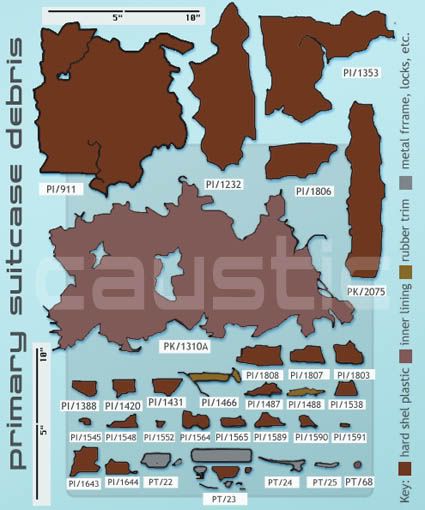
This was examined by Hayes in late January 1989 and he made two observations. First, that the material was compacted as if it had been blasted against a solid surface. And second, that there were flecks of blue material from something else embedded in it. He interpreted the former finding to suggest that the fragment had been blasted against the floor of the container.
This is where it gets murky. That conclusion was sort of buried, because of course it was decided very very soon after that that the bomb suitcase had not been on the floor of the container. No way, no matter what back-flips we have to turn to make it so! Feraday left that bit out when he compiled his Joint Report, that was submitted in December 1991. He didn't leave out the part about the blue flecks. The blue flecks were certainly interpreted at a later date as having come from Patricia's blue suitcase, and showing that her suitcase had been smack alongside the bomb suitcase.
Both of these things can't be true. PI/911 can't have been simultaneously flat against the floor of the container, and flat against Patricia's suitcase. Nobody seems to have explored this in any detail at all. When the defence got hold of Hayes's notes, they seized on the compaction to get back to showing that the bomb suitcase was on the floor of the container. The prosecution on the other hand used the blue flecks on the same fragment to declare that actually the bomb suitcase was placed on top of Patricia's.
This was the evidence used by the Crown to side-step Sidhu's testimony and overturn the original absolute conviction that the Heathrow-origin suitcases had not been moved. We know the bomb was in either the bottom suitcase of the stack, or the one on top of it. If Patricia's case was below the bomb suitcase, that means Patricia's case must have been on the bottom of the stack and the bomb suitcase on top of it. Which means Patricia's case must have been placed where Bedford originally saw the mysterious bronze Samsonite. Which means that case must have been moved. Phew!
This is just bad logic, from both Hayes and the later investigators. Hayes saw the compaction, and immediately jumped to the conclusion that the fragment was compacted against the floor of the container. Silly man. The floor of the container was a fairly thin sheet of aluminium. On top of the suitcase, however, was about a quarter of a ton of assorted luggage. So which surface is going to be the more immovable, when that Semtex goes bang?
This makes perfect sense of the compacted fragment also having the blue flecks. It was compacted against the bottom of this quarter-ton resistance, which happened to be the blue canvas of Patricia's suitcase.
We know Patricia's case wasn't on the bottom layer, from Sidhu's evidence. We know the Bedford case was. We know the bomb was either that case or the one on top of it. And we know Patricia's case was above the bomb suitcase. This leaves us pretty much where we were. Either like this....
Coyle suitcase
Bomb suitcase
Bedford suitcase
Floor of container
Or like this....
Coyle suitcase
Bomb suitcase seen by Bedford
Floor of the container
The first of these two arrangements is the unsustainable one, because it leaves the Bedford case as an entirely unexplained rogue suitcase, appearing from nowhere and vanishing just as mysteriously, its only function being to avoid the glaringly obvious, that the case Bedford saw was the bomb.
The funny thing is, nobody seems to have put that fragment the right way up. Everybody was trying to argue it the way they wanted to play it, without realising that the real solid surface in the context of that explosion near the bottom of the container wasn't the relatively flimsy floor of the container, but the quarter-ton of compacted luggage on top.
Rolfe.
This was examined by Hayes in late January 1989 and he made two observations. First, that the material was compacted as if it had been blasted against a solid surface. And second, that there were flecks of blue material from something else embedded in it. He interpreted the former finding to suggest that the fragment had been blasted against the floor of the container.
This is where it gets murky. That conclusion was sort of buried, because of course it was decided very very soon after that that the bomb suitcase had not been on the floor of the container. No way, no matter what back-flips we have to turn to make it so! Feraday left that bit out when he compiled his Joint Report, that was submitted in December 1991. He didn't leave out the part about the blue flecks. The blue flecks were certainly interpreted at a later date as having come from Patricia's blue suitcase, and showing that her suitcase had been smack alongside the bomb suitcase.
Both of these things can't be true. PI/911 can't have been simultaneously flat against the floor of the container, and flat against Patricia's suitcase. Nobody seems to have explored this in any detail at all. When the defence got hold of Hayes's notes, they seized on the compaction to get back to showing that the bomb suitcase was on the floor of the container. The prosecution on the other hand used the blue flecks on the same fragment to declare that actually the bomb suitcase was placed on top of Patricia's.
This was the evidence used by the Crown to side-step Sidhu's testimony and overturn the original absolute conviction that the Heathrow-origin suitcases had not been moved. We know the bomb was in either the bottom suitcase of the stack, or the one on top of it. If Patricia's case was below the bomb suitcase, that means Patricia's case must have been on the bottom of the stack and the bomb suitcase on top of it. Which means Patricia's case must have been placed where Bedford originally saw the mysterious bronze Samsonite. Which means that case must have been moved. Phew!
This is just bad logic, from both Hayes and the later investigators. Hayes saw the compaction, and immediately jumped to the conclusion that the fragment was compacted against the floor of the container. Silly man. The floor of the container was a fairly thin sheet of aluminium. On top of the suitcase, however, was about a quarter of a ton of assorted luggage. So which surface is going to be the more immovable, when that Semtex goes bang?
This makes perfect sense of the compacted fragment also having the blue flecks. It was compacted against the bottom of this quarter-ton resistance, which happened to be the blue canvas of Patricia's suitcase.
We know Patricia's case wasn't on the bottom layer, from Sidhu's evidence. We know the Bedford case was. We know the bomb was either that case or the one on top of it. And we know Patricia's case was above the bomb suitcase. This leaves us pretty much where we were. Either like this....
Coyle suitcase
Bomb suitcase
Bedford suitcase
Floor of container
Or like this....
Coyle suitcase
Bomb suitcase seen by Bedford
Floor of the container
The first of these two arrangements is the unsustainable one, because it leaves the Bedford case as an entirely unexplained rogue suitcase, appearing from nowhere and vanishing just as mysteriously, its only function being to avoid the glaringly obvious, that the case Bedford saw was the bomb.
The funny thing is, nobody seems to have put that fragment the right way up. Everybody was trying to argue it the way they wanted to play it, without realising that the real solid surface in the context of that explosion near the bottom of the container wasn't the relatively flimsy floor of the container, but the quarter-ton of compacted luggage on top.
Rolfe.
jargon buster
Banned

- Joined
- Dec 9, 2009
- Messages
- 4,773
Phew indeed.If Patricia's case was below the bomb suitcase, that means Patricia's case must have been on the bottom of the stack and the bomb suitcase on top of it. Which means Patricia's case must have been placed where Bedford originally saw the mysterious bronze Samsonite. Which means that case must have been moved. Phew!
I'm beginning to think you are actually working for the CPS and your objective is to muddy the waters so much that you are discouraging people from actively taking an interest in this case at all.
PS you are doing a sterling job.

PPS and when I say "case" I dont mean the suitcase.

Last edited: