
Lockerbie: London Origin Theory

I'm deadly serious. He gave a series of statements. In the second one he just says he chucked the Frankfurt cases on top of the ones that were already there. That was 10th January. The confirmation was much later, could have been 1990, but he says yes it was all fresh in his mind when he gave the original statements, and he's quite sure he didn't move the luggage that was already there. He didn't have to, because the floor of the container was already covered with enough stuff to stop the luggage sliding around.

I'm not entirely sure the defence knew this, because Sidhu wasn't called to give evidence. So his statements wouldn't necessarily have been in the court record, as far as I know. I think what I've got is stuff that was dredged up for the second appeal. But on the other hand, they probably should have known because surely they should have had access to his statements anyway?

Several things kind of slapped me in the face while I was reading the Zeist judgement. One was that there was nothing presented about whose luggage was loaded into the container at Heathrow, and whether any of it was a maroony-brown Samsonite. Nobody asked, if Bedford's case wasnt the bomb, whose was it? Of course we know the prosecution just omitted to call that evidence.

Another thing, perhaps the most obvious thing, was all the speculation about what the loader might or might not have done with these cases while adding the Frankfurt stuff. I mean, it just screams at you. All that, based on Keen asking Crabtree whether anyone might sort of re-jig the placing a bit. Crabtree who never even saw the container until after it was filled and closed. Why don't you ASK THE GUY WHO ACTUALLY DID IT, you freaking morons?

They had Sandhu right there, he helped Sidhu load the stuff. But nobody asked him. And why call Sandhu, who only lent a hand for the latter part of the exercise, and not Sidhu, who started loading the container on his own. (I surmised that's what happened, and in fact Sandhu's statement confirms it.) Well, it seems Sandhu didn't come to help Sidhu until he'd got started, and Sandhu didn't even know there had been any cases in the container when it was wheeled out. So if you're thinking what I'm thinking, Sandhu was the safe one to call.

But why the hell didn't the defence go hunt down Sidhu's statement? Maybe they were concerned that confirming the cases hadn't been moved at all would have confirmed the original "the explosion was too high" riff that Feraday was coming out with? Maybe they preferred to leave open the possibility that Bedford's case had been slid to the left, or replaced on top of Patricia's? But it would have exposed the forensic theory about Patricia's case being on the bottom as complete moonshine, which could not have been bad. Maybe they just didn't want to call someone who was probably originally slated as a prosecution witness?

To be honest, I think the defence relied way too much on the assumption that the prosecution simply hadn't proved their case, and didn't put enough effort into picking holes in it. They didn't bargain for the judges going into bat for the prosecution, and spinning even wilder fantasies about what Sidhu might have done with the suitcases he actually said he didn't touch.

Rolfe.
 
Last edited:
I'm trying to figure out why the forensics people changed their minds about the positioning of Patricia's suitcase in late 1991. I don't really get it.

The main feature of the early analysis of the baggage in the container was the absolute belief that the luggage from Heathrow was not moved when the Frankfurt luggage was added. The logic went, explosion on second layer, nothing on second layer at Heathrow, therefore not one of the Heathrow bags. This seems to have been a justified assumption, based on Sidhu's statements. If the explosion was definitely too high to have been on the bottom, then it was a Frankfurt bag.

At that stage they were assuming Patricia's suitcase had been on top of the bomb bag, and presumably Bedfords #2 brown Samsonite was under it. I don't know what they thought Bedford's case had been. I've not as yet seen any speculation about that in the notes I've been reading. None of the six items identified as having been in the container at that time was a brown Samsonite, so they must have been assuming that Bedford was mistaken. Presumably you'd be looking for something as badly damaged as Patricia's case (which was as badly damaged as the bomb bag). Carlsson's case might be the only candidate, as it wasn't found at all, but I'm not sure what they reckoned his case looked like. (Nobody actually put forward the theory that Bedford's case was Carlsson's, and it had been under the bomb, and was completely destroyed, so I doubt that flies.)

Interestingly, this disposes of the suggestion that Bedford's case could have been Hubbard's rush-tag item. I read the suggestion somewhere (not in the official notes) that Hubbard's case, which was a brown Samsonite, might have been sent from Frankfurt to Heathrow on an earlier flight, and so ended up in the interline shed, and became Bedford's mysterious case. But if Bedford's case wasn't the bomb bag, it was directly underneath it, and Hubbard's case was recovered intact.

So why change their mind in November 1991 (I think that's when CL or someone said it happened) and put Patricia's case under the bomb bag? It was always unlikely that Sidhu had lifted Bedford's case out of the container and put Patricia's in its place, even if you'd never spoken to the guy. But with two signed police statements saying he did no such thing, why do forensics suddenly decide, almost three years in, that he did? For one thing, that leaves the question of what was on top of the bomb bag. It was made clear at Zeist that there was only one case with damage indicating it had been flat alongside the bomb bag (Patricia's), so that was another mystery.

The original FAI tale was clear enough. Explosion on second layer, Bedford's case on bottom layer, Bedford's case not moved, so Bedford's case not the bomb. Why not stick to that? I could just about swallow a story that the case under the bomb got such a pummelling that it disappeared completely.

Could it be that at some time the AAIB people revised their estimate of the height of the explosion from 16-18 inches (which is what I see in the early reports in the press) to 10 inches? 16 to 18 inches is definitely second layer, or an outside chance of third. Definitely not bottom layer. Ten inches, on the other hand, could be bottom layer quite easily, once you factor in margins of error and the possibility that Bedford's case was originally placed partly in the overhang section.

Anybody care to run with this?

Rolfe.
 
I haven't found the exact list of six items in AVE4041 that Ashton refers to, but if it is six items then I think they must be as follows.

Carlson 1
Bernstein 2
McKee 2
Gannon 1

ETA: I have found the list now and that is right. There were 11 items altogether from the "first fifteen" (various reasons why a number of passengers had no checked-in luggage on the flight), but five of them (Rubin (2), Curry (1) and Peirce (2)) were too late to be handled by Bedford and went loose into the hold with the 8 items that were left when the container was filled by Sidhu.

The report also says the only two hardshells in that list were McKee's. Both grey, one a Samsonite and one not. I'm trying to figure out what condition each item was recovered in, but I don't have it all. Carlsson's case seems not to have been found at all. I think both McKee's were found and not pulverised. (One of course had the hole cut in it and the contents removed.) I think Bernstein's and Gannon's were recovered too, not blown to bits.

Elswhere I find a different report saying they were all found and all explosion-damaged. (Well, one of McKee's only had explosives residue.) This report also says that the lock of the bomb suitcase was embedded in one of Bernstein's cases. That's where the "handle towards the back of the container" bit comes from I think, because Bernstein's was one of the cases in the upright row along the back.

If Bedford's case wasn't the bomb, it must have been immediately under it. And it should have been one of these six items. They obviously bust a gut trying to find other items that might have been in that container, and didn't find any.

Whatever it was, it must have been damaged at least as badly as Patricia's case, which must have been on top of the bomb. But the Zeist evidence stated specifically that there was only one item damaged in such a way as to suggest it had been immediately alongside the bomb (Patricia's). Nobody ever asked, in that case if you're saying Patricia's case was under the bomb, what was on top of it?

The only possible candidate is Carlsson's case, which wasn't found. But it wasn't a hardshell. I think it was light-coloured too, but I'm not sure. (Bedford's case was certainly dark-coloured - Sidhu said he didn't really pay a great deal of attention but both cases flat at the front were dark-coloured.)

Here are the two worst-damaged suitcases, pictures linked from Caustic Logic's blog.

coyle.jpg


suitcase.jpg


Enough to be recognisable. So we're talking, apparently, about a three-case sandwich, with the bomb case (the lower one) in the middle and Patricia's on top of it and a third one (Bedford's) under it.

Where's the bits of the third one? How come they weren't picked up if the other two were? And the only candidate we've got isn't another brown Samsonite anyway, but a light-coloured soft-shell (I think).

Remind me why Bedford's case isn't the bomb suitcase again? A couple of inches in the estimate of exactly where the explosion was centred?

Rolfe.
 
Last edited:
Knowing that the Heathrow luggage wasn't moved narrows the whole thing down to one of two basic scenarios. Either forensics were right and the bomb suitcase was on the second layer, in which case it was the meat in a three-case sandwith with the (innocent) Bedford suitcase underneath it and Patricia's suitcase on top of it, or forensics were mistaken and the Bedford suitcase was the bomb bag again with Patricia's suitcase on top of it.
  • The latter fits better with the recovered luggage, as there seems to have been nothing recovered which might have been part of a third suitcase
  • The latter also fits better with the analysis of the luggage in the container, which doesn't offer any reasonable innocent candidate for Bedford's suitcase.
  • The latter also fits better with the estimated bag-counting, which seems to indicate an extra (seventh) item being in the container before it was wheeled out on to the tarmac.
  • The former fits better with the condition of the floor of the container (so Caustic Logic said anyway).
  • The former may also fit better with the estimated position of the explosion.
The luggage stacking is important. The mock-up container shown by the BBC has the left-hand case in the bottom layer partly inside the overhang section. If AVE4041 was loaded like that, it would put the Bedford case in the position of the explosion, pretty much. That's the easy answer. However, the case in the mock-up is large and soft-sided, and in addition the right-hand case is a pretty big case. That's what forces the left-hand case into the overhang. The bomb suitcase was a hard-sided case, and it wasn't particularly large. I think it was less than half the width of the flat part of the floor of the container. Bedford certainly didn't indicate that the right-hand case was bigger than the left-hand case. So that rather argues against the left-hand case being originally placed partly inside the overhang section.

On the other hand the theory that the case on the second layer was protruding into the overhang section doesn't fly terribly well either. Looking at the mock-up, and reading what the baggage handlers said, it appears that the cases were not normally stacked like that. The usual procedure was to build the stacks more or less vertically, while at the same time filling the overhang section with holdalls and other smaller stuff. Again, the bomb suitcase wasn't especially large, and it wouldn't have been expected that Sidhu would have pushed it right over to the left.

Another point is one John Ashton made. If you look at the diagram of the container relative to the explosion, the obvious position for the explosion to have been when considering the centre of the damage to the aircraft is actually lower than the position marked. (Caustic Logic's blog again.)

AVE4041F13.jpg


Also, look at the extent of the damaged area of aeroplane under the floor of the container - it's far more extensive than the damage at the side. The actual floor of the container was blasted right down and hit the floor of the hold pretty hard. All that seems to my eye more compatible with the bottom case in the stack exploding.

One confounder is that when you make diagrams of this arrangement, even (or maybe especially) when you measure it all out, it comes out very neat and four-square. But the reality wouldn't necessarily have been neat and four-square at all, this was semi-random piles of different-sized (and shaped) suitcases being thrown into a big box, which was then shoved in a big hole. Things might easily not have been aligned as we think they should have been.

I'd welcome any other opinions on this.

Rolfe.
 
Last edited:
Or either forensics were wrong and the bomb suitcase was on the first layer, in which case it was the bottom slice of bread in a three-case sandwith with the guilty Patricia suitcase on top of it and Bedford's suitcase in the middle, or forensics were right and the Patricia suitcase was the meat in the sandwich again with Bedford's suitcase underneath it.
 
Wow! Okay, quite a bit to digest, but nonetheless, that is a pretty startling discovery about Sidhu’s statements.

My immediate feelings on this strange matter relate back to the FAI and its conclusions.

The Sheriff was content to disregard the brown Samsonite witnessed by Bedford’s since the explosion had occurred above the cases on the floor of the container and as neither Bedford’s suitcase – nor any of the other Heathrow origin luggage in 4041 – had been repositioned subsequent to Bedford seeing them and Sidhu dealing with 4041. However, this being accepted, no explanation was offered at the FAI for the complete absence of any trace whatsoever of this brown Samsonite suitcase. The only trace ever found of a brown Samsonite was that determined to be the primary suitcase.

Bear in mind that the Sheriff was, to all intents and purposes, basically instructed that the investigation knew that rogue bomb had arrived on 103a from Frankfurt and he should find as such, although this evidence could not be explicitly presented to the FAI. This was despite the investigations knowledge of the Erac printout and the clothes from Malta being central to the ‘bomb bag’ theory of introduction.

This was also where DI Henderson provided the evidence that no passenger on 103 could be associated with this brown samonsite and thus was unaccompanied. But had arrived on 103a, and nothing is mentioned of the brown Samsonite seen by Bedford as a significant discrepancy in the correlation of passengers and baggage made by Henderson.

Of course, bizarrely, this theory was significantly altered when Zeist came around and it was concluded that Ms Coyle’s badly damaged bag had been actually on the floor – where the original Bedford brown Samonsite was observed – immediately beneath the primary suitcase, which of course was now another identical Samsonite suitcase that had arrived via Malta and Frankfurt. And again, despite everyone accepting Bedford’s statements at the FAI and Zeist, and that this suitcase did actually exist, it once again vanished without trace. Much like DI Henderson’s now vanishing testimony..

I find it inexplicable that the defence could have either not uncovered or not being aware of Sidhu’s statements, or that they would have conceivably considered it detrimental to illustrating enough doubt about the prosecution’s theory at Zeist.

I appreciate that presenting Sidhu’s statements does not help to change the determined position of the explosion on 103, and that this still suggests that this occurred above the bottom layer of baggage and not on the floor of the container, but most certainly places the emphasis onto the prosecution to explain, not only their conclusions on Ms Coyle’s bag on the floor, but under far more intense scrutiny the complete and total disintegration of the Bedford suitcase which was, according to the final baggage loader onto PA103, not moved.

The more rational explanation is quite evident: Ms Coyle’s case was above the primary suitcase and unless it can be demonstrated beyond doubt that the Bedford Samsonite when last observed before 103’s loading doors were closed was, contrary to all accounts, actually moved, it thus remained most definitely in a close enough position to be reasonably considered to be the bomb bag.

Now the defence introduce DI Henderson to the Zeist courtroom and pose a considerable problem for the prosecution to explain. Bedford’s brown Samsonite was loaded very near the explosive position determined in 4041, was confirmed to be an unaccompanied item of baggage that was loaded into 4041 in mysterious circumstances, and was never moved again from its original position.

Frankfurt baggage would be, as testified, loaded directly on top of this brown Samsonite, one in particular being Ms Coyle’s which sustained severe damage similar to the primary case itself. Major McKee’s suitcase, placed adjacent to the primary suitcase also suffered more limited damage and perhaps may have been the second suitcase witnessed by Bedford on the floor of the container.
 
Last edited:
Hi Buncrana! Hope the exams went well!

It was DC Henderson, by the way, not DI Henderson (Derek, not Stuart). I've found a couple of possible other brown Samsonites in the luggage trail, but they're irrelevant. One is Hubbard's case of course, and the other is Francis Boyer's case. I think that latter one is the reason for Leppard going on about the mission to get Mme. Boyer to identify her husband's luggage - not that it was the last case that wasn't matched up, but that it was another brown-ish hardshell. Once she identified that, there was no legitimate brown-ish hardshell that might have been the bomb.

I think Bedford's evidence has to be accepted. His account of the arrangement of the luggage was confirmed by Sidhu (although he only described the two flat cases as "dark"), and I think also by the ever-vague Kamboj. There was another loader called Sahota who also saw the container and also concurred. (At Zeist, Kamboj mentioned a Mr. Parmar who seemed to be his co-worker with Alert on the x-ray screening job, but so far I have found no other reference to Parmar and I'm not sure he even existed.) So we have four people confirming the "row of upright cases along the back and two flat in front" arrangement.

Bedford would have been the only one to have any reason to think there was anything unusual about the cases, so I'd certainly back his description of the things. The line about "a maroony-brown Samsonite" really seems to be more than coincidence when you realise what the intact bomb suitcase looked like, even though it was officially called "antique copper".

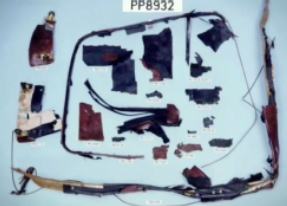
8932.jpg


The court accepted his evidence about the mysterious maroony-brown Samsonite, and no other evidence contradicts it - although Sidhu originally said the cases at the front were black, he revised that to "wasn't really looking, should just have said dark".

Bedford consistently said there were more than six suitcases in his police statements, and all four of them were unanimous that the floor of the container was covered. Sidhu especially, because he said that's why he didn't move any of the original cases. Trials indicated that six suitcases (four in the row along the back and two flat in front) wouldn't cover the floor. When they were asked to load a container the way they remembered that one as being, Bedford, Sidhu and Sahota all put seven cases in.

This is absolutely crucial stuff, but there isn't a bloody syllable about any of it in the Zeist transcripts. At Zeist the impression is given that there were more cases than that, and that nobody was even slightly interested in whose they were or whether any of them might conceivably have been the case Bedford saw.

I really do think you have to do better than "the explosion was a couple of inches shy of where we think that case was situated" to exclude it from being the bomb bag. Especially when Hayes said in his notes that the largest fragment of the suitcase "was compressed and fractured in a manner suggesting it was in contact with the luggage pallet's base."

Rolfe.
 
Last edited:
If I was the prosecution, I'd have wanted to leave Bedford's case where it was, surely? I'd make the case that it wouldn't have flopped into the overhang, not being a floppy sort of case, and not being particularly wide. I'd point out that Sidhu said he didn't move the things at all, and that would include not shoving the left-hand case to the left. So it wasn't in the overhang, and its left-hand side wasn't elevated, so a ten-inch-high explosion a couple of inches into the overhang wasn't it. Coincidence though it was, strange that there was a supernumerary case in the container and that one didn't match any of the passenger luggage but did match the bomb bag and in fact it vanished from human ken even though both the bomb suitcase and the one on top of it were recovered, it wasn't the same case. If I was pressed, I might try to suggest it was Carlsson's case, even if it didn't match Bedford's description, and that it was even more damaged by the blast than the other two cases because it was caught between the explosion and the base of the container, so was essentially vapourised.

That was clearly the line at the FAI, though I'm not clear that it was spelled out in that amount of detail, and I don't believe there was any attempt to identify the Bedford case as any particular passenger's luggage. So why didn't they stick with it?

The minute you allow that case to be moved at all, you've actually conceded ground. If you assert that Bedford's case was lifted out and replaced by Patricia's case, I'd say you just lost. Given the description of the case, its mysterious appearance, and the fact that it was neither matched to known passenger baggage or accounted for afterwards, I'd have said that was game, set and match to the defence. (Watching Federer vs. Benneteau as I type this!) Sufficient reasonable doubt to acquit. If Sidhu really did take Bedford's case out of the container, the most likely thing he would have done with it is put it back on top of the case he replaced it with. If the defence hadn't been asleep at the wheel for most of this trial, and the judges hadn't been batting for the prosecution (well it might have gone anywhere so we'll just assume it went to the other side of the container and then vanished), that would have been that.

So why the bloody blue blazes did they decide to move Patricia's case? Especially in the light of having Sidhu's statement right there saying he did nothing of the sort? And when did they do this? Someone said November 1991. Evidence?

Rolfe.
 
Slightly off-topic, but about the defence. I thought the 8849-might-have-been-from-Damascus stuff was Taylor's own work, suggesting he'd actually done his own analysis of the baggage movements and come up with that possibility. But reading the German reports, I came across what looked pretty much like that same suggestion. It seems to have been a guess at what 8849 might have been from the Germans who were trying to account for all 25 transfer items.

Taylor really wasn't trying at all. I hear tales about his lack of preparation during the trial, and Keene having to cover up for him. Keene did a bang-up job for Fhimah, and he's now Dean of the Faculty of Advocates. Taylor seemed to think it was money for old rope because the case against Megrahi was so threadbare, and assumed he only had to point that out and the judges would agree.

Rolfe.
 
More speculation about the Heathrow baggage loading.

If the bomb suitcase came from Frankfurt, the Heathrow procedures weren't subverted and we're looking at a normal afternoon in the interline shed. How would a normal afternoon arrange that luggage?

Bernt Carlsson flew in at 11.10 from Brussels, the first of the interline passengers. His suitcase would almost certainly have been the first one into the container. He only had the one case. It would have been one of the ones Bedford put along the back.

Next up were Mike Gannon and Tiny McKee, travelling together from Larnaca. They got in at 13.30. Gannon had one case and McKee had two. Again, these are almost certainly among the ones Bedford put along the back.

Finally Michael Bernstein arrived from Vienna at 15.15. He had two cases.

All these items were blast-damaged (or in Carlsson's case, disappeared). The interline passengers who arrived after that (the next one in came in at 16.15) were too late for their luggage to have been put into AVE4041, and it appears they were loose-loaded along with the surplus items from the Frankfurt batch. None of the later-arriving passengers' luggage showed evidence of having been involved in the explosion.

If the luggage arrived in the expected order, the two cases on the front should have been Bernstein's. He was carrying a tan simulated leather American Tourister suitcase, and a tan holdall. Both were found damaged, in two pieces. Two things there indicate that the two flat cases Bedford saw weren't Bernstein's. First, his luggage doesn't match Bedford's description at all. Wrong colour, and not hardshells. Indeed, even if Bedford was wrong about the "maroony-brown" part, Sidhu's description of the cases as being dark, so dark he originally said they were black, essentially rules out a couple of tan items. The other thing is that both items were found. Damaged, but nothing like the state of Patricia's case. Whatever was under the bomb bag in this situation must have been pretty much pulverised.

The other popular suggestion for the two front cases is that they were Tiny McKee's. They were both grey hardshells, one a Samsonite. I'm not sure how dark the grey was, or quite how you mistake grey for maroony-brown, but maybe at a pinch. This falls for the same reason as Bernstein's. Both found, neither pulverised. Neither of these cases was under the bomb bag.

Just for completeness, Gannon's case was a Samsonite, but it wasn't a hardshell and it was navy blue. And it was damaged, but not destroyed.

The only possible candidate for the Bedford suitcase in this scenario is Carlsson's. It's the only one that could have been damaged sufficiently for it to have been under the bomb. But it was the first one to come in, so the least likely to have been one of two late arrivals. And if it did arrive late, what was the other one that also arrived late? The others don't include a single case, as McKee and Gannon flew in together. We'd have to postulate one of McKee's cases (say) also being separated from the group and coming in late along with Carlsson's. Not impossible of course but it's getting strained.

The later reports all note Carlsson's case as not being recovered. Earlier reports mention a grey hardshell "Presikhaaf" suitcase which was severely explosion damaged and in a lot of little bits, also a navy blue soft-sided suitcase, either of which might have been his. I don't know if either of these were eventually linked to someone else, or what. I also don't know if it was ever established what sort of suitcase he was actually carrying.

There was a story, second or third hand, possibly via Patrick, that Carlsson's girlfriend was shown a completely wrecked suitcase she didn't recognise, and told it was believed to have been his and to have been under the bomb. That would support the idea that this was what the investigators were originally thinking. I don't know where this theory went though.

That's the best I can do, for an innocent afternoon in the interline shed. The "Bedford case" was Carlsson's, which arrived after 4 o'clock, even though Carlsson's flight got in before noon. And somehow one of the other cases became separated from its fellows and was loaded with Carlsson's. And Bedford described a grey (or possibly navy) case as "maroony-brown".

And we haven't explained how only six cases could have completely covered the floor of the container, if four of them were standing upright along the back.

Rolfe.
 
Last edited:
It says a lot when the only person that you asked for an opinion on your presentation is someone who isnt interested in it.
I havent really looked at it, I did open it up but it just looked like more of the same so I didn't bother looking in any depth.
It would appear no one else is interested in it either as they haven't taken the time to comment on it.

I haven't seen a thread with so many if's,maybes and mights for a very long time.
 
Last edited:
If you're not interested, you must be awfully bored with whatever you are doing to keep dipping in here.

I thought you were going to deliver a scathing critique of my presentation technique. Oh well.

Rolfe.
 
I havent seen your presentation technique, I have opened your presentation and quickly closed it again.
You presentation technique can only be judged when you present it, not simply prepare it.
When are you going to present it and who to?
Surely you aren't just waiting for me to approve it?

PS yes I am a bit bored, I was just killing some time.
I could join in and paste walls of second guesses and suppositions about some suitcases if you like.
 
I havent seen your presentation technique, I have opened your presentation and quickly closed it again.
You presentation technique can only be judged when you present it, not simply prepare it.
When are you going to present it and who to?
Surely you aren't just waiting for me to approve it?

PS yes I am a bit bored, I was just killing some time.
I could join in and paste walls of second guesses and suppositions about some suitcases if you like.

Uh?
 
Guesses and suppositions are only of use if they come from someone who knows what they're talking about. Word salad is a waste of electrons.

As far as I can see, if the bomb came from Frankfurt, the only possible scenario is the one I just posted. Carlsson's case was delayed somewhere, for some reason, and didn't reach the interline shed until after 4pm, even though his flight landed at 11.10. In a similar manner one of McKee's two cases was separated from its fellows transferring from the Larnaca flight, and that case also failed to make it to the shed before 4pm. The remaining four cases were the "row along the back" Bedford placed before going for his break.

Both delayed cases somehow palled up on the way, and arrived together after Bedford had gone on his break. Kamboj saw them arrive - even though he had gone for a snack too - and even though it wasn't his job he picked them up off the carousel, x-rayed them (which was his job), and put them in the container (which again wasn't his job). And promptly forgot about it so thoroughly that he didn't even remember when police specifically asked him about it a few days later.

Bedford saw both cases when he got back, and asked Kamboj about them. Kamboj said he put them there. Bedford somehow got the impression a grey case was "maroony-brown".

The container was wheeled out to the tarmac like that, and even though four cases along the back wouldn't have much of a hope of covering the floor of the container, somehow Bedford thought it was covered and Sidhu thought it was sufficiently covered that nothing would shift so nothing needed to be moved. Bedford was mistaken when he consistently told the police there were more than six cases in the container. Bedford, Sidhu and Sahota were all three of them mistaken when they needed seven cases to get the container looking as they last remembered it.

Pretty much the first case off the "rocket" from the 727 was the bronze Samsonite case with the bomb in it, and Sidhu placed it on top of Carlson's case, which was the left-hand one. Uncharacteristically he didn't place it so as to continue a vertical stack leaning on the right-hand stack, which was the SOP to leave the overhang section for holdalls, he shoved it right into the angle. And by the most evil chance, he put it with the radio (which was packed along one side rather than across the bottom as would have been natural) next to the plane's hull. A couple of cases later came Patricia's case, and he put that on top. One of Karen's three holdalls went into the angle.

That's the only way I can see it possibly flies, if the bomb came from Frankfurt.

Rolfe.
 
Last edited:
Alternatively, the bomb was loaded at Heathrow. And as we know Sidhu didn't move the cases, again the scenarios are limited.

Carlson's, McKee's, Gannon's and Bernstein's cases arrived in the interline shed when they were supposed to. Bedford arranged them in a row across the back, starting at the left, which would have made Carlsson's the left-hand case on that row, that is the closest of the line to where the bomb ended up. He went for his tea break. Kamboj went for his snack.

Evil terrorist appears, convincingly dressed in airline overalls, carrying the bronze Samsonite. (He may have been prepared to let Kamboj x-ray the thing if need be, secure in the knowledge that it would then be his job to load the thing in the container, but he probably managed to time it so he got a clear run.) He sees the container with a complete row of cases filling the back, and the front clear.

He places the bomb suitcase on the outboard side, the right way round, and as far into the overhang as he can. He's concerned that someone might move the case when trying to get a better fit in the container, so he takes another hardshell case from the row behind (McKee's Samsonite, probably) and places it flat to the right-hand side of the bomb case. And maybe manages to spread the ones at the back out a little so there isn't an obvious gap. Then he scarpers.

Bedford and Kamboj get back from their various refreshments, and Bedford notices the two "new" cases. He thinks this is a bit strange, to the point of noticing the rather peculiar maroony-brown colour of the left-hand case. But he doesn't do anything at all about it. He hands the container over to Sidhu like that. Later, when he's watching the news that night, Bedford remembers the two mysterious cases with a horrible sinking feeling. He realises he may have vital evidence to help the police, and resolves to describe what he saw to the cops. However, he also decides to invent the part where he asks Kamboj if the cases have been screened, to give himself some cover when the inevitable "and you just saw these things there and didn't say a word and let them go?!" question comes calling.

Sidhu leaves things as they are, and starts loading the Frankfurt stuff. Just about the first case off the 727 is Patricia's, and that goes on top of the bomb. One of Karen's holdalls goes in the angle. And the rest, we know about.

The only thing arguing against this is the original contention of the investigators, that the explosion was about an inch higher and two inches or so to the left of where we would assume that case to have been. Apparently there was "complex analytical modelling" going on to get those measurements. As well as just looking at the results of piecing back together some bits of twisted metal that had fallen 31,000 feet. Just how precise are we supposed to imagine this estimate can possibly be.

Or in other words, how certain are we that it's completely impossible for the explosion (in red) to have been associated with the lowest case on the left-hand stack?

twotins.jpg


Rolfe.
 
Last edited:
It is without doubt that Claiden's conclusions should have been subject to certain qualifications with regards to its absolute accuracy in this scenario. An inch or two either way could have crucial implications for the investigation and for responsibility lying with the Heathrow and British authorities or arriving from Frankfurt and a huge sigh from Heqathrow.

Considering the baggage loaded into AVE4041 was not fixed and was distinctly moveable and then was subject to the inevitable dynamics involved in the aircraft takeoff and, as it seems on 21st Dec 1988, some distruptive weather conditions, also leaves any absolute conclusions of the precise and exact spot for the explosion open to question.


Lockerbie Kamp Zeist Judgement [/URL said:
] [25]

It was argued on behalf of the accused that the suitcase described by Mr
Bedford could well have been the primary suitcase, particularly as the evidence did not disclose that any fragments of a hard-shell Samsonite-type suitcase had been recovered, apart from those of the primary suitcase itself.

It was accepted, for the purposes of this argument, that the effect of forensic evidence was that the suitcase could not have been directly in contact with the floor of the container. It was submitted that there was evidence that an American Tourister suitcase, which had travelled from Frankfurt, fragments of which had been recovered, had been very
intimately involved in the explosion and could have been placed under the suitcase spoken to by Mr Bedford.

That would have required rearrangement of the items in the container, but such rearrangement could easily have occurred when the baggage from Frankfurt was being put into the container on the tarmac at Heathrow.

It is true that such a rearrangement could have occurred, but if there was such a rearrangement, the suitcase described by Mr Bedford might have been placed at some more remote corner of the container, and while the forensic evidence dealt with all the items recovered which showed direct explosive damage, twenty-five in total, there were many other items of baggage found which were not dealt with in detail in the evidence in the case.


Well we now know that there was no rearrangement of this baggage from the statements by Mr Sidhu being the very last Heathrow loader to see the bags noted by Bedford and fill 4041 with the rest of the bags from the late-arriving Frankfurt flight. These statements by Mr Sidhu also calls into question the assertion that, bearing in mind Claiden's calculations, the damage sustained to the floor of 4041 which was also said to have been somewhat shielded by the blast by the badly damaged Blue Tourister suitcase said to belong to Ms Coyle.

However, with these new statements by Mr Sidhu, surely all these assertions and conclusions must now be thoroughly and comprehensively revised? The brown samsonite seen by Bedford remained as seen, on the base of the container to the left side near the overhang, and together with another 'similar' case took up the whole floor available in 4041, it now becomes logically and forensically impossible for Ms Coyles suitcase to be underneath the proposed primary suitcase in the location described by Claiden and Hayes/Feraday.


Explosive damage to AVE4041 PA:

AVE4041F6A.jpg


This diagram taken from the official AAIB Report appears to illustrate extensive damage to the outboard face of 4041.


Explosive Damage to AVE4041 Base:

AVE4041F3B.jpg


This photo shows some damage to the floor of the container, and I would assume the base of the container itself would have been substantially protected by the blast than the outer edge of 4041 would have against the outer skin of the aircraft.

If the bag witnessed by Bedford, within a few inches at worst, from the determined spot of the explosion and thus location of the primary suitcase, could have been found by the prosecution as found damaged or non-damaged, but clearly inocent, then this would have been lead at Zeist.

However, any revelation of Sidhu's statements would clearly have huge implications for the whole prosecution case and left the certainty of the AAIB and Claiden's conlcusions in grave doubt.
 
Last edited:
Ah, someone who knows what he's talking about! Thanks for the pics, Buncrana, I was going to hunt these up.

There are different estimates of the position of the explosion, and some of these are detailed in Ashton's book. 10 to 12 inches is one quoted. Interestingly, 10 inches is the lowest estimate of any of them, but exactly 10 inches is the figure Claiden quoted in court. I don't know how to interpret this in terms of margin for error. I also recall some distinctly higher figures being given at an early stage in the inquiry. I have the impression that this figure was constantly being revised down, and that there may have been pressure exerted not to get the figure below 10 inches.

I never understood the apparent certainty that the bomb wasn't on the bottom layer. Caustic Logic said earlier in the thread that he agreed with that because of the pattern of damage to the floor of the container, but I don't really see it myself. And the defence certainly didn't concede that point - Taylor postulated that Sidhu had simply pushed the case a bit to the left. (And the audience rises as one and shouts, why don't you just ASK HIM??)

I note that this is the problem with the Mach Stem Effect error. Keen apparently tied the AAIB in knots in the witness box and forced Claiden to admit to a mistake. If the sums had been done right, then the result actually had the explosion outwith the confines of the baggage container. I don't think that flies to be honest. The condition of the debris makes it obvious that the explosion was in the container. But it does show that their sums weren't infallible to the last centimetre.

Ashton makes an interesting point. He takes the diagram I posted above and notes that the shortest-line from the estimated position of the explosion to the skin of the plane does not intersect with the centre of the blast-damaged area. If you move the line to the centre, the red dot is definitely in the bottom row of luggage.

Rolfe.
 

Back
Top Bottom