Lockerbie: London Origin Theory

Guesses and suppositions are only of use if they come from someone who knows what they're talking about.
Good luck convincing the authorities with your walls of text containing guesses and suppositions.
TBH at the moment all you are posting are your ideas of what might have happened.
It's amazing that not only are you convinced you can put a case forward (pardon the pun) to establish Megrahi's innocence when his defence team couldn't, you also seem to be alluding to the fact that you can provide enough evidence to establish the identity of the guilty party as well.

And as for the phrase "word salad", well, theres nothing more to be said about that.
 
Last edited:
Good luck convincing the authorities with your walls of text containing guesses and suppositions.
TBH at the moment all you are posting are your ideas of what might have happened.
It's amazing that not only are you convinced you can put a case forward (pardon the pun) to establish Megrahi's innocence when his defence team couldn't, you also seem to be alluding to the fact that you can provide enough evidence to establish the identity of the guilty party as well.

And as for the phrase "word salad", well, theres nothing more to be said about that.

What are your ideas of what might have happened?
 
I have no idea what happened, there are lots of different opinions of what might have happened and TBH I couldn't really care less.
Was Megrahi the bomber?
Was Megrahi stitched up?
Was his defence team "in on it"?
Was it Libya?
Was it simply an accident covered up by Pan Am?

Now unless you have concrete evidence either way and you can convince the authorities then its all hot air.
 
OK lets run with my opinion on what happened.
An alien spacecraft flying nearby had a 'past its use by date' laser missile on board and wanted to use it up, so they shot the plane down.
The alien captain then sent down a brainwashing team of aliens to cause a conspiracy to make sure they never got found out.
Any evidence contrary to this has been implanted in the people involved.
In posting this I expect a visit pretty shortly to blank out what I know with a theory that it wasn't Megrahi and that some suitcases were arranged like sandwiches and that a lot of evidence doesn't quite match up and this will allow me to make up more stuff on my own without really having any evidence to back it up.
A bit like the alien story really.
 
The detail of the evidence presented by the prosecution on the Heathrow luggage is very patchy. Contrast the beginning of the trial, when everyone present was treated to several days of air traffic controllers explaining exactly how they supervised that plane's take-off and uneventful flight the length of England. We had every "Good evening Clipper 103" and all the chit-chat through to "Good night, Clipper 103". We had Alan Topp with his radar trace explaining exactly how he saw the plane break up in front of his eyes, and the recordings of the two controllers in Oceanic were read into the evidence as they had both died in the mean time. We had the Shuttle pilot tell how he saw a flash in the sky, then a huge fire on the ground. We had emergency services tell how they were called. We had several local people describing where they were and how it seemed to them as huge chunks of the plane landed on the town. It went on for days. And yet nobody was disputing and nobody had the slightest doubt that the plane had come down exactly the way they said it did.

Then when it comes to the nitty-gritty, the detail stops. How many things might it have been useful for the judges to have known about?

How many passengers came into Heathrow early enough for them to have had luggage in AVE4041? Four.
How many cases did they have between them? Six.
How many cases did Bedford and the other baggage handlers think were in the container? Seven.
Did any passengers arrive at a time which might have led to two cases appearing in the interline shed between 4 and 4.30? Probably not.
Who was the last passenger to have luggage arrive in the interline shed, and what did his luggage look like? Michael Bernstein, a tan simulated leather soft-sided suitcase and a matching holdall.
Was either item damaged consistently with its having been below the bomb suitcase? No.
Was any of these six items a maroony-brown hardshell? No.
Was any of these six items damaged consistently with its having been below the bomb suitcase? No.
Was any of these six items not recovered? Yes, Carlsson's.
Was any recovered item an apparent match for the maroony-brown hardshell Bedford saw? No.
Did the tarmac loader move any of the items already placed in the container at Heathrow? No.

Not a word of that was presented in evidence. It stood out like a sore thumb. I couldn't understand why we weren't being told any of that. It beggared belief that the investigation hadn't established these facts, but they were never brought forward.

Instead we got, there were some transfer suitcases in the container. And a couple of them apparently showed up on their own when the container was unattended. And the left-hand one was a maroony-brown hardshell. But that couldn't have been the bomb bag if it wasn't moved because if was just two inches away from the actual centre of the explosion.

Except, the case that was in that position when the bomb went off was one of the cases from the Frankfurt flight. So we just assume the tarmac loader, even though he was in a big hurry, performed a complicated and apparently unnecessary rearrangement of the luggage. And no we're not going to ask him, we're just going to speculate. And even so, it's impossible the mysterious brown hardshell could have been replaced on top of the Frankfurt case, that was another mysterious maroony-brown hardshell. And no we've no idea where the first mysterious maroony-brown hardshell went (or whose it was or where it came from), why do you ask?

It's bonkers.

It's only not bonkers if the investigators realised that they couldn't defend the proposition that the bomb suitcase couldn't possibly have been on the bottom layer against a single-minded defence advocate in court.

There were only two possible scenarios, really, the ones I outlined above. The prosecution would be arguing specifically that Bedford saw Carlsson's case and one other, that had been unaccountably delayed in their gate transfers. And Bedford was mistaken about what the suitcase looked like. And the bomb bag was loaded on top of Carlsson's case, and although we found some sizeable chunks of the bomb bag we never found any bits of Carlsson's.

The defence would be arguing that there was no reason to assume Carlsson's case had been delayed in transit. That Bedford's description was spontaneous and detailed, and that it exactly fitted the description of the bomb suitcase. That the case-counting exercise showed that there was indeed a supernumerary rogue case in that container. And that the estimated position of the explosion was so close to the mystery case as to make any assertion that it couldn't have been in it tantamount to arguing about angels dancing on pin-heads.

I think moving Patricia's case to the bottom layer defused that last point. It was less important for the defence to attack the position of the explosion when doing that would just have placed the explosion in Patricia's case, which by that time nobody was seriously arguing was the bomb bag. It threw everything into maybes and possiblys and who knows where anything went.

I'm surprised they got away with it though. The possibility that the mystery bag had simply been replaced on top of Patricia's case was never excluded and should still have been the "reasonable doubt" needed to acquit. I still don't really understand why they abandoned the proposition that the luggage wasn't moved.

Rolfe.
 
Maybe the jury decided that all the talk of suitcase sandwiches wasn't actually relevant and just decided to go on the evidence of a witness statement and evidence linking Megrahi to the clothes found at the scene.
 
There's a whole other thread about the clothes purchase for you to troll.

Feel free.

Rolfe.
 
AAIB appx F said:
"The lack of direct blast damage […] on most of the floor panel in the heavily distorted area suggested that this had been protected by, presumably, a piece of luggage. […] This supported the view that the item of baggage containing the IED had been positioned fairly close to the floor but not actually placed upon it.” [5]

Or perhaps, items of clothing and an assortment of other items contained within the primary suitcase? Bear in mind that Claiden was neither an expert on, or received training in explosives, but an engineer with expertise on aircraft failure.

It is an interesting point that Ashton raises in respect of the precise location concluded by Claiden. The AAIB's conclusion of 10" wasn't primarily deduced by damage sustained within AVE4041, but in fact due to the damage, and in particular a small hole, that was observed in the adjacent container AVE7511. The diagram used to explain and illustrate the explosive damage, which for a reason I've yet to see explained, concentrates on the 'blast damage to skin' but opts for the calculations on the outer point of this area. This was used to construct the location of the primary explosion rather than perhaps implying the weakest point in the aircrafts fuselage at the point of detonation.

It's perhaps also worth noting Hayes had, in January 1989, concluded the large portion of suitcase inner lining found (PK/1310A) was from
Hayes said:
"the lower side of a suitcase, compressed and fractured in a manner suggesting it was in contact with a luggage pallet's base and subjected to explosive forces from above."

And so, returning to Claiden and the AAIB report and calculations.


14azi4x.jpg


The two black lines added are mine. The critical 2" calculation, which implied the primary device had detonated just into the overhang section, was determined by the lack of blackening, pitting and damage sustained by the frames (below) that had held together AVE4041.

23ijius.jpg


It was these two crucial dimensions arrived at, the 2" overhang and 10" from the base, that allowed the whole investigation to disregard Heathrow, and thus Bedford's brown samsonite, as the potential primary suitcase.


Here we see the floor of AVE4041 after reconstruction.

n2fhb5.jpg


We can see the extensive damage sustained by the floor area in almost the exact position Bedford witnessed the mysterious brown samosnite and as I suggested earlier, the dynamics of additional bags being loaded, the container being put into position on the aircraft itself, and the takeoff and journey could all potentially result in unanticipated movement of baggage once completed and loaded for the journey.

I think this has also been argued before, or certainly been mentioned by Caustic Logic, that Claiden's reconstruction which included the portion of base floor - the bottom left corner section partly adjoining the section marked 'G' - may well have been positioned incorrectly. Its fit certainly appears to be inconsistent with the other sections torn and replaced together.

This together with the diagrams illustrating the outboard/overhang section of AVE4041 (posted previously above) seems to suggest that while the explosion was most violently felt along the lower section of the container, it was perhaps somewhat protected by the items in the primary suicase, the base of the container and the aircraft body itself giving some element of resistance, while the explosion found the overhang edge and the curved skin of fuselage the weakest point to cause the distruption that ultimately led to the aircraft disintegration.


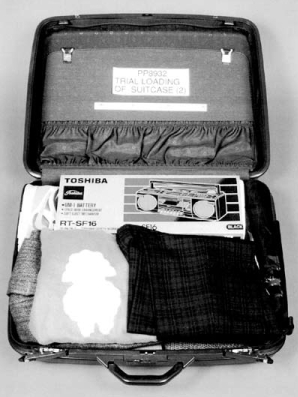
Additionally, amid all this there is also the assertion that the trial loading of the suitcase was incorrect.

suitcase.jpg


The boxed tape recorder, said to contain the bomb, would have been placed along the side of the suitcase, as oppose to at the back-spine of the suitcase as shown above. Which, if the boxed recorder was, as thought placed along the side of the suitcase, places the device once again perhaps an inch or two closer to the determined detonation spot in the container.

 
That was my suggestion, about the packing of the case. I think it was prompted by your observation that the bomb suitcase was lying flat with the handle pointing towards the back of the container. (Just as Bedford described the mystery suitcase, in fact.) Your reason for saying this was, I think, because the lock of the bomb suitcase was found embedded in one of Michael Bernstein's cases, and we know Bernstein's cases were in the row Bedford placed at the back.

But obviously, the bomb suitcase was lying flat. The original guess was apparently that it was sitting in the overhang section, handle up - or so Ashton says. Maybe that's what prompted them to pack the mock-up like that, because in that positioning the radio would indeed have been across the bottom. Or maybe they just packed it the intuitive way anyone would pack it. But the nature of the damage to Patricia's suitcase makes it clear that that case was lying flat alongside the bomb bag, and there's no way if could have been placed like that unless both cases were flat.

I started to wonder about Bernstein's case last night, when I noticed (I think, it was in German) that Bedford started his row of cases from the left. Which puts Carlsson's at the extreme left, immediately behind the centre of the explosion (which could explain why it was very badly damaged, if indeed it was, rather than just being lost on the ground). Then the three McKee/Gannon cases, which would have come in together from the Damascus flight. Then Bernstein's two, which puts them at the right-hand end of the row.

So does that really support the bomb bag's handle being towards the back, or could the handle have been to the right? I'm inclined to think the handle must have been to the back, whichever. If the mystery case was the bomb, we already know the handle was to the back because Bedford said so. If it wasn't, then the bomb suitcase was placed by Sidhu. The fact is that these baggage handlers always placed the suitcases either handle in or handle out. They never placed them with the handles to the side. And no matter the vagaries of the blast, there's no way the lock could have ended up in one of Bernstein's suitcases if the handle had been to the front.

It's amazing the variety of sketched suggestions there are for the possible layout. I've yet to see any attempt that is actually to scale (though I think Caustic Logic did better than most). Most of the "official" efforts have the suitcases far far too small. If you look at the drawings in Ashton's book, they have three cases across the front with space to spare for more! I saw one effort in a police report that had the bomb suitcase (looking like a child's scaled-down case) pushed sort of into the angle of the overhang, with the handle to the right. The artist obviously realised the problem with the packing/orientation, but had gone for the wrong solution.

In contrast, the BBC mock-up above has used rather large suitcases, as did Ashton in his mock-up of the Taylor suggestion with the left-hand side of the left-hand suitcase in the bottom of the overhang section. Nobody is playing it straight.

But I think it's inevitable that the radio must have been down the side of the case, because the case was definitely lying flat in the container, and the loaders didn't load such cases with the handle to either side, and the only case we don't know for certain was loaded by either Bedford or Sidhu is the one Bedford definitely said was placed with the handle to the back.

Rolfe.
 
By the way, here's a sketch of the estimate of the position of the bomb suitcase, taken from a German-language document in the BKA files, dated as early as 7th January 1989.

sketchpos.jpg


Obviously this was a very early estimate, but it shows what the thinking was at that early stage of the investigation, at the time when the Heathrow baggage handlers' statements were being taken.

Rolfe.
 
So I thought I'd read Bedford's statements properly, and the first thing I noticed was that he also mentions Parmar, so I guess he must have been there. Presumably there is a statement from him somewhere.

The second thing I noticed is that Bedford thought there were two early suitcases, not just one, which came in before he selected and labelled-up AVE4041 shortly after 2 o'clock. It's possible one or even two of the cases from the Larnaca flight had got there by then though, because that flight got in at half past one, so it doesn't mean an awful lot one way or the other. (Or maybe I need to qualify that, because later he says it usually takes 45 minutes or even more for the cases to get to him from their incoming flights.) (ETA again, in a slightly later statement these two cases have become "one or two", so I think it's reasonable to say this is Carlsson's suitcase.)

The third thing I noticed was that Bedford thought there were at least six cases in the container before he went on his break. The two he put there first, then another "four or five". In fact the passenger movements indicate that he only had one early case, followed by another five. It certainly doesn't sound as if he only had four cases in there before he went on his break.

And the fourth thing I noticed, which would be a terrible blow to a certain crazy CTer if he were still here (and hadn't been banned, bwahahahaha....), is something Bedford says very clearly.

John Bedford said:
Sometime after 14.00 I brought an empty tin from where it was parked outside into the interline area. The number of this tin I remember was AVE4041. The reason I remember this was because it is my wife's year of birth and my year of birth. There was no particular reason why this particular tin was used. I could have taken any one of about 6 that were parked outside.


Bwahahahaha!!!!!!!

:dl:

Rolfe.
 
Last edited:
More interesting things. The colour of the case. In his original statement to Adrian Dixon, Bedford simply said the mystery case was "brown". (OK, as we know, this was the second statement - on 3rd January he only described the numbers and positioning of the suitcases, not their colour or construction.)

JB said:
I looked inside the tin and saw the suitcases that I had put in the tin still in the same position. Lying on their sides in front of the other suitcases, handle pointing towards the back of the tin were two suitcases. They were hard suitcases of the type 'Samsonite' make. One was brown in colour and the other one if it wasn't the same colour it was similar. In size they took up the remaining base area of the tin. These were the last two suitcases to be put into AVE4041 from the interline area.


I've found the "maroon" reference, and it's surprisingly late. This is a statement given to Derek Henderson on 13th February 1990.

JB said:
I looked in and remember that one of the cases lying flat on the base was a Samsonite make. I said it was a hard sided case because I remember seeing the light shining or reflecting off it. I also said in my original statement it was brown. I am now convinced it was maroon in colour. I would have seen the case at an angle from about ten feet away. If I was asked to try and specify the number of cases in the container I would say seven at the most.


I wonder whether this was a real memory, or whether he had heard anything about the colour the bomb suitcase was supposed to be, in the interim. I also can't find any clear statement that it was the case to the left that was definitely the brown one. I thought that had been established, but I can't find it.

On the other hand, if he wasn't prompted but had simply been trying for the most accurate description/recall, "I remember seeing the light shining or reflecting off it. .... I am now convinced it was maroon in colour."

8932.jpg


Rolfe.
 
And then there's Kamboj. He's supposed to have come back from his "snack" before Bedford went on his break, but I haven't read his own statement yet. Also, every time Bedford mentions the sequence of events, Kamboj mentions the two extra cases before Bedford sees them. Either he mentions them spontaneously, or Bedford says has anything else come in for PA103 and Kamboj says yes, two more, I've dealt with them. Then Bedford looks inside and sees the cases.

If in fact Bedford invented this part to deflect blame, when in fact Kamboj hadn't said a word and he'd simply seen the cases himself and assumed Kamboj had put them there, it doesn't make much difference. But I thought I'd mention it.

The other thing is very odd. Kamboj went on to the plane before it took off. He told Bedford he had a gift for someone on the plane, though Bedford didn't see him carrying anything, and asked if he could get away to board the plane and hand it over. Bedford didn't see him carrying any gift though. Bedford said, not until I get back from my break. Then when he got back, Kamboj reminded him, and he said OK then off you go. He assumed the gift was for one of the flight crew.

I need to go read Kamboj's statements.

OK, Kamboj is quite vague, but he did go on to the plane. He had a Christmas present for one of the Pan Am hostesses he was friendly with, a girl called Susan Stone. (He said she would know him as "Pinky"!) He had bought her some make-up for Christmas. He went on to the plane and looked round but didn't see her. He wished the hostesses he did see a happy Christmas. :( He later discovered Susan wasn't on that flight, and gave her the present. Odd little tale.

He remembers a suitcase from Cyprus (that would be Larnaca), big and heavy and he thought that was maroon. Could have been one of the last cases put into the container. He remembers it because it was the only one he personally took off the carousel. He didn't put any bags into the container that day, and he can't remember how the cases were loaded. And that's about it. No, he really doesn't remember putting anything in that container that day. Could be, maybe, don't remember. And this is 13th January 1989. The rest of it is just about procedure, and the security tape, and a depressing catalogue of an airport where anyone could have walked in any time with anything and put it anywhere they liked.

The big heavy case he remembers must have been one of McKee's (both grey), or Gannon's (navy blue). However, it's interesting he actually names a maroon case (possibly one of the last to be loaded) as early as 6th January 1989.

Rolfe.
 
Last edited:
Harjot Parmar. Seems like a perfectly normal cove. Thought there were about 10 to 12 cases for PA103 that say. However he clarified that although he would take Pan Am luggage off the carousel, he wouldn't sort it by flight, which was the loader's job. He might sometimes put cases in the container to help the loader, but usually they let Bedford do it and with so few cases he's pretty sure he didn't put anything in the container that day. He didn't remember what any of the cases looked like, or how they were arranged in the container. Interestingly though he was the closest of the three of them to getting the right airlines - all BA except 2 or 3 from something else, possibly beginning with s (Air Cyprus, actually). He doesn't mention taking a break, but it was a big shed.

He says he wasn't good at security guard duty but he was good at interline and worked there most of the time. He had three commendations for detecting explosives - one suspicious item that was blown up by a controlled explosion, and two incidents involving loaded firearms. Pan Am gave him a reward each time. He doesn't remember anything unusual about the luggage that day.

And he remembered seeing Kamboj with a wrapped-up Christmas present, Christmas paper and all.

Tarlochan Sahota was a team leader who worked in the build-up shed, and just looked into the container when it was by the build-up shed, not long before it was wheeled out on to the tarmac by Sidhu. He could only say the base of the container was covered and there was no case on top of another one. He couldn't describe any of the cases.

However, on 24th January he was asked to load a container as near as he could remember to how he saw AVE4041 that day. He put five suitcases and a holdall along the back, upright, and two suitcases flat on the floor at the front. Eight in total.

Rolfe.
 
Last edited:
Heh, poor Charles and his theory. Bedford's free choice of container kinda puts paid to any idea that 4041 was earmarked for that flight. This was the proposition that the device was attached to 4041 but not contained inside any of the bags, wasn't it?

The container was recovered about a week after 103's downing, taken to Longtown, and while being examined by Claiden and the AAIB, the Germans had someone there too. Well, that's a very interesting early sketch by the BKA with regards to their initial thoughts on the explosion, being just inside the overhang. Although I appreciate this must've been a very early and rough sketching. Still, their initial instinct from first view of 4041 is curious.

Yeah, I think either Kamboj and/or Bedford could well have slightly altered, elaborated or perhaps coan't remember exactly what happened in the day-to-day routine of that evening's loading. Undoubtedly however, on hearing the news of a Pan Am flight from Heathrow's demise would have some impact on memory or any associated responsibilities. Nevertheless, if Bedford had never said anything about something he clearly realised, given it's mysterious appearence, was memorable for this reason, understanding this case and investigation would have been forever insurmountable.

I'm just reading a very curious bit of the Zeist transcripts and Richard Kean is arguing about the containers being presented to the court as oppose to Claiden's expert testimony, photos and diagrams.

Later.
 
Last edited:
Richard Keen is off my Christmas list, by the way.

Lords, OBEs and a Tory dining club - the people behind Better Together

Tom Gordon and Paul Hutcheon said:
Scotland's most feared lawyer, Richard Keen, the Dean of the Faculty of Advocates, whose ferocity in court earned him the nickname "Rottweiller", also hosted a £1500 table.

Lord Wallace of Tankerness, the former LibDem deputy first minister, was among Keen's guests.

The dinner, organised by the United & Cecil Club (U&CC), a Tory dining club based in Sussex, offered the first public glimpse of those funding Better Together, which was launched last Monday. It is understood the U&CC helped bring around 50 people from London and the southeast to the dinner, suggesting significant funding for Better Together is already from outside Scotland.


That's "Bitter Together", to those of us who hang around on Wings over Scotland. Bloody Unionist turncoat, mutter, mutter, can't trust anybody these days....

Rolfe.
 
Ah, got it about which case was which. At the FAI Bedford was saying definitely maroony-brown, and definitely the left-hand one. Zeist, page 6484. That was late 1990, after the February 1990 interview when he said, look it was maroon.

Rolfe.
 

Back
Top Bottom