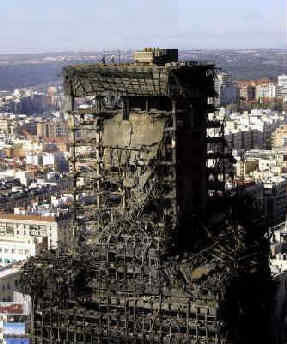
So the whole govt story is dependent upon the unknown theory of fire-proofing blowing off the building.
Let's see, hmm the winsor fire
WTC fire
Winsor "collapse"
WTC collapse
Yeah I see your point.
The Windsor is a PERFECT example. The steel which fell had NO concrete fireproofing. It only took 2:30 for the first steel columns to collapse. What you see standing is steel covered in concrete. The building isn't a tube in a tube design either. It also wasn't hit by an airliner at 500 miles an hour. It's a perfect example of how conspiracy theorists use one dimensional thinking.
This fire is one of the fires Conspiracy theorist like to point to when talking about high raise office fires. This fire lasted 26 hours. But what they don't tell you is that the first collapse happened only 2 hours and 30 minutes after the fire began. But why didn't the building fall completely? It was on fire for 26 hours. The answer is very simple. The building were constructed very differently than the WTC. Reinforced concrete was used in the core and under the 17th floor. Below are detailed descriptions of how the Madrid tower was constructed and the reason for it not collapsing.
The building totaled 32 story's, with 29 floors above ground and three below. A concrete core and concrete frame supported the first 16 floors. Above that was a central support system of concrete columns, supporting concrete floors with steel perimeter columns. An additional feature was the presence of two 'technical floors' - concrete floors designed to give the building more strength. One was just above the ground level and the other at the 17th floor.
concretecentre.com/main.asp?page=1095
The fire protection on the existing steelworks below the 17th floor had been completed at the time of fire except for the 9th and 15th floors. When the fire spread below the 17th floor, those protected perimeter columns survived, except for the unprotected columns at the 9th and 15th floors which all buckled in the multiple floor fire (see Figure 2). However, they did not cause any structural collapse. Obviously, the applied loads supported by these buckled columns had been redistributed to the remaining reinforced concrete shear walls. Nevertheless, structural fire analysis should be carried out before such a conclusion can be drawn.
23:00 Fire started at the 21st Floor
Time / Collapse Situation
1:29 East face of the 21st floor collapsed
1:37 South middle section of several floors above the 21st floor gradually collapsed
1:50 Parts of floor slab with curtain walls collapsed
2:02 Parts of floor slab with curtain walls collapsed
2:11 Parts of floor slab with curtain walls collapsed
2:13 Floors above about 25th floor collapsed
Large collapse of middle section at about 20th floor
2:17 Parts of floor slab with curtain walls collapsed
2:47 Southwest corner of 1 ~ 2 floors below about 20th floor collapsed
2:51 Southeast corner of about 18th ~ 20th floors collapsed
3:35 South middle section of about 17th ~ 20th floors collapsed
Fire broke through the Upper Technical Floor
3:48 Fire flame spurted out below the Upper Technical Floor
4:17 Debris on the Upper Technical Floor fell down
mace.manchester.ac.uk/project/research/structures/strucfire/
CaseStudy/HistoricFires/BuildingFires/default.htm
A survey of the fire damaged structure of the Windsor Tower, Madrid, has concluded that the concrete structure “performed extraordinarily well in a severe fire”. The study, ‘Fire in the Windsor building, Madrid: Survey of the fire resistance and residual bearing capacity of the structure after the fire’ was carried out by the Spanish Instituto Technico de Materiales y Construcciones (INTEMAC). It underlined the need for fireproofing structural steel concluding that the “need for fireproofing of steel members to guarantee their performance in the event of fire was reconfirmed”.
The Windsor Tower fire started on the 21st floor of the 32 storey building in February 2005. The fire quickly spread due to a lack of fire stops between the curtain wall façade and the concrete floor slabs. Designed and built in the 1970s, the tower was built using traditional design methods. Extensive refurbishment was underway at the time of the fire. Ironically, part of the refurbishment programme was to bring the building’s fire standards up-to-date with the installation of active fire prevention and resistance measures.
Structural failure happened with the collapse of the steel perimeter columns which resulted with the floor slabs collapsing as the edge support was taken away. The massive concrete transfer slab at the 20th floor prevented further progressive failure.
cjconnect.com/article.asp?articleid=1224&lastestnews=1
The building had a concrete central core with two rows of reinforced concrete columns in the north-south direction, aligned with the core side walls. The structure above ground was characterized by two transition floors at 3rd and 17th Floor levels, which housed plant and services.
The typical floor slab construction was reinforced concrete bi-directional ribbed slabs, spanning onto composite steel beams in the east-west direction. The slabs were supported along the perimeter by steel columns, supplemented by reinforced concrete columns on two sides below 17th Floor level.
The transition floors were formed with solid RC slabs and deep beams. The original facade mullions and transoms were fixed to the steel perimeter columns, and a new facade structure had been added to outside of old facade. The perimeter columns in turn were supported by transition structures at 17th and 3rd Floor levels.
The central concrete core appeared to perform well in the fire and on initial observations seems to have played a major role in ensuring the stability of the building throughout the incident. The role of cores in multiple floor fires is now an immediate area of study required for the industry, and Arup have commenced investigating this issue.
A thermo-mechanical assessment of this structural design, an understanding of why the structure performed as it did and why total collapse did not occur would provide valuable information for future structural fire analysis in design.
It would assist in the strong move now towards structural fire engineered buildings, and therefore help with the move away from reliance on Building Code based single element testing and associated fire proofing techniques which do not address real and structural behavior in real fires.
arup.com/fire/feature.cfm?pageid=6150
This building did not have as much wieght above it and was not hit by an airliner.
debunking911.com/madrid.htm