Moderated Iron sun with Aether batteries...

Status
Not open for further replies.
That makes everything very clear for any newbies that happen to read it. But I'm not sure the message they'll get is quite the one you intended to communicate, Michael.

You're probably right about that. It's not exactly a newbie friendly topic, and math bunnies is a lingo related to other parts of the conversation. :)

Let's try GM's lingo then.

GM believes that the RD images are a "pie charge of temperatures" that relate directly to an "opaque photosphere, which relates to the inside surface of that red/orange chromosphere.

IMO it is a "pie chart of temperatures" that relate to a solid surface, that is 4800Km inside the chromosphere. When we run a RD image, we should see that the diameter of the round part of the pie, comes up 4800Km short of the chromosphere all along every limb (9600km total difference in diameter).

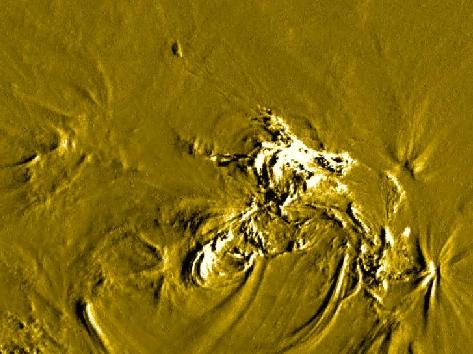
The LMSAL gold imaging technique is as a "faster cadence" RD image, that looks to be "averaged" in some way as the various dots fill themselves in over time. That particular 'technique" produces very high resolution images of the "surface of the sun" that is located about 4800KM inside the chromosphere, underneath of a highly ionized atmosphere that is not "opaque", but relatively transparent to these specific wavelengths of light.

GM's pi * d (inside edges of the chromosphere) circumference will come out quite differently than my predicted pi * d (limb darkened areas in the original image), not because pi is different, but because d is different.

Is that any better?
 
Last edited:
http://aia.lmsal.com/public/firstlight/20100408_013015/f_094_335_193.jpg

Here's another combo of of three iron ion wavelengths. The limb darkening is quite clear all along a jagged limb, and the the region above that limb darkening is "colored" by the electromagnetic lines that discharge through the atmosphere. The various wavelengths of light glow in various colors and they "mix" very clearly just above the limb darkened region. The mixture of various colors creates beautiful colors along the limbs.

You can go back any iron ion wavelength and find that same limb dimming all along the limb.

http://aia.lmsal.com/public/firstlight/20100408_013015/f0193.gif

That "feature" is not an "artifact", it's found in every single SDO iron ion wavelength that's been published to date!
 
http://www.thesurfaceofthesun.com/images/sdo/447006main_fulldiskmulticolor-orig_new1_full.jpg

Now go back to the composite image again and look at the limb dimming again. It's *INSIDE* of the chromosphere, not outside of that boundary. The only way that this image is even possible is if the atmosphere around that opaque disk/sphere is highly ionized. Not only did the SSM get falsified in that first composite image, all "non electric" solar theory got falsified by that same image.
 
http://www.thesurfaceofthesun.com/images/sdo/447006main_fulldiskmulticolor-orig_new1_full.jpg

Now go back to the composite image again and look at the limb dimming again. It's *INSIDE* of the chromosphere, not outside of that boundary. The only way that this image is even possible is if the atmosphere around that opaque disk/sphere is highly ionized. Not only did the SSM get falsified in that first composite image, all "non electric" solar theory got falsified by that same image.

Again, Michael, does it not strike you as odd that in the composite image, the inner edge of the chromosphere is perfectly smooth and quite sharp, while there's no such smooth, sharp edge in the 193 and 171 angstrom pictures you linked? Or that the inner edge of the chromosphere isn't quite concentric with the rougher, blurrier edge that you believe you're seeing through your neon layer?
 
What disk? From SDO's perspective the sun is a giant "disk" in the sky. That disk! This disk in a long cadence RD image:


Your qualifications to communicate in a sane, rational, and intelligent manner on the subject of solar physics has been challenged. Your continuous misuse of terms shows that you don't possess any such qualifications.

The red/orange flaming ring is the chromosphere in SDO.


Grade school children do science that way.

The limb darkening is *INSIDE* of the chromosphere. Likewise the RD image will reside *INSIDE* of that chromosphere. If we were to look at a full disk image, it will show up inside that red/orange region with 4800KM to spare. It will be physically and directly related to that limb darkening region.


Limb darkening doesn't mean what you think it means. And your argument by grade school coloring book descriptions is, well, what we might expect out of a grade school kid.

Let's recap for the newbies now. You have a green "opaque" math bunny problem in the SDO images. If I had access to the FITS files, I would/could turn off the blue iron line in the original release image and demonstrate to you that you have a yellow math bunny problem. I'd then turn the blue line back on and demonstrate your bunny turns green again. I would then turn off the yellow line and turn your bunny blue. I would then turn the yellow line into a red line and make your bunny glow a pretty purple. Alas I can't play with your color bunnies because I can't access the FITS files yet.


Coloring book science. Fun. Well, for children.

The more "decisive' way to demonstrate this point is with the RD images. If the SSM is correct, all those iron line emissions *MUST* start above the chromosphere ring, and the RD image outline should end up right along that red orange ring. If however the iron emissions start at the limb darkened region as I believe they do, then the RD image will show a disk that fits nicely inside that red/orange ring with 4800 KM to spare.


Running difference graphs are simply graphical representations of a series of mathematical computations. It has already been demonstrated that you don't understand them, therefore any arguments you make with references to running difference imagery are worthless. Given that misunderstanding and your reference to limb darkening, which you also don't understand, plus the addition of some grade school kid coloring book science, your above argument is gibberish.

There are technically two different RD techniques we might use. We could use a longer cadence version to find the edge of the disk to see if aligns itself with the chromosphere or the limb darkened region. The second and "better" way to go about it IMO would be to round up the higher cadence/averaged RD process that created this image:


Technically you don't have the slightest idea what you're talking about when it comes to running difference images. Your qualifications to communicate in a rational, understandable way on that issue have been challenged and you have failed to show that you possess any such qualifications.

Apply that process to the 171A channel of SDO. Then lay that chromosphere on top of that image. That will/would be one of *THE* most spectacular images of the sun for all time IMO. It will also demonstrate that the iron line emissions originate in the limb darkened areas, not at the chromosphere boundary. Of course those green bunny problems should have already told you all of this, but then denial seems to be the name of the game around here. "What disk"? :)


It wouldn't demonstrate any such thing. You are not using the term limb darkening in an understandable way.
 
Again, Michael, does it not strike you as odd that in the composite image, the inner edge of the chromosphere is perfectly smooth and quite sharp,

No, that's pretty easy to explain. They simply "subtracted out" the white light photosphere from the HeII image. If you look very closely around the edges, you'll see white light from material of the photosphere coming up through that edge. You really need to get into the image at the pixel level to see these details, but even "ctrl"-Mouse-scroll-wheel forward" will provide enough resolution on a windows platform in the Firefox web browser. I'm not sure about other browsers.

while there's no such smooth, sharp edge in the 193 and 171 angstrom pictures you linked?

There are hardly *ever* "smooth edges" in an iron ion wavelength. That' is not only true of SDO, but true of TRACE limb images as well. There are literally pieces of iron flying through the atmosphere. There are "tornadoes" that can be seen in TRACE limb images.

http://trace.lmsal.com/Public/Gallery/Images/movies/T171_991127.mov

It's a *highly* active atmosphere.

Or that the inner edge of the chromosphere isn't quite concentric with the rougher, blurrier edge that you believe you're seeing through your neon layer?

Keep in mind that that there are powerful "mass flows" related to coronal loop and discharge activities. Those mass flows come up and through and then down and through the various layers. It's not likely to be "smooth" or "crisp" everywhere, but overall, we should see atmosphere that is about 4800KM thick.
 
Taking up an idea someone made, earlier in this thread (accurate attribution welcome): if I, or someone else, could find a sequence of images of Jupiter, or Saturn, could GM (or anyone else!) produce an RD movie from them? And from that movie, could one image be colourised using a scheme similar to the one used in his 'rugged mountains on the Sun' fave?

Jupiter has, of course, many persistent features, some more or less stable over several centuries (e.g. the Great Red Spot). When Shoemaker-Levy 9 hit it, there were many features which persisted, with changes, over several Jovian days. I for one would be curious to know what a suitably colourised RD movie of Jupiter would look like.


Well I have made some running difference images of clouds and of water vapor satellite images of the Earth. They look a lot like those optical illusions Michael so badly misunderstands when he stares at the running difference graphs from the solar imagery. Of course you can't see Kalamazoo through the clouds by making those graphics any more than you can see several thousand kilometers through opaque plasma by making a running difference graph using thermal data taken from several thousand kilometers above.

It's reasonably easy to make a running difference graph from any two images. Someone mentioned earlier in the thread that they wouldn't even have to be related, like a couple of pictures of different people's faces.

If I can find some sequential images of Jupiter I'll make up a couple frames and post them. For a video I'd need to find a reasonable length series. Typical video might be from 15 to 60 frames per second, so even 30 frames would only be a couple of seconds of video.
 
http://aia.lmsal.com/public/firstlight/20100408_044515/f_211_193_171.jpg

Is there anyone here that really cannot find the "opaque" limb of the sun in the iron ion wavelengths in a multiple color/wavelength image?

Does anyone actually believe it cannot be found in *EVERY* iron ion wavelength?


Nobody here is quite clear on what you're talking about. Your use of the standard terminology of solar physics is so badly convoluted that your arguments amount to piles of gibberish.
 
http://aia.lmsal.com/public/firstlight/20100408_013015/f_094_335_193.jpg

Here's another combo of of three iron ion wavelengths. The limb darkening is quite clear all along a jagged limb, and the the region above that limb darkening is "colored" by the electromagnetic lines that discharge through the atmosphere. The various wavelengths of light glow in various colors and they "mix" very clearly just above the limb darkened region. The mixture of various colors creates beautiful colors along the limbs.

You can go back any iron ion wavelength and find that same limb dimming all along the limb.

http://aia.lmsal.com/public/firstlight/20100408_013015/f0193.gif

That "feature" is not an "artifact", it's found in every single SDO iron ion wavelength that's been published to date!


The green strip around the edge of the SDO image you were so ecstatic about (until you found out how wrong you were) is an artifact of processing. NASA said it is, and being qualified as somewhat of an expert in image processing, I say it is.
 
Your qualifications to communicate in a sane, rational, and intelligent manner on the subject of solar physics has been challenged.

You're not a challenge GM. I already put up my numbers and I await the outcome. History is the only thing "challenging" this solar model at the moment. You're an insignificant player IMO.

I have clearly explained to you how to create the definitive RD image. Go round up that RD imaging technique that produced this specific RD image:

171surfaceshotsmall.JPG


http://trace.lmsal.com/POD/TRACEpodarchive4.html
http://trace.lmsal.com/POD/movies/T171_000828.avi

Run the 171A channel of SDO through that *EXACT* same software program. Take that image and overlay the chromosphere on that image. That composite RD/chromosphere image will demonstrate my point in vivid gold color for you. With all your contacts on the inside, that should be a piece of cake for you.

I've clearly explained now how to find that limb darkened region in two different RD techniques. If you can't find the 'disk" in a RD image after all those explanations, you must not speak English as your native language.
 
Last edited:
The green strip around the edge of the SDO image you were so ecstatic about (until you found out how wrong you were) is an artifact of processing. NASA said it is, and being qualified as somewhat of an expert in image processing, I say it is.

Then the two different RD techniques that I suggested should demonstrate that you are correct. Go get SOMEONE OTHER THAN YOU to make them for us and publish them.
 
Keep in mind that that there are powerful "mass flows" related to coronal loop and discharge activities. Those mass flows come up and through and then down and through the various layers. It's not likely to be "smooth" or "crisp" everywhere,

But in the composite image, the lower edge of the chromosphere (in your interpretation) is, in fact, perfectly smooth and crisp.

but overall, we should see atmosphere that is about 4800KM thick.

But in the composite picture, your 4800 km atmosphere is completely absent along the right side of the image.
 
Follow the following steps GM.

Step 1: Go get the software that produced the high cadence/averaged RD image that is the first image on my website.

Step 2: Run the 171A channel of SDO through that routine.

Step 3. Take a HeII ion SDO image and subtract out the while light photosphere as was done in the composite image.

Step 4 overlay the remaining HeII image on the RD image just as was done with the published composite image.

Step 5: Count the pixels between the disk borders and the inside edge of the chromosphere.

Step 6: Publish the results.

Is that clear enough for you?

If the edge of the gold disk isn't 4800Km inside of the chromosphere, this solar model goes down in flame. If it does show up along those limb darkened areas, 4800 km inside that chrmosophere, then the SSM is falsified and you'll need electricity to fix it. What a hell of a dilemma for you guys. You *HATE* EU theory with a passion, but the only way to fix *any* plasma solar theory is going to require that you add electrical current to your theory. :) Wow. That's going to be quite the ego fry for you.
 
You're probably right about that. It's not exactly a newbie friendly topic, and math bunnies is a lingo related to other parts of the conversation. :)

Let's try GM's lingo then.

GM believes that the RD images are a "pie charge of temperatures" that relate directly to an "opaque photosphere, which relates to the inside surface of that red/orange chromosphere.

IMO it is a "pie chart of temperatures" that relate to a solid surface, that is 4800Km inside the chromosphere. When we run a RD image, we should see that the diameter of the round part of the pie, comes up 4800Km short of the chromosphere all along every limb (9600km total difference in diameter).

The LMSAL gold imaging technique is as a "faster cadence" RD image, that looks to be "averaged" in some way as the various dots fill themselves in over time. That particular 'technique" produces very high resolution images of the "surface of the sun" that is located about 4800KM inside the chromosphere, underneath of a highly ionized atmosphere that is not "opaque", but relatively transparent to these specific wavelengths of light.

GM's pi * d (inside edges of the chromosphere) circumference will come out quite differently than my predicted pi * d (limb darkened areas in the original image), not because pi is different, but because d is different.

Is that any better?


You completely misunderstand solar physics in general, and you've misrepresented my position in particular. But your qualifications to communicate in a sane, rational, intelligent, and honest way about solar physics have been challenged. And you haven't demonstrated that you have any such qualifications. So another strawman or two and some more lies is what we have come to expect from your arguments.

Oh, and the diameter of a circle times pi is the circumference of that circle. It's geometry. You don't get to take liberties with math simply because you don't have the qualifications to understand it. :p
 
Well I have made some running difference images of clouds and of water vapor satellite images of the Earth. They look a lot like those optical illusions Michael so badly misunderstands when he stares at the running difference graphs from the solar imagery. Of course you can't see Kalamazoo through the clouds by making those graphics any more than you can see several thousand kilometers through opaque plasma by making a running difference graph using thermal data taken from several thousand kilometers above.

It's reasonably easy to make a running difference graph from any two images. Someone mentioned earlier in the thread that they wouldn't even have to be related, like a couple of pictures of different people's faces.

If I can find some sequential images of Jupiter I'll make up a couple frames and post them. For a video I'd need to find a reasonable length series. Typical video might be from 15 to 60 frames per second, so even 30 frames would only be a couple of seconds of video.
Try this one: http://www.sai.msu.su/apod/ap070312.html (Jupiter, from New Horizons)

SL9 impact: http://zebu.uoregon.edu/images/r.mpg (may not be suitable without quite a bit of processing to register the individual frames).

For visual effect, I think it is very important to colourise the RD images (a linear grey scale will, of course, contain all the data, but since the sole basis for MM's nonsense claims is qualitative, visual impressions ...)
 
You're not a challenge GM. I already put up my numbers and I await the outcome. History is the only thing "challenging" this solar model at the moment. You're an insignificant player IMO.

I have clearly explained to you how to create the definitive RD image. Go round up that RD imaging technique that produced this specific RD image:

[qimg]http://www.thesurfaceofthesun.com/images/171surfaceshotsmall.JPG[/qimg]

http://trace.lmsal.com/POD/TRACEpodarchive4.html
http://trace.lmsal.com/POD/movies/T171_000828.avi

Run the 171A channel of SDO through that *EXACT* same software program. Take that image and overlay the chromosphere on that image. That composite RD/chromosphere image will demonstrate my point in vivid gold color for you. With all your contacts on the inside, that should be a piece of cake for you.

I've clearly explained now how to find that limb darkened region in two different RD techniques. If you can't find the 'disk" in a RD image after all those explanations, you must not speak English as your native language.


Why on Earth do you keep asking other people to do your work?
 
But in the composite image, the lower edge of the chromosphere (in your interpretation) is, in fact, perfectly smooth and crisp.

That is because the white light photosphere from one of the two channels that is sensitive to that surface was simply 'subtracted" from the HeII image. Since the white light surface is relatively smooth, so is the underside of that HeII image. Since the mass flows tend to flow up and through that point, all the mass flows coming up from the surface create those jagged edges that look like flames.

The rest of the composite image is simply the iron ion light from the sun. The green color is directly related to the colors assigned to each wavelength, and the blending of light that occurs between the various wavelengths. Whatever color scheme we select for the ions, we should see a blending of those colors along the horizon just as it becomes opaque. That's where the most light shines from each of the wavelengths (other than the active regions of course). That blending of colors is a critical clue, as is the RD outline. The RD outline is more conclusive IMO because it really leaves no room for any more doubt. If the light originates along the darkened limb lines (as it must) then the RD disk outlines must also follow that same line. The circumference of the RD image is going to match that 4800 limb darkened area, not the inside of the chromosophere as would be true if the SSM were correct.

But in the composite picture, your 4800 km atmosphere is completely absent along the right side of the image.

It's not actually "absent" if you take the image apart, but I'm not publishing any more solar images EVER. I'm done. You can do it for yourself if you like. The reason it looks to be absent in that one image is because of the high amount of activity in that region that is "in front of" that part of the limb. If we simply used a 193A image, it would probably come out a lot more clear, but since they used so many different wavelengths, and there is so much light in that region, it's harder to see the border. It's possible to see it by playing around with color schemes, but like I said, I'm done publishing images that I personally created. I refuse to be called a fraud over a solar image ever again.

I'll be happy to create a host of predictions, all related to the 4800Km limb darkened region, but someone besides GM and me will have to create them.
 
Last edited:
Follow the following steps GM.

Step 1: Go get the software that produced the high cadence/averaged RD image that is the first image on my website.

Step 2: Run the 171A channel of SDO through that routine.

Step 3. Take a HeII ion SDO image and subtract out the while light photosphere as was done in the composite image.

Step 4 overlay the remaining HeII image on the RD image just as was done with the published composite image.

Step 5: Count the pixels between the disk borders and the inside edge of the chromosphere.

Step 6: Publish the results.

Is that clear enough for you?

If the edge of the gold disk isn't 4800Km inside of the chromosphere, this solar model goes down in flame. If it does show up along those limb darkened areas, 4800 km inside that chrmosophere, then the SSM is falsified and you'll need electricity to fix it. What a hell of a dilemma for you guys. You *HATE* EU theory with a passion, but the only way to fix *any* plasma solar theory is going to require that you add electrical current to your theory. :) Wow. That's going to be quite the ego fry for you.


And once more, is there some particular reason you are completely unwilling to do your own homework? A little graphics processing or some simple math too difficult?
 
Status
Not open for further replies.

Back
Top Bottom