How To Use Bitcoin – The Most Important Creation In The History Of Man

Status
Not open for further replies.
Overstock.com had $1.1 billion in revenue last year. Let's do a thought experiment.

Suppose their revenue is flat this year, but they do 0.1% of their sales in BTC. That's $1.1 million. Do all of the exchanges, combined, have $1.1 million in liquidity to pay Overstock off? They're gonna want their money... and not in BTC.
 
I was assuming you're following the thread, but in any case, I posted a couple of links earlier listing places that accept bitcoin. It should be in the top 3 results when googling 'vendors who accept bitcoin': https://www.spendbitcoins.com/places/

A lot of them seem specifically designed for BTC use, however.

Maybe you need vendors in the millions to not consider it "very few".

Thousands will do, but I need some big names, too. Some obscure website selling hand-made dildos will probably not get my attention. WalMart accepting BTC would, of course, be at the opposite of the spectrum.

Then psionl0 was right, there have only been allegations, no-one in this thread, at least for the last 15 or so pages, hasn't provided any evidence for that claim.

I'm happy to retract it if you say that the claim is unfounded. However, in the interest of not being called wrong again, would you mind if I ask you to show large BTC transactions in 2013 ? Say, a million or more.
 
Overstock wanting to get paid for stuff they sold is "really stupid"?

ETA: Surely you don't think Overstock is just going to hold on to the BTC? They can't use them for anything. They can't pay suppliers, they can't pay their employees, they can't buy more stuff (except hot gift cards). So yes, they're going to be redeeming them at the exchanges, and if there's any significant usage at all they're going to suck the exchanges dry in nothing flat.

To me this sounds like someone at Overstock heard about BTC, and wanted to be hip and edgy, and didn't do any homework about the mechanics of the thing. I predict that Overstock will quietly stop accepting BTC within six months of whenever they start accepting it.

Man, can you just READ WHAT'S WRITTEN?

Suppose there was a surge of activity, and exchanges take money in but wait a week or two before delivering coin. That's cash in their hands from the new buyers to pay off the new sellers. That's the exact reverse of a 'liquidity problem'.

You don't even understand how exchanges work.

Why not stick to things you do understand to comment on?

Anyway, merchants use 'bitcoin payment systems'. Not exchanges. Examples from the bitcoin wiki.

Bitcoin payment systems
 
Suppose there was a surge of activity, and exchanges take money in but wait a week or two before delivering coin. That's cash in their hands from the new buyers to pay off the new sellers. That's the exact reverse of a 'liquidity problem'.

Isn't this the definition of a Ponzi scheme?

No. It's the definition of trade. More specifically, delivery of good and services with secure payment required in advance.
 
....That's $1.1 million. Do all of the exchanges, combined, have $1.1 million in liquidity to pay Overstock off? They're gonna want their money... and not in BTC.

Are you frikking kidding? Major Silicon Valley investment from venture capital firms is going into bitcoin exchanges.

1.1M is nothing.
 
ETA: Surely you don't think Overstock is just going to hold on to the BTC? They can't use them for anything. They can't pay suppliers, they can't pay their employees, they can't buy more stuff (except hot gift cards). So yes, they're going to be redeeming them at the exchanges, and if there's any significant usage at all they're going to suck the exchanges dry in nothing flat.

They even said that in the article -- they would have to do near-constant BTC to cash conversions to avoid losses. Which is what many of us have been saying in this thread all along; if you list prices in BTC, and not pegged to a real currency, you're asking to get pillaged the next time BTC goes on one of its bubble spikes.

It'll be interesting to see what happens; I don't think they correctly apprehend the amount of effort required to keep the BTC-to-cash pipeline flowing so that they don't accidentally sell a bunch of goods at half price.

To me this sounds like someone at Overstock heard about BTC, and wanted to be hip and edgy, and didn't do any homework about the mechanics of the thing. I predict that Overstock will quietly stop accepting BTC within six months of whenever they start accepting it.
The owner himself, apparently: "Byrne said the move stems partly from his background in the Austrian School of economics, which is associated with the Libertarian party in the United States."

The commenter on Wildy's link who referred to it as "libertarian funbux" really hasn't got it too terribly wrong; but then libs are often goldbugs too, so it's very similar.
 
Suppose there was a surge of activity, and exchanges take money in but wait a week or two before delivering coin. That's cash in their hands from the new buyers to pay off the new sellers. That's the exact reverse of a 'liquidity problem'.

You're doing it backwards. Overstock doesn't WANT coin. They want CASH. They want USD. Where are they going to get it?

And eirik is right; what you've written above is precisely the definition of a Ponzi scheme.
 
...."Byrne said the move stems partly from his background in the Austrian School of economics, which is associated with the Libertarian party in the United States."

The commenter on Wildy's link who referred to it as "libertarian funbux" really hasn't got it too terribly wrong; but then libs are often goldbugs too, so it's very similar.
Golly Holy Jesus.

You're not supposed to ever TALK about that. Here.

http://www.internationalskeptics.com/forums/showthread.php?t=215947

Have some respect for the commands of your totalitarian Overlords of correct thinking.

You're doing it backwards. Overstock doesn't WANT coin. They want CASH. They want USD. Where are they going to get it?
Go back and read what I already repeated for you. This time try to understand it.

And eirik is right; what you've written above is precisely the definition of a Ponzi scheme.
Well, you are just going to have to try to understand the workings of a Ponzi scheme, apparently. So trading goods for money is Ponzi. What a crock.
 
Last edited:
You don't even understand how exchanges work.

Why not stick to things you do understand to comment on?

Please explain how they work. Your sentence is woefully useless. Do better or don't make claims about exchanges you cannot substantiate. So far, what I can see is that exchanges are having a difficult time getting anything other than BTC in or out of them. That would be international currencies that could be exchanged for BTC. Right now, trades are just matched up based on purported $ prices but BTC doesn't get liquidated at those $ prices. Some sort of credit in $ is given to the BTC seller but good luck getting that out of the exchange in any form but BTC. Thus, the $ values are purely notional.
 
And eirik is right; what you've written above is precisely the definition of a Ponzi scheme.
You would say that whether it was or not because you disapprove of bitcoin.

When somebody transfers money from is bank account to somebody else's, the money gets taken from his bank account quick smart. However, there can be a considerable delay before the money appears in the payee's account. The bank holds onto it in the mean time.

Of course, you won't call that a ponzi scheme because you approve of banks.

There are laws that govern how quickly banks must make funds available to depositors. No such protections apply to bitcoin. If Mt. Gox says you can't get your cash for 60 days after you "sell" your BTC, there's nothing you can do about it.
 
When somebody transfers money from is bank account to somebody else's, the money gets taken from his bank account quick smart. However, there can be a considerable delay before the money appears in the payee's account. The bank holds onto it in the mean time.

Verified funds can be credited almost immediately given a decent level of interest. The bigger the credit, the higher the level of interest. I can assure you that I have deposited 6 and 7 figure checks that were cleared in 24 hours or less depending on the issuing bank. Of course wire transfers are immediate credit and work very well for large amounts but they are more of a hassle. This kind of thing is nothing more than a wet dream for the large bitcoin holders. They just aren't going to be able to cash out at today's clownish prices.
 
Well, you are just going to have to try to understand the workings of a Ponzi scheme, apparently. So trading goods for money is Ponzi. What a crock.


Straw man. Nobody said trading goods for money is a Ponzi.

Not having enough dollars to pay cashout requests, and having to wait for additional infusions of dollars from new investors, is what you described, and that is what is called a Ponzi scheme.
 
Could you give a cite for that, for TeapotCavalry's edification ?
That 50 is a number that I gave which JHunter then misunderstood and used to support a separate and unrelated argument.

50 is the max daily number for the consumer account, for immediate credit, in and out at the Coinbase exchange, merchant is of course different.

Merchant services implement the bitcoin payment system.
 
Could you give a cite for that, for TeapotCavalry's edification ?

See Mhaze's post #3897. 50 BTC/day limit at Coinbase.

Someone upthread actually compiled the withdrawal limits and expected wait times for withdrawals at various exchanges; the wait times were typically in weeks and withdrawal limits were usually in the $20-50K range. I'll see if I can find the post.
 
Straw man. Nobody said trading goods for money is a Ponzi.

Not having enough dollars to pay cashout requests, and having to wait for additional infusions of dollars from new investors, is what you described, and that is what is called a Ponzi scheme.
No, that is not even close to the words in posts I have made, or the actual reality of operations in exchanges. Not in the least. It's called 'making things up'.

http://www.youtube.com/watch?v=bZCDifG3zQc
 
Last edited:
There are laws that govern how quickly banks must make funds available to depositors. No such protections apply to bitcoin. If Mt. Gox says you can't get your cash for 60 days after you "sell" your BTC, there's nothing you can do about it.
Transaction delays have nothing to do with the definition of "ponzi scheme". That is just a word you pulled out of your backside simply because you disapprove of bitcoin.
 
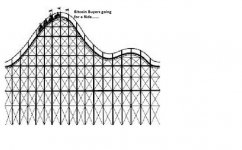
What does this look like?

Roller Coaster ride anyone?
 

Attachments

  • btcrollerc.jpg
    btcrollerc.jpg
    23.9 KB · Views: 9
  • btcrollerc1.jpg
    btcrollerc1.jpg
    40.1 KB · Views: 7
Status
Not open for further replies.

ISF - Join now!

Every member here is approved by hand. No bots, no spam, just people who care about evidence and honest debate.

Membership is free!

Create your free account

Back
Top Bottom