• Security incident: ISF was recently accessed by intruders. Please change your password, and change it anywhere else you used it. Read more

Gun Violence Supported In The USA

St. Louis consistently rates among the "most dangerous cities" as a result of it's high murder rate.
However, the homicides tend to be concentrated in a very small area of the city, one plagued by poverty, drugs, and gang activity. Indeed, there is a single street which is so notorious that one homicide detective quipped that they could halve the homicide rate by removing a few blocks of it...
 
Why do you assume that "firearm availability" is the same as "concealed carry allowed"?
Because the one is dependent on the other.
I am trying to figure out where you found this city ranking data. Looking at the 2006 UCR violent crime rates by Metropolitan Statistical Area, I see that Denver (427.7) has a lower violent crime rate than Colorado Springs (550.9). But for some reason Denver, didn't make the top 10 in your list.
The list I was using was based on 2005 data. But it doesn't matter, since Denver is still in Colorado, which is a shall issue state. It doesn't have significant additional restrictions; and doesn't have the "inner-city" problem that cities in the 10-highest list do.

Here's a CNN article with a list of the 20 most and least affluent cities in the US, as well as the 20 most and least affluent counties. There is a far stronger correlation between poverty and violence than between legal firearm availibility/concealed carry and violence.
 
Freud was largely off the deep end. Hoplophobia does exist and is always the core psychological motivation for restricting them.
I believe hoplophobia, to the extent it does exist, is almost completely unrelated to people's opinions about restricting firearms.

First, phobias are per definition the irrational fear of the object of the phobia, making hoplophobia irrational fear of firearms. Since firearms are, in fact, extremely effective weapons and as such very dangerous, someone who is afraid of firearms in certain contexts or situations is not necessarily a hoplophobe, just as fearing venomous snakes in certain situations or contexts is not necessarily a sign of ophidiophobia.

Second, while I do not know of any studies on the subject, I personally find many firearms to be beautiful weapons and am fascinated by the way they work and the way they are used - but I believe that the ownership and use of them should be extremely restricted, and would never own one myself. In fact, I am largely a pacifist and would like to see the vast amount of firearms designed to kill human beings eradicated off the face of the earth.

Now, if I was on the pro-gun side, my aesthestic opinion about firearms would no doubt be the source of much mockery and psychological digs at my personality. Which is exactly my point - what opinions we have on the practical treatment of the gun problem (which is, undeniably, a problem) has very little to do with our psychological relationship to them as such. Just as one's opinion on nuclear weapondry has very little to do with whether one irrationally fears or is overly excited about explosions.

Sometimes a firearm is just a firearm.
 
Picking statistics out of context can make them say anything you want them to.....Big snip ...
They certainly can and you have printed a load that appear to agree with what I was saying. Lonewolf suggested that conceal and carry laws led to a reduction in crime as people don't know if the victim is armed. I think we have both shown that the figures do not back this up.

So the two states that prohibit firearm carry are both among the top 20 "most dangerous" by your standards.
Thanks, I would like to take credit but cqpress might get a bit miffed. Illinois is 21 and Wisconsin is 41st. The table I linked was the safest states so you need to count from the bottom up.

Evidence please, since this is a completely unsupported assertion. In fact, I'll go so far as to call it complete crap.

For starters, Nebraska and Kansas instituted concealed carry in 2006, not 2007. Crime statistics for 2007 have not yet been fully compiled by either the DoJ or FBI.
Go back to the table above (for 2008) and to the right hand column. Nebraska and Kansas have negative figures. Compared to other states they are less safe than they were. I am sorry you feel this is crap but I suggest that you take it up with the authors. Their address is;
CQ Press
2300 N Street, NW
Suite 800
Washington, DC 20037
(202)729-1900

No, but the vast majority of the ones here are.
A lot of people think ad homs are a pathetic form of argument resorted to by moronic losers who don't have the intellectual capacity to engage in real debate and so avoid using them. I admire your bravery in going against the flow.
 
Last edited:
I believe hoplophobia, to the extent it does exist, is almost completely unrelated to people's opinions about restricting firearms.
That wasn't a belief, so you are already at a disadvantage here.

First, phobias are per definition the irrational fear of the object of the phobia, making hoplophobia irrational fear of firearms. Since firearms are, in fact, extremely effective weapons..
They aren't.

I am largely a pacifist and would like to see the vast amount of firearms designed to kill human beings eradicated off the face of the earth....

...source of much mockery and psychological digs at my personality. Which is exactly my point - what opinions we have on the practical treatment of the gun problem (which is, undeniably, a problem) has very little to do with our psychological relationship to them as such. Just as one's opinion on nuclear weapondry has very little to do with whether one irrationally fears or is overly excited about explosions.
So, you just have an unrealistic outlook about the human condition...

Sometimes a firearm is just a firearm.
Never is the firearm, or a sword for that matter, the motivation.
 
That wasn't a belief, so you are already at a disadvantage here.
If you actually think you know this, then I suspect you are very, very unreasonable, but I'll give you the benefit of asking if you have any particular reason or (surprise) evidence for the suggestion.

They aren't.
Everything is relative, of course, but considering their size and intended usage I'd say they are effective.

So, you just have an unrealistic outlook about the human condition...
We can discuss that once you've explained what is realistic about your outlook. We all try our best, don't we? :)

Never is the firearm, or a sword for that matter, the motivation.
No, a sword is probably not the motivation for restricting firearms. As for firearms, well, they are sort of a factor in the restricting of firearms, don't you think?
 
If you actually think you know this, then I suspect you are very, very unreasonable, but I'll give you the benefit of asking if you have any particular reason or (surprise) evidence for the suggestion.
You insinuated the problem is vast numbers of inanimate objects or civilized society is at odds with their presence. This ignores obvious observations:
  • Firearms have recreational, sporting, and principled uses in polite society.
  • Firearms do not motivate violence. Their legal presence has a positive effect on social stability. Their illegal presence in proportion to legal presence and social decline does not.
  • No point regulating high explosives, chemical and biological agents would exist, much less firearms. Mr.Fission (or Mr.Fusion, even more charming) would sit next to our air conditioning units, and we wouldn't need to take our shoes off before boarding flights either.
You stated: "In fact, I am largely a pacifist and would like to see the vast amount of firearms designed to kill human beings eradicated off the face of the earth."
That contradicts this: "I personally find many firearms to be beautiful weapons and am fascinated by the way they work and the way they are used.."

Do you see what I mean now.

Everything is relative, of course, but considering their size and intended usage I'd say they are effective.
It is a common misconception they are social liabilities.

No, a sword is probably not the motivation for restricting firearms.
I was referring to social disruption. Recently in Japan someone stabbed 17 people. Do gourmet knives, designed to cut through tissue efficiently, motivate you to do likewise? If you used less invasive means for food preparation, and someone else used them, they would appear to be ominous and dangerous. In which case that is the precursor to what a phobia is defined as.
 
Last edited:
Hi

... 0 ... "Hey, owning Guns is like having a HUUUUUUUGE penis." :)


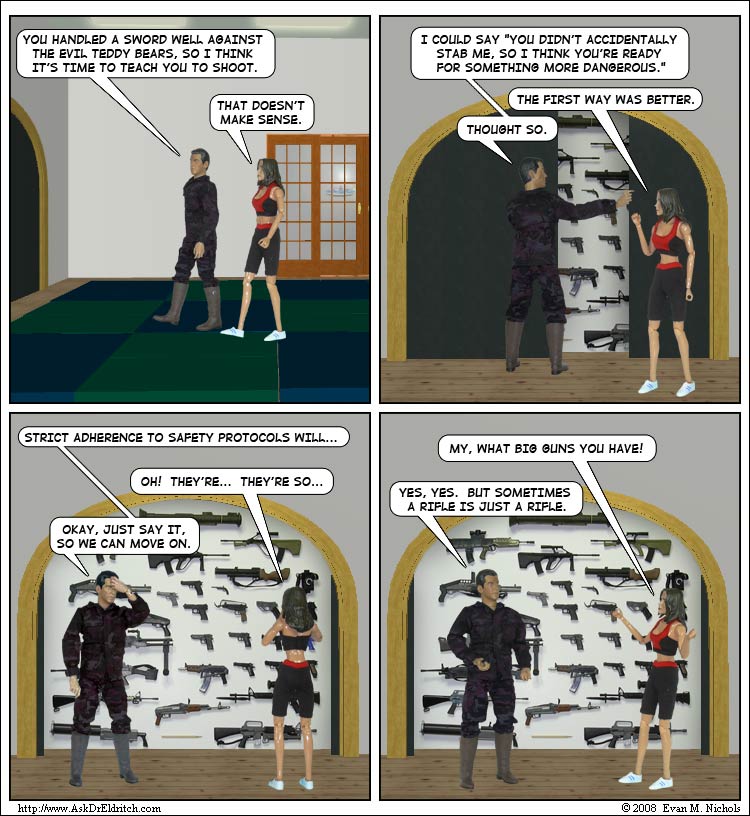
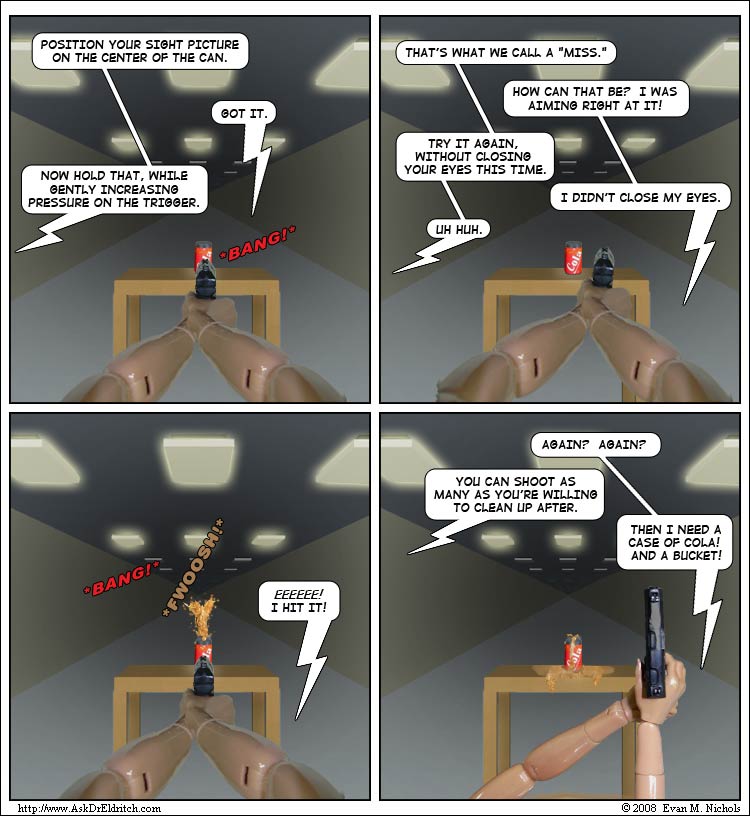
Well... the most excellent, "Ask Dr. Eldritch," answers this... well.. most excellently!


...and what usually happens when you taker a non-shooter shooting for the first time:


(Webcomic used with explicit permission of the author. Sorry for the lat hit, but it took some time to get his permission.)
 
Gagglegnash said:
...and what usually happens when you taker a non-shooter shooting for the first time:

So true. I've taken two new shooters out for the first time in the last couple of months. One wasn't nervous or anything, but the other literally held it like she was holding a dead rat the first time I tried to get her to pick up an unloaded one during my safety presentation.

Two hours later she was running around the range showing every person there her targets. :)
 
Last edited:
You insinuated the problem is vast numbers of inanimate objects or civilized society is at odds with their presence.

This ignores obvious observations:
  • Firearms have recreational, sporting, and principled uses in polite society.
  • Firearms do not motivate violence. Their legal presence has a positive effect on social stability. Their illegal presence in proportion to legal presence and social decline does not.
I am not interesting in a debate about guns, because such debates here tend to be endless and fruitless. I am interested in why you claim that hoplophobia is "always the core psychological motivation" for restricting firearms.

  • No point regulating high explosives, chemical and biological agents would exist, much less firearms. Mr.Fission (or Mr.Fusion, even more charming) would sit next to our air conditioning units, and we wouldn't need to take our shoes off before boarding flights either.
Could you clarify this? I have no idea what you are talking about or how it relates to my objections.

You stated: "In fact, I am largely a pacifist and would like to see the vast amount of firearms designed to kill human beings eradicated off the face of the earth."
That contradicts this: "I personally find many firearms to be beautiful weapons and am fascinated by the way they work and the way they are used.."
No, it does not, and that was exactly the point of the example. I find many firearms to be beautiful and fascinating and I would like many of them not to exist. And yes, the categories are overlapping. So I am far from a hoplophobe (if we try to use the word clinically despite the fact that it did not orginate in psychology), yet I am strongly advocating restriction of guns. I just wanted you to understand why I personally believe there is little or no correlation between the two.

Do you see what I mean now.
Obviously not.

It is a common misconception they are social liabilities.
Which is completely unrelated to what I said. I said they are effective weapons.

I was referring to social disruption. Recently in Japan someone stabbed 17 people. Do gourmet knives, designed to cut through tissue efficiently, motivate you to do likewise? If you used less invasive means for food preparation, and someone else used them, they would appear to be ominous and dangerous. In which case that is the precursor to what a phobia is defined as.
I use a large, sharp knife (which would presumably work very well to murder several people with) in my cooking on an almost daily basis. If I was a hunter, I would probably be using a firearm in my hunting on an almost daily basis. So what? I am not irrationally afraid of either, and would be careful in the handling of both.
 
They certainly can and you have printed a load that appear to agree with what I was saying. Lonewolf suggested that conceal and carry laws led to a reduction in crime as people don't know if the victim is armed. I think we have both shown that the figures do not back this up.
Nope, you misread my post. As noted, violent crime rates have been steadily decreasing nationwide, at the exact same time as states have been increasingly permitting concealed carry. The fact that this rate has fallen more or less consistently overall, with a few notable exceptions for reasons previously stated, indicates that concealed carry is not the only factor, but it is certainly one of the factors in this trend. How much of a factor has yet to be fully determined, but it's clearly not zero.
Thanks, I would like to take credit but cqpress might get a bit miffed. Illinois is 21 and Wisconsin is 41st. The table I linked was the safest states so you need to count from the bottom up.
That table is worthless for this debate, for reasons noted below. And I was making my determination based entirely on the violent crime statistics indicated; not on any other factor. Both of those states are within the top 20 highest violent crime rates. I can't speak for this particular award (not study, since there was no study linked or referenced that I could find); but all such rankings I've found online base "safety" on a number of factors in addition to violent crime, most notably property crimes and standards of available medical care. Not really relevant to this discussion.
Go back to the table above (for 2008) and to the right hand column. Nebraska and Kansas have negative figures.
Yet more misleading, out of context nonsense. Well over half the states on that table have "negative figures". Does that mean well over half the states in the US have become "less safe" despite the fact that the trend in violent crime rates has been steadily downward for the nearly the last decade?
Compared to other states they are less safe than they were. I am sorry you feel this is crap
I noticed that you didn't bother to link to the source of that table. The table itself, without context, is meaningless nonsense.

First, there needs to be a formal definition of the meaning of "safe" in this context; including the criteria used to make that determination, and the data supporting the criteria and ranking. That's not in the table.

Furthermore, that table doesn't show what you claim it does. It doesn't say that those states have become less safe. It's a relative ranking, not an absolute one; and all that's stated is that they've fallen in ranking. That doesn't mean they've become "less safe", that simply means that other states have become "more safe". They may have remained exactly the same, or even improved slightly; just not to the same degree relative to the rate of improvement of other states on the list.

This is especially interesting, since the FBI's Uniform Crime Report hasn't even been published for 2007 yet, let alone 2008; and any declaration of "safest" that doesn't include that information is worthless; unless the authors have access to the same information regarding nationwide crime that the FBI does. Hell, 2008 isn't even over yet.

Even worse, from what little information you've provided, the table is an "award" from a journalistic publishing company, not a finding by a government or academic research institution. I couldn't find any information about any relevant study by searching the website where the table is posted, which you cleverly omitted from your post. So, for all we know it could be based entirely on public opinion, rather than any hard scientific data.

If you're going to use a reference to support your assertions, it's a good idea to make sure it says what you think it does; and that it's verifiable.
but I suggest that you take it up with the authors.
Since you're the one making the assertion, it's up to you to support it by providing relevant data.
A lot of people think ad homs are a pathetic form of argument resorted to by moronic losers who don't have the intellectual capacity to engage in real debate and so avoid using them. I admire your bravery in going against the flow.
You also clearly don't seem to understand the meaning of argumentum ad hominem either; since you're using the term inaccurately.

So far you're batting 0.000 for useful contributions here.
 
Nope, you misread my post. As noted, violent crime rates have been steadily decreasing nationwide, at the exact same time as states have been increasingly permitting concealed carry. The fact that this rate has fallen more or less consistently overall, with a few notable exceptions for reasons previously stated, indicates that concealed carry is not the only factor, but it is certainly one of the factors in this trend. How much of a factor has yet to be fully determined, but it's clearly not zero.
Is there a direct correlation between a change in conceal and carry laws and a drop in crime. You should be able to pick it out quite clearly looking when each state changed its laws and how its figures changed. As you say it has yet to be determined whether conceal and carry is a factor. I suggest it has not been proven.

That table is worthless for this debate, for reasons noted below. And I was making my determination based entirely on the violent crime statistics indicated; not on any other factor. Both of those states are within the top 20 highest violent crime rates. I can't speak for this particular award (not study, since there was no study linked or referenced that I could find); but all such rankings I've found online base "safety" on a number of factors in addition to violent crime, most notably property crimes and standards of available medical care. Not really relevant to this discussion
Sorry I have not bought the report. The methodology of this particular "award" is given here.
The Safest and Most Dangerous State rankings are determined using rates for six crime categories—murder, rape, aggravated assault, burglary, robbery, and motor vehicle theft—by calculating a state’s position relative to the national average for each category.
Crime categories are weighted equally, so that state comparisons are based purely on how states performed against the national average. The weighted, aggregate scores are totalled, and a state is assigned a final score. The farther below the national average a state’s crime rate is, the safer it ranks; the farther above the national average, the more dangerous

Yet more misleading, out of context nonsense. Well over half the states on that table have "negative figures". Does that mean well over half the states in the US have become "less safe" despite the fact that the trend in violent crime rates has been steadily downward for the nearly the last decade?
I thought it was self explanatory. The title "change" next to 2007 rank indicates a movement in ranking. So negative figures means a state has a lower ranking than in 2007. A positive ranking means a state has a higher ranking.
I noticed that you didn't bother to link to the source of that table. The table itself, without context, is meaningless nonsense.


First, there needs to be a formal definition of the meaning of "safe" in this context; including the criteria used to make that determination, and the data supporting the criteria and ranking. That's not in the table.
I have linked above how they got the rankings. I appreciate that I only linked the table. However the source of the table is given as CQ press. From their home page it is fairly easy to find the "Crime State Rankings 2008" page

Furthermore, that table doesn't show what you claim it does. It doesn't say that those states have become less safe. It's a relative ranking, not an absolute one; and all that's stated is that they've fallen in ranking. That doesn't mean they've become "less safe", that simply means that other states have become "more safe". They may have remained exactly the same, or even improved slightly; just not to the same degree relative to the rate of improvement of other states on the list.
The table says exactly what I said it does. The clue was my use of the words Compared to other states. This suggests a comparison as opposed to an absolute change.

This is especially interesting, since the FBI's Uniform Crime Report hasn't even been published for 2007 yet, let alone 2008; and any declaration of "safest" that doesn't include that information is worthless; unless the authors have access to the same information regarding nationwide crime that the FBI does. Hell, 2008 isn't even over yet.
The report uses the 2006 figures, See table of contents. 2008 refers to the year the report was published. I appreciate your concern however, I do hope people haven't been confused and thought that this report might predict the future crime in their state.

Even worse, from what little information you've provided, the table is an "award" from a journalistic publishing company, not a finding by a government or academic research institution. I couldn't find any information about any relevant study by searching the website where the table is posted, which you cleverly omitted from your post. So, for all we know it could be based entirely on public opinion, rather than any hard scientific data.
Curses obviously I was not clever enough for a sleuth like you. What gave it away? Was it the address of the page I linked; the CQPress "source" at the foot of the table or was it me attributing the report to them and my printing of their address?

Now you have cracked my secret I give in I may as well tell you more about the report as you are bound to uncover it eventually. The details of the report are given in the link above.
If you're going to use a reference to support your assertions, it's a good idea to make sure it says what you think it does; and that it's verifiable.
I agree. Please let me know anytime you spot me not doing this.

Since you're the one making the assertion, it's up to you to support it by providing relevant data.
Actually I was questioning an assertion.

If I have made any assertion that I have not backed up I will happily withdraw it.

You also clearly don't seem to understand the meaning of argumentum ad hominem either; since you're using the term inaccurately.
The link says "It is most commonly used to refer specifically to the ad hominem abusive, or argumentum ad personam, which consists of criticizing or personally attacking an argument's proponent" I do apologise, I mistakenly thought that you calling people "insulting arrogant pricks" was a personal attack when in fact it was.... please help me here.

So far you're batting 0.000 for useful contributions here.
I don't follow rounders is that good?
 
Last edited:
Is there a direct correlation between a change in conceal and carry laws and a drop in crime. You should be able to pick it out quite clearly looking when each state changed its laws and how its figures changed. As you say it has yet to be determined whether conceal and carry is a factor. I suggest it has not been proven.
Nope, sorry, real life doesn't work that way. There are numerous factors affecting violent crime; concealed carry is only one of them.

Typical of the anti-gun lobby, trying to paint all issues in black and white, good vs evil, for us or against us rhetoric. But that's not how the real world operates. If all the anti-gun nuts were right, then there should have been an overal increase in violent crime with the increasing availability of firearms and concealed carry. Since precisely the opposite has happened, they clutch at whatever straws they can invent to avoid admitting the bleeding obvious.
Sorry I have not bought the report. The methodology of this particular "award" is given here.
The Safest and Most Dangerous State rankings are determined using rates for six crime categories—murder, rape, aggravated assault, burglary, robbery, and motor vehicle theft—by calculating a state’s position relative to the national average for each category.
Crime categories are weighted equally, so that state comparisons are based purely on how states performed against the national average. The weighted, aggregate scores are totalled, and a state is assigned a final score. The farther below the national average a state’s crime rate is, the safer it ranks; the farther above the national average, the more dangerous
(emphasis added)
Yup, pretty much what I thought. Not just violent crime, but property crime as well. And while violent crime has fallen nationwide, property crime hasn't fallen by nearly as much; and has actually increased considerably in some regions, such as Florida. So your little chart is pretty much worthless for this discussion, since it isn't talking about the same things this thread is talking about.

And that's about the lamest, most pointless methodology statement I've ever seen. Nowhere does it give actual forumulae, data-gathering methodology, error margins, or any of the other stuff typically noted in a real scientific study. Useless.
I thought it was self explanatory. The title "change" next to 2007 rank indicates a movement in ranking. So negative figures means a state has a lower ranking than in 2007. A positive ranking means a state has a higher ranking.
Except that the ranking is really useless for this purpose, as noted above.
The table says exactly what I said it does. The clue was my use of the words Compared to other states. This suggests a comparison as opposed to an absolute change.
Which is meaningless here, since this thread is about violent crime, not property crime.

And in any case, it's another lie. Your exact original quote was:
After bringing in conceal and carry laws in 2007 Nebraska and Kansas become more dangerous.
And just so you and everyone else can verify that I'm not engaging in sort of selective editing you do, the entire post can be found here: http://www.internationalskeptics.com/forums/showthread.php?postid=3761761#post3761761

The fact that you later moved the goalposts is irrelevant, since it's still wrong. They did not "become more dangerous" compared to other states, they simply did not improve as much as other states did. You lose again.
The link says "It is most commonly used to refer specifically to the ad hominem abusive, or argumentum ad personam, which consists of criticizing or personally attacking an argument's proponent" I do apologise, I mistakenly thought that you calling people "insulting arrogant pricks" was a personal attack when in fact it was.... please help me here.
Yet more of your oh-so-clever selective editing. The actual line you deliberately misquoted was "which consists of criticizing or personally attacking an argument's proponent in an attempt to discredit that argument". Completely changes the meaning of the sentence, as you're no doubt well aware.

Typical disingenuousness from the rabid anti-gun nuts. Just once I'd like to meet one who was capable of honest debate. But then, if they were honest with themselves, they'd have to admit that their adamant opposition to inanimate objects is at least a little bit irrational and unsupported by real-world evidence.

Since I wasn't attempting discredit anything, merely pointing out that most of your fellow gun banners here on the forum are jackasses, you lose again.
 
Because the one is dependent on the other.

The list I was using was based on 2005 data. But it doesn't matter, since Denver is still in Colorado, which is a shall issue state. It doesn't have significant additional restrictions; and doesn't have the "inner-city" problem that cities in the 10-highest list do.

Here's a CNN article with a list of the 20 most and least affluent cities in the US, as well as the 20 most and least affluent counties. There is a far stronger correlation between poverty and violence than between legal firearm availibility/concealed carry and violence.

Firearms availability is controlled by the laws regulating firearms purchases and how they are enforced. You don't need a concealed carry permit to purchase a handgun, so concealed carry laws have little to do with the availability of firearms in a community.
 
Nope, sorry, real life doesn't work that way. There are numerous factors affecting violent crime; concealed carry is only one of them.

Typical of the anti-gun lobby, trying to paint all issues in black and white, good vs evil, for us or against us rhetoric. But that's not how the real world operates. If all the anti-gun nuts were right, then there should have been an overal increase in violent crime with the increasing availability of firearms and concealed carry. Since precisely the opposite has happened, they clutch at whatever straws they can invent to avoid admitting the bleeding obvious.

Yup, pretty much what I thought. Not just violent crime, but property crime as well. And while violent crime has fallen nationwide, property crime hasn't fallen by nearly as much; and has actually increased considerably in some regions, such as Florida. So your little chart is pretty much worthless for this discussion, since it isn't talking about the same things this thread is talking about.

And that's about the lamest, most pointless methodology statement I've ever seen. Nowhere does it give actual forumulae, data-gathering methodology, error margins, or any of the other stuff typically noted in a real scientific study. Useless.

Except that the ranking is really useless for this purpose, as noted above.

Which is meaningless here, since this thread is about violent crime, not property crime.

And in any case, it's another lie. Your exact original quote was:

And just so you and everyone else can verify that I'm not engaging in sort of selective editing you do, the entire post can be found here: http://www.internationalskeptics.com/forums/showthread.php?postid=3761761#post3761761

The fact that you later moved the goalposts is irrelevant, since it's still wrong. They did not "become more dangerous" compared to other states, they simply did not improve as much as other states did. You lose again.
I am happy with my original quote, it was right under a link to the table and I am fairly happy that most people would understand that what was meant. The only figures in that table from a previous year referred to the ranking. It is clear therefore that any reference to a change has to be a change in ranking.
I appreciate that you don’t like rankings, however your first point is very valid, there is more than one factor at play. Therefore national trends could easily influence absolute numbers more than local initiatives.
It appears to me that looking at how a states overall position changes in comparison to other states is much better than looking at the overall numbers. Where I erred is in missing the fact that the data is 2 year out of sync. I still maintain however that it is a better test than looking at the absolute rate.
Consider a change in policy leads to a drop in crime. If everywhere has a similar drop a ranking system would show no change in order. If however everywhere else the crime rose the ranking order would show it better.
You appear to have repeated Lonewolf’s claim and are suggesting that the bleeding obvious is that conceal and carry leads to a reduction in crime. It is not bleeding obvious to me, but if it is that bleeding obvious you will have no problem proving it.


Yet more of your oh-so-clever selective editing. The actual line you deliberately misquoted was "which consists of criticizing or personally attacking an argument's proponent in an attempt to discredit that argument". Completely changes the meaning of the sentence, as you're no doubt well aware.

Typical disingenuousness from the rabid anti-gun nuts. Just once I'd like to meet one who was capable of honest debate. But then, if they were honest with themselves, they'd have to admit that their adamant opposition to inanimate objects is at least a little bit irrational and unsupported by real-world evidence.

Since I wasn't attempting discredit anything, merely pointing out that most of your fellow gun banners here on the forum are jackasses, you lose again.
You were trying to discredit a group of people who you categorise thorough their arguments. Appears plumb LBW to me.

Indecently where I live I regularly see civilians wandering round with guns and I hardly bat an eyelid, and have no problem with them owning guns. To suggest that I have adamant opposition to inanimate objects is at least a little bit irrational and unsupported by real-world evidence.
 
I am not interesting in a debate about guns, because such debates here tend to be endless and fruitless. I am interested in why you claim that hoplophobia is "always the core psychological motivation" for restricting firearms.
Restriction is directed towards civilians with no constructive point in mind. The Brady Bill 'Assault Weapons Ban' is an excellent example.

Could you clarify this? I have no idea what you are talking about or how it relates to my objections.
Pacifism is unrealistic.

No, it does not, and that was exactly the point of the example. I find many firearms to be beautiful and fascinating and I would like many of them not to exist.
Which and why?

And yes, the categories are overlapping. So I am far from a hoplophobe (if we try to use the word clinically despite the fact that it did not orginate in psychology), yet I am strongly advocating restriction of guns. I just wanted you to understand why I personally believe there is little or no correlation between the two.
Except the 'restriction' of them would be disastrous, and if absent, you would have civil dependence on whatever government. A complete lack of control over it also, history proves.

I said they are effective weapons.

They require a lot of training to use effectively as weapons, handguns in particular. To be sure, firearms have a disproportionately high lethality with small paramilitary teams.

I am not irrationally afraid of either, and would be careful in the handling of both.
Lack of control or familiarity with something dangerous is unsettling. In someone else's control it is ominous. You have exaggeration and a situation where indirect control is a coping mechanism then. This is a phobia, and yes it does clearly exist with firearms. With hoplophobia, it's simply object association with the fear of death, or thantophobia.
 
I would have thought that open carry was more sensible? A lot of people tell me that people carry guns to deter assailants....when they pull out and wave a gun the person has second thoughts. Wouldn't open carry have this effect in many cases without having to brandish the gun? It would also have the effect of making the general public more at ease when they can see that citizens around them are carrying guns.

My other theory involves compulsory low slung holsters, spurs and Stetson hats for gun carriers.
In some states you can carry exposed without a permit, but you need a permit to conceal. In other states you are not allowed to carry exposed, but must carry concealed. None of it makes any sense. At any rate, if people want to harm each other there is nothing much you can do to stop it. If they want to harm each other with illegally obtained firearms there is nothing much you can do to stop it. And there will always be some people who want to have others. How restricting the rights and liberties of those who do not want to harm others helps in anyway is completely beyond me. There is a certain amount of disingenuous, typically, on both sides of any controversial issue, but in the case of gun control advocates of it seem perfectly willing to advocate gun control even when it can be demonstrated that attempts at gun control actually lead to more crime and more violence, simply as a matter of principle.
 
Firearms availability is controlled by the laws regulating firearms purchases and how they are enforced. You don't need a concealed carry permit to purchase a handgun, so concealed carry laws have little to do with the availability of firearms in a community.

And, predictably, you read my post exactly backwards. Nice try, but you fail again.
 
I would have thought that open carry was more sensible? A lot of people tell me that people carry guns to deter assailants....when they pull out and wave a gun the person has second thoughts. Wouldn't open carry have this effect in many cases without having to brandish the gun? It would also have the effect of making the general public more at ease when they can see that citizens around them are carrying guns.

People concealed carry for protection. While it can be argued back and forth forever whether concealed laws deter crime, it's NEVER about deterrent for the individual. A gun should never be pulled or brandished to diffuse a situation, they are for when a situation has past that point and your life is in immediate danger.

If you're sitting down to eat in a restaurant and someone comes in to rob the place, an exposed gun serves exactly one purpose: It tells the criminal who to shoot first.
 
I am happy with my original quote, it was right under a link to the table and I am fairly happy that most people would understand that what was meant.
Yes, I'm pretty sure everyone here understood what you meant. Unfortunately for you, what you meant is still completely wrong.
The only figures in that table from a previous year referred to the ranking. It is clear therefore that any reference to a change has to be a change in ranking. I appreciate that you don’t like rankings,
Which, again, is irrelevant, and even nonsensical. Whether I "like" rankings or not is a complete non-sequitor that you pulled straight out of your nether regions.

My points, which you have so far completely failed to address:

1) Your claim that these states have become "more dangerous" relative to their status before the institution of more liberal concealed carry laws is completely wrong. In fact, violent crime in these states have decreased on par with the national trend. So they have, in fact, become more safe than they were previously. The fact that they have not improved as much as other places doesn't change the fact that they have, in fact, improved.

A runner who improves his mile time from 7:20 to 6:30 is still running faster than he was, no matter how many other runners manage to do the mile in 6:00.

And, in fact, the article does not even prove that these two states haven't dramatically improved violent crime rates. The numbers are distorted by the inclusion of property crime. So a major decrease in violent crime, combined with an increase in property crime, would result in a net lower ranking, despite the fact that violent crime has improved at least as much as other states.

No matter how you twist and distort the language and the numbers, you cannot legitimately claim that they have become less safe; because the facts are against you.

2) The rankings you are so fond of are completely meaningless. They include property crime, which is on the increase, and which is not even remotely related to or affected by firearm availability, and completely outside the topic of this discussion. There is also no proper methodology statement, and thus no way to ascertain how valid their results are. For all we know, they could have pulled those numbers out of thin air, or performed any kind of selective data gathering to prove their point.

I'm still waiting for you to address these points coherently, particularly the latter.
It appears to me that looking at how a states overall position changes in comparison to other states is much better than looking at the overall numbers. Where I erred is in missing the fact that the data is 2 year out of sync. I still maintain however that it is a better test than looking at the absolute rate.
That's because you think it supports your anti-firearm position. I can guarantee that if those two states had show a greater decrease in violent crime, you'd be arguing in favour of an absolute rate.

Comparison to other states is apples and oranges in many ways, since different regions have different population demographics and different legal subtleties. Absolute rate, and historical trends are far more important than any outside comparison. Other factors that must be considered are demographic breakdown and changes, economic trends, immigration trends, law-enforcement activity, and a number of other factors that the article you quoted from doesn't appear to allow for.

On top of that, you still haven't acknowledged the fact that the article you are so fond of doesn't address violent crime, it addressed violent crime and property crime, which isn't what is being discussed here. You're comparing apples and wombats again.
Consider a change in policy leads to a drop in crime. If everywhere has a similar drop a ranking system would show no change in order. If however everywhere else the crime rose the ranking order would show it better.
This is gibberish. Every state has different laws, polices, economies, and demographics.
You appear to have repeated Lonewolf’s claim and are suggesting that the bleeding obvious is that conceal and carry leads to a reduction in crime. It is not bleeding obvious to me, but if it is that bleeding obvious you will have no problem proving it.
Again with the straw men. Typical disingenous misdirection from the anti-gun nuts. Read what I actually wrote, because I've said no such thing. I'll spell it out for you, since you seem to have had difficulty with your reading comprehension: Concealed carry is one of many factors involved in violent crime rates. They are not the sole deciding factor in whether violent crime happens; and possibly not even a major factor. That has not yet been adequately researched. They are, however, one of the most important factors in surviving and defending against violent crime. Regardless of the overall rate of violent crimes, the rate of survival is considerably higher in states with more liberal concealed carry provision. It also helps to remember that in states with concealed carry provisions, a lot more violent crime goes unreported than it does in other states, because the attempts have failed due to citizens defending themselves successfully.
You were trying to discredit a group of people who you categorise thorough their arguments. Appears plumb LBW to me.
I hope you don't smoke, 'cause with all the straw men you're creating, you're sitting in a major fire hazard by now.
Indecently where I live I regularly see civilians wandering round with guns and I hardly bat an eyelid, and have no problem with them owning guns. To suggest that I have adamant opposition to inanimate objects is at least a little bit irrational and unsupported by real-world evidence.
I guess you should also look up the term "hoplophobia", particularly since nearly everything you've posted here in oppostion to firearm ownership and carry is irrational and not backed by any verifiable evidence.

 
Last edited:

ISF - Join now!

Every member here is approved by hand. No bots, no spam, just people who care about evidence and honest debate.

Membership is free!

Create your free account

Back
Top Bottom