Ed Forum birdwatching 2008

Just a couple more. No particular reason. The tern looks a bit like Elvis, don't you think?
 

Attachments

  • Willit.JPG
    Willit.JPG
    17.4 KB · Views: 1
  • Elvis Tern.JPG
    Elvis Tern.JPG
    22.8 KB · Views: 1
Still Winter down here so not much yet.

Just a better view of the Eastern Yellow Robin:

jpaakw.jpg

[Sherbrook Forest 17th Aug 2008]
 
Last edited:
A general question, directed mainly at the UK residents participating in this thread:

As I have mentioned earlier, I am going to London in December. The dates have not been fixed: 30th of November to 20th of December. I know that Eric has mentioned in passing that he'd like to meet up sometime during my stay there, and I was wondering if anyone else would be interested in doing so?

I'll spend all my days at the Natural History Museum, looking at lice, but I believe I have the weekends off.
Well, we're looking at booking trip back to Oz to flesh out the Forum lis.... er, visit family. I'll drop you a note when I firm up the trip. In the meantime, work and pleasure may help add a couple of African countries. I'm peeved with Mercutio's post, we'd hoped to have added that archipelago to 2008 - looks like it's now going to be 2009.

Oh and I got the latest list from Kotatsu last night - so being worked on, hopefully tonight for the lists at least.
 
A fun morning for me... had to bring the car to the shop, so as I biked home, I stopped by the park where I saw the seagulls earlier. It was low tide, so there were some waders about. Green Herons, Great Blue Herons, and Great Egret (I think):

2775451739_0c72ed21a5.jpg


2775451045_af90b7e606.jpg


2776304752_b5511cffa5.jpg


Oh, yeah, and a Belted Kingfisher a bit out of focus:

2775444859_3eb162e5f8.jpg


But, just as I was warned, it starts getting difficult when it comes to sandpiper-ish things... [next post]
 
Ok, it's a lousy shot, but it looks like this guy has a very distinctive ring around his eye:

2776298220_df9c9d3885.jpg


Different shot, same guy, same ring:

2775443867_bf95ae420b.jpg


Same guy, different view--especially the pattern on the back feathers.

2775444323_f8d7a96a2d.jpg


Those features lead me to suspect "Solitary Sandpiper". My book says we are out of their major range, though.
 
Last edited:
Ok, it's a lousy shot, but it looks like this guy has a very distinctive ring around his eye:

I'm still not very good at American waders (but I am learning!), but I'd say juvenile Spotted Sandpiper Actitic macularia. The second picture suggests that it has a lighter tone to the middle of the throat, surrounded by two darker patches. In the first picture, this seems almost like a darker band across the chest, suggesting that it's started it's moult to first winter plumage. Going into total speculation territory, it seems to me that one could argue that both the first and the third picture might show that the tail extends beyond the tips of the wings, which would rule out Solitary. The beak colour is a bit off, but the bird seems to be very illuminated.

I'd appreciate if someone with more expertise on North American Waders gave this matter some thought, though.
 
The eye ring alone is sufficient to nail this as a Solitary, this a particularly well-marked individual.

Solitary and Spotted are pretty much the Nearctic equivalents of Green and Common sandpipers in the Palaearctic and many ofthe same rules ofthumb for distinguidhing them apply.


The squarish head is a good start but give away is the head and neck position.

Here are some pictures of Spotted Sandpipers

http://images.google.co.uk/imgres?i...spotted+sandpiper&um=1&hl=en&safe=active&sa=N

The "comfortable" postion for spotteds is to (roughly) have the line of the back lined up with the eye and running through to the base of the bill. This short-necked hunched appearance can make it look a bit rodenty. When its head is raised, to check out the photographer, you can see the neck is stretched quite thinly.
On your bird the head is well above the line of the back and the neck is clearly relaxed and quite thick, the bird's not straining at all.
Also note how far short of the tail tip the wingtips fall in the link. Your bird seems to have them of equal length.

The incessant bobbing of spotteds is another good feature, solitaries will bob not as persistently.

I've seen Solitary near Ipswich so it isn't really out of range - particulary now that wader migration is underway.
 
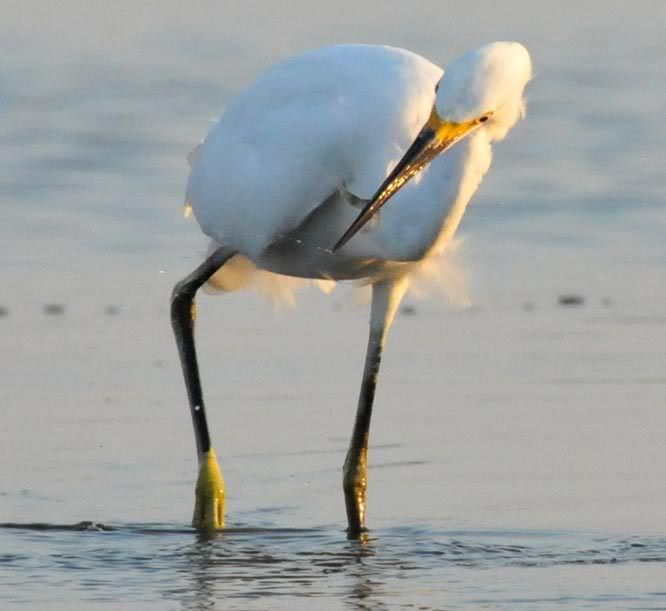
Snowy Egret

snowy-e-w-shrimp.jpg


Estuary, low tide, August 18, Wells, Maine US

You may already have filled the quota for Snowy Egrets but this one has lunch in his beak. The sand shrimp is tough to spot when they are in the water. They are nearly transparent and what color they have is sand color.
 
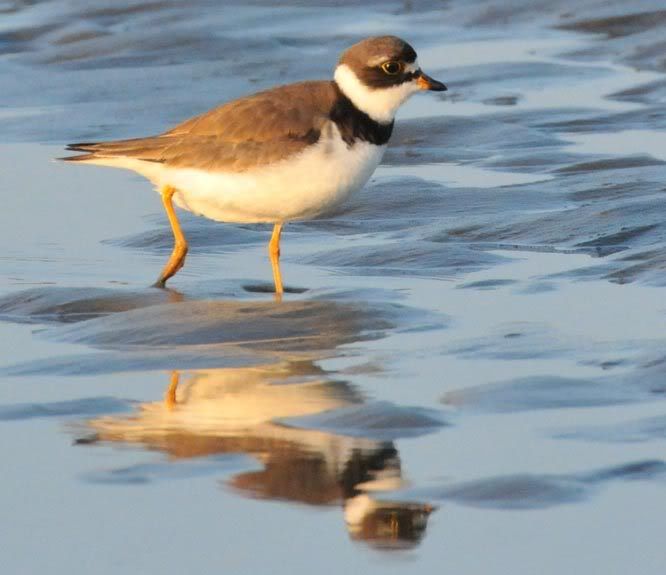
Ringed Plover or Little Ringed Plover?

Everything about this bird points to Ringed Plover except for the color around the eye. Expert opinion?

ring-neck-P.jpg


Estuary, low tide, August 18, Wells, Maine US
 
Well, I think I've caught up. I'll shoot Kotatsu the updated list to check for my errors, in the meantime the count is something like this.

Order Total :19
Family Total :91
Species Total :515
Species Total :518(inc. Subspecies)
Carrion/Hooded, Rock/Domestic Pigeon, Short-Eared/Hawaian Owl
Total Sightings:1609

Webpage update to be done Thursday night GMT.
 
Ok, I have a stupid question. The Order total is 19, as it is currently on the webpage... but when I count up the Orders on the sightings list, I get twenty-something, 22 or 23 or so. Are there some that don't count? How many Orders are there? Does anybody have a wish-list of what you'd like to see on the list?

(Yeah, some answers are probably googleable, but I thought I'd ask here anyway.)
 
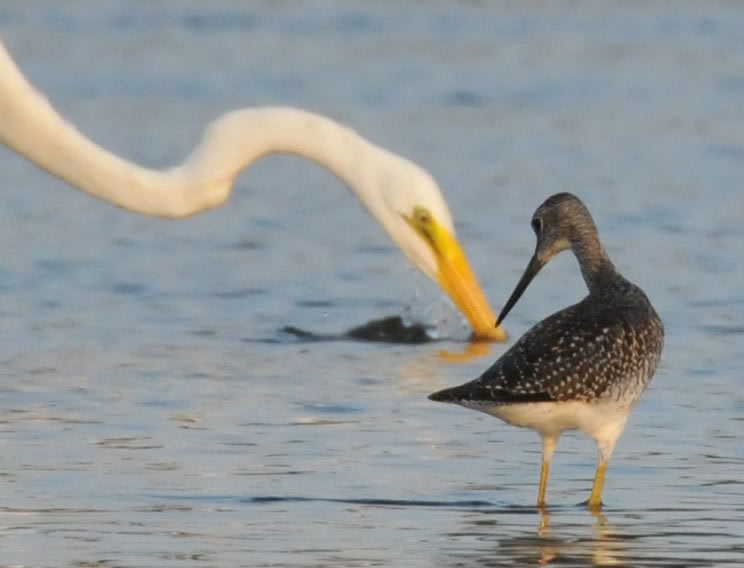
Greater Yellowlegs

Getting fishing lessons from the Great Egret?

geater-yellowlegs.jpg


Greater Yellowlegs
Estuary, low tide, August 18, Wells, Maine US
 
Everything about this bird points to Ringed Plover except for the color around the eye. Expert opinion?

Estuary, low tide, August 18, Wells, Maine US

Well, my non-expert opinion is that it is a perfect match, in my Audubon book, for a Semipalmated Plover.

(ETA--I think I have seen your camera, YoPopa--but what lens are you using?)
 
Last edited:
Well, my non-expert opinion is that it is a perfect match, in my Audubon book, for a Semipalmated Plover.

You are probably right Merc. Much more likely the Semipalmated Plover based on location. I was using wikipedia for my reference but I neglected to check the range of the two.

(ETA--I think I have seen your camera, YoPopa--but what lens are you using?)
You saw my old camera. This spring I picked up a Nikon D300. The lens is the Nikon AF-S DX VR 18-200mm f/3.5-5.6 G-ED
.
You are welcome to come play with the lens on your camera if you come this far North. The VR feature seems to give better performance at the longer range of the lens. I have an older but faster (80-200 f2.8) lens that I am going to start taking a few of these same type shots with to see which I really like better on this camera.
 
Hmmm... Wells isn't that far. Yeah, I love the VR feature (I used the 55-200 for my shots); it came in handy in some museums that did not allow a monopod, but were not exactly well lit.
 
Ok, I have a stupid question. The Order total is 19, as it is currently on the webpage... but when I count up the Orders on the sightings list, I get twenty-something, 22 or 23 or so. Are there some that don't count? How many Orders are there? Does anybody have a wish-list of what you'd like to see on the list?

(Yeah, some answers are probably googleable, but I thought I'd ask here anyway.)

Hmmm. Well, I get 22 or so as well, and that seems reasonable. I don't know what's wrong in the excel sheet, but I'll check it tonight.

A wishlist would include the following things (I have limited myself to North American birds, as that's where you live):

- HUMMINGBIRDS!!!!!! There's like a bazillion of them over there, and we've got one measly one on the list.

- Wood Warblers and Vireos. Same here; lots of them around, but few on the list. I'm guessing that it's because they're not very spectacular (but google Wilsonia citrina, Mniotilta varia or Dendroica fusca...)

- For your own sake, you should go and have a look at gulls. Soon, it'll be wintertime, and it'll be harder to tell some of them apart, but there is still time to see both juvenile and adult plumages in most species.

- Loons. It should not be impossible, I think, to get all the world's species on the list, but that'd require someone on the West Coast to keep their eyes open for Pacific Loon Gavia pacifica and Yellow-billed Loon Gavia adamsii during winter. I have filled in all the European species (the Black-throated one Gavia arctica has been observed, but it not presently on the site), and it shouldn't be impossible to find a Common Loon Gavia immer somewhere on the East coast.

- Pied-billed Grebe Podilymbus podiceps and Eared Grebe [/i]Podiceps nigricollis[/i] should be possible as well, I guess. I've missed all my reasonable chances of seeing the latter in Sweden, as I won't have time to go to Lake Hornborga again this year.

That's a good start that should keep you busy until I come back from London^^.
 
I'm a bit busy with teaching, and haven't had time to do much with the lost today; I'll get back to it tomorrow when I have no teaching at all. In teh meantime:

Just a couple more. No particular reason. The tern looks a bit like Elvis, don't you think?

Willet Catoptrophorus semipalmatus and Royal tern Sterna maxima?

Also, as neither of these, I believe, are on the lists, are your report eligible? That is, are the photos from this year? If so: where and when?

The eye ring alone is sufficient to nail this as a Solitary, this a particularly well-marked individual.

So I stand corrected^^. Thank you for some tips as well. I'll no doubt have use for them next year, if everything goes as planned.

Everything about this bird points to Ringed Plover except for the color around the eye. Expert opinion?

Mercutio's opinion seems to be correct. The extremely short bill is a good sign; compare with this one, which is a Ringed Plover Charadrius hiaticula.
 

Back
Top Bottom