attacking a technobabble argument
I apologize for interrupting what appears to have been a productive discussion between
carlitos and
femr2.
In another thread,
I cited the following exchange, but
ozeco41 and
femr2 are disputing the factual basis for that citation. Since the exchange occurred in this thread, it seems best to review the context and technical discussion in this thread.
This exchange took place over a month ago, so I'll remind you of the context.
carlitos made a sensible suggestion.
ozeco41 then asked two sensible questions about that suggestion:
I think you're being facetious, but I actually suggested this (maybe a couple of years ago?) in the femr2 video thread. He's got (at least?) 2 different camera angles worth of data. In terms of analyzing the real life movement of the building(s), wouldn't it be to sync them up and look at the 3d movement? I'm not an expert on broadcast video, but I would imagine that there's a SMPTE-like code that shows real time.
An interesting idea but it seems to me to conflate two issues viz:
1) Can it be done technically; AND
2) What are the benefits.
Here's the first part of
femr2's response to
ozeco41's questions:
Yes, but...
With out having done so already, the pitfalls are obvious.
So far so good (although the pitfalls were less obvious to me than to
femr2).
femr2 continued:
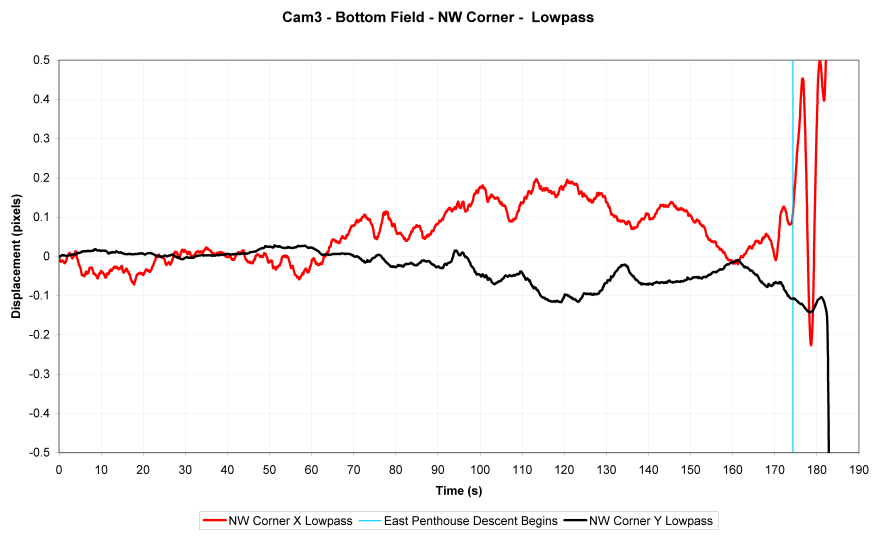
The kind of motion already extracted from videos is well sub-pixel in nature, and contains some noise.
Combining trace data from two or more viewpoints, each with their own noise sources, each with limited knowledge of exact camera location, each with...you're just ADDING noise.
You'd be MUCH better off performing an estimated perspective correction using a single viewpoint.
That first sentence ("The kind of motion already extracted...") seems okay to me, after allowing for the infelicitous phrasing we're all prone to use in these off-the-cuff posts.
That second sentence ("Combining trace data from two or more viewpoints...") is qualified by "each with limited knowledge of exact camera location", to which I will return in a moment. Stripped of that qualifying phrase,
femr2's sentence denies one of the basic principles of signal processing. If you're lucky enough to have two independent but noisy time series that measured essentially the same signal, you can improve the signal-to-noise ratio by (essentially) adding those (synchronized and normalized) time series together. The signal is essentially the same for both, so adding the two time series together improves signal strength by a factor of two. The noise tends to increase also, but the noise is essentially uncorrelated so it increases by less than a factor of two. The signal-to-noise ratio improves by that factor of two divided by that number less than two.
To return to
femr2's qualifying phrase: Although we don't have
exact knowledge of the camera locations, we do have
some knowledge. If we didn't have
any knowledge of the camera locations, the "estimated perspective correction" of which
femr2 spoke in the next sentence ("You'd be MUCH better off...") could not be achieved.
If our knowledge of the camera locations is good enough to achieve an "estimated perspective correction" that would be good enough to rely on the corrected form of just one time series, as
femr2 advocated, then our knowledge of camera locations should be good enough to improve the signal-to-noise ratio by combining the corrected time series. Hence
femr2's argument does not hold up under examination.
femr2's opinions on 2d / 3d video analysis are worthless. Silly statements like "motion already extracted from videos is well sub-pixel in nature" confirm this. One may as well say "eighth notes extracted from Charlie Parker solos are well radians per second in nature." Meaningless technobabble, designed to fool or impress the credulous.
I don't think
all of
femr2's opinions about 2d/3d video analysis are worthless, but the opinions
femr2 expressed in the post to which
carlitos was responding are indeed worthless.
carlitos appears to have been reacting to the category error in what I regard as one of the less silly sentences in
femr2's post. As explained above,
femr2's next two sentences were considerably sillier.
On the other hand, those two sentences were the core of
femr2's argument, and they were indeed "meaningless technobabble". I also think it'd be hard to find anyone with knowledge of signal processing who'd disagree with that assessment.
Then another word for the GLOSSARY:
"technobabble" - a coded expression meaning either "I don't understand" OR "I don't want to understand" OR "I wish femr was not so explicitly clear as to his goal because I want him to have a different goal".

Sort of "evaderbabble" OR "trollingbabble" but neither of those rolls of the tongue as good as techno.....

That was a
tendentious definition of "technobabble".
tsig offered a less tendentious and more relevant definition:
Authors and others who wish to convey a feeling of technical sophistication may write or talk in technobabble. They may use jargon without considering what it actually means to give an impression that they know things that their readers or listeners do not. However, if the jargon is decoded, it becomes apparent that the originator does not really understand what has been said or is deliberately being unclear. When used in this way, technobabble is considered pretentious and often unacceptable. If used inappropriately, even novice listeners can often detect that nonsense is being spouted forth.
ozeco41 responded:
I'm aware of the accepted meanings. The point I made still stands - it is a pity those using "technobabble" here are not using the term legitimately. There is a serious topic for discussion - trivial false comments add nothing.
Contrary to
ozeco41's bare assertion,
carlitos was using the term legitimately.
Even if carlitos had been wrong about femr2's post being technobabble, he was still using the term legitimately.
Not everything
femr2 writes is technobabble. In my opinion,
most of what
femr2 writes here is
not technobabble.
Furthermore, I'm aware that it's hard to carry on an informal discussion of technical subjects without making a few mistakes every now and then. Lapsing into technobabble is one of the mistakes we're all likely to make.
On the other hand, defending a poster's technobabble does not advance our discussion. When anyone (even so exalted a contributor as
femr2) lapses into technobabble, we should be able to identify the lapse as technobabble without being accused of attacking the arguer.
When
carlitos characterized
femr2's argument as "meaningless technobabble", he was attacking
femr2's argument, not
femr2. In this particular case,
carlitos was right: the argument
femr2 put forth in
that particular post was indeed technobabble. But this is worth repeating: Even if
carlitos had been wrong about
femr2's argument, he was still attacking
femr2's argument. It was not a personal attack on
femr2.


 . There may have been little or no bulge. There's no information to confirm or refute.



 Credits for original single frame static smearogram has to go to the911forum member einsteen back in 2009(?) but interesting to read.


