
• Security incident: ISF was recently accessed by intruders. Please change your password, and change it anywhere else you used it. Read more

Merged DDWFTTW in a “Real” Wind

Status
Not open for further replies.
Free balloons travel close to the wind, but no object ever gets to 100% of WS. That implies a force on the balloon of zero. If one is naive enough to think that the air in front of the balloon travels at the same speed as the air at the rear, then you have my ducks is a row.
It is obvious even from commons sense, that the balloon will cast a wind shadow. The Carteers accept that no sail can get to WS, but think a balloon can.
Of course, here humber fails to understand the critical difference between a balloon and a sailboat: A sailboat has a hull in the water, causing drag when the boat moves relative to the water, since a sail moving directly downwind will generate less force as its speed approaches that of the wind, an equilibrium below wind speed will be reached. Similar arguments apply to land yachts or ice boats. The rolling resistance of the wheels, or the friction of the runner on the ice will prevent the sailcraft from reaching wind speed.

A free-floating balloon, however, has nothing interacting with a medium with relative motion to the air. It will, in short order, be moving at the same velocity as the air it is floating in.
They have a world of cartoons, where all complex matters are dismissed.
Spork retails simple-minded analogies.


Thus demonstrating that they don't travel at WS. If the string is not at WS, then the balloon can't be, unless you think the balloon can travel further than the string, while attached to the string. A vertical string may demonstrate WS.


Hot air balloons have an engine: a heat engine. They use potential energy gained from gravity to exceed the wind. They may travel less than, the same as or more than windspeed.
Calling the burner of a hot-air balloon a heat engine is a real stretch, but whatever. The burner allows the balloon to move vertically, by changing the bouyancy of the balloon. It may move relative to the air briefly, if it moves between altitudes with differing wind velocity, but will pretty qucikly match the velocity of the air it's floating in.

The balloons are used by Carteers to avoid talking about the major problems they have with their BS cart: the cheating, data manipulation, burning need for a record at all costs, a rotor that defeats itself, a theory not supported by any paper, peer-reviewed or not. etc etc.
It is only TAD's myopic ambition that keeps them afloat.

I think the quoted post clearly demonstrates two things:

1. Humber's claims of being some kind of expert, indeed, his claims of having any idea what he's talking about on any matter related to physics are completely discredited.

2. Humber has demonstrated very nicely for us that he will never, ever, admit he is wrong. No matter how silly his assertion, he will concoct increasingly bizarre assertions in a futile effort to defend it.
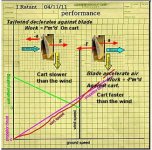
 
.
In discussing an existing machine, why not use the configuration of -that- machine for illustrations?
Most of these carts use what is termed a right-hand twist propellor.
The propellors in most of the illustrations show the propellor blade cross-section from the other side of the machine.
Who would do that?
Other than having that blade going up, why not use the blade on this side of the machine?
That it's going down machs nichts.
It's just being consistent, and simple.
Most of the lethargic explanations (when any at all is offered) of the principles here are equally obtuse, and are not presented in a clear manner, easy for the non-technical persons to untangle.
Educate, don't obfuscate.

The blade orientation that you have, I Ratant, is quite OK, and TAD will have to go a long way to deny it. It does exactly what they claim.
The problem is power. Below WS, there is the wind, and that can do work on the cart as it is decelerated against the blade. The reaction is to push the cart forwards. But above WS, the situation is reversed, and now the cart must accelerate the air, so the reaction is to push the cart backwards.
The wheels are not a source of power, so the cart will slow to below WS, where once again it can take energy from the wind.
The gearing serves no purpose other then to hamper the cart.
The trials exploit winds that are not ddw, to overcome that obvious blunder.

attachment.php
 

Attachments

  • I_ratant.jpg
    I_ratant.jpg
    34.5 KB · Views: 73
Of course, here humber fails to understand the critical difference between a balloon
Did I mention a sailboat? No, so why are you seeking refuge in it?

A free-floating balloon, however, has nothing interacting with a medium with relative motion to the air. It will, in short order, be moving at the same velocity as the air it is floating in.
Sure. Flying bricks too.


Calling the burner of a hot-air balloon a heat engine is a real stretch, but whatever.
The engine in your car is a heat engine. A combustion engine.

The burner allows the balloon to move vertically, by changing the bouyancy of the balloon. It may move relative to the air briefly, if it moves between altitudes with differing wind velocity, but will pretty qucikly match the velocity of the air it's floating in.
So the entire balloon gains potential energy m*g*h

I think the quoted post clearly demonstrates two things:
1. Humber's claims of being some kind of expert, indeed, his claims of having any idea what he's talking about on any matter related to physics are completely discredited.
so you say.

2. Humber has demonstrated very nicely for us that he will never, ever, admit he is wrong. No matter how silly his assertion, he will concoct increasingly bizarre assertions in a futile effort to defend it.
Not even complex. Mrs Geddes would agree.
 
Wow!

Really, just wow!

Anyone, what's the SI unit of denial?
I don't think there is one, but I propose that we define one and call it the humber.
Wait: let's just pause a moment - humber, are you now saying that when you denied claiming it was impossible to draw an underwound reel up a slope, what you actually meant was that you actually did claim that, and in fact you still do claim that? Is that your position?

Notice that humber responded to this post but not to your closing question?
 
Did I mention a sailboat? No, so why are you seeking refuge in it?
You mentioned a sail. Surely that sail is a attached to something.
Sure. Flying bricks too.
Oops! Bricks are heavier than air. How embarrassing for you.
The engine in your car is a heat engine. A combustion engine.
Why yes it is, Captain Obvious. OTOH, I don't usually call the burner on my gas stove a heat engine.
So the entire balloon gains potential energy m*g*h
Mark this day on your calendars folks, humber finally used a formula correctly.
so you say.


Not even complex. Mrs Geddes would agree.
 
Last edited:
Sure. Flying bricks too.

If you can get a brick to float in air, sure. You could tie it to a balloon.

Apparently, the thousands of web sites and books that say a balloon travels at the speed of the wind are all wrong. Show me references that say a balloon travels slower than the wind, or show me anything not written by you that says so; and I don't mean some equation that you have misapplied, I mean something that says "a balloon will always move slower than the wind due to drag", as you claim.
 
That math...only for geeks, eh?

Time constant, tau.

[latex] V(t) \ = \ V_o e^{-t / \tau} \, [/latex]

All sorts of natural phenomenon are related to 'e'

In the case of the balloon, friction limits the exponential rise to below WS.

Quoting again, you need to make an application. As quoted your claim only applies to a balloon starting below wind speed, not to one towed to a speed higher than wind speed and then released. Also you are making exactly the same "mistake" that you claim students are when it comes to charging a capacitor, in fact the equations are almost identical.

Once again, the big question here is "Will a neutrally buoyant balloon towed above the speed of the wind travel with a velocity greater, equal, or less than the speed of the wind after it is released?"
 
The amazing thing about humber's claim about balloons traveling slower than the speed of the wind, which has a small amount of truth to it since in an idealized case a balloon in a perfectly unvarying wind would approach wind speed asymptotically, is that he has claimed that a balloon towed to a speed faster than the wind will slow down to a speed slower than the wind:jaw-dropp

Yes, I remember that. The earth is magic in the humberverse.
 
You will not find one reference in any text book:
Tacking Props
Objects that travel at the speed of the medium including NB balloons
Freewheeling props that generate thrust

That's because Spork made it all up, while he was "absent from his aero class"
 
Quoting again, you need to make an application. As quoted your claim only applies to a balloon starting below wind speed, not to one towed to a speed higher than wind speed and then released. Also you are making exactly the same "mistake" that you claim students are when it comes to charging a capacitor, in fact the equations are almost identical.

Once again, the big question here is "Will a neutrally buoyant balloon towed above the speed of the wind travel with a velocity greater, equal, or less than the speed of the wind after it is released?"

You have the capacity to understand, so why bluff for Spork?
ETA:
When I have the raw data, that will finish TAD, for good.
 
Last edited:
If you can get a brick to float in air, sure. You could tie it to a balloon.

Apparently, the thousands of web sites and books that say a balloon travels at the speed of the wind are all wrong. Show me references that say a balloon travels slower than the wind, or show me anything not written by you that says so; and I don't mean some equation that you have misapplied, I mean something that says "a balloon will always move slower than the wind due to drag", as you claim.

You won't find one reference that says the do. Hot air balloons have an engine,
so they don't count. Off you go to find that evidence.
JF contacted the Met Bureau in the UK, and they said no.
 
Instead of making up those nonsense terms, just work with actual physics: velocities and forces. Draw some vectors, or try to understand the ones posted by others.

[qimg]http://img811.imageshack.us/img811/4922/propellervectors.png[/qimg]

That last diagram is a bit misleading in the case of the cart, it is more applicable to a broad reach.

The relevant components in the cart case are vertical and horizontal, as thrust and opposing torque.
 
.
So you have no explanation.
Sad.

Wrong. You didn't ask him for an explanation.

lemme help a tad.

He's demonstrated that he understands it. You've demonstrated that you don't. When are you going to start asking questions?

It's all ballpark out-of-our-respective asses "data" anyway.

Hmmmm.... our data is actually data. But we're the ones you accuse of not doing real science!

.
In discussing an existing machine, why not use the configuration of -that- machine for illustrations?
Most of these carts use what is termed a right-hand twist propellor.
The propellors in most of the illustrations show the propellor blade cross-section from the other side of the machine.

The other side of the machine!? The other side from what?

Most of the lethargic explanations (when any at all is offered) of the principles here are equally obtuse, and are not presented in a clear manner, easy for the non-technical persons to untangle.
Educate, don't obfuscate.

You came here to insult us, never asked for explanations, can't understand the explanations we offer, and that's all our fault!?
 
Last edited:
Originally Posted by humber
So the entire balloon gains potential energy m*g*h
Mark this day on your calendars folks, humber finally used a formula correctly.

Not so sure about that. When the balloon is neutrally buoyant I don't think it's quite accurate to say it's gained potential energy by moving to higher altitude.
 
Not so sure about that. When the balloon is neutrally buoyant I don't think it's quite accurate to say it's gained potential energy by moving to higher altitude.

To be fair, the context was a red herring raised by humber of a positively buoyant hot air balloon.
 
Not so sure about that. When the balloon is neutrally buoyant I don't think it's quite accurate to say it's gained potential energy by moving to higher altitude.

Doh. Does that apply to planes too? They fly because of lift.
Balloons also have a lift, and that is how they manage to rise. If they don't, as may be contrived, then someone or something must lift them to the required height. The work done is equal the the gravitational potential energy gained.
Another class missed.
 
Quoting again, you need to make an application. As quoted your claim only applies to a balloon starting below wind speed, not to one towed to a speed higher than wind speed and then released. Also you are making exactly the same "mistake" that you claim students are when it comes to charging a capacitor, in fact the equations are almost identical.
That is right, the same "e".
The analog with the electrical circuit is to consider the source resistance Rs, of the voltage charging the capacitor, and the parallel resistance represented by the capacitor's leakage resistance RL. That forms a voltage divider, and the capacitor will charge to

V_cap = VS * Rl/(Rs + Rl)

The voltage will rise exponentially to the value.
Voltage is the analog of velocity, current is the analog of force, and friction is the analog of resistance. All electrical power sources have an equivalent source resistance, and so do mechanical sources. For example for a simple device as a rotray mechanical damper, B = T/N, where B is the mechanical resistance T is torque and N is angular velocity.
There is in the balloon all of the above. You will not find one reference that says balloons travel at WS, because that is a simple-minded fabrication.

Once again, the big question here is "Will a neutrally buoyant balloon towed above the speed of the wind travel with a velocity greater, equal, or less than the speed of the wind after it is released?"

No, it will fall back to below WS.
 
Status
Not open for further replies.

ISF - Join now!

Every member here is approved by hand. No bots, no spam, just people who care about evidence and honest debate.

Membership is free!

Create your free account

Back
Top Bottom