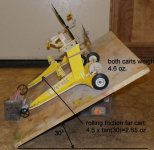
It's funny how I Ratant demands that people define their terms, but at the same time throws around with some self-invented terms like "sail effect", "prop drag effect". Has he ever defined those terms formally, using physical quantities like forces, torques, velocities etc.?
.
Gotme!
Ouuuooo!

The "sail effect"... the propellor on the driven cart has the function of a sail.
It is the sole source of energy available to move the cart at all, presuming no push truck.
It continues this contribution as the cart begins to move, and the wheels then through the drive connection start to rotate the propellor.
We all know (I hope) the propellor would rotate in the opposite direction were it free to rotate, but the drive connection to the wheels prevents that rotation, but that drive connection to the wheels has to fight the natural rotation of the prop.
Up to the point where the cart achieves wind speed, the propellor is functioning as a sail. Hence, "sail effect".
"prop drag effect". On an airplane, when the motor is turned off, the propellor has no thrust. It ---drags- on the airframe.
Many unfortunate incidences in the history of aviation have led to the requirement that propellors do the least worst effect to the airplane in terms of drag, which is a bad thing most of the time.
With airplanes with a wide speed margin, and variable pitch propellors, the unpowered propellor can be rotated on a axis along the blade(s) to where the blade(s) provide the least amount of drag to the airplane.
This is termed "feathering". (just being thorough)
When the prop isn't being powered and isn't feathered, the airspeed and propellor pitch can be such that the propellor rotates. On a single engine airplane, this adds drag. Which will require a change in the flight path.
On a multi-engine airplane, the drag will be off the center line of the plane, which will require some control surface adjustments to realign the flight path.
The lower the pitch (blade angle of the propellor relative to the airstream) the more drag the propellor adds to the airframe at any speed. Therefore the least drag condition is with the propellor feathered, as noted above.
One might, and can say, this is the "prop drag effect".
Or run off into torques and other things, which say the same, but less clearly.
I even gots a pichur...