What about a cart on the table? It has zero velocity relative to the air, but I don't think you would say it was at wind speed. Rest the chassis on some books or whatever, and spin the wheels using an electric drill. Now it is at windspeed? All the TM does is to spin the wheels and prop.
No. It is
not a Galilean Equivalent. Just because that theory is right, does not mean the TM is right. Read up on it. Mechanical equivalence is also a prerequisite. You may be surprised to find that Galileo had some ideas that are now considered to be odd. It is not used much in machines, and is now a matter of philosophy and Relativity.
"It is not generally appreciated, but Galileo made it plain that the reason for the correspondences of observations (in a stationary versus moving shipboard cabin) hinged on the fact that everything in the ship's cabin, especially the air, was moving with the observers.
Regarding these tests Galileo does not mention unaccelerated motion in a straight line. On the First Day discussions he makes it plain that he cannot
abide the idea of motion in a straight line. (Straight line travel, according to Salvatius, would soon put the traveler into outer space with no place to go.) It may be said, tongue-in-cheek, that Galileo preferred circular arguments. [Elliptical orbits and oblate spheroids hadn't been invented yet.]"
It is not possible to actually construct a new reality, the TM is a
model, not the "same thing".
No. The belt is the
road. That is; the
planet's surface. Imagine that from outer space. The claim becomes that the spinning Earth is driving the cart. That is, it is "dragging it backwards" through the air to create a "virtual tailwind". Nonsense.
The atmosphere moves with the planet. Wind is independent motion of the air, like local stirring. If not, all places would see the same wind as the planet moved under the atmosphere.
The TM is a simple machine.
Imagine that a simple wheeled cart is put on the belt. There is good friction, so a drag force of 1N, and the belt drags the cart down the belt. Perhaps over 1/10 second it moves 10mm, and gains KE in the direction of the belt.
But, if the wheel turns, all of the work is done on the wheel, and none on the cart. All of the KE is stored angularly in the rotating components.
It has no KE down the belt.
That is largely how it works. The prop provides a stabilising force. The rest is rather complex detail over short time scales, but the overall effect is that the cart gains no linear KE, and operates at a very low power level, resulting in low friction to the belt. It essentially slides on the belt. There are several means of doing the same thing and they bear no resemblance to a prop cart.
http://www.internationalskeptics.com/forums/attachment.php?attachmentid=21614&stc=1&d=1301505921
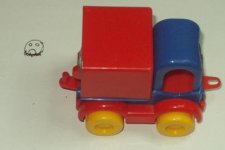
Buy a simple cart like this. Put it in your pocket and experiment at the supermarket checkout. It takes nothing to stop it moving with the belt.
Here is mine. Cost 1 Euro. I already knew the answer, but I tested it to see what I may have missed, and to try to explain it on the forum. None of the Carteers bothered to repeat the test.
http://www.internationalskeptics.com/forums/attachment.php?attachmentid=21615&stc=1&d=1301506578