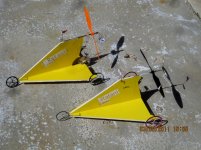
Jack by the hedge
Safely Ignored

Why not? It is moving at the same velocity as the air. It may be unconventional to declare the existence of wind when air is not moving relative to your surroundings, but windspeed is just the local speed of motion of the air and that's what the cart is matching. So yes, it is going at windspeed.What about a cart on the table? It has zero velocity relative to the air, but I don't think you would say it was at wind speed.
Yes again. The cart is still at windspeed.Rest the chassis on some books or whatever, and spin the wheels using an electric drill. Now it is at windspeed? All the TM does is to spin the wheels and prop.
Right. It's a model. That's what I said.<Galileo digression snipped>
It is not possible to actually construct a new reality, the TM is a model, not the "same thing".
I rather thought I said that, too.No. The belt is the road. That is; the planet's surface.
Nonsense indeed. The claim is that relative to the air, the land is moving backwards and the cart is moving forwards, driven against the air by its propeller which is powered by the motion of the land under it, and the energy to drive the system comes from the relative motion of the air and the land. Which doesn't sound very much like what you said.Imagine that from outer space. The claim becomes that the spinning Earth is driving the cart. That is, it is "dragging it backwards" through the air to create a "virtual tailwind". Nonsense.
I was with you right up to the highlighted non sequiturs. The cart has no need to slide at all. (Is essential sliding different to actual sliding, I wonder.) The cart's wheels roll on the belt. No slip is required to make the design operate.<irrelevant digression on the nature of wind snipped>
The TM is a simple machine.
Imagine that a simple wheeled cart is put on the belt. There is good friction, so a drag force of 1N, and the belt drags the cart down the belt. Perhaps over 1/10 second it moves 10mm, and gains KE in the direction of the belt.
But, if the wheel turns, all of the work is done on the wheel, and none on the cart. All of the KE is stored angularly in the rotating components.
It has no KE down the belt.
That is largely how it works. The prop provides a stabilising force. The rest is rather complex detail over short time scales, but the overall effect is that the cart gains no linear KE, and operates at a very low power level, resulting in low friction to the belt. It essentially slides on the belt.