Merged DDWFTTW in a “Real” Wind

Status
Not open for further replies.
Poor humber, he still does not realize it does not matter how the cart got up to speed.

humber, it has been shown that the cart can get up to speed from a dead stop, if it is given a long enough run up. There are even some runs that they did this way on record day. Do you dispute this point?

Since the cart cannot remember whether it was pushed to a velocity or if the wind got it to a specific velocity it does not matter how it got to that velocity, all that matters is what it does after that point. Do you dispute this point?

Knowing you, you probably will. And you will be wrong both times. Over to you humber.
 
Who gives a damn what units are used?


Again, who gives a damn?


Yes
The above says you don't.


A trend of deceleration that results in a 2 MPH increase in speed, you have some interesting concepts floating around in that brain of yours.

Well, there are reasons for that, but now our claim is the the rate of acceleration fall less when ddw than when not? A sail can do that, if the wind is falling at the same time.
 
Humber what about that idea I had of making online flash cards for you? I can make a flash player version or straight html whichever you prefer.

The cart was not in a race.
The cart cannot remember past acceleration.
The cart has no sails.

I can't imagine why you would feel embarrassed or shamed if you have some disability which prevents you from making them with cardboard and scissors. Why not let me help you?
 
Last edited:
The above says you don't.
No, it doesn't.


Well, there are reasons for that,
Yes, the fact that the trend for the jerk was essentially flat through the measurement period is the biggest reason.
but now our claim is the the rate of acceleration fall less when ddw than when not?
No "now" about it, I pointed that out months ago when I first posted the un averaged charts of the record run. Of course with the addition that the fall is caused by falling wind speed.


A sail can do that, if the wind is falling at the same time.

Below wind speed maybe, above, definitely not.
 
No, it doesn't.

It does. And how many bits is the converter? What is the latency of the GT31's Fourier analyser, that determines the velocity?

Yes, the fact that the trend for the jerk was essentially flat through the measurement period is the biggest reason.
Support the source of energy for that jerk. Jerk is the rate of change, the derivative of acceleration. If that derivative is negative, then the energy demand is falling.

No "now" about it, I pointed that out months ago when I first posted the un averaged charts of the record run. Of course with the addition that the fall is caused by falling wind speed.
Which will apply to a sail. It says nothing about the cart being better ddw.

Funny how there is a need to ask you. Spork can't support his own claim, so it must be someone else, as it is with the ddw papers.
The claim rests on some short term effects. The cart gains directly from the push, and eventually reaches 1.8WS, after being pushed to WS. The wind falls, so the claim instantly becomes 2.8WS, even though the energy demand has fallen and the average acceleration is less than 0.1ms-2. Magic. Sleight of hand.
A pathetic and cowardly trial to cover a failure. That failure is seen in video of the small cart in the wind, and the theory. The TM is readily explained as a simple machine, unrelated to WS travel.

Removed breach. Cut out the name calling.
Replying to this modbox in thread will be off topic  Posted By: LashL

attachment.php


attachment.php
 
Last edited by a moderator:
Humber what about that idea I had of making online flash cards for you? I can make a flash player version or straight html whichever you prefer.

The cart was not in a race.
There is a fixed time between the start and the window.
V=at.

The cart cannot remember past acceleration.

http://en.wikipedia.org/wiki/Kinetic_energy
The kinetic energy of an object is the energy which it possesses due to its motion.[1] It is defined as the work needed to accelerate a body of a given mass from rest to its stated velocity. Having gained this energy during its acceleration, the body maintains this kinetic energy unless its speed changes. The same amount of work is done by the body in decelerating from its current speed to a state of rest.

The push adds directly to the top speed.

I can't imagine why you would feel embarrassed or shamed if you have some disability which prevents you from making them with cardboard and scissors.
Why not let me help you?
Because you are not competent to do that. You will first need to learn a lot.
 
It does. And how many bits is the converter? What is the latency of the GT31's Fourier analyser, that determines the velocity?
All irrelevant.


Support the source of energy for that jerk.
The source of energy is the difference between air velocity and ground velocity relative to the cart. Same as always. And when that difference reduces, so will acceleration. And vice versa, as the measurement period clearly shows.

Jerk is the rate of change, the derivative of acceleration. If that derivative is negative, then the energy demand is falling.
Yep, so what?


Which will apply to a sail. It says nothing about the cart being better ddw.

Wrong.
 
All irrelevant.
Hah.

The source of energy is the difference between air velocity and ground velocity relative to the cart.
which is the difference of cart and wind. The cart acceleration falls because the wind falls, but the wind direction continues to change.


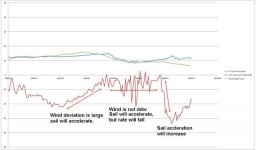
The cart's performance suffers when the wind approaches ddw, even though the windspeed is rising.

attachment.php
 
Hah.


which is the difference of cart and wind. The cart acceleration falls because the wind falls, but the wind direction continues to change.


The cart's performance suffers when the wind approaches ddw, even though the windspeed is rising.

[qimg]http://www.internationalskeptics.com/forums/attachment.php?attachmentid=22607&stc=1&d=1308159561[/qimg]
LMAO at humber using a 10 second average centered on the period being averaged to induce the very same misleading effect he has complained about.
 
So, even if a sail is pushed above WS it can't accelerate DDW once above WS?

I wonder how they cheated then . . .

There is the changing wind. The always changing wind direction. It is not correct to compare the angle of the wind necessary to achieving 5WS, as was done in the Observer's report, with the capacity to accelerate when below that speed. Ice-carts that achieve 5WS at less than 10 degrees, still accelerate when at a broader reach when slower. And can do so at smaller angles than 10 degrees, but of course, not reach 5WS, until it spends enough time in the wind to accumulate the energy. If not, they could never start.
The ice-cart may reach a terminal speed of say 2WS at 30 degrees. That limit is set by the power available from the wind. If it moves towards ddw, where there is less available power, it would slow. The sails are adjusted to
reduce the drag, and so the power demand, and the cart moves closer to the wind and velocity increases, but acceleration falls. Basing the result on final speed and wind angle, is clearly flawed.

The cart is a poor sail boat, because the prop is geared to the wheels, and that hinders it.

attachment.php
 

Attachments

  • jref_chart24.jpg
    jref_chart24.jpg
    23 KB · Views: 2
Last edited:
Hah.


which is the difference of cart and wind. The cart acceleration falls because the wind falls, but the wind direction continues to change.
Nope instantaneous readings. No averages employed.
However, that response shows you do see a problem, and that is why you tried that average gambit.

The cart's performance suffers when the wind approaches ddw, even though the windspeed is rising.

The source of energy is the difference between air velocity and ground velocity relative to the cart.
humber said:
which is the difference of cart and wind.
Wrong again

"The source of energy is the difference between air velocity and ground"

Known as the wind's speed over the ground. The windspeed.

"ground velocity relative to the cart."

Known as the land speed. The cart's speed over the ground,

Leaving the difference of cart and wind speed, as is commonly understood, save by Carteers and their relative "visions". Like the literal "tacking prop", and the "backwards" road.

"Most students prefer their abstractions cast in concrete." — Piaget's lost principle.
 
Last edited:
Nope instantaneous readings. No averages employed.

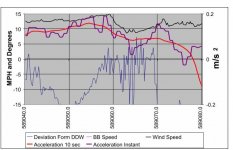
I don't know if you are trying to cute, but that curve is of the instantaneous values of the acceleration averaged over 10 seconds, from 5 seconds before to 5 seconds after.

However, that response shows you do see a problem, and that is why you tried that average gambit.
Wrong, it shows I know wtf the data looks like.

The cart's performance suffers when the wind approaches ddw, even though the windspeed is rising.
Wrong


"The source of energy is the difference between air velocity and ground"

Known as the wind's speed over the ground. The windspeed.

"ground velocity relative to the cart."

Known as the land speed. The cart's speed over the ground,

Leaving the difference of cart and wind speed,

Wrong again.
 
Last edited:
I don't know if you are trying to cute, but that curve is of the instantaneous values of the acceleration averaged over 10 seconds, from 5 seconds before to 5 seconds after.
No it is not.

humber said:
The cart's performance suffers when the wind approaches ddw, even though the windspeed is rising.
Wrong
attachment.php


humber said:
"The source of energy is the difference between air velocity and ground"

Known as the wind's speed over the ground. The windspeed.

"ground velocity relative to the cart."

Known as the land speed. The cart's speed over the ground,

Leaving the difference of cart and wind speed,
Wrong again.

A - B =C
C + B =A

The wind's speed is measured relative to the ground and is a constant. A fixed anemometer will confirm that.
Constants remain that way. The cart's speed is the variable, so the difference
is cartspeed and the windspeed.

And you know how to read data do you?
The GT31, only give an output once a second, but the logger operates at 5 per second, so there should be a strings of 5 samples each the same.
"just interpolation" or a lot more? The variance is well outside that capacity of the GT31.
This data is not raw, but has already been manipulated by the competitor, but presented as "raw".

attachment.php
 
Last edited:
No it is not.
Yes it is. I posted charts 2 or 3 months ago with the instantaneous acceleration, everyone has seen it. I went ahead and averaged the acceleration over 10 seconds and got the exact same curve you show in that graph.

Stop lying.

attachment.php
 

Attachments

  • Acceleration Shenanigans.jpg
    Acceleration Shenanigans.jpg
    40.3 KB · Views: 53
A - B =C
C + B =A

The wind's speed is measured relative to the ground and is a constant. A fixed anemometer will confirm that.

hopelessly wrong
Constants remain that way. The cart's speed is the variable,
Hopelessly and obviously wrong.
so the difference is cartspeed and the windspeed.
No, the difference is air and ground.
And you know how to read data do you?
A lot better than you.
The GT31, only give an output once a second, but the logger operates at 5 per second, so there should be a strings of 5 samples each the same.
The GT31's were not connected to a logger. They recorded once per second.


"just interpolation" or a lot more? The variance is well outside that capacity of the GT31.
Nope, not a lot more, but not linear either. And yes, outside the capabilities of the GPS.

This data is not raw, but has already been manipulated by the competitor, but presented as "raw".

Wrong, everyone (except maybe you) knew the gaps were interpolated.
 
The cart's speed is the variable, so the difference is cartspeed and the windspeed.

So, you are suggesting, as profawhatsit did, that the wheels of the cart stop turning when the cart reaches wind speed?

-- Roger
 
hopelessly wrong

Hopelessly and obviously wrong.

No, the difference is air and ground.

Yeah, sure. Frames or reference do not disobey the laws of arithmetic commutation. The world has not been waiting for someone to show it how the wind blows.
As if Brunel would have missed what you say would have allowed his ships to travel for free.

From Spork's submission
"Thus we’ll tow the vehicle up to a speed of 20 mph in a 15 mph tail-wind and then let it loose. In this situation the vehicle will experience a relative head-wind of 5 mph."
-5mph = Windspeed - Cartspeed.
Windspeed is constant
Cart speed is the variable
In this case, Spork has assumed the groundspeed to be zero.


The GT31's were not connected to a logger. They recorded once per second.
Really?
Then you have no Doppler speed data, but only the C/A once a second from the other GPS (12m apart at 27mph), and the errors that brings.

Even worse.

You really should not take note of what Spork feeds you, in the hope of covering his tracks. I do hope NALSA will take note of this sort of malpractice.

Nope, not a lot more, but not linear either. And yes, outside the capabilities of the GPS.
So not valid data at all. You really should have learned by now, that Spork will tell you anything, and at your expense, if he thinks it will server him.


Wrong, everyone (except maybe you) knew the gaps were interpolated.
Not interpolated, but manipulated.
And BTW, HDOP and VDOP are statistical. The GT31 uses a table that can be loaded into the receiver. It is a empirical data, and the result can only be expressed as a probability.
 
Last edited:
Yeah, sure. Frames or reference do not disobey the laws of arithmetic commutation. The world has not been waiting for someone to show it how the wind blows.
As if Brunel would have missed what you say would have allowed his ships to travel for free.
The energy comes from the difference between the air speed and ground speed relative to the cart. The larger that difference, the more power the cart has to accelerate, no difference, no power.

I know you don't understand this

Really?
Then you have no Doppler speed data, but only the C/A once a second from the other GPS (12m apart at 27mph), and the errors that brings.
Are you now saying that the GT31 doesn't do doppler?


You really should not take note of what Spork feeds you, in the hope of covering his tracks. I do hope NALSA will take note of this sort of malpractice.
You really should not make such assumptions humber, it only makes you look worse than you do already.

Not interpolated, but manipulated.
Wrong again.

And BTW, HDOP and VDOP are statistical. The GT31 uses a table that can be loaded into the receiver. It is a empirical data, and the result can only be expressed as a probability.

I bet rp is really impressed by this, but it has nothing to do with anything under the circumstances.
 
Status
Not open for further replies.

ISF - Join now!

Every member here is approved by hand. No bots, no spam, just people who care about evidence and honest debate.

Membership is free!

Create your free account

Back
Top Bottom